
White Crust in a Greenhouse Bed: Salts or Another Cause?
Greenhouse growing guide
A white crust on a greenhouse bed is easy to mistake for fertiliser salts, but its colour alone cannot tell you what it is. Soluble salts from feed or irrigation water are possibilities; dried minerals, fungal growth and pale particles from the growing medium can look similar. The useful clues are where the deposit forms, how it feels, what has been applied and what a properly collected water or medium test shows. Avoid flushing, adding fertiliser or treating the surface until those clues agree.

Appearance and location are clues
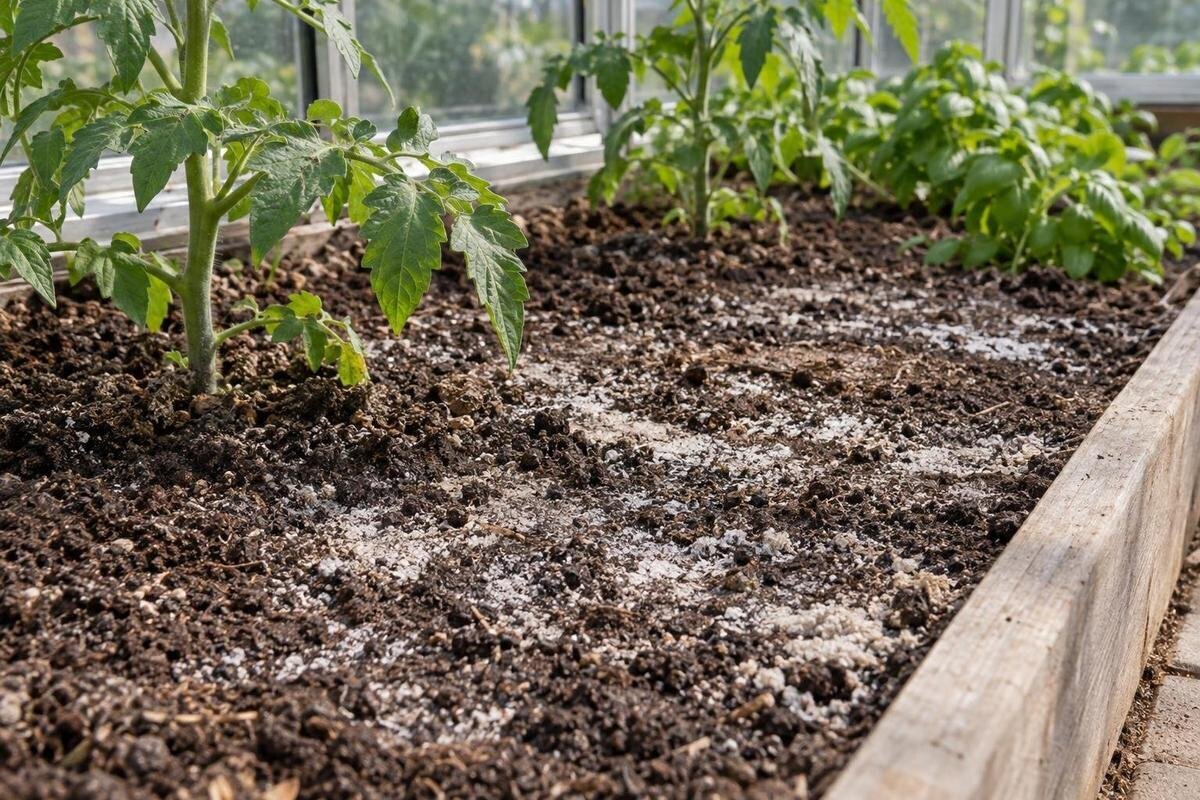
The first useful distinction is whether the white material is a deposit formed on the surface or pale particles already mixed through it. A firm, chalky line is different from a loose scatter of bright grains or a soft, cottony web. Yet texture is only a clue: salts and minerals can look alike once dry, while fungal growth may appear powdery or filmy. Check whether the material is raised, loose, fibrous, slippery or embedded in the medium, and view it in good light. Photograph a close-up and the whole bed before disturbing anything. Colour alone cannot identify its chemistry.
Check the same spot after ordinary watering and as it dries; do not deliberately flood the bed as a test. Does the deposit return where water evaporates, appear beside a dripper, follow a pot edge, or remain in exactly the same place? Note whether it followed a recent feed, compost top-up, lime or other amendment. Record whether the crop looks different there, but treat yellowing, leaf-edge browning or slow growth as supporting clues only: each can have several causes. Timing is useful too, so note whether the mark appeared after a drying cycle. Comparing damp and dry patches gives context, not a diagnosis.
Map the affected areas
Draw the bed and mark the white patches, irrigation points, wet areas, dry margins, low spots and places where water drains. A deposit concentrated around an emitter or at the edge of a damp patch may reflect how water moves and evaporates; a uniform coating across beds may have another explanation. Record whether it is on an in-ground bed, raised bed, pot or grow bag. Each may contain a different medium and drain differently, so do not combine them mentally or in one sample. The distribution can be more revealing than how much surface looks white. Also note any recent spills or hand-watering routes.
Compare patterns rather than judging one patch in isolation. Are beds receiving the same water but different feeds affected, or do otherwise unrelated beds share the mark? For a new growing area, use a floor plan to identify where you would place beds and containers. The Spacious Greenhouse range is listed from 47 to 70 m², but the useful detail for this exercise is the arrangement within your selected model. Mark each bed separately so that observations can be traced to a particular location. Keep the sketch with your photographs rather than relying on memory when a deposit disappears or returns.
Fertiliser and amendment history
Soluble fertilisers contain dissolved mineral ions. When repeated feeding adds more than plants and drainage remove, salts can accumulate in the root zone; as water moves towards the surface and evaporates, some material may be left behind as crystals or a pale crust. A heavy dose is not the only possible trigger: concentrated feed mixed incorrectly, uneven application or repeated feeding in a small area can change the pattern. If fertiliser is delivered through irrigation, differences in wetting may create local differences too. A surface crust cannot show the exact nutrient concentration around roots or identify which ions formed it.
Write down product names, amounts, dates and which beds received each feed. Note whether it was broadcast, placed in a band or delivered through irrigation. Include recent compost, manure-based products and mineral amendments, because their soluble-salt contribution varies with material and analysis; do not assume an amendment is either harmless or responsible. When planning beds for a Classic Aluminium Greenhouse, record the area actually receiving each application. A feeding rate based on bed area should not be calculated from the whole greenhouse footprint, which also includes paths and other space. For containers, keep the feeding record tied to the individual growing system.
Minerals in irrigation water
Irrigation water can leave a pale mineral residue as droplets dry, particularly when it contains dissolved calcium, magnesium or bicarbonate. This may look chalky or crystalline, but a visible film does not establish that the root zone has a damaging salt level. Water hardness usually refers to calcium and magnesium; it is not the same measurement as total soluble salts or alkalinity. Conversely, clear-looking water can still carry dissolved ions. Do not decide that a supply is unsuitable from appearance, taste or a household hardness description. Rainwater collected from a roof or stored in a tank should not automatically be assumed to have the same composition each time.
Test the source used for irrigation, especially after a change from tap water to borehole water, a tank or a blend, or when the crust appears across unrelated beds. Ask a suitable laboratory or horticultural adviser which water measures fit the crop and medium; EC and alkalinity answer different questions, and water pH alone will not answer both. Sodium and chloride may also matter in some situations. When considering a Lean-to Greenhouse, include the intended water source and water access in your layout plan. Record any source changes so that later test results can be compared with the water actually used.

Fungal growth and pale growing-medium particles
Not every pale layer is a mineral deposit. White threads or a soft, web-like film on a damp, organic-rich surface may be fungal growth feeding on decomposing material. That presence is not, by itself, proof that a plant disease is affecting roots. A slick film is more suggestive of algae, often greenish, while loose white flecks may come from perlite or other pale particles in a growing mix. Previous additions such as lime or gypsum can also leave visible fragments. Fungal threads may bridge organic pieces, but a crust and a web can overlap, so appearance remains a clue rather than a test.
Inspect the material in good light and compare it with an unused sample of the same growing medium, if one is available. Notice whether it is fibrous, granular, crusted or simply scattered, and whether it returns after the surface dries. Review recent amendments and the bags used rather than assuming every new patch arose from irrigation. If a plant is declining, photograph the whole plant and affected area and seek crop-specific advice; a surface fungus or crust alone cannot establish a root disease or nutrient shortage. Avoid applying fungicide, acid or extra fertiliser as a guess, and do not dig through healthy roots just to identify a surface film.
Water movement in a covered bed
A greenhouse roof usually prevents rain from falling directly onto a bed, so rainfall does not naturally rinse the soil as it might in an uncovered plot. Irrigation, evaporation and drainage therefore shape where dissolved material moves. The surface of a frequently wetted bed can dry while deeper layers remain moist; water may move salts towards a drying edge or leave them in a poorly drained area. This can produce a distinct surface mark even when the whole bed is not equally affected. The extent depends on the growing system and its drainage: a covered bed is not automatically waterlogged or salt-laden.
Use the map to separate zones with different watering, drainage, crop or medium histories. Do not assume conditions are uniform because the plants share one roof: a bed served by a different dripper, a container and an in-ground row may need separate investigation. When planning irrigation for a Limited Edition Aluminium Greenhouse, mark which outlets will serve each growing area. This gives you a way to connect a recurring deposit with a particular watering zone rather than treating the whole structure as one bed. Keep unusually wet or dry areas identifiable instead of averaging them into the surrounding conditions.
Representative growing-medium samples
For a useful growing-medium test result, sample below the visible deposit, using the depth and procedure specified by the testing laboratory. Take separate samples from affected and unaffected zones, and keep soil beds, containers and different mixes apart. Do not send only the crust: it may show what dried on the surface but will not represent the root environment. Avoid taking one scoop from an unusually fed spot and treating it as the whole bed. Label each sample with crop, bed, watering source and recent inputs, and follow the lab’s instructions for packaging and delivery. Collect water separately rather than mixing it with the soil sample.
Ask for EC and pH using a method suited to that soil or growing medium. Results from different extraction methods are not directly interchangeable, so write down the method and use it again when tracking change. A calibrated home meter can be useful for trends only when its sampling procedure is consistent; a probe reading taken in one wet patch is not a laboratory result. For a planned T-Model Orangery Greenhouse, give each proposed bed or container group a clear reference on the layout. Use those references on sample labels and reports. Record the test units as well as the number.
What EC and pH results mean
EC indicates how readily a solution conducts electricity and is used as a measure of soluble salts; it does not identify which nutrient or salt is present. A high reading needs context: crop, medium, moisture, extraction method and recent feeding all matter. A fresh fertiliser application can influence a sample, which is why timing should be reported to the laboratory. A low surface reading does not cancel a high root-zone result, and a pale crust may sit above a different root-zone condition. Use laboratory interpretation or crop-specific guidance for thresholds; no visual test or universal EC cut-off suits every crop and medium.
Keep pH separate from EC. pH describes acidity or alkalinity and can affect nutrient availability, but it does not measure the amount of soluble salt; water alkalinity is another measure again. A crop can show a nutrient problem even where salts are high, so adding feed because a leaf looks pale may worsen the imbalance. If results suggest a sodium issue or a structural problem in the soil, request the appropriate analysis rather than inferring it from whiteness. For a planned Pyramid Greenhouse, list the intended crops and growing media when asking for interpretation of test results. The interpretation needs to relate to those growing conditions.

Corrective action depends on the result
If tests and the feeding record support salt accumulation, pause further corrective feeding until the crop’s needs and input rate have been reviewed; this does not mean every crop should be left without nutrients. Check how much product was applied to the measured bed, whether dilution and application followed its label, and whether irrigation and drainage allow salts to move out of the root zone. Removing or scraping the crust may improve the surface but will not remove salts already in the medium. Avoid repeating a rinse if drainage is slow or the bed remains saturated.
Flushing a bed is not a universal answer. It can be considered only when the crop, medium, drainage and water quality make it appropriate, with a plan for where the drainage goes; otherwise it may waterlog roots or move salts into another zone. If water mineral residue is implicated, compare tested sources and seek crop-specific advice before changing supply or treatment. If the deposit is fungal or simply pale mix material, salt removal is not the remedy. If you are considering a Limited Edition Greenhouse with Storage as part of a redesign, resolve the bed drainage separately from the choice of structure.
Records for future comparisons
After identifying a likely cause, make one measured change at a time and keep the same sampling method. Record the date, water source, feed and amendment, crop stage, location of crust, test method and results, then photograph the same marked patch after normal management. Note amounts and the bed area they served; that makes comparisons more meaningful than a note saying only that the bed was fed or watered. If several things change together, a disappearing or returning crust cannot be linked to one action. Re-test when the medium and crop schedule make it meaningful; appearance alone is a poor measure of root-zone recovery. Keep records for separate beds separate.
When replacing a bed or selecting a Prestige Greenhouse, plan the growing system around your intended crops rather than treating a new structure as a remedy for a white deposit. Measure bed length, width and depth separately, note containers and paths, and check the selected model’s exact dimensions and configuration. The greenhouse footprint is not a bed-volume calculation. For container systems, record the number of containers and their medium volume separately. Leave access for inspecting the bed surface and reaching each watering zone. Retain the old bed records so that a replacement system can be compared with what was there before.
Frequently asked questions
Does white crust always mean too much fertiliser?
No. It may be fertiliser salts, minerals left by irrigation water, pale particles from an amendment or growing mix, or biological growth. Appearance cannot show the concentration around roots or identify the ions present. Check your feeding and watering history, then compare suitable tests of the water and growing medium before changing the fertiliser routine.
Can hard water cause a white layer?
It can leave mineral residue as water evaporates, but water hardness, alkalinity and total soluble salts are different measures. A crust cannot show which is involved or whether the root zone is affected. Test the irrigation source separately from the growing medium, particularly after changing water sources.
Is white mould on greenhouse soil harmful?
Not necessarily. A soft white web may be fungal growth feeding on decomposing organic matter, but appearance alone cannot confirm what it is or rule out a crop problem. Note the moisture and any plant symptoms, and avoid applying fungicide as a precaution. If plants are declining, photograph the affected area and seek crop-specific advice.
Should I scrape off the crust or flush the bed?
Scraping may improve the appearance but will not correct a cause in the root zone. Extra water is not a universal remedy: its effect depends on the crop, medium, drainage and water quality. Test first, and avoid flushing unless those conditions support it and there is a suitable plan for the drainage.
Which tests should I request first?
Ask for a growing-medium test that reports electrical conductivity (EC) and pH using a stated method, and have irrigation water analysed separately. Depending on the pattern and source, a laboratory or crop-specific adviser may recommend measures such as alkalinity or sodium. Keep affected and unaffected zones separate, and do not compare results from different extraction methods as if they were equivalent.
A white crust becomes useful evidence only when it is linked to its pattern, inputs and measured conditions. Map the affected area, rule out biological growth or pale mix particles, and test irrigation water separately from the root-zone medium. Read EC alongside pH and crop requirements, then address the cause the results support. That approach avoids unnecessary flushing, extra feeding or soil replacement, while giving you a sound baseline for future greenhouse beds.
