
Worn Greenhouse Glazing Seals: Clean or Replace?
Greenhouse repair guide
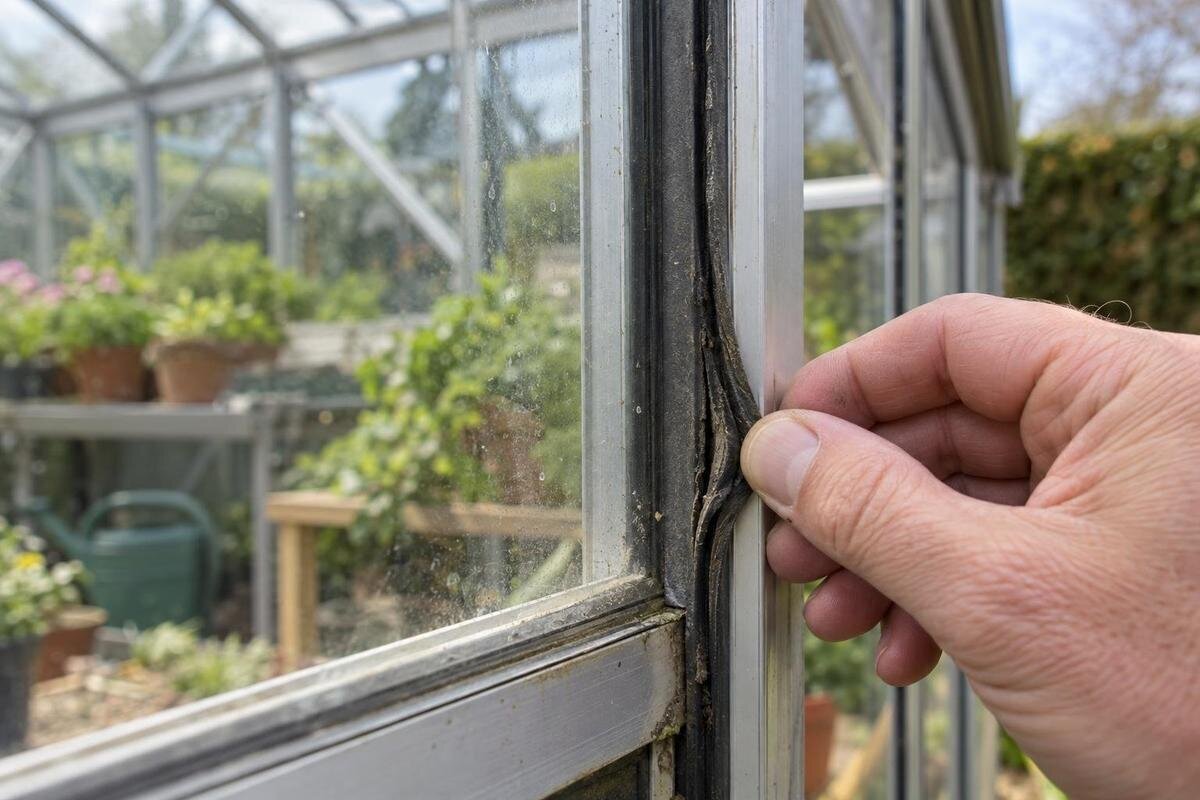
Greenhouse glazing seals can look dirty long before it is clear that the material has worn out. Dust or algae on the exposed surface may come away with careful cleaning; washing will not restore a seal that has split, hardened, flattened or shrunk out of its channel. The useful test is not whether it looks new, but whether it remains continuous, seated and in its intended position. Clean gently according to the greenhouse maker’s care instructions, then inspect the seal at the pane edge. If the material is still loose or misshapen, identify the exact greenhouse and glazing system before requesting a replacement. Similar-looking strips can have different profiles and functions.

01
When cleaning is enough
Begin with a gentle clean rather than a hard scrub. Dust, pollen, soil splash, algae residue or cleaner build-up can make an intact glazing seal look tired, especially along an exposed pane edge. Follow the greenhouse maker’s cleaning instructions for the frame, glazing and seals, since these components may have different care requirements. If no special method is specified, start with clean water and a soft cloth, working only on the exposed surface. Wipe along the seal without pulling it from its channel. Do not use a blade, wire brush or abrasive pad, and avoid solvents or strong household cleaners unless the manufacturer confirms they are suitable. A product that is safe for glass or aluminium is not automatically safe for the seal beside it.
Rinse and dry the area as the care instructions require, then inspect it in good light. If the dirt lifts and the seal remains continuous, seated and in the same shape, cleaning may be all that is needed for now. A mark that remains after cleaning does not prove the seal has failed; some discolouration is cosmetic. Compare the seal’s position along the same run, looking for a gap, raised edge or end that has pulled away. Do not keep scrubbing a stubborn mark to make aged material look new. If you cannot tell whether a line is on the seal or the adjoining frame, take a photograph rather than scraping at it.
Identify the seal before judging it
First work out which component you are looking at. A greenhouse may have a gasket or strip at the edge of a pane, a separate glazing bead or retainer, and weather seals around a door, vent or opening section. These parts can sit close together but have different functions. In some systems a flexible gasket cushions the glazing; another component may help retain it. The arrangement and terminology depend on the manufacturer’s design, so a manual or parts diagram is more useful than a general description. Do not assume that every flexible strip around the greenhouse is a glazing seal or that similar-looking components are interchangeable.
Record where the affected strip sits: a roof pane, side pane, vent, door, corner or joint between sections. Note which edge is involved and whether the problem runs along one short section or a longer length. A water mark, draught or condensation does not by itself identify a failed glazing seal; another opening or nearby joint may be involved. A catalogue name such as Pyramid Greenhouse identifies a model, not the seal position or profile. Use the observed location and the manufacturer’s documentation to guide the parts enquiry.
02
Signs a seal is worn beyond cleaning
After cleaning, look for a split through the material, cracks, brittle or crumbly areas, missing pieces, or sections that have pulled out of their channel. Ends that no longer meet as intended can leave an opening, and a seal that has shrunk or stayed flattened may no longer sit against the pane as designed. Compare the affected area with an undamaged part of the same run, but do not repeatedly bend the seal to test it. Wear can also change its original shape, so the section you see may not be a reliable guide to the profile you need to order.
Note whether the defect is isolated or appears in several places; that helps the supplier understand the request, but does not prove that all seals are the same age or profile. Photograph the affected edge and nearby frame without pulling at the material. If your paperwork names a T-Model Orangery Greenhouse, copy that full model wording into the parts enquiry rather than describing the structure by appearance alone. If a pane is loose, cracked or moving, stop handling it and arrange a professional assessment instead of continuing the inspection.
Why the exact seal profile matters
Choose a replacement by its manufacturer reference, not just by colour or visible width. The profile may differ in cross-section, thickness or shape, and the correct part can depend on its position, glazing type and the frame’s retaining arrangement. A greenhouse may use more than one component around its panes, vents or openings. Details at corners and joins matter too: a strip that looks close along a straight edge may not connect as intended at an end. A visual match beside the old material is not evidence that the new part belongs in the same channel.
A poor match may sit loosely, bunch up, leave a gap or be difficult to fit; forcing it could damage the seal or put pressure in the wrong place. Do not substitute self-adhesive foam, household weather-stripping, silicone or another generic product unless the manufacturer approves it for that specific glazing system. Likewise, do not stretch, cut or splice a seal to make an approximate length work unless the instructions say it is designed that way. A broad catalogue heading such as Aluminium Greenhouses does not specify the seal profile. Look for the exact part number, drawing or written confirmation from the supplier.

03
Find the model name and part reference
Start with the greenhouse’s own documents: its installation manual, parts list, order confirmation or product label. Record the full model name and variant, along with a serial or batch reference if one is present and safely accessible. Add an approximate purchase date only if you know it; do not guess from the frame’s appearance. If the glazing type is stated in the manual, include that information too. Similar product names or model revisions can be easy to confuse, and the required seal may depend on a precise component reference rather than the greenhouse’s overall shape.
A product page can help confirm a name used for a complete greenhouse, but it is not a spare-parts diagram. If your documents identify a Bloomcabin Prestige Greenhouse, record that wording and then look for the manual’s component code or contact the supplier’s parts team. Do not infer seal dimensions, material or compatibility from a model title or product photograph. If the label or manual is unavailable, say what you do not know and provide clear photographs for identification rather than selecting the closest-looking product.
Prepare a clear replacement-parts request
Make the request specific. State that you need a glazing seal, identify the pane or opening it belongs to, and describe the affected location and quantity. Include the greenhouse model, variant, serial or order reference where available, and any part number shown in the manual. Identify the glazing type only when you have a reliable record. If your paperwork uses the name Limited Edition Aluminium Greenhouses, copy the full name and any variant rather than reducing it to a general description. Ask the supplier to confirm the part identity and the locations it covers before ordering.
Photographs can resolve questions that a short description cannot. Take one wider image showing the greenhouse and one clear close-up of the seal in place, with the pane edge and nearby frame visible. Include an accessible label or serial mark if it is safe to photograph. If the supplier requests dimensions, a ruler beside the exposed section may help describe it, but it is not a substitute for a profile drawing or part code. Do not remove glazing or pull out a fitted seal just to provide a sample. Send a loose piece only if it is already safely available and the supplier asks for it.
04
When to use a qualified installer
Whether the work is suitable for a homeowner depends on the manufacturer’s instructions, the seal’s function and how safely the pane can be reached. Some glazing systems have separate retaining components, and the seal may be part of an arrangement that keeps a pane seated. Do not prise out a bead, shift glass or use a tool to test a roof panel as an informal check. Stop and contact a qualified greenhouse installer or glazier if a pane is loose, cracked or high up, if a retaining component is damaged, or if you cannot tell how the assembly is held together.
For a parts enquiry, ask the supplier whether the specified seal is available and whether fitting should be handled by an installer. Share the manual and photographs, and ask what the work involves rather than assuming the strip simply pushes into place. If you are considering a new wall-mounted structure instead of repairing the existing greenhouse, you can include the Lean-to Greenhouse in that separate enquiry. Its product page does not provide repair instructions or establish compatibility with an older structure. Where access, glass movement or the retaining method is uncertain, have a professional assess the actual glazing system.
Seal-only repair or wider replacement?
A seal-only repair is the narrower option when the frame and glazing remain in sound condition and the manufacturer can identify the correct component. Ask whether the replacement is supplied as a short section, a complete run or a kit, and whether adjacent panes or openings use different parts. Follow the model-specific instructions rather than replacing every strip as a precaution. A new seal will not correct a damaged frame channel, a displaced pane or a faulty retaining component; those issues need separate assessment before the repair scope is decided.
Consider replacing the whole greenhouse only after checking parts support and the condition of the wider assembly. A worn seal alone is not proof that the frame or every panel needs replacing. If the manufacturer cannot identify or supply a compatible part, a replacement enquiry could include current models such as Limited Edition Aluminium Greenhouses with Storage. That page identifies a complete greenhouse range; it does not establish that a new model suits your site or that its parts can be fitted to an older structure. Compare layout, available space, glazing and assembly requirements separately.

05
If the original seal is no longer available
Ask the manufacturer or supplier whether there is an approved successor part, replacement kit or fitting method for your model revision. Request the exact component reference in writing and confirm which locations it covers. A successor should be identified by the supplier, not chosen because it looks similar or appears to press into the existing groove. If the answer is uncertain, provide the model details and additional photographs, or ask an installer to identify the glazing system before ordering. Keep any written confirmation with the manual so that the part choice is clear if the greenhouse needs attention again.
When no suitable part can be confirmed, weigh the work involved in restoring the existing greenhouse against replacing the complete structure. Consider the condition of the frame and glazing, the availability of other model-specific components and whether the work can be completed safely; the decision cannot be based on the seal alone. If you decide to compare complete greenhouses, include the Spacious Greenhouse in a separate replacement enquiry rather than using its product page to identify spare parts. Check the current product information and ask the supplier about the details relevant to your site before treating it as a suitable replacement.
Check the repair and keep its details
Once an approved replacement has been fitted, follow the manufacturer’s check procedure and inspect only from a safe position. The seal should sit as specified along the relevant edge; it should not be forced into a gap to disguise movement or a damaged frame. If the pane still moves, a gap remains or the original problem returns, stop and tell the installer or supplier rather than adding sealant over the area. A recurring defect may point to a fitting issue or another component, and its cause should be identified before further repair is attempted.
Keep the part number, supplier confirmation, model and serial reference, replacement date and affected pane or opening together with the greenhouse manual. If an installer carried out the work, retain their notes as well. This record makes future enquiries more precise and avoids repeating the same visual guess. If the repair exposed wider problems, note them separately so that any later parts or replacement discussion is based on the condition of the greenhouse, not only on the appearance of one worn strip.
Frequently asked questions
Can cleaning repair a cracked or flattened glazing seal?
No. Cleaning can remove grime or residue, but it cannot restore material that has split, shrunk or remained flattened. Clean gently so you can see the condition clearly, then request the correct replacement for the greenhouse model and glazing position. If a pane is loose or moving, do not handle it; arrange a professional assessment.
How can I tell whether a seal is worn or just dirty?
Clean it according to the manufacturer’s instructions and inspect it once dry. Dirt or residue may lift away, while a split, missing section, pulled-out edge or persistent gap remains. Discolouration on its own does not prove that the seal has failed.
Can I use a universal greenhouse glazing gasket?
Do not assume a generic gasket will fit. Profiles, dimensions and retaining arrangements can vary by greenhouse model and pane position. Ask the manufacturer or supplier to confirm the correct part or an approved alternative before ordering.
Should I replace every greenhouse seal at the same time?
Not automatically. Different locations may use different parts, and wear can be local. Inspect the affected areas and ask the manufacturer whether the seal should be replaced as a short section, a full run or a kit for that particular system.
Can I replace a greenhouse glazing seal myself?
It depends on the manufacturer’s instructions, the seal’s role and whether the glazing can be accessed safely. Do not prise out a pane or retaining component as a test. For roof-level work, loose or damaged glass, or an unclear assembly, use a qualified greenhouse or glazing professional.
Cleaning is the right response to dirt, not to material that has split, shrunk or lost its shape. Once physical deterioration is visible, the important question is not simply which strip looks similar, but which part belongs to the greenhouse’s exact model, glazing position and retaining system. Use the manual, part reference and clear photographs to request a manufacturer-matched replacement; leave work on glazing at height, or any work you are unsure about, to a qualified professional. If no approved part can be identified, compare restoring the existing structure with replacing it completely. Careful identification is safer and more useful than a quick generic substitute.
