
Why Tiny Greenhouse Cucumbers Turn Yellow and Stop Growing
Greenhouse growing guide
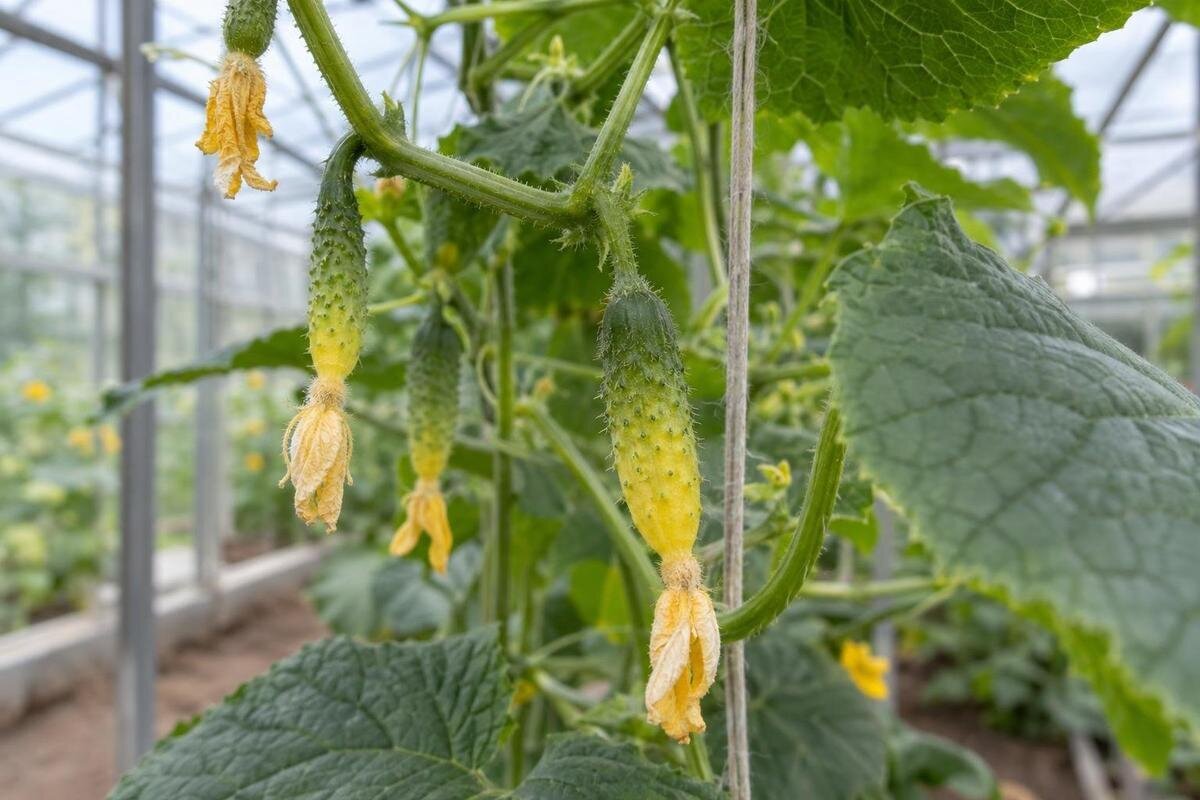
Tiny greenhouse cucumbers that turn yellow before they lengthen are often failing to develop. That visible change is an outcome, not a diagnosis: the cause may be poor pollination in a variety that needs it, a vine carrying more fruit than it can support, or stress around the roots or flowers. To narrow it down, confirm the cultivar, compare affected fruit and leaves with healthy ones, and check for recent changes in growing conditions or problems with pollen transfer. A single yellow cucumber cannot identify a nutrient deficiency or prove that bees are the problem.

What a yellow, stalled cucumber tells you
Cucumber fruit develops from the small ovary behind a female flower. After a successful set, that ovary starts lengthening; when development fails, it may stay undersized, turn pale yellow, then shrivel or drop. Growers call this fruit abortion: the term describes the outcome, not the cause. Poor pollen transfer can explain it in varieties that need pollination, but an overloaded vine, stressed roots or a sudden change in growing conditions can lead to the same result. A fruit that is fully yellow and has stopped growing is unlikely to return to normal. The useful question is what changed when it began to stall.
Look beyond the colour. Note whether the fruit is still attached, whether its flower has fallen, and whether the fruit is firm, soft or shrivelling. Compare it with a healthy cucumber at a similar stage on the same vine. If one fruit fails while new growth and other fruit progress, a poor individual set is plausible. If many tiny cucumbers on several plants stall together, look for a shared condition such as limited pollen transfer, uneven watering or temperature stress. This is a clue, not proof: more than one problem can occur at once. The pattern across plants is more useful than a close-up of one yellow fruit.
Check the cucumber variety’s pollination requirement
Look at the flowers before assuming that bees are missing. A female cucumber flower has a small cucumber-shaped ovary directly behind its petals; a male flower sits on a thinner stalk and has no miniature fruit. In many varieties, pollen from a male flower must reach a female flower for its ovary to develop normally. Some greenhouse cucumbers are parthenocarpic, which means they can form fruit without fertilisation. Those varieties do not need insect pollination to set fruit, so an absence of bees would not explain their stalled cucumbers. The variety changes the first question to ask.
Read the seed packet or supplier’s description for terms such as parthenocarpic, pollination required or all-female flowering. An all-female description is not enough on its own to tell you whether the variety sets fruit without pollination; follow the specific growing instructions. Do not introduce pollinators or hand-pollinate every flower until you know what you are growing. Pollination may be unnecessary for some types, and certain parthenocarpic varieties can develop seeded fruit if pollinated. If the label is missing, take clear photographs of the flowers and ask the seed supplier or a local horticultural adviser to help identify the variety.
When pollination is the likely cause
Pollination becomes a stronger suspect when the variety needs it, female flowers are present, and several tiny ovaries yellow soon after flowering while the rest of the vine looks reasonably healthy. Check whether male flowers are open at the same time as female flowers; individual cucumber blooms are open for a limited period. Look for insects visiting those flowers, not simply insects elsewhere in the greenhouse. Closed doors, mesh or few visits during flowering can limit pollen transfer. Weather conditions can also affect flower activity, so the fruit’s colour alone does not confirm that pollination failed.
Watch a few newly opened flowers and note whether male flowers are available and insects visit. If the variety needs pollination and transfer appears absent, you can test a small number of female flowers by gently placing pollen from a fresh male flower on the female flower’s stigma. Mark those flowers and compare their development with untreated ones. Do not do this routinely to a parthenocarpic crop. For future planning, the Classic Aluminium Greenhouses range is listed from 3.77 m² to 28.08 m²; area alone does not show whether the layout and openings allow the access your chosen crop needs, so check those details separately.
Crop load and the vine’s stage of growth
A vine has limited capacity to enlarge fruit. A new transplant with little established leaf area, a plant recovering from stress or a vine carrying several developing cucumbers may shed some young fruit. The relevant load is not simply the number of fruit: a vigorous plant with healthy leaves may support more than a smaller or damaged one, and cultivar and training method matter. Fruit left well beyond the recommended harvest stage can also compete with new growth. Look at the whole vine, including its current growth, functional leaves and the sizes of existing fruit. Note whether stalled cucumbers appeared while the plant was already carrying a heavy crop.
Harvest fruit at the stage recommended for its variety rather than leaving it to become oversized, and avoid stripping healthy leaves in response to yellowing. A fully aborted fruit can be removed once it is clearly shrivelling or softening, particularly if it is starting to decay. When planning a future growing space, the Lean-to Greenhouse listing covers options from 3.69 m² to 14.34 m². Use the stated area as a starting point for planning beds, paths and vine spacing; it does not tell you how many plants your chosen training method can support. A crowded layout can also make harvesting and inspection harder.

Check moisture around the roots
Cucumbers can struggle when the root zone repeatedly swings between very dry and saturated. Drying can restrict water uptake while young fruit is trying to enlarge. Waterlogged growing medium leaves less air around the roots and can also impair their function, even when plenty of water is present. The surface alone is a poor guide: it may look dry while deeper soil remains wet, or seem damp after a brief splash while roots below are still dry. Check moisture in more than one spot at root level and compare how quickly different beds or containers dry. Moisture deserves attention if fruit failure follows wilting or uneven growth, but it is not the only possible cause.
Review how water is being distributed, not just how often you apply it. Check for a blocked emitter, a leak, a dry corner, runoff or standing water; neighbouring plants can otherwise have different root conditions. Aim for moisture that is consistent with the crop and growing medium, with drainage that prevents prolonged saturation. After a dry spell, avoid compensating with one excessive soak. Keep notes on watering and which fruit stalls. For planning beds in a new structure, Limited Edition Aluminium Greenhouses are listed in area options from 3.77 m² to 28.08 m². That footprint can help with layout, but irrigation coverage and drainage still need separate planning.
Temperature and ventilation affect fruit set
A greenhouse can become much hotter than the outside air in strong sun, while nights may cool sharply. The size of the change depends on the site, structure and how the space is managed. Heat can affect flowers and increase the plant’s water demand; cold conditions can slow growth and pollen activity. A sudden change during flowering may therefore matter more than the season’s average temperature. There is no single temperature threshold that suits every cultivar and growing system. Check the guidance for your variety rather than treating a general figure as a diagnosis.
Measure the air where the flowers and leaves are, away from the glazing and direct sun, and record both daily highs and lows while young fruit is failing to develop. Note whether openings were closed, shade changed or plants wilted at the same time. Ventilation and shade can help manage conditions, but a model name or floor area cannot show how a greenhouse will perform at a particular site. The T-Model Orangery Greenhouse listing covers 16.52 m² to 30 m²; if comparing structures, check the stated opening and ventilation details rather than inferring performance from its name.
Check nutrients and root health before feeding
A yellow cucumber is not enough evidence to diagnose a nutrient deficiency. Nutrient problems need to be considered alongside the wider pattern in leaves and growth, because similar symptoms can follow root damage, unsuitable pH, excess salts or watering problems. Adding fertiliser without checking can worsen root stress or create an imbalance; it will not correct poor pollination or a vine carrying more fruit than it can support. Note what fertiliser or compost was applied and when, and whether changes affect older or newer leaves. A change after feeding is useful evidence, but it still needs interpretation.
If several plants are weak, have yellowing leaves throughout the canopy or wilt despite moist soil, inspect the roots and growing medium rather than focusing only on individual cucumbers. Where practical, test the soil or container mix and use the results alongside the fertiliser label to guide feeding. Avoid applying a corrective dose based only on a photograph. When comparing the Pyramid Greenhouse range, listed from 5.53 m² to 18.9 m², include access to beds and containers in your layout plan so you can inspect plants and their growing medium. Assess the medium’s pH, fertility and drainage separately.
Look for symptoms beyond the fruit
When fruit yellowing appears alongside leaf spots, mottling, stem damage, visible pests or persistent wilting, widen the investigation. Those signs can have different causes, and a photograph of one leaf is rarely enough to identify a disease or pest. Check whether symptoms affect one plant or several, where they start and whether new growth is involved. Examine leaf undersides and the stem base without damaging the plant. If the leaves remain healthy and the problem is limited to the smallest fruit, a whole-plant disorder is less obvious, but that does not prove pollination or crop load is responsible.
Take one photograph of the whole vine and a close-up of the affected fruit while it is still attached; include the flower or the point where it was attached to the fruit if possible. Use clear, consistent light so colour is visible, and record the date and cultivar. These details are more useful to an adviser than an isolated image. Leave enough access to inspect and photograph plants when planning rows. If you also need storage, the Limited Edition Aluminium Greenhouses with Storage range is listed from 5.52 m² to 28.08 m². Check the individual layout to establish how much space remains for beds and paths.

Record the pattern before changing several things
Keep a short record while new flowers and fruit develop. Note the cultivar, when a flower opens, how many young fruit the vine is carrying, and which ones stop growing. Add daily high and low temperatures, root-zone moisture, watering changes, feeding and whether insects visited flowers that need pollination. Photograph the same part of the plant from a similar angle. Comparing affected and unaffected plants in the same greenhouse can show whether the problem follows a particular row, watering point or period of weather. A record helps turn a vague impression into evidence you can compare.
Use the pattern to guide the next check: fruit failure after a dry or unusually hot period points you towards the root zone and climate; failure on a heavily loaded vine puts crop load higher on the list. If the cultivar needs pollination and flowers received no visits, investigate pollen transfer. None of these patterns proves the cause alone. Where possible, change one manageable factor at a time and judge the next fruit, since a stalled, yellow cucumber is unlikely to recover. If records show a repeated issue in one part of the structure, map the rows and openings. For a future layout comparison, the Bloomcabin Prestige Greenhouse range is listed from 3.77 m² to 28.08 m²; consider where those rows and access paths would fit.
Use the greenhouse layout as context, not a diagnosis
If the problem repeats in the same row or at the same time of day, look at the layout alongside your crop notes. Check whether dense growth makes flowers difficult to reach, whether you can inspect each plant, and whether the observed heat or moisture pattern follows a particular area. Make adjustments based on what you have recorded rather than assuming that changing the greenhouse itself will cure fruit abortion. For the next planting, allow space to train vines, reach flowers and harvest fruit without damaging neighbouring plants. Keep the cultivar’s instructions in view when deciding how to arrange and manage the crop.
If you are comparing structures for a future crop plan, consider usable bed area, paths, intended vine training and the ventilation information for the exact model and site. The Spacious Greenhouse listing gives an area range from 47 m² to 70 m². Use that range for an initial comparison, then work through the individual layout to see how you would arrange beds and reach the crop. Base the planting plan on the chosen cucumber variety’s needs rather than filling all available space with vines. For the current crop, keep the diagnosis grounded in the pattern of flowers, fruit, leaves and root-zone conditions.
Frequently asked questions
Can a tiny cucumber that has turned yellow start growing again?
If it is fully yellow and has stopped enlarging, it is unlikely to develop into a normal cucumber. Remove it once it is clearly shrivelling or softening, then focus on the next flowers and fruit. Check the variety, pollination, crop load and recent growing conditions rather than trying to treat the yellow colour itself.
Do all greenhouse cucumbers need bees?
No. Some varieties need pollen transferred to female flowers, while parthenocarpic varieties can set fruit without pollination. Check the seed packet or supplier’s notes before trying to attract pollinators or hand-pollinating. An all-female flowering description alone may not tell you whether a variety needs a pollen-producing plant.
Should I hand-pollinate every female flower?
Only consider it if your variety requires pollination and you have reason to think pollen is not reaching the flowers. You can test a few newly opened female flowers using pollen from a fresh male flower, then mark and compare them with untreated flowers. Avoid doing this routinely to a parthenocarpic variety unless the supplier advises it.
Could too much water make small cucumbers turn yellow?
Yes. Waterlogged roots can struggle to take up what the plant needs, just as a root zone that repeatedly dries out can restrict growth. Check moisture below the surface and inspect drainage; the condition of the root zone matters more than whether the top of the soil looks dry.
When should I ask someone else to identify the problem?
Seek local horticultural advice if fruit failure continues after you have checked the cultivar, moisture and growing conditions, or if plants also show spreading leaf or stem damage, persistent wilting or visible pests. Share the cultivar name, dated photographs of the whole plant and affected fruit, and notes on watering and temperature.
Treat a yellow, stalled cucumber as a clue about fruit development, not as a diagnosis in itself. Confirm whether the variety needs pollination, then compare the affected fruit with the rest of the vine and review crop load, root-zone moisture and recent temperature changes. Record what you find before making adjustments. The failed fruit may not recover, but the next flowers and fruit can show whether a targeted change has helped. If the whole plant is also declining or symptoms are spreading, use clear photographs and your growing notes to seek a more specific diagnosis.
