
Buying a Pre-Assembled Sauna: Delivery and Crane Access
Sauna buying guide
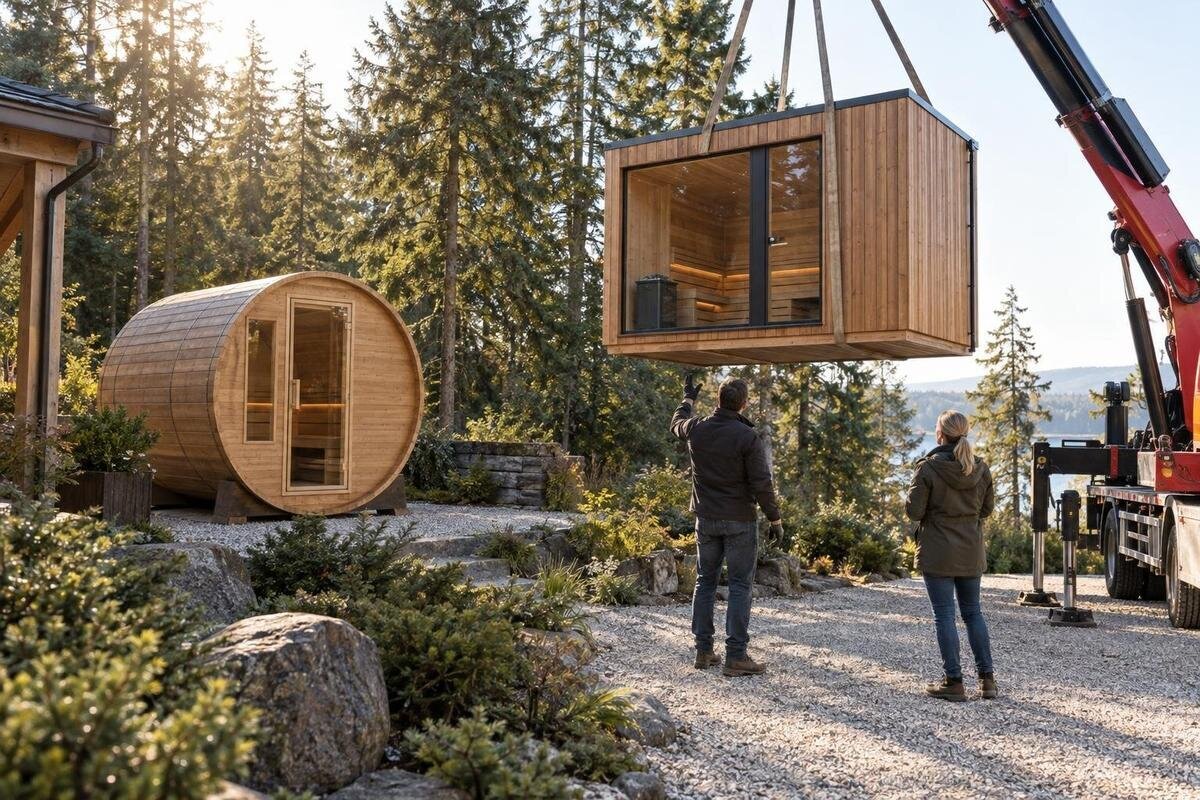
Buying a pre-assembled sauna involves more than checking whether the cabin will fit in its final spot. The delivery format determines what must pass through the property, where a vehicle can stop and whether unloading needs a crane. A sauna that suits the available space can still be impractical to deliver if its packed size, overhead clearance or lift path has not been checked. Before choosing a model, trace the route from the delivery vehicle to the installation area, confirm what arrives and get the proposed handling method agreed with the supplier.
What pre-assembled means for delivery
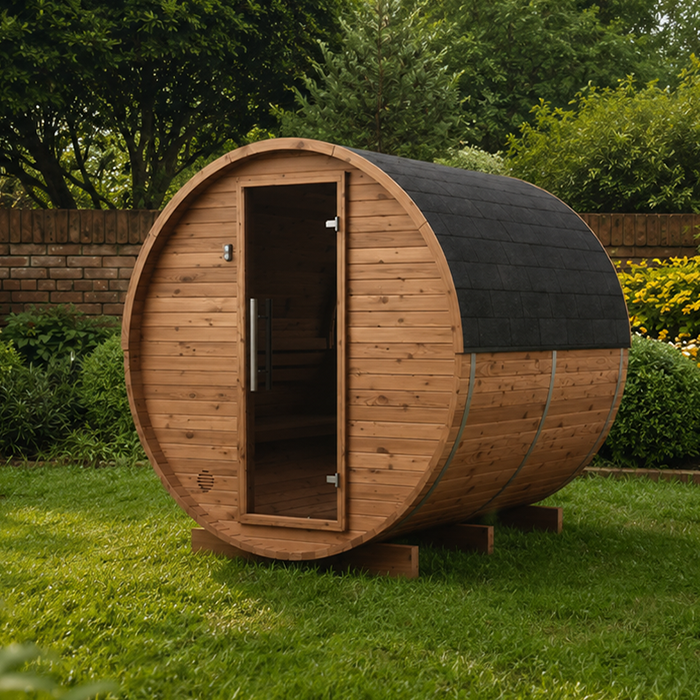
Pre-assembled describes an assembly state, not necessarily how a sauna is packed, unloaded or positioned. One supplier may mean a mostly completed cabin; another product may still arrive in sections or need work on site. Ask what the term means for the exact model and configuration you intend to order. A listing such as Thermowood Barrel Sauna S 140 product page can help identify a candidate, but its name or photograph does not confirm transport dimensions, weight or delivery format. Treat those as separate questions, not details to infer. The same broad description should not be assumed to apply across a range or to every selected option. Ask whether the sauna is shipped as one load, multiple packages or components, and whether any handling or assembly must happen before it can be placed.
Request the delivery instructions that match the order, including how the sauna is moved, what equipment is expected at the property and which work is left to you or an installer. Ask for the external dimensions in the transport configuration, the total shipment weight and any supplier-approved lifting information; do not estimate these from the room dimensions or another item in the range. Confirm whether assembly or fitting remains after unloading, and how much space that work needs. Check whether any listed package measurement refers to an outer crate or just the cabin. The aim is to know what arrives, how it must be handled and what must be ready before the vehicle turns up.
Match the delivery method to your property
Delivery can mean quite different handovers: a carrier may leave the shipment at an agreed access point, a crew may unload it, or a separate crane may place it at the final location. Some units may be delivered in parts and need on-site assembly. These are possibilities to confirm, not services to assume. Ask how the exact sauna is transported, where the carrier can stop, what standard delivery includes and whether placement beyond that point needs a separate arrangement. The HC150 Thermowood Barrel Sauna product listing is one candidate to identify in that enquiry; do not infer its delivery method from the model name. Ask for the handover point in plain terms, not simply whether delivery is available.
Match the method to your actual property rather than planning around a best-case delivery. If the unit can be brought only to the driveway, you still need a workable path and handling plan for the rest of the distance. If a crane is proposed, its set-up position and lift route must also work. Confirm who supplies lifting equipment, who moves the sauna from the unloading point, whether final placement is included and whether assembly is part of the service. Get the handover point and any exclusions in writing. The supplier, carrier and crane contractor may have separate responsibilities, so name each one. This prevents you from treating delivery to a kerb or driveway as delivery to the installation area.
Measure the full route from vehicle to installation area
Walk the route from the street or agreed unloading point to the intended installation spot, measuring every gate, doorway and pinch point along the way. Include the driveway, side passage, path between buildings, fence openings and access around corners; a generous entrance does not make a narrow section later on disappear. Measure the clear opening with gates fully open, and note posts, latches, handles, wall projections and other fixed obstructions that reduce usable space. For a candidate such as the Thermowood Barrel Sauna HC 225 listing, ask the supplier for the transport dimensions you need to compare with those measurements. Include any point where the delivery vehicle itself may have difficulty entering or stopping.
Record each measurement in millimetres or centimetres, label where it was taken and sketch the route in order. Measure clear height as well as width, plus thresholds, steps and changes in level that could affect handling. A path that is wide enough in a straight line may still fail at a turn, where the shipment must change orientation or the crew needs room to manoeuvre. Do not rely on the diagonal of an opening unless the supplier or delivery team confirms the unit can pass that way in its actual transport position. Repeat the survey after movable items are cleared, and photograph awkward points with a measurement visible rather than describing a gate as standard.
Check overhead clearance and room to turn
A route also has a vertical envelope. Check the height from the delivery vehicle's likely approach through any carport, eaves, low branches, awnings or other overhead obstructions, and consider the space needed if a load is raised or turned. Note utility wires or other overhead services and flag them to the delivery provider and crane contractor; do not assume a lift can simply pass above them. The required clearances depend on the transport configuration and proposed equipment, so ask the people responsible for delivery to assess the actual path. A product-page photo cannot show whether your own access has enough overhead room. Include obstructions at the unloading point as well as along the route.
Plan for corners and the approach to the final spot, not just the narrowest straight section. A bulky unit may need room for a controlled turn, and a fence opening can be wide enough yet leave no space to line up. Record slopes, steps, soft or uneven surfaces, tight bends and any place where a delivery crew would need to pause or reposition the load. The Thermowood Barrel Sauna N 210 product page identifies a model to ask about, but use its transport drawing, not a similar-looking image, to assess the route. Ask whether the carrier needs an uninterrupted path or space for handling equipment, and describe any obstruction that cannot be moved.
Assess crane access before relying on a lift
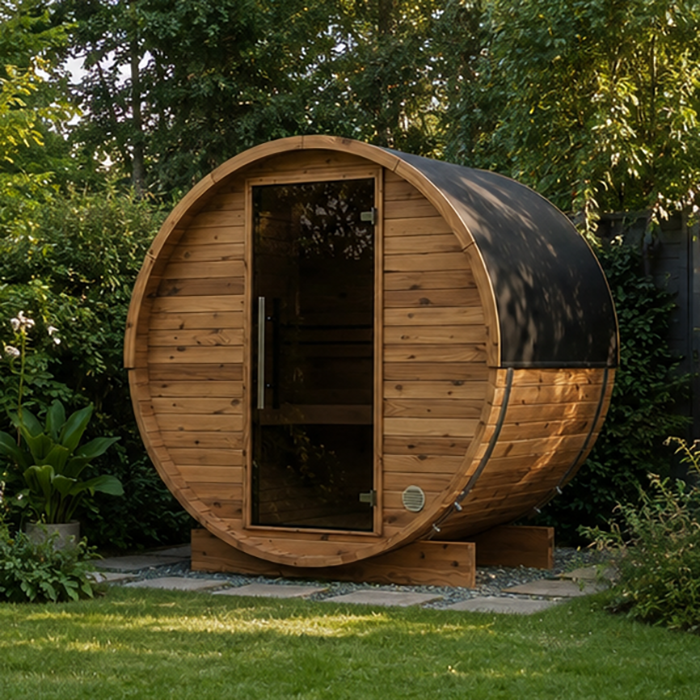
A crane can help with a route through a narrow garden passage only if the crane truck can reach and set up in a suitable position and the lift can reach the landing area. Distance alone is not enough: the contractor needs the shipment's verified weight and dimensions, its approved lifting points or handling method, the crane's position, lift height and the obstacles along the route. Ask a competent crane contractor to assess the particular lift using current supplier information. Do not choose equipment or try to work out a safe lift from a model number, an online image or a rough estimate. The Thermowood Barrel Sauna N 250 listing identifies a model to ask about; it is not a crane specification.
Check whether the truck can enter or park where planned, whether there is room for its support equipment and whether branches, roofs, fences, parked vehicles or overhead services affect the proposed path. The crane contractor needs accurate photographs and measured site details, while the supplier needs to confirm the package information and any handling restrictions. Ask who will inspect the site, who is responsible for arranging the crane and whether crane hire, unloading and final placement are separate from the sauna delivery. If access is shared or restricted, coordinate the proposed set-up with the relevant owner or manager before booking. A crane is a planned delivery method, not an automatic fix for every route.
Prepare the landing area and final position
Assess the landing point as carefully as the route. The required footprint and support conditions should come from the sauna's installation documents and supplier, not from assumptions about similar models. Confirm what base or surface is required, whether it will be ready before delivery and who will judge its suitability. If levelling, ground preparation or a question about load-bearing capacity is outside your knowledge, ask the supplier or a suitably qualified site professional to assess it; do not rely on a guess or an engineering calculation made from an image. The Thermowood Barrel Sauna LC 260 product page can identify a candidate, but it does not establish the preparation needed at your property.
Think through exactly where the sauna will face and how it will be lowered into position. Leave the clearances the manufacturer specifies for installation and later access, and make sure the crane's landing zone does not put the unit somewhere that requires an unplanned move. Note nearby walls, fences, trees, eaves and paths that affect the chosen orientation. Confirm the entry side from the product documentation and ask how much working space is needed if assembly remains after unloading. Keep the route to the landing point clear for the agreed method, but leave placement decisions to the supplier's instructions and the delivery or crane professionals.
Confirm who unloads, positions and assembles the sauna
Write down who handles each stage: freight transport, unloading from the vehicle, crane hire, movement from the drop point, final placement, on-site assembly and removal or disposal of packaging. These may involve different businesses, and one party's delivery service does not necessarily include the next. The Thermowood Barrel Sauna HCF 300 product listing lets you identify the candidate when asking for a quote, but confirm its exact delivery scope with the supplier. Ask which party supplies labour and equipment, who prepares the route and landing area, and whether you must arrange an installer or crane contractor separately. Clarifying this early helps you avoid leaving an essential part of the delivery unassigned.
Confirm how the appointments fit together: the supplier's dispatch, the carrier's arrival window, any crane booking and any installer who will finish the work. Ask what happens if the vehicle cannot reach the agreed point, the route is blocked or the crane cannot be set up on arrival, and whether a rebooking or additional charge could apply. Read the relevant delivery terms rather than assuming the carrier will wait, carry the unit further or return another day. If the route crosses a shared driveway or another person's land, make arrangements with the owner or manager beforehand. One written plan helps each contractor understand the same handover point and avoids a gap in responsibility.
Compare models using confirmed transport details
Compare candidates using model-specific documents, not names, photos or nearby models. Ask for the assembled dimensions and the dimensions and weight of each package in the form it will arrive; request the number of separate packages or loads and the orientation required for transport. Ask for supplier-approved lifting or handling notes that the delivery or crane team can rely on. Do not infer length, width, mass, capacity or delivery state from a number in a model name. For example, the Thermowood Barrel Sauna LCF 300 product listing identifies the product but does not, by itself, supply the measurements needed for access planning. Use current information for the exact order.
Put each option in a simple comparison record with its transport measurements, on-site assembly requirements, unloading method, final placement and any access-dependent service. Then test each against the route and lifting plan, rather than ruling a model in because its image looks compact. Check whether selected options or bundled components alter the shipment, and ask for revised documents if they do. If the supplier provides only finished dimensions, explain that you are planning delivery and need the packed dimensions too. Mark any unknowns as unconfirmed; a blank space is not evidence that the item will fit. This keeps the purchase decision tied to information for each candidate.
Have a fallback if the route will not work
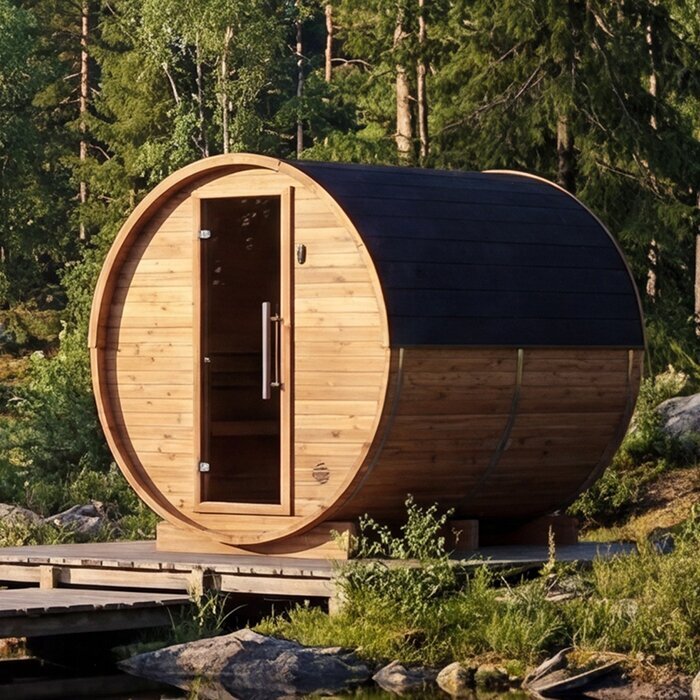
If a route check reveals a barrier, treat it as a purchase issue before ordering, not a delivery-day improvisation. Ask the supplier whether the selected model can be delivered in sections and assembled on site, whether another route or approved crane position is possible, or whether an alternative product format is available. Do not assume any of those options are offered. A crane may help bypass some obstacles, but it still needs suitable truck access, a feasible lift and a place to lower the sauna. The supplier and crane contractor need to agree that the proposed plan works for the actual package and site, not just a general product description.
Compare alternatives on their full requirements, including any extra labour, equipment, preparation or charges, and the effect on timing and assembly. Ask whether a different delivery method changes what you must arrange on site. A smaller-looking option is not automatically a solution; verify its packed dimensions and repeat the route check. If no workable method is confirmed, pause the order rather than relying on a future change to the fence, garden or driveway that has not been planned. Where property access is shared, agree practical arrangements with the other people involved before committing to a delivery method.
Get the delivery plan confirmed in writing
Give the supplier a clear record of the route: a simple sketch from the vehicle stopping point to the landing area, measurements at every restriction, overhead notes and photos of difficult turns or crane set-up options. Ask the supplier to confirm the exact model and delivery configuration against those details, then provide the same information to the crane contractor or installer. Request written answers about transport dimensions and weight, unloading, final positioning, assembly work and any site conditions that must be ready. If one party has only seen a product photo and another has only seen a site sketch, they may be working from different assumptions.
Before you place the order, make sure the purchase documents and delivery arrangement agree on the model and options, whether it arrives pre-assembled or in components, the agreed drop-off point, who unloads and positions it, and who arranges a crane if needed. Ask about exclusions, access-dependent charges and what happens if the route or site is unsuitable when the crew arrives. Keep supplier and contractor confirmations together, and recheck the route if access changes before delivery. The aim is not to predict every on-site detail yourself; it is to resolve the questions that determine whether the sauna can be delivered and placed as planned.
Frequently asked questions
Does pre-assembled mean the sauna arrives as one complete unit?
Not necessarily. The term does not confirm how a particular model is packed or whether any work remains after delivery. Ask the supplier whether it arrives as one unit or in separate packages, and what needs to be done before it can be placed.
Will I need a crane to deliver a pre-assembled sauna?
That depends on the shipment, the route and the unloading method offered for your order. Ask the supplier where the carrier will leave it and whether a crane is needed for the final placement. Have a crane contractor assess the actual site and lift if one is proposed.
What should I measure before ordering?
Measure the route from the vehicle stopping point to the installation area, including the narrowest openings, turns, height restrictions and overhead obstructions. Also record the space available for a crane to set up and for the sauna to be lowered into position. Compare these with the supplier's confirmed transport details.
Can I tell whether a crane can reach from a photo?
Photos can help a contractor understand the site, but they do not establish whether a lift is feasible. Provide measured site details and the supplier's confirmed package dimensions, weight and handling information. Ask a competent crane contractor to assess the proposed set-up and lift.
Who arranges unloading and crane hire?
That depends on the delivery arrangement. The supplier, freight carrier, crane contractor and installer may handle different parts of the job. Ask who unloads, who moves the sauna to its final position, whether assembly is included and what charges or exclusions apply, then get the agreed scope in writing.
The useful comparison is not just between the sauna models, but between their confirmed delivery requirements and the access your property can provide. Once you know the shipment format, route clearances, unloading responsibilities and whether a crane contractor can support the proposed lift, you can choose on delivery facts rather than assumptions. That planning turns access from a last-minute obstacle into part of the buying decision.
