
How Long Does an Outdoor Sauna Take to Heat Up?
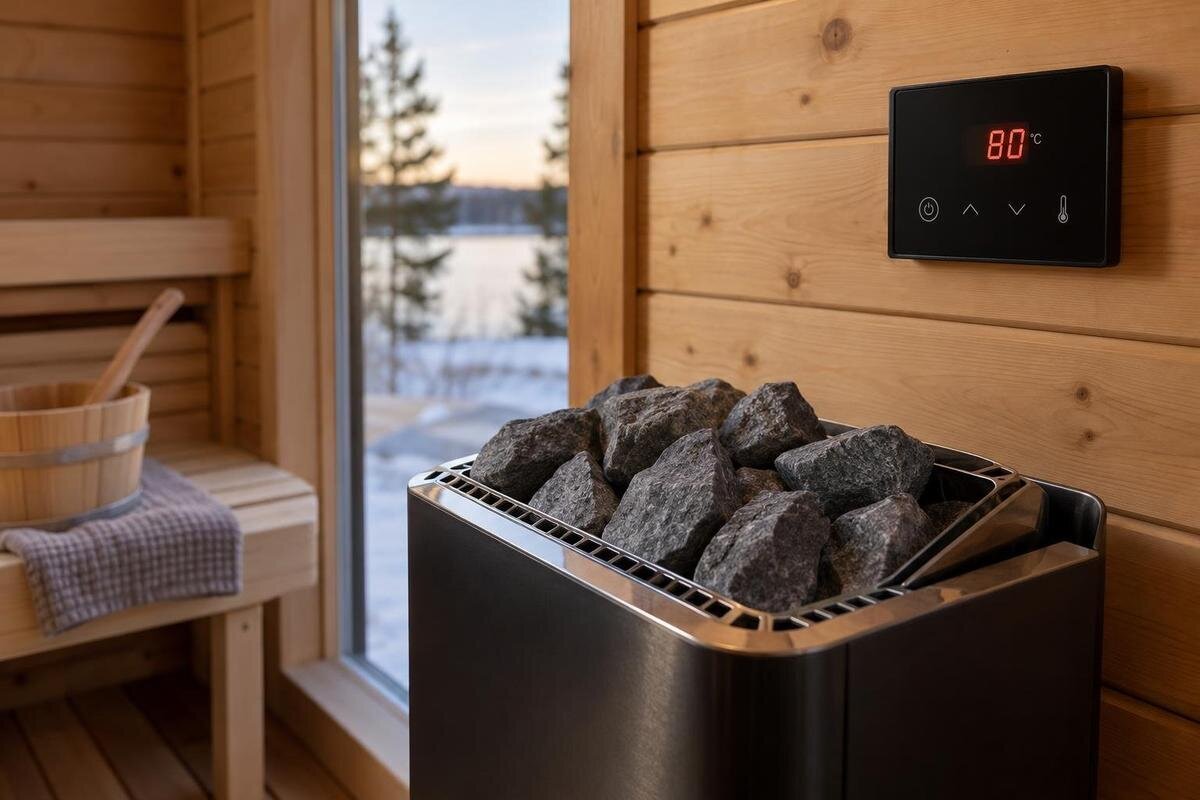
Outdoor sauna heating
An outdoor sauna may reach its chosen temperature quickly after a recent session and take longer after sitting cold overnight. The clock alone does not explain why: the starting temperature, outside weather, cabin heat load, heater configuration and the way temperature is measured all change the result. The useful question is not just “How long?”, but “From which starting conditions to which measured endpoint?” This guide explains how to interpret warm-up times, what a fair comparison needs to record, and which details to confirm when assessing a sauna and heater. The product information supplied for this article contains no timed tests for the listed models, so it would be misleading to attach a set number of minutes to any one of them.
Why there is no single outdoor sauna warm-up time
A reported warm-up time needs a defined start and finish. If a test starts when the heater is switched on and stops when a sensor at a specified position reaches a target, its minutes describe that procedure. Another account may start timing earlier or call the sauna ready when it feels comfortable; that is a different endpoint. An outdoor sauna can also begin from a true cold start after a long idle period or from a partial warm restart. Without a stated start and finish, a number in minutes says little about the conditions it represents or whether it applies to your routine.
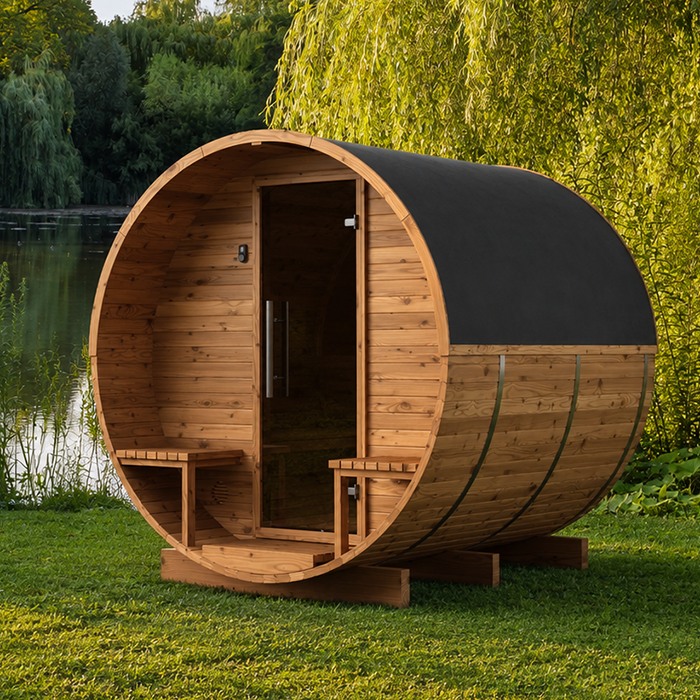
The Sauna HC-150 Thermowood Barrel Sauna is listed with an area of 2.97 m². That helps describe its scale, but it does not state the cabin’s starting temperature, heater configuration, thermometer position or elapsed heating time. A product name and an area figure are not a warm-up test. When a retailer or manufacturer quotes minutes, check whether the tested setup matches the one you are considering and what condition marked the end of the test. Keep the quoted duration together with that explanation when comparing options, rather than copying the number alone into a shortlist. Otherwise, a qualification such as “after recent use” can easily disappear from the comparison. Even a properly measured result applies to its stated conditions, not automatically to another unit or day.
Cold starts and warm restarts
Take a reading inside the cabin just before heating begins; do not assume it matches the outdoor air or a controller’s last displayed value. After a long idle, the cabin may be close to ambient, while recent use or sunlight can leave its air and surfaces warmer. Record the starting temperature, how long the sauna has been idle and whether it has been used since its previous cool-down. That separates a true cold start from a restart. Without this context, a faster result might simply reflect stored warmth rather than a different heater or cabin.
Interior surfaces may retain heat even after the air reading has fallen, so a restart begins with a different heat load from a first run after a long pause. The listing for Thermowood Barrel Sauna HC-225 gives an area of 4.4 m², but that figure cannot tell you the unit’s measured temperature at switch-on. Log the actual start reading and time since last use for each run. Keep those two details together: the temperature records the air reading, while the idle period helps explain the cabin’s recent heating history. This distinction matters when comparing an occasional cold start with a second warm-up after a shorter break, even if both tests use the same target.
How outdoor weather affects a heating test
The outdoor temperature affects how readily heat leaves the cabin, so a cold morning and a mild afternoon are not comparable just because the same heater is used. Wind exposure, shelter and changing weather can also affect conditions during a run. A sauna that starts at a particular internal temperature may warm differently on a still day than on a windy one. Those differences are reasons to record the weather, not grounds for assuming a fixed number of extra minutes.
For a useful weather record, note the outdoor temperature near the sauna at the beginning and end, along with wind exposure, shelter and any change in conditions. If you are collecting results for a particular unit, include its exact identity, such as Sauna N-210 Thermowood Barrel Sauna, beside the weather notes. Describe the conditions at the sauna rather than relying only on a broad label such as “winter test”. If the weather changes during heating, retain that note with the result instead of grouping it with runs made in steady conditions. You do not need to account for every weather variable, but you should state what was recorded and what remains unknown.
Cabin size and heat loss
Warm-up depends on the cabin’s internal air volume and how readily it loses heat, not on an outside footprint alone. Interior height and shape affect volume; insulation, gaps, doors, glazing and required ventilation also influence the heat load. A larger internal volume generally asks more of a heater, but openings and construction affect the picture too. An area figure on its own cannot produce a reliable heating-time calculation. Check the sauna dimensions and the heater manufacturer’s selection guidance rather than scaling a quoted time by area.
Product listings may show an area in square metres, while heater selection guidance may use internal volume and specify adjustments for features such as glazing. Check what a published measurement refers to and use verified dimensions for the exact configuration. The Thermowood Barrel Sauna N-250 is listed at 5.27 m²; that is a scale reference, not an internal-volume figure or a warm-up result. Keep area, internal volume and measured heating time as separate entries in a comparison. Each answers a different question, and none should silently stand in for another. Two cabins with a similar listed area may still have different volumes and heat-loss characteristics, so an area-based ranking would leave important differences unexplained.
The heater and its configuration
The heater’s output, controls and suitability for the cabin are central to a warm-up test. Use the manufacturer’s instructions to check whether the selected heater is appropriate for the sauna’s stated volume and features. A result obtained with one heater cannot be treated as the performance of a cabin on its own. If a report names only a sauna model but not the heater, its output or control setup, it leaves out information needed to interpret the time.
Operating differences matter too. With an electric system, the heater and controller settings affect the test; with a solid-fuel system, the start-up routine, fuel and refuelling can add variation. Follow the applicable manual rather than changing the setup to chase a shorter time. Have electrical or solid-fuel installation requirements confirmed by a suitably qualified professional. When assessing Sauna LC-260 Thermowood Barrel Sauna, check which heater is specified for the exact configuration and whether any quoted test used that setup. If a listing offers a choice of heaters, do not assume a time associated with one choice describes all of them. The comparison needs to identify the complete tested combination, not just the cabin.
What does “heated up” mean in a test?
A temperature reading describes the air at the thermometer, not every part of the cabin. Readings can differ by position, so follow the sauna or heater instructions for where the sensor should be placed and keep that position consistent between tests. Record whether the result comes from the controller display or a separate thermometer; those readings may not be taken at the same point. If you switch devices or move a sensor between runs, a difference in the displayed temperature may reflect the measurement method rather than a change in heating performance.
State the target temperature and the point at which the timer stops. The air at one sensor may reach the target before interior surfaces have warmed to a similar degree, so a test ending at that reading does not describe every aspect of the cabin’s temperature. A listing for Thermowood Barrel Sauna HCF-300 does not by itself tell you where a test sensor was placed. Distinguish the controller’s selected setting from the temperature actually recorded: a statement that the heater was set to a target is not the same as a timed observation that a sensor reached it. A useful result identifies the unit, heater, measurement location and endpoint without leaving the reader to infer any of them.
How to record a repeatable warm-up
Keep the test setup as consistent as practical: use the same sauna and heater configuration, the same normal control settings, the same target and the same sensor position. Before starting, record the cabin air temperature, outdoor temperature, time since the cabin was last heated and the weather conditions. Note the state of doors and ventilation as they are used in normal operation. Do not alter ventilation or bypass safety controls to try to shorten the test; operate the heater as its instructions require.
Start the timer at a clearly stated point, such as heater activation, and stop it when the agreed sensor reaches the chosen target. Record the elapsed time, not a rounded estimate, and note anything that changed during the run, such as a door opening or a shift in weather. For a test tied to a particular model, write down its exact identity, for example Sauna LCF-300, along with the heater and control details. Use the same recording format each time so that a missing detail is visible rather than mistaken for an unchanged condition. If a run is interrupted, keep the interruption in the record. Repeating a run under similar stated conditions can show how consistent that setup is, but does not guarantee the same result in different weather.
How to compare measured results fairly
First decide what is being compared. Two complete sauna-and-heater packages can be compared as packages if each test states the exact cabin, heater and method. That does not isolate the sauna shell from the heater, so describe the result as a comparison of those packages rather than proof that one cabin design heats faster. To examine the effect of weather on one setup, keep the unit, heater, target and measurement point fixed and record the changed conditions. The Thermowood Barrel Sauna S-140 is listed at 1.93 m², but a listed area does not make two warm-up results comparable. Nor does it account for different starting temperatures or heater setups. Decide which question the results can answer before drawing a conclusion from the elapsed times.
No verified timed tests are supplied for the listed models, so this guide cannot report observed minutes or rank them by speed. When reading a published comparison, look for a side-by-side account of the conditions, not just the final times. Check whether both runs used the same definition of a cold start, target temperature and timing endpoint, then identify any differences in the heater, weather or measurement position. A report that says only “from cold” leaves the starting point unclear; “after recent use” needs more detail too. Where conditions differ, the results may still describe those individual runs, but they do not establish which setup would be faster under matching conditions. Keep that limitation attached to any comparison you make.
Why everyday warm-up times vary
A test with closed doors and a fixed endpoint differs from ordinary use if people enter, leave or open the door during heating. Ventilation settings, target changes and controller behaviour can also affect the reading. For a solid-fuel heater, variations in the start-up and refuelling routine may change the elapsed time. These are not necessarily faults; they are differences in how the sauna was operated. If you compare a measured test with your own experience, note which of these conditions were different.
A brief record of your own starts can help you plan around your setup without turning one result into a promise. Keep cold starts separate from restarts, and distinguish uninterrupted warm-ups from those involving door openings or setting changes. This makes the record easier to interpret than a single list of durations with no explanation. Look at the individual runs before combining them: an average that mixes different starting conditions can hide the distinction you need for your routine. An average describes only the runs included in it; it cannot predict every future day. Retaining the conditions beside each time lets you see which observations are relevant to the warm-up you are planning.
What to confirm before choosing a sauna setup
Before choosing a sauna or heater, confirm the cabin’s internal dimensions and volume, the heater’s manufacturer-stated suitability, and whether the selection guidance calls for adjustments for glazing or other features. Check what heater and controls are specified for the exact offering rather than inferring them from a product name or photograph. Separate the question of whether the heater suits the cabin from the question of how quickly that combination reached a target in a test. A stated match between cabin and heater is not itself a measured warm-up time. If a duration forms part of your buying decision, check that it refers to the configuration you would receive and to a clearly described test.
If a supplier provides a timed result, ask for the starting cabin and outdoor temperatures, the idle period, the heater setup, the target, sensor location and the point at which timing stopped. If those details or verified test results are unavailable, there is no sound basis for assigning a precise duration to that sauna. Use the manufacturer’s setup guidance and distinguish a measured observation from an estimate. A warm-up time is most useful when you know exactly what it describes.
Frequently asked questions
How long does an outdoor sauna take to heat up?
There is no dependable single duration. A cold start and a warm restart are different, and outdoor temperature, cabin heat load, heater setup, target and thermometer position all affect the result. Use a measured time only when its starting conditions and endpoint are stated.
Does colder weather make a sauna take longer to heat?
It can. A colder starting cabin and greater heat loss to the outdoors can extend a warm-up, while wind and exposure may also affect the test. Record the cabin and outdoor temperatures, not just a general description such as “cold day”.
Can the listed area predict heating time?
No. An area figure helps describe scale, but it does not give internal volume, heat loss, heater compatibility, starting temperature or a measured warm-up result. Use the sauna and heater manufacturers’ specifications to check the setup, and rely on a timed test only if its conditions are documented.
Why do advertised warm-up times differ?
They may refer to different starting temperatures, heater configurations, targets, thermometer positions or definitions of “ready”. One result might be a cold start and another a restart after recent use. Compare the test methods and conditions before treating either time as relevant to your setup.
Does reaching the controller’s setting mean the sauna is ready?
It means the temperature reported by the controller has reached the selected setting; a separate thermometer elsewhere in the cabin may show a different reading. Check the heater instructions for the intended measurement point, and distinguish the selected controller setting from the measured air temperature in any comparison.
A useful outdoor sauna warm-up time is a measured result attached to its starting temperature, weather, heater, target and sensor position. Those conditions are part of the answer, not minor footnotes. Compare like with like; where the test details or verified times are unavailable, a bare figure in minutes cannot tell you what to expect from another cabin or another day.
