
Sauna Display Visit Checklist: Try, Measure and Ask
Sauna buying guide
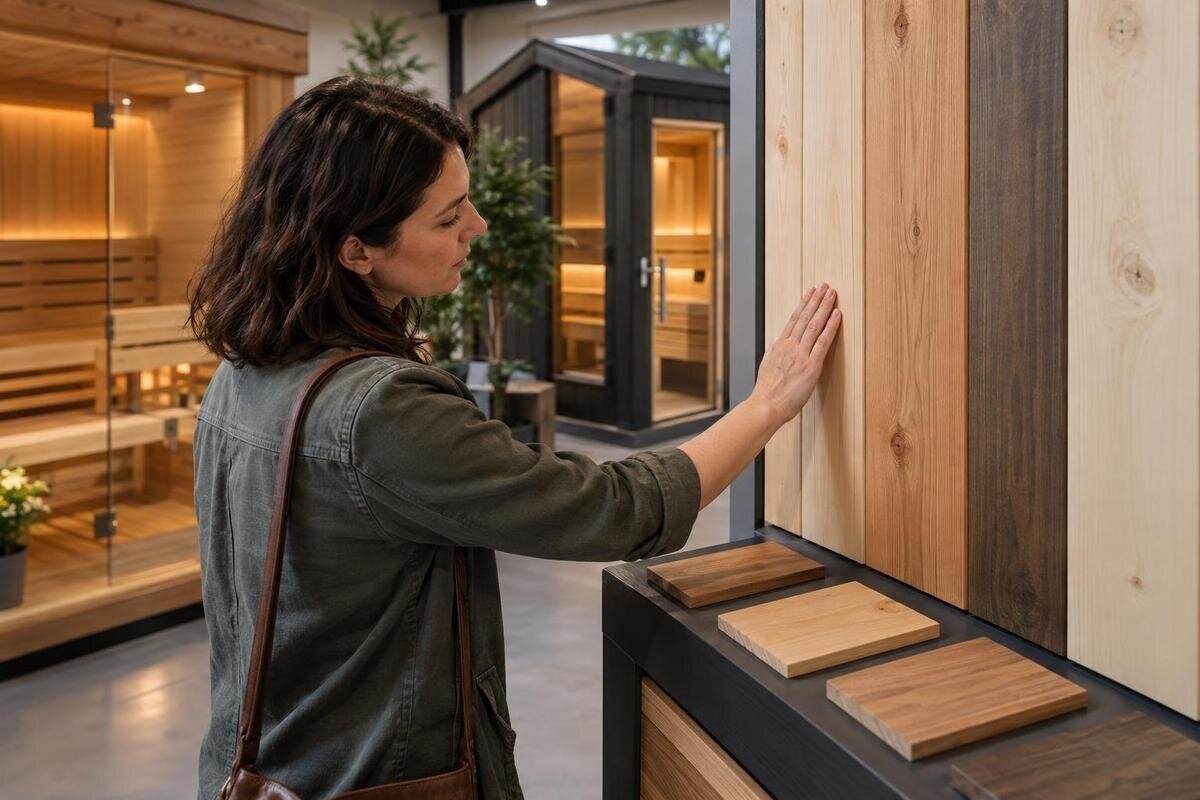
An in-person sauna visit can answer questions that photographs cannot: whether you can enter and sit comfortably, how the door and controls feel, and what the finish looks like close up. A display, however, may not match the model or configuration in your quote. Before travelling, confirm that the venue actually has a display you can enter and establish which model it is. Bring a simple site sketch, a tape measure and a written question list; leave with observations and documents attached to an exact model name.
01
Confirm what you can inspect before travelling
Before travelling, call or email the venue to confirm that a sauna is currently on display at that location and can be inspected in person. Ask whether visitors may enter it or only view it from outside, whether you need to book, and when someone familiar with the product will be available. A retailer's address or an online product page does not establish that a physical display is available nearby, so check the specific site rather than assuming. Confirm the opening hours and access arrangements for the day you plan to go. If you are bringing someone else to test the fit, ask whether they can join the visit.
Ask which model and configuration the display represents. Find out whether it includes options, replacement parts or showroom-only additions that might not appear in a standard order. If there is more than one unit, identify the one closest to your shortlist, and ask whether you may photograph its label and features. Check what you are allowed to try: sitting on benches, opening the door, examining surfaces or seeing controls demonstrated. Follow the venue's instructions; do not assume display equipment is available for operation just because it is in front of you. Record any differences between the sample and the version being discussed.
Bring measurements and a simple site sketch
Prepare a measured sketch of the place where the sauna is intended to go. Note the maximum length, width and height available, fixed obstacles, overhead restrictions, nearby doors or paths, and the route from the likely unloading point to the proposed position. Record how many people may use it at once and any practical access needs, such as a low step or space to turn. A simple sketch with measurements and a few labelled phone photos is more useful than trying to remember the site in a showroom. Mark whether each measurement is confirmed or provisional so you know which dimensions need checking when you return home.
Write down what each published number describes before comparing it with your site. For example, the listing for Sauna HCF-300 states 6.89 m²; treat that as the listing's stated area, not as confirmed external length, width or the clearance required around a unit. Ask for a dimensioned drawing that names the relevant measurements, and check which refer to inside space, outside dimensions or access around the sauna. Do not make a pad or room plan from an area figure alone. Keep the exact model name beside each measurement, particularly if similar names appear in your notes or quote.
02
Try the seating and bench layout
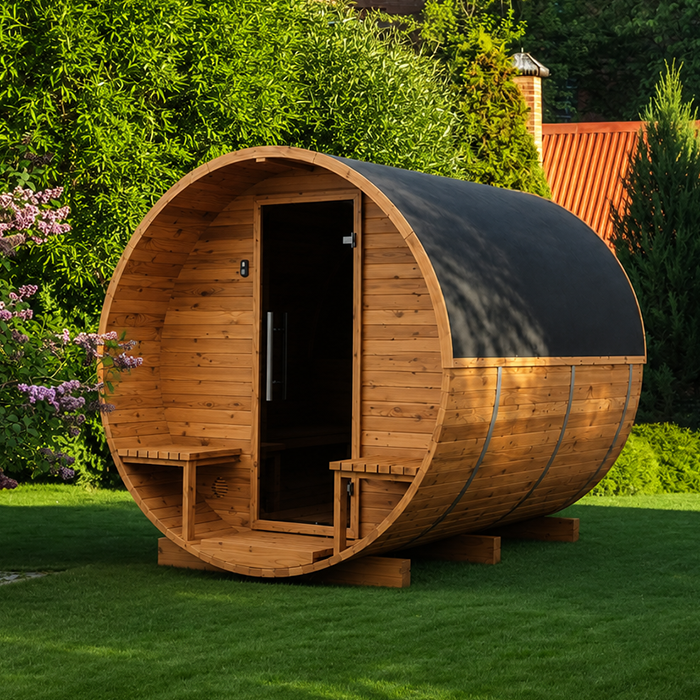
With permission, sit on each bench intended for use and assess your posture and available space rather than judging from a photograph. Check whether you can sit naturally, rest your feet, move your knees and shoulders freely, and sit comfortably beside the wall and other occupants. Try the posture you expect to use at home; notice if you have to hunch or twist to fit. Different heights and leg lengths affect how a seat feels, so invite the people who will use it to try it as well, if the venue allows. Note which position you tried; a vague memory of “comfortable” is hard to compare later.
Try moving from the doorway to the bench, changing position and standing up again, while respecting any restrictions on the display. Notice whether the edge, backrest or gap between seats affects how you settle in, and whether you can shift without bumping another occupant. If a particular layout feels right, record the exact display model alongside the observation. For instance, if Sauna LCF-300 is on your shortlist, ask whether the seating arrangement you tried belongs to that exact model and configuration. Do not assume the benches are identical across models simply because the outer design looks similar.
Check the doorway and movement inside
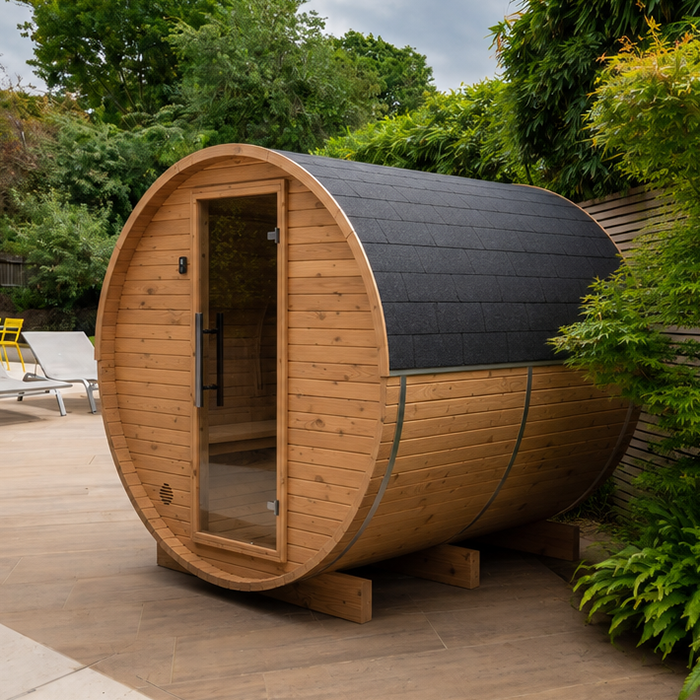
Spend a moment at the entrance before concentrating on the interior. If permitted, open and close the door, note which way it swings, how much floor space it uses, where the handle sits and how the latch feels. Look at the step or threshold and the clear width you actually pass through; a photograph can hide both. Imagine the door beside a fence, wall or path at your own site, not in the open showroom aisle. Ask the supplier for the clear opening, threshold and door-swing dimensions in writing rather than estimating them by eye. If staff restrict access, observe only and request the drawing.
Consider the sequence of entering, closing the door, reaching a bench and leaving, including whether someone needs to wait nearby or pass behind you. A convenient place to stand while handling the door and enough room to turn can matter as much as the internal seat arrangement. Do not assume that an area figure describes access: the listing for Sauna S-140 gives 1.93 m², but that figure does not establish a doorway's clear width or the space needed outside it. Ask for those measurements separately and add them to the site sketch. If access matters to the people who will use the sauna, have them assess it in person.
03
Inspect visible surfaces and workmanship
Look at the surfaces in ordinary showroom light, both from a normal standing position and, where allowed, closer to the joints and edges. Note visible marks, rough patches, gaps, loose-looking fittings, uneven alignment or damage, and distinguish an observed feature from an assumption about how the unit is made. Touch a surface only if staff permit it, and do not scrape, pull at a joint or test a fitting by force. A display may have been handled, cleaned or altered; one scuff does not tell you what a new unit will look like. Ask which materials and finishes are documented for the exact configuration you are considering.
Pay attention to the surfaces your hands or body would contact, not just the exterior presentation. Ask whether the finish shown is standard, an optional treatment or a result of display use, and request the manufacturer's care instructions for cleaning and any maintenance that may apply. If Sauna HC-150 is the model you are assessing, use that name when asking which finish information applies; the product title alone is not evidence of the interior timber or treatment. Do not infer species, durability or upkeep from colour, scent or a polished sample. Record any visible concern and ask whether the same feature would be present on a newly supplied unit or is specific to that display.
Ask for a demonstration and clarify inclusions
If the venue permits, ask a staff member to demonstrate the door latch, controls, lighting and ventilation features that are actually fitted. Observe whether labels are easy to understand and whether controls are reachable from where you would use them. Ask which parts of the display work and which are illustrative or disconnected; a panel or accessory on a sample does not prove it is part of a sale. Do not switch equipment on or handle hot components without explicit staff instruction. If a demonstration is not available, request the operating manual and note that you have not tested the feature. A demonstration tells you about that display, so check whether it matches the configuration being quoted.
Use the visit to clarify the boundary between the sauna itself and the items or services shown beside it. Ask the supplier to list what is included, what is optional and what is supplied separately, including any heater, controller, rocks, lighting, guards, accessories, assembly or commissioning that are relevant to the quote. Do not infer that an item is included because it appears in the display. If you are comparing a quote for Sauna HC-225, ask for the inclusions against that exact model and chosen configuration. For questions about electrical supply or connection at your property, ask for the manufacturer's requirements and have a qualified electrician or installer assess the site; do not rely on a showroom demonstration.
04
Compare the drawing with your property
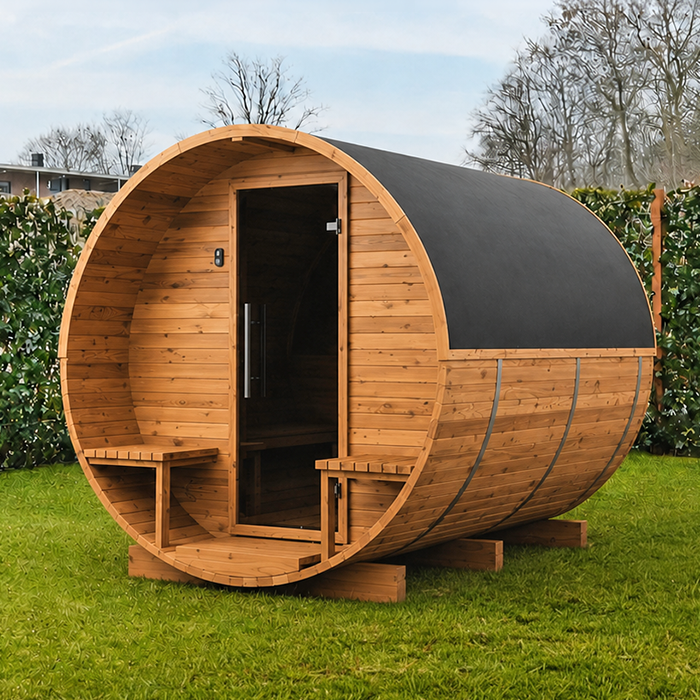
Compare an actual manufacturer drawing with the measured site, not the open floor around a showroom sample. Ask for the overall external dimensions and total height, not only a stated area or internal seating space. Check whether the drawing identifies the door swing, projecting parts and any manufacturer-specified clearances for use or maintenance. The listing for Sauna N-210 states 4.43 m²; unless its documentation defines that figure, do not use it as a pad size, overall footprint or access allowance. Keep the model code with the drawing so you are comparing like with like. Resolve any mismatch using the drawing rather than scaling a photograph.
Check the delivery route separately from the space where the sauna will sit. Measure narrow gates, paths, turns and overhead restrictions, and note steps or surfaces that may affect access; share clear photos with the supplier if they help explain the route. Ask what dimensions or access details are needed for delivery and whether the arrangement shown assumes assembly at a particular location. An assembled showroom display cannot tell you how a unit will reach a restricted backyard. Site preparation, base suitability, drainage and electrical connection are property-specific questions. Ask the relevant qualified installer or trade professional to assess them rather than drawing conclusions from the display.
Request model-specific drawings and care information
Ask for a current, model-specific dimensioned drawing, with the model code and configuration identified. Depending on what the manufacturer provides, useful views may show the plan and elevations, external measurements, door and bench layout, and connection points or required clearances. Ask what each dimension includes and whether a feature is standard or an option. If the display or quote is identified as Sauna N-250, check that the drawing carries the same model name and reflects the selected options; a drawing for a similar-looking sauna is not a substitute. If the final configuration is undecided, ask which details could change and request an updated drawing before relying on it.
Request the product specification, inclusions list, assembly and operating instructions, care information, and written warranty terms that apply to the quoted model. Ask for claims about materials, capacity or performance to be tied to the relevant specification rather than relying on a verbal summary or the appearance of the display. Check that the care document covers the surfaces and configuration you will receive, and keep the document version with your quote. If the staff member cannot answer a question during the visit, write it down as unresolved and ask for the applicable document or a written clarification. A set of model-specific documents is easier to review than a pile of generic brochures.
05
Review the quote, availability and responsibilities
Ask for an itemised written quote that repeats the exact model, configuration and selected options. Check it against the inclusions discussed during the visit, especially any accessories, electrical components, assembly, delivery or commissioning. Ask the supplier to resolve omissions or unclear descriptions in writing rather than relying on your recollection of the conversation. If your shortlist includes Sauna LC-260, put that exact name beside your comparison notes and check that the quote repeats it. Do not use a display photograph to fill in a missing line item or assume that two models in one range share the same package. A like-for-like comparison needs matching inclusions and services, not just similar product descriptions.
Confirm current local availability and any quoted timing directly with the seller, and ask how delivery, site access and installation responsibilities are handled for your location. Check which tasks you or another contractor would need to arrange, what site information is required, and what happens if the proposed route or position differs from the assumptions in the quote. Ask for warranty and after-sales details in writing, along with any quote conditions or expiry date. These are purchase details, not things a display can demonstrate, and they can change; do not rely on an old sheet or casual estimate as a current commitment. Leave uncertain costs or timing marked as unconfirmed.
Keep a clear record of the visit
After the visit, write down the display's exact model and configuration, the date, what you physically tried, what you measured and what staff told you. Separate your own observations from staff explanations and details shown in drawings or specifications, so you can trace each note to its source. If photography is allowed, label each image straight away with the model and the feature shown. Record how each seat and the entry felt, plus any issue you want to check again. Replace vague notes such as “door access was fine” with the opening measurement, the direction of the door swing and any obstruction you noticed. This makes the record useful when comparing the display with your planned site.
Compare the record with the drawings, written inclusions and site measurements for each candidate. Separate firm constraints—such as the available space, door approach and route—from preferences such as seat feel or appearance, then identify which unanswered details could affect the choice. If the display was a different model or configuration, do not carry over its seating, clearances or finish by assumption; seek confirmation against the exact item quoted. Use a relevant qualified professional for site-specific electrical or preparation questions. Keeping “unknown” visible in your notes shows what still needs confirmation instead of turning a showroom impression into a specification.
Frequently asked questions
How can I identify the exact sauna model on display?
Ask a staff member to show you the model name or label and confirm any options or changes to the display unit. Write down the exact model and check that the same name appears on the drawing and quote. If the identity is uncertain, mark it as unconfirmed rather than matching it to a similar-looking model.
Can I sit in or operate a display sauna?
Only if the venue permits it. Ask staff what you can try and whether they can demonstrate the controls. Do not switch equipment on or handle hot components without their explicit instruction. If you cannot enter the display, request model-specific drawings and note which features you have not been able to test.
What measurements should I take to a showroom?
Bring the available length, width and height at the proposed site, plus measurements of relevant gates, paths, turns and overhead restrictions along the access route. Mark them on a simple sketch. Compare them with a dimensioned drawing; a published area figure alone does not confirm a sauna's footprint or required clearances.
Which documents should I ask the supplier for?
Ask for a current drawing that matches the exact model and configuration, a product specification, an inclusions list, assembly and operating instructions, care information and written warranty terms. Keep those documents with the quote, and ask the supplier to clarify any claim or measurement that is not explained.
What if the display differs from the model I want to order?
Record the display model and the differences you can see, then ask for documents and written answers that apply to the exact model and configuration in your quote. Do not assume that its seating, finish, clearances or inclusions will match the display. Treat anything not confirmed as an open question.
A useful display visit gives you more than a first impression. You should come away knowing which model and configuration you tried, how its seating and entry felt, which site measurements need checking, and what documents are still outstanding. Compare those notes with the drawing, specifications and written quote for the sauna you are considering. That way, the display helps you make a grounded choice without standing in for details that only the model-specific paperwork can confirm.
