
Sauna Kit vs Fully Assembled Sauna: Which Should You Order?
Sauna buying guide
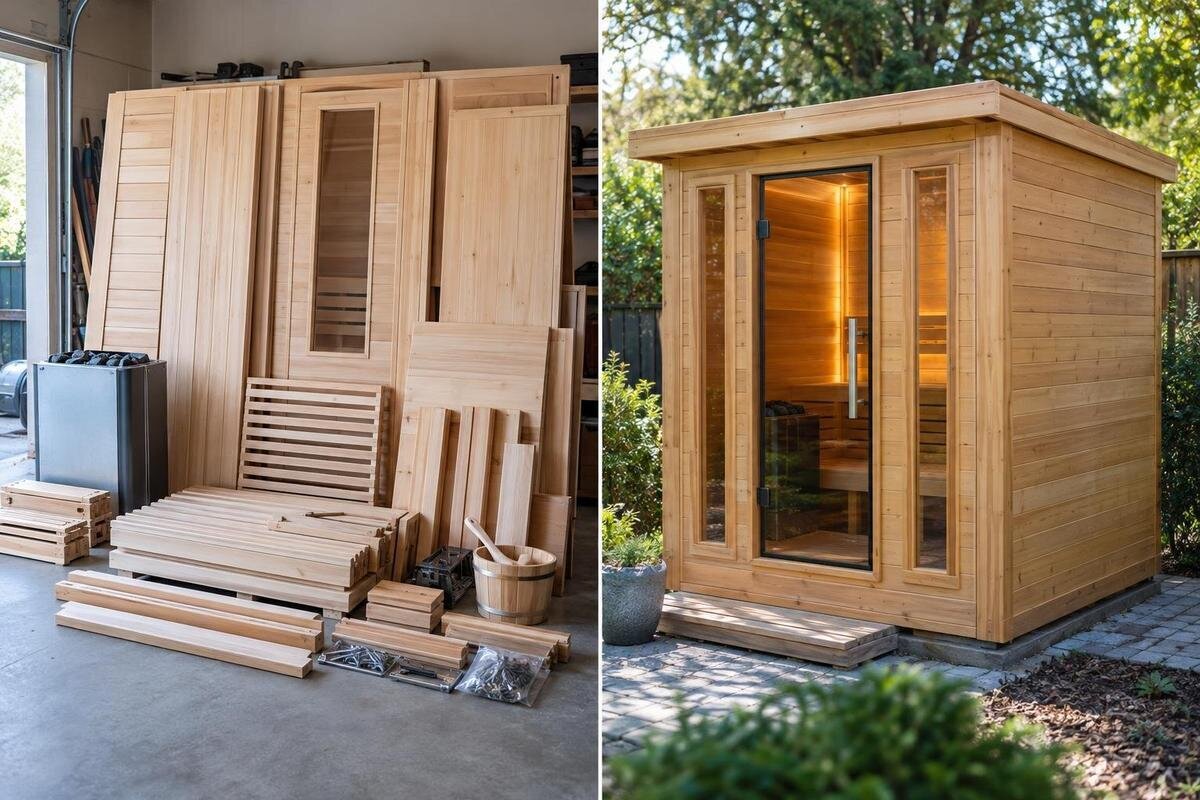
Choosing between a sauna kit and a fully assembled sauna is largely a decision about delivery and responsibility. The difference involves the load that reaches your property, the route it must travel, what remains to be built and who handles each task. A kit may suit a restricted route if its individual packages fit, but it still needs safe handling, space to organise components and competent assembly. An assembled unit can reduce on-site building, but only if that format is offered for the exact model and your postcode and the delivery plan gets it to the intended spot.
01
What ‘kit’ and ‘fully assembled’ mean in practice
The terms kit and fully assembled are not universal specifications. A kit may mean separate components, pre-made sections or a mix of parts requiring on-site assembly; an assembled option may still leave some fitting or setup to do. Those are possible delivery states, not promises about any particular sauna. Ask the seller to describe exactly how the ordered model will arrive: the condition of the main structure, which elements remain separate, what work is expected after delivery and what must be finished before handover. If the answer relies on a broad label, ask for a plain-language breakdown before comparing options.
Separate three responsibilities in your notes: assembly, delivery and final placement. One provider may assemble a unit while another transports or unloads it; none of those tasks automatically includes the others. Ask who supplies any parts or fixings needed for assembly, who carries out each stage and what you must have ready. Clarify what the seller means by completed assembly, including any fitting left for you or another contractor. A written breakdown makes gaps easier to spot than a phrase such as ready to go.
Confirm the format offered for your exact order
Check which delivery formats can actually be ordered for Australia, your postcode and the exact model and configuration. A model name, photograph or area figure does not say whether the sauna is packed as components, assembled before dispatch or paired with an assembly service. If the Thermowood Barrel Sauna LC-260 is on your shortlist, ask which arrival state is available for that exact order and whether it includes any on-site work. Do not infer the answer from a similar model or product image; availability and scope need confirming against the current local offer.
Ask for the information that lets you plan: a current product drawing or manual, a description of the shipment, and package measurements and weights if it is supplied in pieces. For an assembled delivery, request the overall dimensions and any handling information the supplier or carrier can provide. Check that the documents apply to the configuration quoted, not just the model family. Ask whether measurements refer to the packed load or the completed sauna; both matter, but for different parts of the plan. Have the supplier state whether assembly is included, optional or something you must arrange independently, and note any exclusions. Keep the documents with the quote if the configuration changes.
02
Measure the whole route to the sauna site
Measure the full path from the point where the delivery vehicle can stop to the planned sauna position, not just the space where the sauna will sit. Record the narrowest gate and doorway, height restrictions, bends, turning room, steps, changes in slope and overhead obstructions such as eaves or branches. A long package or complete structure may need room to turn as well as enough straight-line clearance. When asking about the Thermowood Barrel Sauna HCF-300, use the exact model code and request dimensions and handling requirements for the chosen delivery format; the listing name cannot show whether your route works. Include latch hardware, raised sills and fence returns that reduce the usable opening.
Include the route from the street or driveway, any shared access and the distance from the unloading point to the site. Note where a vehicle can wait, whether gates can stay open, and any garden features or parked vehicles that narrow the way on delivery day. Send clear measurements and photos to the supplier or carrier, then ask them to confirm the route and delivery endpoint in writing. Photos help explain a corner or step, but they do not replace measurements or confirmation of the carrier’s handling plan. Measure the clear opening with gates fully open, rather than relying on a nominal gate size. If access depends on moving a barrier or stored items, say so and confirm who will clear them.
What a kit requires from the buyer
A kit moves some of the work to your property. Before choosing one, allow for space to receive and sort the components, access to the work area and time to assemble them. Ask the seller for instructions for the exact configuration, a list of required tools and the number of people needed. Confirm which tools and labour you must provide. Some parts may be bulky or awkward even when delivered separately, so request package weights and handling guidance rather than assuming one person can manage them. If considering the Thermowood Barrel Sauna LCF-300, request its assembly instructions before deciding who can do the work. Check where the components can be unpacked without blocking the route, and how to store them if assembly is delayed.
Treat the advertised kit as a transfer of tasks, not a guarantee of lower cost or faster setup. Include labour, tool hire or purchase if needed, moving and staging packages, and coordination with any separate installer in your comparison. Ask whether the quote includes assembly, fixings, a process for missing or damaged parts and rubbish removal; if those items are not covered, decide who will handle them. If using an independent assembler, confirm the job scope and availability before the shipment is booked rather than assuming they can take over any kit. Ask how to check the shipment before assembly begins and what support is available if the delivered parts do not match the plan.
03
What an assembled sauna delivery includes
An assembled sauna reduces the amount of construction on site only to the extent the supplier has actually assembled it. It does not, by itself, say whether the carrier unloads the unit, moves it along the access path or places it at the prepared position. Ask where the carrier’s responsibility ends, what equipment is included and who handles the last part of the route. For the Thermowood Barrel Sauna S-140, identify the precise model when asking whether an assembled format is available and which delivery and placement services are attached to that order. Ask the carrier to assess turns and clearances using its delivery method, not just the unit’s outside dimensions. Clarify what happens if the agreed method cannot reach the planned position.
Keep assembly separate from connection and commissioning. If the selected configuration needs electrical or other service work, confirm who arranges it and use appropriately qualified tradespeople; an assembly quote is not evidence that services are included. Ask which fittings, checks and handover tasks remain after the main structure is assembled. Confirm whether the team delivering the unit completes those tasks or whether a separate visit is needed. This distinction helps you judge how much on-site work an assembled option actually removes.
Prepare the site for either delivery format
Site preparation applies to both formats, although the work area differs. A kit needs room to lay out and assemble components; an assembled unit needs a clear approach to its final position. Obtain the manufacturer’s site information for the exact model, including any documented base, clearance or surface requirements. Do not copy a base size or spacing from a different sauna, or treat a product image as an installation drawing. If Thermowood Barrel Sauna HC-150 is under consideration, ask for the relevant site documents for that model and configuration before arranging groundwork. Ask which measurements describe the sauna itself and which, if any, describe additional space needed for the site.
Plan any groundwork or service changes separately from the sauna build. If the site calls for excavation, drainage changes, structural work or electrical services, have the relevant task assessed by a suitably qualified professional rather than guessing from catalogue pictures. Decide when the site will be ready and who confirms that it meets documented requirements. For a kit, allow for somewhere to keep components until assembly; for an assembled delivery, prepare the access and final position before arrival. Ask how the supplier expects a delay or site issue to be handled, and do not start work from generic dimensions while the manufacturer’s requirements are unclear.
04
Who supplies the tools and lifting equipment?
Equipment needs depend on the shipment, route and unloading method, not simply on whether a sauna is labelled a kit. A kit may require tools named in its instructions; a larger or awkward load may need mechanical handling. An assembled unit may need a forklift or vehicle-mounted lifting equipment if the supplier’s delivery assessment calls for it, but do not select equipment by guessing. Ask the seller or carrier what is required, who supplies and operates it, and whether the access and offload point suit that plan. Use the exact Thermowood Barrel Sauna HC-225 model and format when requesting this information. Reach, overhead obstacles and the intended set-down point may affect the provider’s choice.
Confirm who provides the people as well as the equipment. A delivery driver may not assemble the sauna or carry every package to the site, and an assembler may not include unloading. Establish who operates any handling equipment and who assists with the move. If lifting machinery or specialist assistance is suggested, have a suitable provider assess the task and coordinate its arrival with the carrier. Avoid improvising a lift or assuming equipment can reach the final position just because it can reach the driveway.
Clarify unloading and the delivery endpoint
Clarify where the delivery service ends. A quote may describe delivery to an access point rather than movement to the final site, so ask exactly where the load will be set down and whether unloading or internal movement is included. For an order such as the Thermowood Barrel Sauna N-210, get the carrier’s answer for the quoted delivery format, not a general promise about the model. If it is a kit, ask how many packages to expect, where they will be placed and whether the assembly team is responsible for moving them from that point. Check whether the set-down area can be kept clear during unloading.
Sequence delivery with assembly and site readiness. If components arrive before the work area or assembler is ready, you may need temporary storage; if a finished unit arrives, the route and position must be ready for the agreed unloading plan. Ask the supplier how to inspect the shipment and report a missing or damaged item. Follow its storage directions during any wait before assembly, rather than assuming the packages can be left anywhere. If the carrier and assembler are different businesses, confirm when responsibility for the shipment passes from one to the other. Do not assume delivery and assembly happen together.
05
Compare the full cost and work involved
Compare complete, like-for-like quotes rather than the product amount alone. When asking about the Thermowood Barrel Sauna N-250, request a breakdown for the exact configuration and postcode: product, freight, unloading, movement to the site, assembly, any equipment, and separate site or service work. These may be priced or arranged separately, so ask instead of assuming they are included. Check who supplies tools or materials, who removes packaging, and whether travel or access-related charges are listed. Keep the route information and agreed delivery endpoint with the quote; offers based on different assumptions are hard to compare. Note any assumptions about steps, gates or vehicle access.
Include your own contribution in the comparison. For a kit, count your time, help from others, tool costs, storage and the effort of coordinating assembly. For an assembled option, account for any unloading equipment, placement service or tradespeople you must arrange separately. Do not assume a kit saves money or that an assembled option necessarily costs more overall: the figures depend on the quote and what you would otherwise pay someone to do. Compare offers with matching models, configurations and service scopes, and ask how an access assumption is treated if it proves inaccurate.
Which format fits your access and assembly support?
A kit may suit your plans when its packages can make the route, there is a workable staging area, and you can meet the documented assembly requirements with the time, tools and labour available. An assembled sauna may suit you better if you want to reduce on-site building, but only if the completed load can reach the position and the supplier confirms unloading and placement. Each format shifts the challenge: a kit has more parts to move and work to complete; an assembled unit can make access and handling more demanding. Neither label guarantees a hands-off delivery. If neither route is confirmed, ask whether another delivery format or site plan is available.
Before ordering, bring the agreed details into one written plan covering the delivery format, dimensions, route, site preparation and division of work. Record any equipment or labour you must supply, along with the delivery endpoint and handover arrangements. If a measurement, responsibility or handling step remains unresolved, clarify it with the supplier or an appropriate professional before committing. Share the plan with each provider and revisit it if access or site conditions change. That gives everyone the same basis for delivery, rather than leaving separate conversations to fill the gaps.
Frequently asked questions
Will a kit fit through a narrow side gate?
Possibly, but the word kit does not guarantee small packages. Compare the largest package’s width, height and length with each restricted point and turning space, then check how it will be handled along the route. Send measurements and photos to the supplier or carrier and ask them to confirm. Don’t assume components can be dismantled further if they do not fit.
Does fully assembled include placement on the base?
Not necessarily. Assembly describes the build state; unloading and moving the sauna to its final position are separate scope questions. Ask where the carrier will set it down, what handling equipment is included and whether a stated service places it at the prepared site. Confirm who is responsible if the planned move cannot be completed.
Is a sauna kit always less expensive?
There is no universal answer. Compare the quote with any assembly labour, tools, storage, unloading equipment and other work you would need to arrange. A kit may shift tasks from a supplier’s service to your time or a contractor’s, so the total depends on the actual quote and your circumstances. Compare the same model, configuration and scope.
Can I assemble a sauna kit myself?
Decide only after reviewing instructions and requirements for the exact configuration. Check the tools, people and handling arrangements involved; don’t assume one person or a particular skill level will be enough. If the work is unclear or beyond your experience, request a suitable assembly service. Keep any electrical or other service work separate.
What information should I send for a delivery assessment?
Provide your postcode, exact model and configuration, plus measurements and photos from the vehicle stopping point to the site. Include gates, corners, overhead limits, steps, the proposed unloading point and the final position. State whether you are considering a kit or assembled delivery, then ask the supplier or carrier to confirm the route and plan in writing.
The better choice is the delivery format that matches your access and the work you can reliably arrange. A kit is not a shortcut if its parts cannot be moved or assembled; an assembled sauna is not hands-off if the carrier cannot unload it where it belongs. Considering format, route, handling, site preparation and labour together turns the choice into a practical plan rather than a guess.
