
Planning an Irish Greenhouse for Alpine Plants
Greenhouse growing guide
An alpine label does not describe one growing climate. Species from high, exposed ground can differ sharply in light, moisture, soil and winter needs, so plan a greenhouse around the collection rather than a single setting. In Ireland, cover is often most useful for keeping persistent rain off sensitive crowns and pots, while ventilation prevents the sheltered space becoming warm and stagnant. The aim is a bright, cool growing area with well-drained containers and air that can move freely.

Before choosing a greenhouse 1
Rain shelter and heating requirements for alpines
Treat the greenhouse primarily as a rain shelter, not as a heated room. A roof and sides can reduce direct rainfall on plants that suffer when crowns or compost stay wet through long spells, and cover makes watering in pots easier to control. It does not make every alpine safer: an enclosed space can become hot in sunshine, while a sheltered plant still needs the moisture appropriate to its roots. Decide which plants genuinely benefit from cover and which will do better outdoors. A heated setup is only relevant when the requirements of particular species call for it, not as a default for the collection.
Before choosing the footprint, count pots, propagation trays, bench space and an aisle that lets you reach each plant without shifting others. A compact house filled edge to edge is harder to inspect and ventilate; spare room lets you separate groups with different watering needs. The Limited Edition Aluminium Greenhouses listing gives a floor-area range from 3.77 m² to 28.08 m². Use that as an initial comparison, then check internal dimensions, access and opening details for the selected configuration. Allow for a small working area too, so routine care does not mean moving an entire tray.
Group plants by habitat and species
‘Alpine’ describes a broad origin, not one growing recipe. Plants from a dry, exposed ridge, a damp meadow, a crevice or a snow-covered slope can differ in water, soil reaction, summer rest and winter protection. Check each label against reliable species or cultivar guidance, including its preferred light, drainage and whether it is intended for outdoor rock-garden culture or a covered alpine house. Nursery labels may omit detail, especially for older collections, so keep names and care notes when you acquire plants. Group plants by shared needs rather than putting every mountain plant together, and do not change one group’s growing medium to suit another.
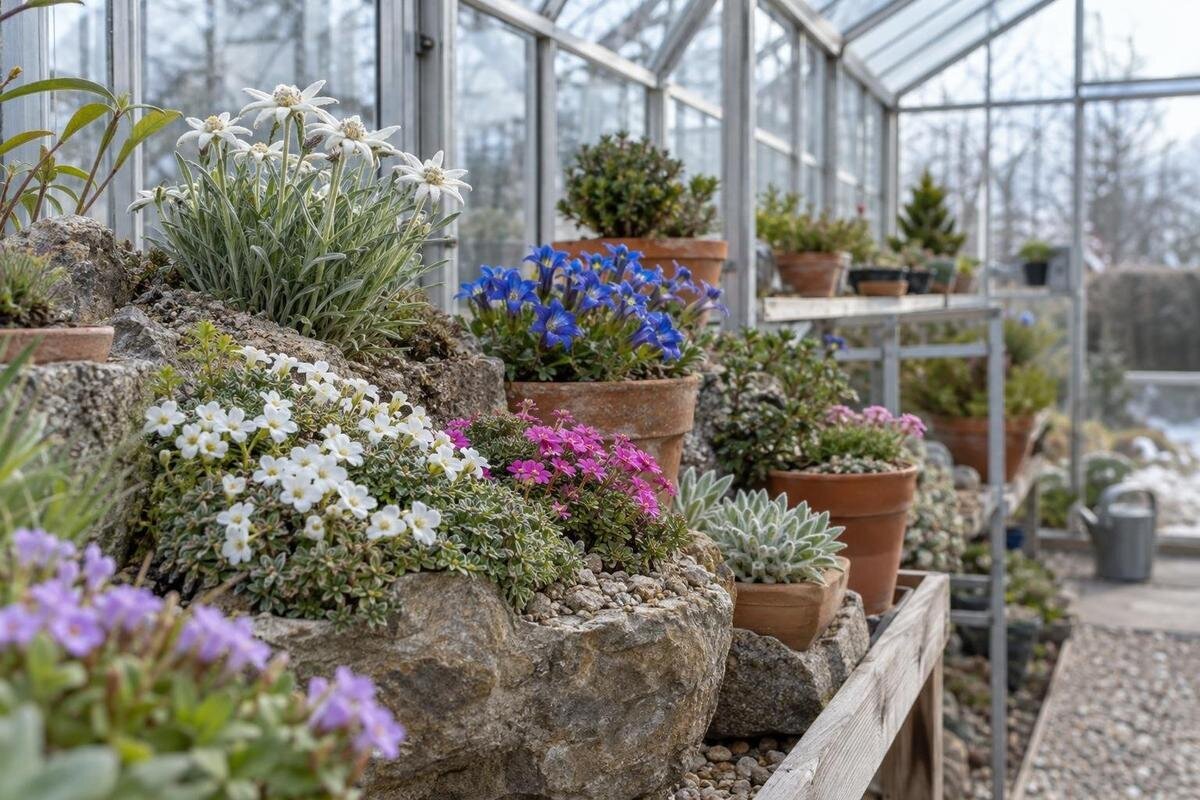
Sempervivum tectorum, the common houseleek, is a hardy, sun-loving plant commonly grown outdoors in sharply drained conditions; it does not need greenhouse warmth. Some cushion saxifrages in the Kabschia group are sheltered under glass to reduce prolonged winter rain on their crowns, while still being kept bright, cool and airy. Leontopodium alpinum, or edelweiss, is another sun-loving, free-draining alpine that can suit an outdoor rock garden where conditions match. These are examples rather than a universal planting scheme: check the needs of the actual species or cultivar and give groups with different watering requirements separate positions.
Before choosing a greenhouse 2
Choose a bright site and account for shade
Choose the brightest practical position and check it at more than one time of day. A nearby wall, hedge or deciduous tree can cast a different shadow as the sun moves; winter light is also lower than summer light. Note what happens where benches and shelves will sit, because a sunny roof does not guarantee light at every plant. Avoid deep shade, but do not assume every species wants uninterrupted direct sun. Some tolerate or prefer partial shade, and strong sun can drive a small greenhouse temperature sharply upwards. Plan any shading as an adjustable response, rather than leaving plants in permanent gloom.
Keep glazing clean enough for light to reach lower benches, and avoid placing taller plants where they shade small cushions throughout the day. A simple sketch of the site’s shadows can help compare possible positions before the structure is installed. A lean-to location can use space beside a building, but the wall may shade it or affect air movement at openings. The Lean-to Greenhouses listing shows floor areas from 3.69 m² to 14.34 m²; compare the footprint with the site, then confirm the light and opening arrangement for the chosen configuration.
Keep persistent rain off without letting roots dry out
A greenhouse keeps off only the rain that its covering intercepts. Wind-driven showers can enter through open doors or vents, while water may splash in from hard paths or nearby surfaces. Watch what happens during a storm to identify positions exposed to spray, and move vulnerable pots away from those areas. Do not block vents or shut the house simply to keep every drop out, as stagnant air creates another problem. Check conditions during windy weather as well as calm showers. Rain shelter reduces prolonged soaking; it does not guarantee dry plants or dry ground.
Once direct rain is excluded, containers may dry sooner than outdoor beds, so judge each pot rather than following a fixed calendar. Check below the surface as well as the top; water needs vary with root growth, container size, growing medium and weather. Let excess water escape through unobstructed drainage holes, and remove standing water from trays where the species is not meant to sit in it. For plants sensitive to wet crowns, direct water to the medium rather than routinely wetting the rosette. Aim for suitable root moisture without prolonged waterlogging, not uniformly dry pots.

Before choosing a greenhouse 3
Match drainage and containers to each plant
Use a growing medium that holds enough moisture for the individual plant but drains freely after watering. A mix with mineral grit or another coarse aggregate may suit many rock-dwelling alpines, but the right balance depends on the species, pot depth and root structure. Fine, moisture-retentive compost behaves differently from an open mix; neither is automatically right for the whole collection. Check whether a plant needs a more acidic or alkaline medium before settling on a recipe. A larger, deeper pot may stay moist longer than a shallow tray, so judge the root zone rather than the surface alone.
Choose pots with clear drainage holes and keep them out of runoff; raising a pot slightly can help its base drain if the bench allows. Group containers by similar watering needs, but leave enough room to lift one out and inspect it. If you use a gravel top dressing, keep the crown visible and make sure you can still check the compost below it. The Aluminium Greenhouses listing gives floor areas from 3.77 m² to 28.08 m². Compare the footprint with the room needed around containers, for watering, drainage and access.
Build ventilation into the plan
Ventilation is needed on cool days as well as during sunny spells; it is not just a way to prevent obvious overheating. Warm air rises, so a high-level opening can let it out while a lower door or vent supplies replacement air, depending on the greenhouse design. Openings that can be used together give more control than relying on a single doorway, but performance depends on their size, position and outside conditions. Check the number and location of vents and how they are operated. If openings are high, consider how you will reach them safely. Do not assume a tall shape or large floor area guarantees useful air movement.
Fresh air helps limit stagnant, persistently damp pockets around foliage, but it cannot correct waterlogged compost or poor spacing. Keep vents usable after benches and plants are in place, and do not stack trays in the path of moving air. On a cool, wet day, some ventilation may still be needed; in a drying wind, reduce exposure if pots dry too quickly. Adjust the openings by observing the plants and conditions inside, rather than sealing the house whenever it is cold. The Bloomcabin Prestige Greenhouse listing spans 3.77 m² to 28.08 m²; compare the area, then check vent details for the chosen configuration.
Before choosing a greenhouse 4
Monitor temperature through summer and winter
Greenhouse temperatures can change quickly when sunlight reaches the glazing, even if outdoor air still feels cool. Use a maximum–minimum thermometer near the plants, out of direct sun and away from hot glazing, to record the local air temperature. A reading by the door may not represent a shelf at the far end, and benches at different heights can experience different conditions. Keep notes on warm afternoons, overnight lows and how plants respond. You can then judge changes to ventilation or shading against actual observations, rather than relying on how the house feels. There is no single ideal setting for every alpine, so use species-specific guidance before setting temperature targets.
Winter care is equally individual. Some alpines need a cool dormant period, while others require protection from particular cold or wet conditions; altitude alone does not establish how a plant will fare in a garden greenhouse. Do not assume an unheated structure will stay frost-free, and avoid warming the whole collection when many plants are adapted to cool conditions. If a species needs protection, confirm its requirements and plan for that group separately. The Spacious Greenhouse listing gives floor areas from 47 m² to 70 m². A larger area may allow distinct groups, but floor area alone says nothing about temperature or ventilation.
Plan floor area, working height and benches
Measure the usable interior as well as the outside footprint. Draw in benches, shelves, door access, a working aisle and the position of vents; check that a plant can be reached without lifting several others first. Small alpines are easy to place on a high shelf, but that shelf can shade plants below and may be awkward to water. Consider a comfortable working height and whether high openings can be operated safely from where you stand. Leave flexibility for seasonal trays or plants that need to be moved, rather than allocating every available space to permanent staging.
Plan groups by the care they share: plants that need similar watering can be kept together, while a drier group can occupy a separate bench or position. Do not crowd foliage simply to maximise the pot count; it makes inspection and air movement harder, and leaves less room to remove an individual plant. The T-Shaped Orangery Greenhouse listing shows floor areas from 16.52 m² to 30 m². Compare the listed size with your drawn layout, then check the actual internal measurements and openings; the product name does not specify how your benches should be arranged.

Before choosing a greenhouse 5
Check the site and greenhouse form together
Select the position for the conditions around it, not just the clearest patch of lawn. Check shade from buildings and trees, exposure to wind, access for carrying pots and whether water collects near the proposed base. A sheltered corner can be darker or less ventilated, while an open position may have more light and stronger wind exposure. Leave room to open doors and carry out routine cleaning. Consider where runoff will go so it does not create a persistently wet patch beside sensitive plants. For base, anchoring and other site-specific construction questions, follow the supplier’s instructions and seek qualified help where needed.
Consider the greenhouse form in relation to that site. A structure beside a wall can experience shade and altered airflow; a freestanding form needs enough clear space around it for access and maintenance. Compare the plan for the exact model, including its full external dimensions, door position and available openings, not just a headline floor area. The Pyramid Greenhouse listing gives a range from 5.53 m² to 18.9 m²; use that as a footprint comparison, then verify the selected configuration against the space and exposure you have. A product name or outline does not prove a particular growing climate.
Keep seasonal records and allow space for care
Make checks part of ordinary care, especially after prolonged wet weather and during bright spells. Look at the compost below the surface, check that pot drainage holes and any drainage channels are clear, and notice whether air moves freely around each group. Record plant names, positions and changes in growth or flowering alongside temperature and watering notes. If a plant repeatedly stays wet or shows stress, compare its conditions with its species-specific needs; changing several factors at once makes it harder to see what helped. Keep glazing clear enough to admit light and remove fallen plant material so it does not accumulate around pots.
Reserve bright growing space for plants, not boxes of labels and spare pots. Keep a working area for potting and dry storage for tools, while checking that these do not block a vent or reduce room to reach the benches. The Limited-Edition Aluminium Greenhouses with Storage listing covers 5.52 m² to 28.08 m² and identifies a storage option. Compare the growing and access space in the chosen layout rather than counting the whole footprint as plant area. A simple plant register also helps distinguish long-term requirements from a short response to one unusual spell of weather.
Frequently asked questions
Does every alpine plant need a greenhouse?
No. Many hardy alpines grow outdoors when the site and soil suit them. A greenhouse is most useful for plants that benefit from shelter from prolonged rain or for collections that need different growing conditions kept separate.
Should an alpine greenhouse be heated?
Not by default. Many alpines need cool conditions, and a greenhouse can warm up quickly in sunshine. Check the winter requirements of each species before deciding whether any particular group needs extra protection.
How much sunlight should an alpine greenhouse get?
Choose a bright position, but do not assume every plant needs uninterrupted direct sun. Light preferences vary, and strong sun can raise the temperature inside. Check both the site’s seasonal shade and how plants respond.
Does rain shelter remove the need for watering?
No. Covered pots may receive little direct rain, but roots still need moisture suited to their species. Check the growing medium below the surface and let surplus water drain away rather than following a fixed watering calendar.
What ventilation should I check when choosing a greenhouse?
Look at the position and operation of the openings, and whether they can provide a useful route for air through the space. Check the details for the exact configuration; floor area or the greenhouse’s name alone does not show how it will ventilate.
A useful alpine greenhouse is defined by the conditions it provides: shelter from prolonged rain where needed, bright light, a free-draining growing medium and adjustable ventilation. Those features work best when plants are grouped by their actual requirements, rather than treated as one crop. Keep robust species outdoors where they thrive and reserve covered space for plants that benefit from it. The result is a cool, manageable growing area, not a warm greenhouse by default.
