
Aluminium or Timber Pergola | Which Material Is Best?
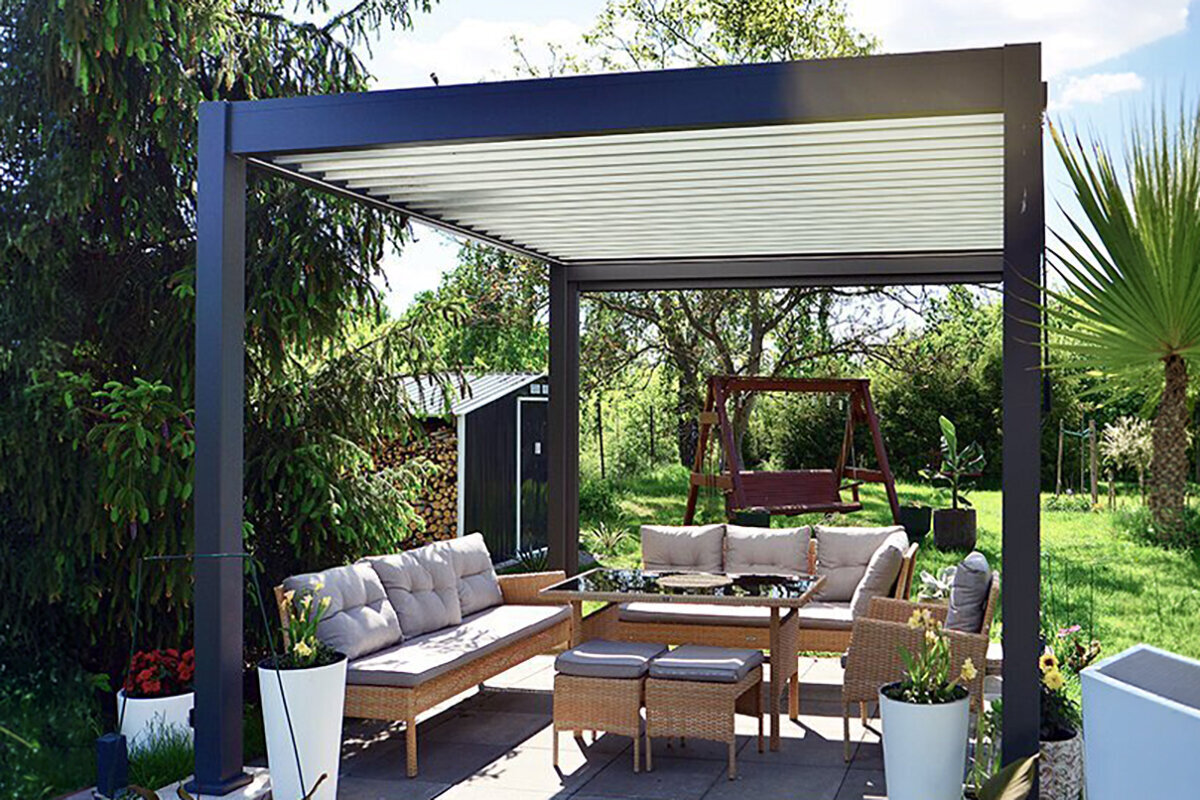
Ireland • Choosing pergola materials • Bloomcabin Journal
Aluminium or Timber Pergola
How do timber and aluminium compare for longevity, care, appearance, Irish weather, cost and contemporary patio use?
Putting both materials in perspective
A convincing argument for aluminium should first give timber proper credit for its strengths.
Wooden pergolas can be striking. No metal coating fully reproduces natural grain, tonal variation or the feel of timber. Carpenters and capable DIY builders can saw, drill and modify it on site, while its familiar appearance often complements cottages, traditional houses and buildings where wood already defines the architecture.
Aluminium answers a different need. It neither absorbs atmospheric moisture nor undergoes wood’s related swelling and shrinkage. Rot and wood-boring pests do not consume it. Extruded sections can support the structure, channel water, conceal cables and provide mountings for moving louvres within a single profile.
The useful question is not which material wins in every case, but which one fits your intended use, preferred appearance and willingness to maintain the pergola over the years ahead.
For purpose-designed outdoor living, compare Bloomcabin Aluminium Pergola with Bioclimatic Aluminium Pergola or the attached Lean-To Pergola.
01 • Decision overview
Timber and aluminium pergolas compared at a glance
| Category | Aluminium | Timber | Advantage |
|---|---|---|---|
| Routine care | Wash surfaces; examine fasteners and drainage routes | Inspection and finish renewal vary with species and surface treatment | Aluminium |
| Decay and pests | Cannot rot; termites and decay fungi cannot consume it | Service life reflects species, protection, damp exposure and construction details | Aluminium |
| Movement caused by moisture | Humidity is not absorbed, so it does not produce swelling | Hygroscopic; moisture variation changes dimensions. | Aluminium |
| Material character | Controlled lines and a uniform architectural surface | Genuine texture, grain and visual warmth | Timber |
| Changes during a DIY build | Coordinated components; alterations must respect the system design | Readily sawn, drilled and shaped during site work | Timber |
| Adjustable bioclimatic louvres | A natural fit for accurate moving assemblies | Achievable, though uncommon in intricate weather-sealed mechanisms | Aluminium |
| Concealed water management | Rainwater routes can be formed within profiles and posts | More often uses separately fitted gutters and outlets | Aluminium |
| Heat at the surface | A dark finish may grow hot under strong sunshine | Often feels less warm to the hand | Timber |
02 • Life outdoors
Why aluminium simplifies ownership in year-round outdoor exposure
Builders have relied on aluminium for many years because it combines useful structural performance, corrosion resistance and accurate forming. Contact with air creates a protective oxide film on the metal. An anodised or powder-coated finish can then add another protective layer while providing a chosen colour and appearance.
Aluminium still needs attention. Wash off salt, dirt, leaves and airborne deposits, then inspect coatings, fixings and drainage regularly. Its principal advantage is that the metal frame needs no defence against biological rot.
Ireland’s Atlantic setting commonly means cool, windy winters and mild summers, although coastal, inland and sheltered sites differ. Aluminium removes one long-term risk—decay within the frame—yet good detailing remains essential. For aluminium, compare the coating, water paths, screws and separation between unlike metals. With timber, scrutinise end grain, horizontal ledges, post bases and poorly ventilated joints. Either material lasts better when water drains quickly instead of pooling; in wood, flawed detailing more directly raises moisture within the structural member.
03 • Humidity and dimensional stability
Why timber’s hygroscopic nature matters outdoors
Timber absorbs moisture from nearby air and later dries, changing its dimensions in the process. Correct seasoning, suitable species, coatings and protective detailing limit movement, yet the material will always retain this basic response.
Seasonal conditions can therefore make outdoor members shrink, swell, crack or warp. Good timber design anticipates those shifts and eliminates water traps. This behaviour is a normal property of wood, not a fault in an otherwise suitable component.
Aluminium also changes length, expanding as it warms and contracting when cold, so competent systems allow for thermal movement. Its difference from wood is that atmospheric moisture does not create an additional cycle of swelling and shrinkage.
04 • Fungal decay, rot and insects
The clearest practical distinction between the frame materials
Correctly selected and detailed wood can provide a very long service life. Where members are often wet or stay damp, however, greater demands fall on inherent durability, impregnation, finishes and construction that keeps rain away.
Longer timber life is supported by an appropriate durable species, suitable protection, unrestricted run-off, stainless-steel connections and clearance from surfaces that remain damp.
Aluminium neither rots nor feeds fungi or wood-damaging insects. Coatings, seals, fixings and accessories continue to need care, but biological agents do not consume the profiles carrying the load.
The outcome: For avoiding insect attack and biological decay, aluminium holds the decisive material advantage.
05 • Ongoing care
How do the maintenance routines differ?
Caring for aluminium
Wash the frame, examine it and keep rainwater moving.
Rinse away grime, pollen and salty residue.
Examine seals and connection points periodically.
Keep gutters, downpipes and movable louvres unobstructed.
Caring for timber
Clean and inspect it, refreshing its protective finish when required.
Inspect cracks, junctions and details where water lingers.
Maintain stain, paint or protection as product and exposure require.
Repair breaks in the finish promptly.
Weather and UV visibly change exposed wood, affecting colour, roughness and surface checking. Some owners appreciate this patina. Those who want a more consistent finish over many years will usually find coated aluminium easier to keep that way.
06 • Visual character
The qualities that belong to genuine timber
Powder coating cannot reproduce real wood. Solid timber has grain, knots, tonal variety and tactile warmth; it ages visibly and accepts sanding, stain, paint and traditional carpentry. For an Irish cottage, conventional house or timber-led garden, a wooden pergola may therefore be the most coherent visual choice.
Heavy beams, exposed rafters, decorative braces and generous climbing plants often look at home on a wooden frame. The house itself should guide the selection. Slim aluminium can sit comfortably beside large glazed areas, exposed concrete and dark window frames. By contrast, timber may better suit traditional woodwork, period character or an intentionally rustic garden. Judge either material not only on technical merit, but alongside the façade, terrace, furniture and planting that will surround it.
Aluminium’s design language
Orderly proportions, even colour and architectural clarity.
Choose aluminium where slender lines, crisp joints, consistent colour and a deliberately modern overall effect matter most.
07 • Integrated design
Why adjustable-roof pergolas are so often built from aluminium
A traditional open timber pergola is mechanically simple: posts, beams and rafters make shade. A modern bioclimatic version coordinates adjustable louvres, a motor, internal gutters, drainage through posts, screens, optional sliding glazing and channels for LED lighting.
Extrusion is what gives aluminium this advantage. Complex profile shapes can carry loads, receive louvre pivots, hide wiring and direct water simultaneously. A quality section is therefore more than a decorative metal beam: channels for gaskets, screws, cables, drainage and accessories may be designed into it from the outset. Glass panels, blinds or lighting can then be added far more cleanly than through improvised retrofitting. This integration can decide the material choice when a pergola is expected to function as extra living space, not simply support climbing plants.
When active roof control is central
For this role, the Bloomcabin Bioclimatic Aluminium Pergola is designed around adjustable louvres and built-in comfort.
If you prefer a simpler freestanding structure, consider the classic Bloomcabin Pergola instead.
08 • Comparing costs
Is a timber or aluminium pergola more expensive?
There is no honest universal answer. A basic pressure-treated timber pergola differs greatly from bespoke work in premium wood, just as a static aluminium frame differs from a motorised bioclimatic installation with louvres, drainage and glass. Assembly method affects total cost too. Provided dimensions and foundations are right, an engineered kit offers a planned installation; custom carpentry allows more freedom but usually demands more work on site.
Timber may provide the lowest starting point
A simple DIY timber frame may be among the cheapest ways to form an open canopy.
Aluminium may reduce work during ownership
When assessing completed premium systems, include finish renewal, repair needs, care time, rainwater management, roof operation and accessories alongside the initial frame price.
See practical dimensions and layouts in the local Bloomcabin pergola size guide.
09 • Assembly, alterations and repairs
Timber welcomes adjustments at the property; aluminium rewards careful advance planning.
Timber gives carpenters and experienced DIY builders genuine flexibility. Beams can be trimmed, brackets added and details altered on site with ordinary tools. A damaged piece may often be exchanged individually.
An aluminium pergola depends on profiles, roof parts, gutters, brackets and fixing points engineered to work together. Less improvisation is needed, but structural sections must not be cut or drilled arbitrarily.
10 • What the roof must achieve
Roof function should guide the material choice
Timber competes strongly where the goal is an open structure for climbers and shade. Its straightforward roof can be tailored closely to the architecture and plants.
Once the pergola must actively control sun and rain, the challenge changes. Adjustable louvres require exact axles, seals, mechanisms and drainage that remain aligned through repeated cycles.
This is why aluminium dominates premium bioclimatic systems. Also read the Bloomcabin guide to bioclimatic and classic pergolas.
11 • Surfaces warmed by sunshine
How hot can an aluminium frame feel?
Yes. Dark, powder-coated aluminium can get very hot in direct sun because the metal conducts heat readily. Timber conducts much less and commonly feels cooler under the hand.
A hot frame does not necessarily mean hotter seating beneath it. Shade, airflow, roof shape and solar angle matter more. Bioclimatic louvres can be positioned to block direct sun without closing off ventilation.
12 • Fire performance
A metal frame should never be confused with a fireproof pergola
Wood is combustible; its fire performance depends on ignition, charring, section size and, where present, protective treatment. Aluminium contributes no timber fuel but can lose strength at high temperatures. Coatings, motors, cables, screens and furniture may also burn.
Calling an aluminium pergola “fireproof” is therefore wrong. Only the frame lacks wood fuel; fire safety and appropriate separation still require project-specific assessment.
13 • Environmental considerations
Can either frame material claim an overall environmental lead?
A responsible conclusion needs product-level life-cycle information. Timber from well-managed sources is renewable and retains biogenic carbon during use. Suitable sourcing combined with a long working life can make that a meaningful benefit.
Aluminium has another circular strength: it is readily recyclable, retains substantial material value and uses only a fraction of primary-production energy when recycled.
Compare the actual wood species, certification and treatment with the aluminium’s recycled content and coating, then consider expected service life and end-of-life recovery. Broad environmental labels reveal little without product data. A manufacturing-intensive material may still make sense if it lasts and is recovered effectively; responsibly sourced timber can be equally persuasive when maintained for long use. The sounder approach is to assess the particular pergola—wood species or aluminium alloy, surface system, repairability and expected years of service—instead of assuming either material name guarantees the greener result.
14 • Irish climate
Choosing a frame for local exposure
Rain, humidity and dryingIreland’s Atlantic influence varies by location, strongest near the coast, while inland frost can occur even in spring. Timber needs quick-draining, fast-drying details and suitable durability. Aluminium removes rot risk from the frame, not the need for drainage and care.
Salt near exposed coastsCoastal salt calls for regular aluminium cleaning and a sound coating. Timber also needs compatible fixings and careful detailing. Exposure by the sea raises maintenance demands for both.
Periods of strong sunshineDark aluminium heats in sun; UV and weather visibly age timber. Adjustable louvres can help manage shade when solar exposure is high.
Frost, wind and occasional snowMaterial alone does not decide snow or wind capacity. Engineering, spans, roof angle, anchoring, foundations and local design loads all require assessment for the site.
15 • Choosing honestly
Situations that favour timber or aluminium
Timber may suit you when …
natural timber appearance is your first priority.
heavy beams and traditional carpentry details are wanted.
the build requires extensive adjustment or fabrication at the site.
scheduled inspection and renewal of the finish are acceptable.
an appropriate, durable and responsibly certified species is available.
Aluminium may suit you when …
low frame maintenance matters.
clean modern lines suit the property.
the design includes movable louvres or bioclimatic roof control.
water channels, lighting, glazing or screens require tidy integration.
you value components developed together as one factory system.
16 • Bloomcabin’s view
Why our completed premium pergolas use aluminium
Bloomcabin sells aluminium pergolas, so our commercial preference is open. That does not make timber a poor construction material. Rather, today’s pergola has evolved from simple shade into a technically integrated exterior space.
Aluminium becomes the natural platform when adjustable roof control, internal drainage, concealed joints, consistent colour, slim profiles, glazing and screens are priorities. It also removes timber’s moisture movement, biological decay and recurring refinishing of the supporting frame.
For these reasons, we recommend aluminium for most ready-engineered premium pergola projects.
See Bloomcabin’s Bioclimatic Aluminium Pergola17 • Common questions
Questions about timber and aluminium pergolas
Can aluminium pergolas rust?
Aluminium does not rust like iron; it forms a protective oxide layer. Corrosion can still arise from salt, chemicals, coating damage or poor contact between metals, so detailing and cleaning matter.
Can timber provide many years of use?
Yes. An appropriate species, suitable treatment, efficient rainwater run-off, compatible hardware and consistent care can keep a wooden pergola serviceable for a long period.
Why is aluminium commonly chosen for bioclimatic roofs?
Its accurately formed sections can coordinate moving louvres with concealed water routes and other equipment. For more detail, read the Bloomcabin pergola systems comparison.
Which frame is more accommodating when plans change?
Timber is easier to alter during site work. Aluminium suits factory-planned louvres, drainage, lights, screens and glazing.
What works next to the house?
Either can work. For a modern patio structure attached to the house, see the Bloomcabin Lean-To Pergola and our comparison of wall-attached and freestanding pergolas.
What deserves attention before ordering?
Check structure, foundations, drainage, roof system, finish, accessories, plus local wind and snow loads. The Bloomcabin pergola foundation guide offers a useful starting checklist.
Technical references and further reading
- Thünen Institute — Wood–water interaction research
- Thünen Institute — Timber research
- DIN Media — CEN/TS 16818 on timber durability and moisture dynamics
- European Aluminium — Material overview
- European Aluminium — Uses of aluminium
This guide compares typical pergola materials, not guaranteed product performance. Results vary with alloy or wood, protection, fixings, design, exposure, installation and care. Check planning, building control, foundations and site loads for an Irish project.
