
Compost in Greenhouse Beds Without Overfeeding Crops
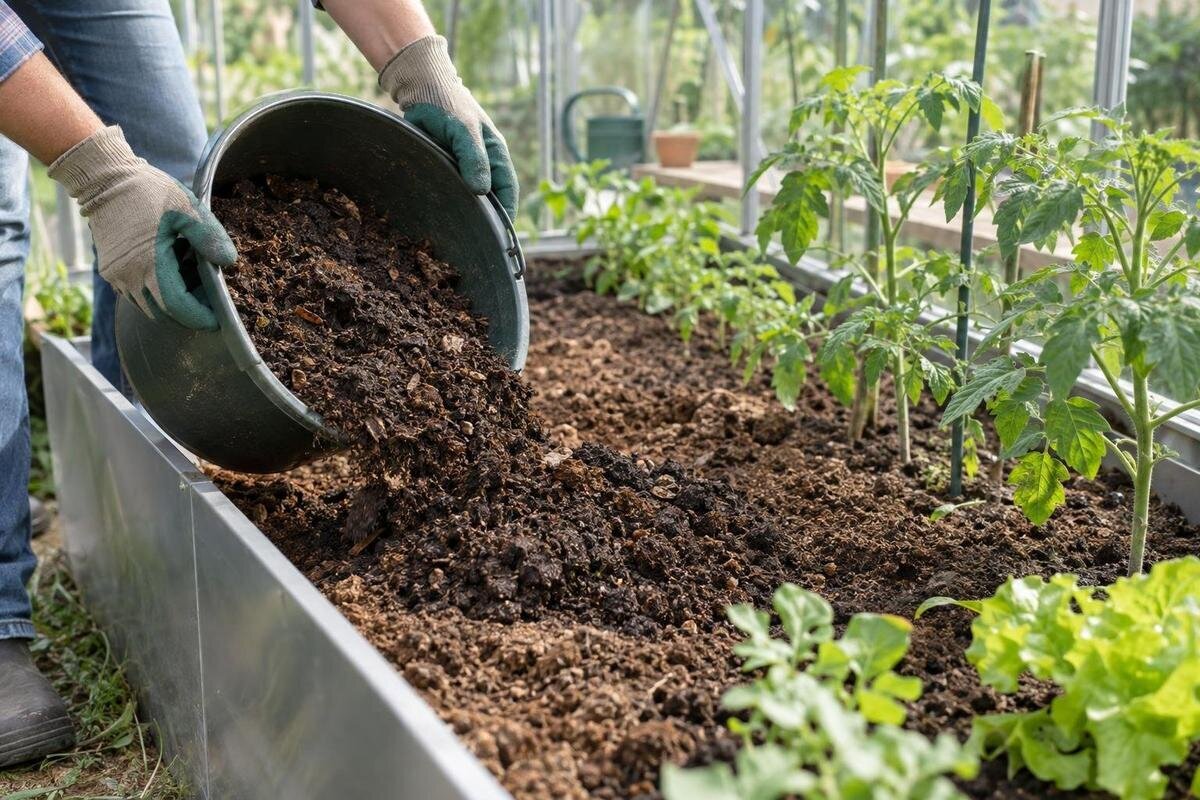
Greenhouse soil care
Compost is often added to greenhouse beds because it is familiar and easy to spread, but it is not a nutrient-free way to refresh soil. In a covered growing space, crop removal, irrigation and the material already present all influence what happens after each addition. A generous layer can supply useful organic matter and still push nutrient or salt levels beyond what a bed needs. This guide focuses on judging maturity, reading compost and soil information, and working out an amount for the actual bed rather than setting a blanket fertiliser routine.

Why greenhouse beds can accumulate nutrients
Compost is not a nutrient-free soil conditioner. It adds organic matter and brings nutrients and soluble salts; the amounts depend on feedstock, processing and moisture. A bed can gain useful organic matter while also receiving more phosphorus, potassium or nitrogen than its crops will use. Repeated additions of similar material create a cumulative input, even when each dressing seems modest. The useful question is not whether compost is generally good, but whether this bed needs it and what the next batch will contribute. The same compost may suit one bed and be excessive in another with a different input history.
A greenhouse roof limits direct rainfall on the soil, so do not assume outdoor and covered beds lose nutrients in the same way. Irrigation, drainage, plant uptake and evaporation still move or concentrate soluble material: a greenhouse is not a closed system, and accumulation is not automatic. The Bloomcabin Prestige Greenhouse is listed from 3.77 m² to 28.08 m², but that model area range is not the surface of soil receiving compost. Work from the actual beds inside the chosen structure, then use tests and crop guidance to decide whether to add anything. The distinction matters when beds occupy only part of the growing space, so a greenhouse-wide schedule is a poor substitute for measuring them.
Measure the bed area before estimating compost
Measure only the surface that will receive compost. For each rectangular bed, multiply its inside length by its width; a 4 m by 1 m bed is 4 m². Split an irregular bed into simple rectangles and add their areas. If you are filling or topping up a raised bed, use the inside dimensions of the growing area, not its outside walls. Exclude paths, benches, potting areas and empty gaps. Calculate containers separately because they have a finite volume and may use a different growing medium. Write measurements down in metres before ordering; small errors multiplied across several beds can change the total.
Keep each bed’s measurement before adding areas together: two beds may have different crop histories or need different inputs. The Spacious Greenhouse is listed in sizes from 47 to 70 m², but the selected structure’s stated area does not show which parts will be beds, access or storage. Draw the intended layout and label each area by growing system. Add together only the beds that will receive the same compost at the same rate. If only one section needs an amendment, order for that section rather than applying a greenhouse-wide layer. If the beds are not built yet, use intended internal dimensions and revisit the quantity when the layout is fixed.
Test the existing soil before topping up
Before adding anything, reconstruct the bed’s recent history: compost, manure, fertiliser, other nutrient products, imported topsoil and crops grown over recent seasons. These inputs affect what a soil test may show. A bed that appears tired can have a structural or watering issue instead of a nutrient shortage, so appearance alone is not a reason to add more. A laboratory test can assess pH and nutrients; an electrical conductivity (EC) result can indicate soluble salts. Ask which tests are included and how to interpret them for the crop and growing medium, because methods differ. A pH reading alone does not describe overall fertility. Keep earlier reports if available so you can compare trends rather than relying on one result.
Take a representative sample as the laboratory directs, using several small samples from the same reasonably uniform bed rather than one handful from a convenient corner. Follow the lab’s instructions on sampling depth and handling. Keep beds separate when they have had different inputs, supported different crops or contain different media; do not combine them just to save a sample. Leave out a fertiliser spill or the edge of a drip outlet when testing the average bed, but submit an unusual patch separately if that is the question. When planning permanent beds in an Aluminium Classic Greenhouse, mark these sampling areas on the layout so each result can be matched to the right bed.
Check compost maturity, not just appearance
Maturity and nutrient strength are separate questions. Maturity describes how far decomposition has progressed, while stability refers to how little readily decomposable material remains; suppliers may use those words differently. Ask for the compost’s feedstocks and any maturity or stability information, especially if it will go near young plants. Well-finished compost often has a settled, earthy smell and no obvious fresh ingredients, but those are clues rather than proof. Dark colour or a fine texture by themselves do not show whether the material is stable or suitable for a particular bed. A supplier can explain what evidence supports its maturity claim and whether it applies to the current batch.
Immature material can continue decomposing after it is spread. Microbes may temporarily use nitrogen already in the soil while breaking down carbon-rich matter, and unfinished compost may contain compounds unsuitable around germinating seed or sensitive roots. The effect varies with the compost and how it is used, so material that is still changing is a poor choice as a substantial part of the root medium. For homemade compost, keep track of what went in and allow the batch to finish; age, warmth or crumbliness alone cannot confirm maturity. If it heats again after turning or has an ammonia or sour odour, check further; the absence of those signs does not prove it is mature. A visually finished batch may still contain substantial nutrients, so maturity does not answer how much to apply.

Read the compost analysis by nutrient and unit
Read the analysis as a description of a batch, not as a ready-made dose. Look for nitrogen, phosphorus and potassium, pH, electrical conductivity, moisture and organic matter where available, and note whether results are reported as received or on a dry-matter basis. Reports may express phosphorus and potassium as elements or as oxide equivalents, so compare like with like rather than treating the numbers as interchangeable. EC indicates soluble salts under a specified test method; it does not identify every salt or, by itself, establish crop suitability. Ask for units and the test method if they are missing. Check whether the analysis applies to the whole product or to a tested sample from a named batch.
Total nutrient content is not the same as the amount a plant can use immediately. Nitrogen in compost is released over time, and the fraction available depends on the material and bed conditions; phosphorus and potassium may remain after one crop. A report from a similar-looking product may not describe a different batch, particularly when feedstocks and moisture differ. Use current batch information where possible and ask the supplier or laboratory how the figures translate into an application rate for your crop. If no interpretation is available, do not turn a nutrient percentage into a guessed rate or assume that a compost is low in nutrients because it is organic. This matters especially when a product is sold by volume but the analysis is given by weight.
Match compost to the crop and growing medium
Different crops remove nutrients at different rates and can be sensitive at different stages. Seedlings, newly planted crops and established fruiting crops do not all call for the same treatment, and the phrase heavy feeder is not enough to justify a blanket extra layer. Use crop-specific horticultural guidance alongside the bed test. If the test already shows high phosphorus or salts, adding compost to meet an assumed nitrogen need may increase nutrients the bed does not need. Consider soil structure and nutrient supply as separate questions: a bed can need more organic matter without needing a nutrient-rich compost. Nutrient demand also depends on harvest frequency and what is removed from the bed, not just the crop’s name.
Treat permanent soil beds, raised beds, pots and grow bags as separate growing systems in your plan. A container has a limited volume and a different water and drainage pattern from an open bed, so an open-bed compost rate cannot simply be transferred to it. When planning the growing space in an aluminium lean-to greenhouse, identify which areas will contain soil beds and which will hold containers. Measure each separately and follow guidance for the relevant medium. A soil test from one bed does not describe a potting mix, even when both support the same crop.
Convert the recommendation into a measured amount
Once a suitable rate has been given for your crop and compost, apply it only to the area it covers. For a rate stated in kilograms per square metre, multiply by the measured bed area in square metres; if it is in grams per square metre, keep the units consistent before converting. If advice specifies a layer depth, litres equal bed area in square metres multiplied by depth in centimetres and then by 10. For example, a purely illustrative 2 cm layer over 3.5 m² is 70 litres. That calculation only converts depth to volume; it does not recommend a 2 cm layer. Use the rate that matches the actual bed and material.
Do not convert nutrient percentages straight into buckets or barrow loads. To estimate a nutrient contribution from a concentration, you need the correct mass basis, moisture content and, for volume measures, bulk density; you also need to know what fraction becomes available to crops. Use the laboratory or supplier’s interpretation rather than assuming that one tub always weighs the same. For a proposed layout in a Limited Edition Aluminium Greenhouse, calculate the amount from the measured beds and the recommended rate before deciding how much to order. If advice uses a different unit, ask for a conversion rather than mixing units yourself.
Apply compost only to the beds that need it
Decide whether compost is needed as a surface amendment or as part of bed preparation; these are different jobs. In an established bed, mature compost may be placed on the surface where crop guidance permits, while incorporation can disturb roots or soil structure. In a newly prepared bed, mixing instructions depend on the growing system and the compost analysis. A no-dig bed, raised box and planted bed should not automatically receive the same treatment. Follow advice for the chosen system rather than burying material simply because it has been delivered. Where plants are already growing, take care not to disturb roots or cover plant crowns.
Spread the recommended amount evenly across only the mapped bed. Avoid piling material against stems or crowns, and do not bury low-growing foliage. If two beds have different test results, measure each share separately rather than applying one greenhouse-wide layer. When planning beds for a T-Shaped Orangery Greenhouse, label their boundaries and intended crops on the layout so any compost recommendation can be assigned to a specific bed. Record what was applied to each zone, including the quantity and date, so you can interpret later test results in light of those additions.

Use water and salt readings to guide follow-up
EC and irrigation are worth considering before trying to correct a bed with more compost. Water evaporates from the surface and crops take up some nutrients, while irrigation can also move soluble salts through soil if drainage allows. Neither outcome can be assumed: a poorly drained bed may retain salts, while excessive watering can carry nutrients away and disturb roots. Irrigation water itself may contribute salts or affect pH. A high EC result therefore needs context from the compost, soil, water and drainage, rather than an automatic instruction to flush the bed. The same reading can have different causes in different growing systems.
Use a suitable soil test and, if indicated, an irrigation-water test to identify the likely source; a pale crust or plant stress alone does not prove compost is to blame. Avoid adding more compost as a general remedy for a reading that has not been interpreted. On a layout for a Pyramid Greenhouse or another model, mark irrigation zones and any observed drainage differences alongside the beds. These notes help you compare results from the same locations over time. If a result is unclear, ask the testing laboratory how to interpret it before changing the compost routine.
Keep a compost record and retest
Keep one record per bed or clearly defined zone: compost source and batch, maturity information, analysis date, quantity, mass or volume unit, treated area, application date and crop. Note other nutrient inputs and unusual irrigation changes too. Recording the volume or weight of each addition makes it possible to compare a routine spring dressing with later test results. For a container or raised bed, record its growing medium and volume separately rather than treating it as the original ground bed. These notes also help identify whether a change followed a new compost batch or a different growing practice.
Retest on a schedule suited to cropping and input history, or sooner if a result, crop response or visible deposit raises a specific question. If nutrients are ample but soil structure needs attention, ask for guidance on an amendment that does not add the same nutrient load instead of increasing compost automatically. Keep a labelled layout with the records, distinguishing planted beds from other areas. For a model such as the Limited-Edition Aluminium Greenhouse with Storage, include the storage area on that plan without counting it as growing space. Review the previous batch and amount alongside the next test rather than repeating the application by habit.
Frequently asked questions
Can I add compost to a greenhouse bed every year?
Not by default. Regular additions can build up nutrients or soluble salts, particularly when the same material is used year after year and rain does not reach the bed. Check the bed’s input history and current soil analysis, then consider the compost analysis and crop guidance. If the bed already has adequate organic matter or high nutrient levels, an annual dressing may add more than the crop needs.
How can I tell whether compost is mature?
Ask the supplier about its feedstocks and any maturity or stability testing. A settled, earthy compost with no obvious fresh ingredients offers useful clues, but colour, smell and age alone cannot confirm maturity. Immature material can continue decomposing and temporarily tie up soil nitrogen, so it may be unsuitable around germinating seed. For homemade compost, keep batch notes and allow the process to finish rather than judging by texture alone.
Which figures should I look for in a compost analysis?
Look for nitrogen, phosphorus and potassium, along with pH, electrical conductivity and moisture content where available. Check whether results are reported as received or on a dry-matter basis, and whether phosphorus and potassium are shown as elements or oxide equivalents. Total nutrient content is not the same as the amount available to plants straight away, so ask the laboratory or supplier how to interpret the figures for your crop.
Can I use compost if it has no nutrient analysis?
You may still be able to use it, but you cannot calculate its nutrient contribution with confidence. Find out what it is made from and whether it is mature, and test the existing bed before adding more. Avoid relying on repeated or substantial applications when the batch’s nutrient strength is unknown. If the bed’s results or the compost information leave you unsure, ask the supplier or a soil laboratory for advice before spreading it.
What if the bed needs organic matter but already has high nutrient levels?
Do not assume that nutrient-rich compost is the right answer. Separate the need to improve soil condition from the need to supply nutrients, and ask a horticultural adviser or laboratory about an amendment that suits both the test results and the crop. Compost varies, so check the analysis rather than treating all products as equivalent. Keep the test report and any advice with your bed records so future additions can be based on the same evidence.
A measured amount of mature compost can be useful, but a greenhouse bed does not need an automatic annual layer. Let the bed’s history, a representative soil test, the compost batch’s analysis and crop guidance shape the decision. Measuring only the beds to be treated keeps the quantity realistic, while a simple record makes it easier to see whether repeated additions are helping or building up nutrients the crops do not need.
