
Choosing Drip Lines or Soaker Hoses for Greenhouse Beds
Greenhouse watering guide
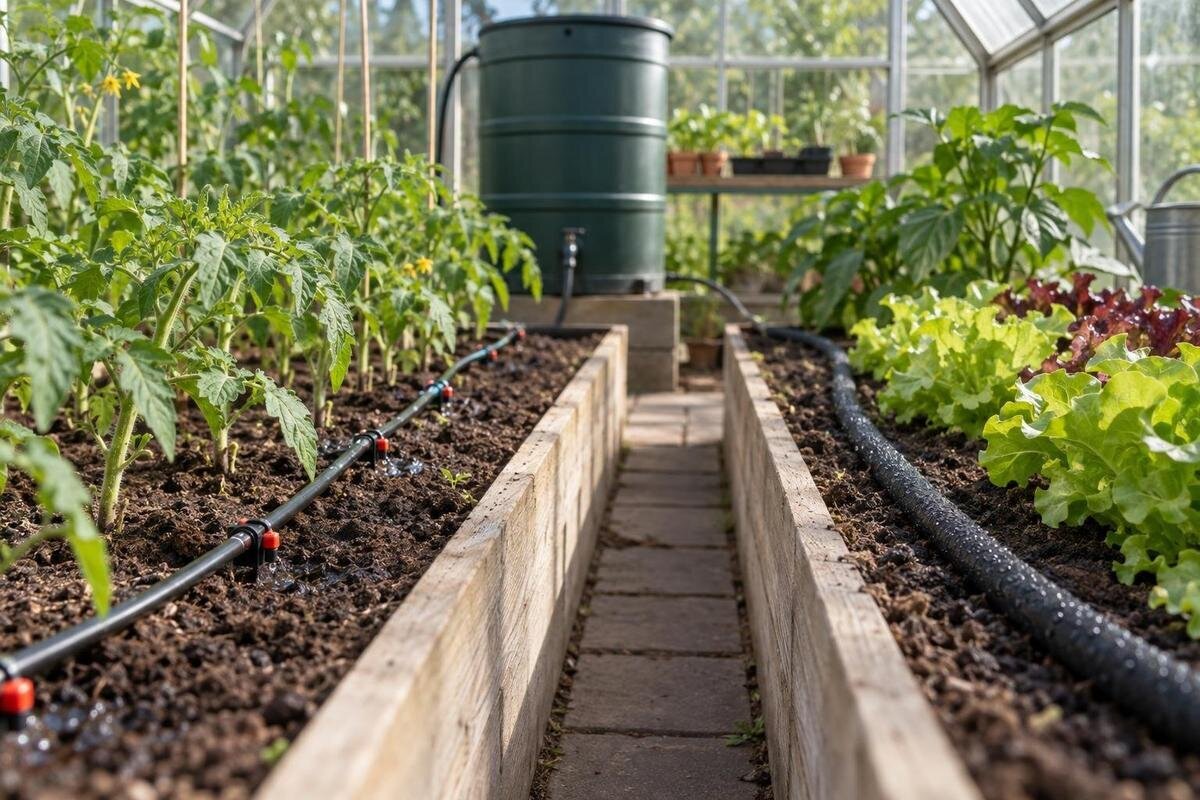
Inside a greenhouse, rainfall does not reliably reach planted beds, so the watering line has to match the bed rather than simply reach it. Drip lines release water at separate emitters; soaker hoses seep along a length. That difference shapes the wetting pattern, pressure and filtration checks, and the way you spot a fault. The better option depends on the crop rows, soil, water supply and the product's stated limits. This guide explains how to judge uniformity and maintenance under your own greenhouse conditions.

How drip lines and soaker hoses deliver water
Drip lines and soaker hoses both bring water to a greenhouse bed at low level, but they distribute it differently. A drip line is tubing with separate emitters, often built into the line; each releases water at a defined point, with spacing and nominal output set by the product. A soaker hose passes water through a porous wall or openings along its length, which can create a continuous wet strip rather than separate wet spots. The pattern still varies with hose construction, pressure and soil. Products within either category differ, so check emitter spacing, stated flow, pressure requirements, filtration guidance and maximum run instead of relying on the name.
Think of drip as a row of outlets and a soaker as a line of seepage, not a promise that the whole bed receives equal moisture. With drip, soil between emitters may remain comparatively dry if water does not spread far enough; with a soaker, ground beside the damp strip can stay drier than the soil directly underneath. Either method can work when its wetting footprint reaches the crop roots. Several rows or varied plant spacing may call for more than one run or a different line position. The useful comparison is how each specific product wets your soil, not whether one label sounds more thorough. Neither should be chosen by appearance alone.
What affects uniformity along a line?
Even delivery is a system result, not an automatic advantage of either method. With a drip line, compare the stated emitter output at its operating pressure with the pressure available while water is flowing. Friction along the line, a long run, changes in level and several laterals open together can affect what reaches the far end. Some products use pressure-compensating emitters, but only within their stated operating range; that feature cannot make a blocked filter or an overlong run harmless. A soaker hose also has limits set by its construction, recommended pressure, length and feed arrangement. Use the instructions for the particular hose rather than assuming a familiar-looking line behaves like another.
Check the inlet, middle and far end of each run. A wet patch near the supply is not proof that the far end is receiving enough water, and a single dry spot beside a soaker may reflect placement or soil spread rather than a failed hose. Run the system as you expect to use it, with its usual number of lines open; adding more later can alter available flow. If the pattern is uneven, identify the cause before increasing watering time for every bed, as that can leave the near end too wet while the far end still receives too little water.
Match the wetting pattern to soil and crop rows
Soil texture, compaction and bed depth affect how water spreads sideways and downwards. A point emitter may create a narrow wet column in one bed and a wider area in another; the damp strip from a soaker also changes with the soil. Do not assume a single line will cover the full width of a broad raised bed. Map crop rows, root zones and plant spacing, then place the line so water can reach the plants without leaving a persistently dry band at the edge. Direct-sown seed rows can be more sensitive to gaps between emitters at the surface than established transplants with roots already extending into the bed.
Test with the same soil mix and bed depth you intend to grow in, not on a hard floor or in different compost. After a trial, compare moisture at the line, between lines and towards the outer edge at more than one depth; check both ends as well as the centre. When planning beds within the Limited-Edition Aluminium Greenhouses with Storage range, listed from 5.52 m² to 28.08 m², sketch the planted areas and crop rows separately from the overall footprint. Use that sketch to decide where to test line positions and whether one line, different emitter spacing or several soaker runs will cover the root zones. Recheck the pattern as plants grow and their roots spread.
Pressure requirements and maximum line length
A description such as low pressure is not enough to confirm that a line will work with your supply. Look for the product's operating pressure range, flow per emitter, emitter spacing and maximum recommended length. Compare those requirements with the pressure available while water is flowing, not only the reading at a closed tap. If the supply is gravity-fed or comes from a low-pressure tank, check that the specific line is designed for it. If the maker does not publish the information you need, ask before buying rather than assuming that a standard greenhouse supply will suit it.
Measure the route the water will actually take, including branches and turns; the bed's longest dimension is not necessarily the line length. The Bloomcabin Prestige Greenhouse range is listed from 3.77 m² to 28.08 m², but floor area alone cannot establish irrigation pressure or run length. Mark each proposed run on your layout and compare it with the line manufacturer's maximum length and connection instructions. If your plan exceeds a stated limit, ask whether a shorter run, another feed or separate circuits are supported. Do not try to compensate by raising pressure or joining tubing that the manufacturer has not confirmed as compatible.

Filter requirements and water quality
Select filtration from the irrigation line's instructions and the condition of your water source, not from a general rule that every system needs the same filter. Drip emitters can have narrow passages, and suspended particles may obstruct an outlet and leave a plant or section short of water. The product maker may state a filter rating in mesh or microns, or specify a compatible filter. Use that recommendation: a mesh figure without context can mislead, and there is no universal rating for every line. Soaker hoses can also collect sediment or deposits, depending on their construction.
Stored rainwater may carry sediment or organic debris, while other sources have different characteristics; do not assume that clear-looking water needs no attention. Use a filter that is compatible with the line and source, and clean it as directed. A clogged filter can restrict flow across a run, making the fault look like low pressure. If you are planning irrigation for the Spacious Greenhouse range, listed from 47 m² to 70 m², include an accessible filter position in the route to the beds. Choose its rating and capacity from the water source and irrigation product specifications. If either requirement is unclear, ask the irrigation supplier or maker.
Test the wetting pattern in the bed
Before planting, and again after changing a line, carry out a simple output check under the conditions in which it will run. For drip, collect water from emitters near the inlet, around the middle and at the far end over the same interval, using identical small containers. Compare the amounts rather than aiming for a generic target that may not apply to that product. Sample more than one lateral if several feed the bed, and include outlets from different points along each. Follow any test method supplied by the maker. This detects variation in output, but does not show by itself whether water reaches the root zone.
For a soaker hose, compare soil dampness rather than trying to catch water from every point along it. After a trial, inspect the soil at several depths and positions: beneath the hose, between parallel runs if present, and near both ends. The Aluminium Classic Greenhouse range is listed from 3.77 m² to 28.08 m²; use your chosen bed layout to identify the sampling points for each installed line. Repeat the test after cleaning a filter or correcting a kink, as a change in flow can alter the wetting pattern. Keep notes on the positions, depths and timing of your checks so later comparisons are meaningful.
Plan the route and accessible connections
Draw the route from the water source to each bed before laying the line. Mark the main feed, laterals, connectors and ends, as well as paths, doorways and places where trays or tools need to move. A line across a walking route can be a trip hazard and may be moved or crushed during routine work. Keep tubing accessible and free of kinks; secure or cover it only in ways allowed by the product instructions. If you plan to bury a line or cover it with mulch, first confirm that the product permits this and leave access to filters, valves and flushing points.
Do not assume tubing, connectors and end closures are interchangeable because they look similar. Match connection type and size to the product instructions, and do not force a join. When drawing a bed layout for the Lean-to Greenhouses range, listed from 3.69 m² to 14.34 m², mark where the water feed enters and how it will reach each bed without crossing working routes. Keep the ends of a soaker hose and the last emitters on a drip line accessible for inspection. Check that you can reach connections as well as the tubing itself. A practical route lets you inspect and adjust the system without disturbing crops or dismantling the bed.
Routine maintenance and common faults
Both systems need occasional inspection, even when the initial wetting pattern looks consistent. For drip, check accessible emitters for missing flow, look for kinks or leaks, and clean the filter or flush the line at the interval and in the manner the maker specifies. For a soaker, watch for sections that no longer dampen the soil as expected, leaks at joints and damage from tools or moved bed contents. Do not clear an emitter or porous wall with a pin or an unapproved chemical; it may damage the outlet or hose. Use only maintenance methods stated for that product.
Access matters when a route branches across the growing area. For a layout in the T-Shaped Orangery Greenhouse range, listed from 16.52 m² to 30 m², mark the actual beds, line branches and maintenance access points on your sketch. Keep end closures and joining points reachable so you can flush or inspect them without pulling up plants. When watering becomes uneven, look first for a dirty filter, kinked tube, loose connection or blocked emitter. Correct an identified fault using the product's approved method, then check the affected section again. If these checks do not explain the problem, compare the operating pressure and product limits before replacing a full line.

When a drip line or soaker hose makes sense
A drip line may be easier to assess when crops grow in defined rows and emitter spacing corresponds to plant positions, particularly if the maker provides clear flow and pressure data. You can compare outlets separately and identify a poorly performing section. It may be a poor fit if fixed points repeatedly miss the roots or the tested wetting pattern does not cover the bed. A soaker hose may suit a continuous row where a damp strip is wanted, but a porous line is not automatically more even: a long run, unsuitable pressure or uneven soil can still leave dry areas.
Include maintenance and water quality in the choice as well as the bed layout. If the source carries particles, filter requirements and ease of cleaning matter; if crops are in scattered positions, emitter spacing and the number of runs matter. When considering the Limited Edition Aluminium Greenhouses range, listed from 3.77 m² to 28.08 m², compare the irrigation options against the planted area you intend to use. A drip line with unsuitable spacing may leave gaps in coverage, while a soaker layout may need several runs to reach the rows. Choose between them using the tested wetting pattern and the pressure, filtration and maintenance requirements you can meet.
Check the whole irrigation system before buying
For each bed, note its length and width, crop rows and spacing, water source, route from source and intended number of lines. Then compare candidate products for delivery pattern, operating pressure, filter specification, flow, maximum length and approved fittings. If a detail is missing, ask the maker or supplier rather than filling the gap with an assumption. A tap or pump does not make every line compatible, and a fitting that joins neatly is not proof that pressure and flow are suitable. Include access for cleaning and inspection in the plan, not just the initial route.
For a bed layout within the Pyramid Greenhouse range, listed from 5.53 m² to 18.9 m², use the greenhouse plan to mark the proposed irrigation routes. Set up a representative run before repeating the design across all beds. Check emitter output or soil wetting near the inlet, midway along the run and at the far end, then inspect the filter and connections after the trial. Record any changes needed to line position, length or fittings before buying the remaining components. Review the arrangement as crops grow or the layout changes. The sound choice delivers the required wetting pattern with the available supply and remains accessible for ordinary checks.
Frequently asked questions
Is a drip line always more even than a soaker hose?
No. A drip line gives water at separate emitters, while a soaker hose releases it along its length, but either can wet a bed unevenly if pressure, line length, soil or placement is unsuitable. Compare the product specifications and check the wetting pattern in your own bed.
Do soaker hoses need a filter?
Follow the hose manufacturer's instructions. Some designs can be affected by sediment or deposits, and stored rainwater may carry particles. Use a filter that is suitable for the particular hose and water source; there is no one filter rating for every system.
How can I check whether water reaches the far end?
With drip line, collect water from emitters near the inlet, in the middle and at the far end over the same interval, then compare the amounts. With a soaker hose, inspect soil dampness at corresponding points and depths. Test with the system running as you plan to use it.
Will a gravity-fed rainwater tank run either system?
Only if the specific line is designed to work with the pressure and flow available. Check its stated operating range and any filter requirements, and confirm that the intended line length is supported. Do not assume that all drip lines or soaker hoses suit a gravity-fed supply.
How often should I clean or flush an irrigation line?
Use the maintenance interval and method given by the manufacturer; there is no universal schedule. Inspect the filter and line when watering becomes uneven, after a change to the system, and as part of routine checks. Use only cleaning methods approved for that product.
Drip lines offer defined outlets; soaker hoses release water along a length. Neither wins on uniformity in every greenhouse: pressure, line design, filtration, soil and placement all shape delivery. Use product specifications to rule out unsuitable systems, then test the wetting pattern in the actual bed before repeating a layout elsewhere. Checks near the inlet, in the middle and at the far end can show whether a different line position, shorter runs or routine maintenance is needed. Choose the method you can verify and keep accessible, not simply the one that looks simplest at first glance.
