
Diagnosing White Crust on Greenhouse Soil
Greenhouse growing guide
White crust on greenhouse soil can come from soluble salts, minerals in irrigation water, surface growth or particles in the growing medium. A pale colour alone cannot tell you which. The useful clues are where the deposit forms, how it feels, what has been applied and what tests of the irrigation water and root-zone medium show. This guide explains how to gather those clues before altering a bed.

What a white surface deposit can indicate
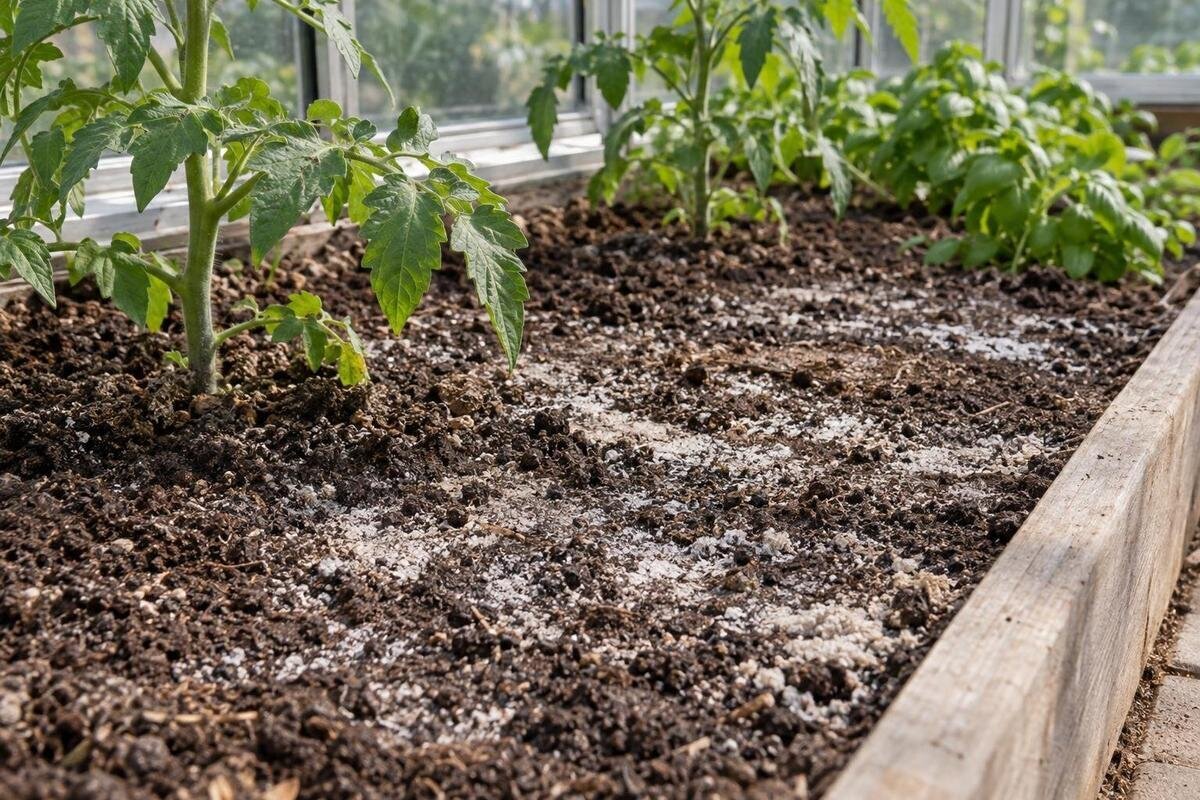
A white deposit on greenhouse soil is an observation, not an identification. It may be soluble salts left behind as irrigation water dries, mineral residue associated with the water, surface fungal growth, or pale particles from a growing medium or amendment. More than one cause can be present at once: dissolved fertiliser salts may dry over a surface that also has fine fungal threads. Here, ‘salts’ means more than just table salt: the term includes substances that release dissolved ions into water and may come from the source water, soluble feed or both.
The surface does not show how much dissolved material is in the root zone. A deposit can concentrate where evaporation is strongest while the roots occupy a wider area; a small mark can also sit above a more widespread issue. Colour is not a pH reading, and leaf scorch, poor growth or wilting do not prove that salts are involved. Those symptoms have other possible causes, including watering problems and root damage. Use the deposit as a prompt to investigate, rather than as proof that one particular input is at fault.
Map the deposit before disturbing it
Photograph the patch before brushing it away and note whether it looks powdery, gritty, crystalline, crusted or thread-like. Record where it sits: on the soil surface, inside a pot, around a dripper, along a bed edge or on a tray below containers. A ring at the level where water dries can tell you more than a thin film across the whole bed. Mark affected and unaffected spots on a simple sketch, and note whether the surface was wet or dry when you saw it.
Compare areas by crop, growing medium, watering method and feeding history. If only one line of pots or one part of a bed is affected, identify it separately on the sketch. Give each location a simple label linking its photograph to any samples and later results. Mark the boundary of the patch as well as its centre, so you can see whether it spreads or recedes. Avoid mixing material from a clean area into the deposit before collecting samples. For a replacement structure, the Spacious Greenhouse range lists areas from 47 to 70 m². Draw the proposed beds and irrigation zones within the footprint you are considering, with enough detail to distinguish individual growing areas. The overall floor area alone cannot show which parts share the same growing conditions.
How soluble salts accumulate
Water carries dissolved ions through the growing medium. When some of that water evaporates from the surface, the ions remain behind; repeated wetting and drying can make them visible as a pale crust. Soluble fertiliser can contribute, as can the minerals already present in irrigation water. Under greenhouse cover, rain does not fall directly on a bed to wash its surface, so residues may persist. Water moving upwards through a drying surface can also bring dissolved material towards the area where it evaporates.
A crust does not reveal which ions are present or whether the amount is harmful to a particular crop. Some salt build-up is visible, while dissolved salts may be present without an obvious surface layer. Leaf-edge scorch, reduced vigour or poor germination can occur with excess soluble salts, but these signs are not unique to them. Record which plants show symptoms and whether their positions coincide with the deposit, rather than treating every weak plant as part of the same problem. EC testing is more informative than appearance. When comparing the Aluminium Classic Greenhouse range, with listed areas from 3.77 m² to 28.08 m², distinguish the structure’s footprint from the proposed planted area. Show whether that area will be one continuous bed or several separate containers. That distinction helps you organise sampling without assuming that one reading represents every growing area.
Mineral residue from irrigation water
Some water leaves a hard, pale residue as it evaporates. Deposits may form around a watering point, on pot rims or on trays as well as on the bed, which can help identify water as a possible source. Hardness usually refers to calcium and magnesium in water; alkalinity is its capacity to neutralise acids and is often associated with bicarbonates. They are related, but they are not the same measurement. A water pH reading alone will not tell you how much mineral material it may leave behind.
A small amount of crust placed in clear water can provide a rough clue: readily soluble material may dissolve, while some mineral deposits remain or dissolve slowly. This does not identify the substance, and a mixture may behave unevenly. Note what happens rather than assigning a chemical name to the residue. For a useful check, have the source water tested for EC and, where indicated, hardness or alkalinity. Identify the source supplying each growing area and label water samples accordingly. If different supplies are used, keep their results separate instead of treating them as one greenhouse water supply. For a proposed layout in the Lean-to Greenhouse range, listed from 3.69 m² to 14.34 m², mark the watering points and the beds or pots they serve. This makes the water records useful when comparing deposits; the structure’s size cannot tell you the composition of its irrigation water.

Fungal growth and pale particles
Fine white threads, a soft or fluffy patch, or a layer that follows persistently damp organic material may be surface fungal growth rather than a salt crust. Some fungi decompose organic matter in compost and growing media; their presence does not by itself establish that a plant disease is present. Growth can appear alongside a separate mineral deposit, so do not assume that every part of a pale surface has the same cause. Note whether the material is thread-like and where it stays damp.
Pale particles can also be ingredients or additions in the medium, or remnants of material incorporated at the surface. Individual granules look different from a continuous film, but appearance alone may still be inconclusive. Keep loose material separate from the root-zone sample. If you have the growing-medium packaging, check its ingredient information rather than guessing from colour, and compare the particles with those in an unaffected pot containing the same mix. When considering a container layout in the Pyramid Greenhouse range, listed from 5.53 m² to 18.9 m², distinguish groups of pots by their growing medium. Adjacent containers need not have identical contents or histories: comparing pots filled with the same mix is more useful than treating proximity as evidence of a shared cause.
Review the water and feeding history
Write down the water source used for the affected area, including any change between tap water, collected rainwater, a well or a mixed supply. Note whether the crust appeared after a change in source, watering routine or fertiliser. Some domestic ion-exchange softeners replace calcium and magnesium with sodium, so water from a softened supply is worth checking rather than assuming it is suitable. Record the feed product, its label directions, how often it was used and whether the same mix went to affected and unaffected beds.
Include other additions that might explain pale material, such as lime, ash or a new growing-medium ingredient. Dates, approximate amounts and the bed receiving each input can reveal a pattern that colour cannot. Keep product names and label directions with this history, distinguishing measured quantities from estimates. Where an amount is unknown, leave it recorded as unknown rather than guessing. Compare the timing of additions with the first appearance of the crust, and note whether unaffected areas received the same treatment. The Limited-Edition Aluminium Greenhouse with Storage range has listed areas from 5.52 m² to 28.08 m². When comparing a layout that includes storage, distinguish that space and the paths from the planted area. Feeding records should refer to the individual beds or containers receiving an input, not simply to the greenhouse’s overall footprint.
Test the water and growing medium separately
Collect the crust and the root-zone growing medium as separate samples. Follow the testing laboratory’s instructions; if none are available, ask how and where to take a representative sample before collecting it. For a uniform bed, several small samples from the affected zone may be more useful than a single pinch from the surface. Keep different beds, crops, pots, media and irrigation zones separate if their histories differ. Label each sample with its location, crop, water source and recent feeding, and do not add loose crust to the medium sample unless the laboratory asks for it.
Ask for a growing-medium EC test using a method suitable for the material, and consider a separate pH test. EC estimates the concentration of dissolved ions; pH measures acidity or alkalinity. Different extraction ratios can produce readings that should not be compared directly, so record the method and use crop-specific interpretation rather than a universal threshold. Keep the sample identification, units and method with each result: a number copied into a notebook without these details is harder to interpret later. Test the water separately if it may contribute salts or mineral residue. If you are comparing the Limited Edition Aluminium Greenhouse range, listed from 3.77 m² to 28.08 m², consider how you would reach the beds or containers to collect samples. Base the sampling plan on those growing areas and the laboratory’s instructions, not on the greenhouse’s overall size or whichever surface is easiest to reach.
Choose a response that fits the result
If EC is higher than appropriate for the crop and the test method, trace the result back to the water, fertiliser or both before changing the bed. Flushing may be considered only where the medium drains freely and the water used is suitable; otherwise, it can leave a bed waterlogged or fail to reduce the salt load. A persistently high reading or unclear result calls for crop-specific advice from a horticultural laboratory or adviser. Do not use the visible crust alone to decide how much water to apply or how much medium to remove.
If the evidence points instead to mineral residue, check the source-water results before changing your watering supply. If the white material is fungal growth or a component of the medium, adding more fertiliser, lime or an acid is not a diagnosis-based response. Remove or disturb surface material only when you know what it is and have a reason to do so; scraping can mix a deposit into the root zone and make later sampling less useful. Record the area treated, the change made and the reason for it, so that follow-up observations relate to a specific action. For the T-Model Orangery Greenhouse range, with listed areas from 16.52 m² to 30 m², use the actual proposed layout to show the extent of each bed and irrigation zone. A correction intended for one affected bed should remain identifiable on that plan, rather than becoming an undocumented change across the whole growing area.

Reduce the chance of another crust
Once tests point to a source, keep the change specific. Review the feed and water together, follow the product label and crop guidance, and avoid adding a second amendment simply because a white layer remains. If the water source changes, record when it changed and which beds receive it. Check that water can drain from the growing area; a surface deposit can recur if dissolved material remains and the same wetting-and-drying pattern continues.
For follow-up testing, use the same sampling zone and method where possible so that the results can be compared sensibly. Review photographs alongside the readings, noting whether the surface was wet or dry each time. Any intervening change in water source or feed belongs in that comparison; otherwise, you may attribute a difference to the wrong action. Changing the greenhouse structure does not address deposits in growing medium that you retain. If you are considering the Prestige Greenhouse range, listed from 3.77 m² to 28.08 m², keep the history of any existing beds or containers included in the new layout. Follow-up samples should represent the growing medium and irrigation zone actually treated. This helps distinguish a lasting improvement from a temporary change in surface appearance.
Treat beds, pots and grow bags as separate test zones
A continuous soil bed, a potting mix in containers and a growing medium in bags do not necessarily share the same water movement or input history. Test each type separately if the deposit appears in more than one. A pale patch beneath a pot, for example, could be related to drainage from that container rather than to the bed underneath it. Note where water drains, which source reaches each growing system and whether the same fertiliser is used in all of them.
A result from one affected zone should not lead automatically to a correction across every growing system. If only a group of pots is affected, keep its treatment and follow-up separate from those of the permanent beds. Where results vary across the greenhouse, compare the media, water delivery and feeding histories before assuming a test is faulty. The important distinction is between growing areas with comparable conditions, not simply between positions inside the same structure. Use that distinction to decide which results can reasonably be considered together and which need their own interpretation.
Frequently asked questions
Does a white crust always mean there is too much fertiliser?
No. Soluble fertiliser salts are one possibility, but mineral residue from water, fungal growth and pale particles in the growing medium can look similar. Feeding history is useful evidence, not a diagnosis on its own.
Can I identify salts by scraping or dissolving the crust?
Texture and a small water test can offer clues: many soluble salts dissolve, while some mineral deposits do not dissolve readily and fungal threads may remain visible. A mixed deposit can behave in more than one way, so this is only a preliminary check.
Should I flush the bed as soon as I see a crust?
Not without checking the growing medium, water and drainage first. Flushing can waterlog a bed that drains poorly, and water with a high soluble-salt content may add to the problem. Test before choosing that response.
Will a pH test confirm salt build-up?
No. pH describes acidity or alkalinity; electrical conductivity (EC) is used to assess the concentration of dissolved ions. The results answer different questions, and EC readings depend on the test method used.
Is white mould on greenhouse soil harmful to plants?
Not necessarily. Fine surface growth may be a decomposer living on organic material, but appearance alone cannot identify it. If plants are also declining, test the growing medium and review watering and feeding rather than assuming the surface growth is the cause.
A reliable diagnosis brings together the deposit, the irrigation water and the root-zone medium rather than relying on colour alone. Photograph and map the affected area, then test representative samples with methods suited to the material and crop. If the results do not match the appearance, use the results from properly collected samples to guide the next decision instead of making a broad change to every bed.
