
Direct Sowing or Raising Transplants for Greenhouse Crops?
Greenhouse growing
Direct sowing puts seed straight into the bed or container where the crop will grow; raising a transplant means starting it in a module, tray or pot and moving it later. The better option depends on the crop’s roots, how long it needs to develop and whether its final greenhouse space is ready. A mixed plan is more practical than using one method for every seed.

How direct sowing differs from raising transplants
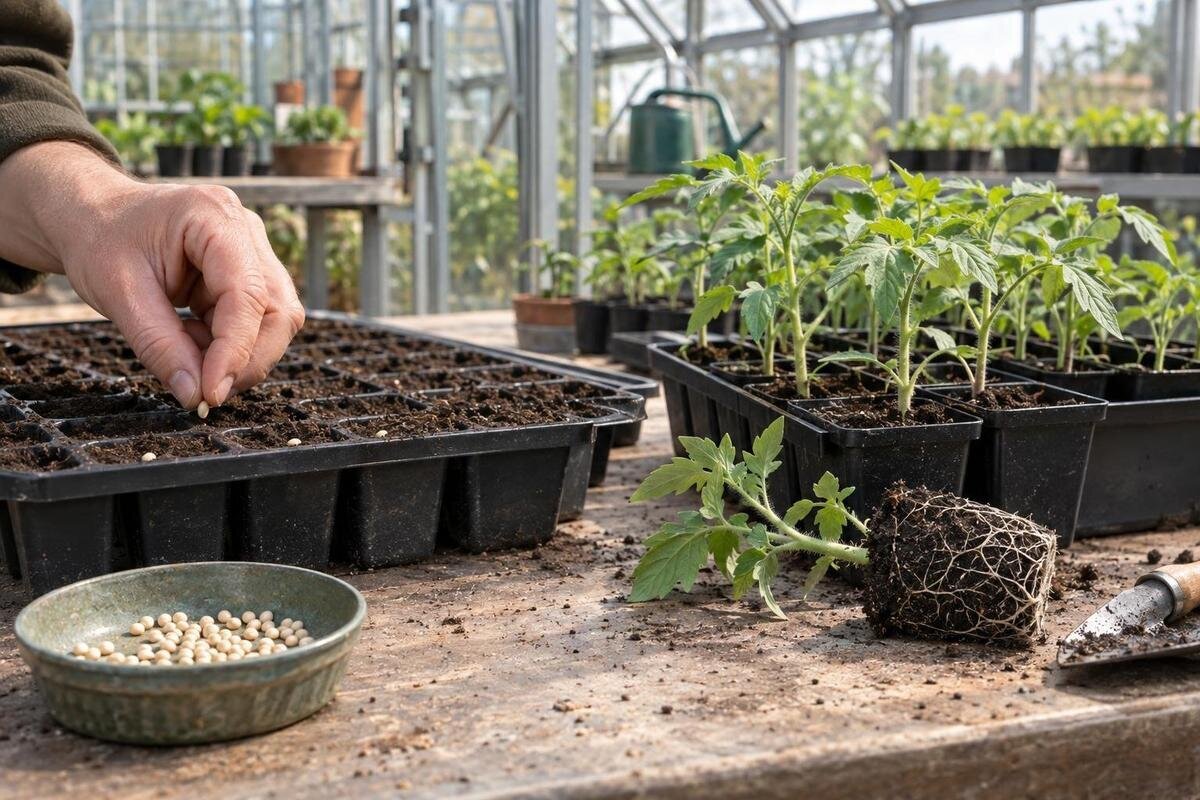
Direct sowing means placing seed in the bed or container where the plant is intended to grow through to harvest. Raising a transplant means sowing first in a module, tray or pot, caring for the seedling separately, then moving it into its final greenhouse position. Transplanting adds a stage and a handling job; direct sowing removes that move but commits the final growing space from the outset. The two methods also give you different levels of control: in modules, seedlings can be labelled and watched together, while a direct-sown row depends on a prepared bed, steady moisture and clear spacing. Neither route is automatically quicker or easier; each moves work to a different part of the growing cycle.
Start with the crop instructions, then ask whether its roots tolerate moving, whether the final bed will be free and whether you can care for seedlings until planting. A crop with a long early growth period may benefit from a nursery stage; a crop whose roots are easily disrupted may not. You can use different routes for separate batches of the same crop, especially when planting dates differ. Greenhouse floor area is only a starting point for planning: the Limited Edition Aluminium Greenhouses collection lists models from 3.77 to 28.08 m², but the stated area does not tell you how much usable bench or bed space remains after paths and layout are considered. Match the method to the crop and your actual plan rather than choosing one rule for the whole greenhouse.
Crops that suit direct sowing
Carrots and parsnips are usually direct-sown because lifting and replanting can disturb their developing main roots, which may lead to forked or misshapen roots. Sow them in their intended bed rather than raising them for transplanting. Radishes and quick-growing salad leaves are also convenient direct-sown crops: the seed goes into the row or patch to be harvested, and small repeat sowings can provide a succession without first filling modules. Beetroot is more flexible; it can be sown directly and thinned, or raised in small modules if that makes spacing easier. The important question is whether a young plant can be moved without affecting the crop you want to harvest.
Beans can also be sown in their final position once conditions suit, avoiding an unnecessary move for seedlings that establish readily in place. Direct sowing is most manageable when the bed is prepared, the recommended seed depth and spacing are followed, and rows are labelled before seedlings appear. It becomes less convenient if you need to clear the bed shortly afterwards or cannot keep moisture even. A directly sown crop occupies its final growing area from sowing, so include it in your bed plan. The T-Shaped Orangery Greenhouse page gives an area range from 16.52 to 30 m²; use it as a footprint comparison, then plan actual beds and access from the layout. Thin seedlings at the stage recommended for the crop, rather than leaving every seedling to compete for space.
Crops commonly raised in modules or pots
Tomatoes, peppers and aubergines are commonly started in modules or pots before being planted into their greenhouse growing positions. The nursery stage lets you manage a small batch separately while the main bed is still in use, and makes it easier to count the plants available and plan their spacing. It can be useful when a crop needs a longer start than the bed schedule allows. Brassicas and some leafy crops may also be raised in modules where regular spacing matters. A tray does not guarantee a better plant, however: seedlings still need suitable light, water and room, and a plant held too long in a small cell can be difficult to establish after planting. Follow the crop’s guidance rather than treating early sowing as an advantage by itself.
Cucumbers, courgettes and similar crops need a slightly different judgement. They can be sown directly where they will grow when conditions allow, or started individually in pots and moved while young. Their roots are sensitive to disturbance, so avoid repeatedly pricking them out; an individual pot reduces the need to separate tangled roots. If the bed will not be ready, a pot provides a temporary stage, but the seedling still needs attention and timely planting. Where the sowing instructions allow either method, the state of the final bed can settle the choice. The Pyramid Greenhouse range lists areas from 5.53 to 18.9 m²; that figure is not a module count, so compare the intended growing surfaces and access separately.
Root disturbance and transplant handling
Root sensitivity is an important distinction, but root crops are not the only plants affected by handling. Some seedlings cope with moving when young and the compost around their roots stays intact; others may struggle if a main root is broken or exposed. A module-grown transplant is generally less disturbed than a seedling lifted from a communal tray, but modules do not make transplanting suitable for every species. That is why carrots and parsnips are usually sown where they will grow, while a tomato seedling can be moved after its nursery stage. Use crop-specific guidance to decide both the method and the stage at which to transplant.
Prepare the final position first, then lift a seedling with its root ball rather than tugging at the stem. Avoid leaving roots exposed while you sort a batch, set the plant at the depth appropriate for that crop, and water after planting. Labels matter too: mark each tray before sowing and keep its name with the corresponding bed row. If storage is part of your greenhouse plan, the Limited-Edition Aluminium Greenhouses with Storage range is listed from 5.52 to 28.08 m². Check the actual layout to see how storage, growing space and access are arranged. Direct sowing removes transplant handling, but thinning a close row still calls for care around the seedlings you keep.

Timing sowings around crop growth
Sowing dates should follow crop requirements and likely conditions, not a single calendar for every greenhouse. Read the seed packet for its recommended sowing period and any stated growing conditions, then consider whether the final bed or container will be ready when the plant needs it. A greenhouse can warm quickly during the day and cool later, especially if it is unheated, so a bright spell alone does not prove that a seedbed is suitable. Direct sowing depends on conditions in the permanent position. Module sowing gives you a separate nursery stage, but only helps if you can care for the seedlings while they wait.
For transplants, work backwards from when the final position will be available. Allow enough time for a seedling to become manageable, but not so much that it outgrows its space or has to be held for weeks. With direct sowing, wait until the final position is ready and the crop instructions allow. Repeated small sowings can spread the harvest of quick crops better than one oversized batch. Record the sowing date, first emergence and planting date, along with what happened. Those notes can show whether a direct-sown batch started too late or whether module-grown seedlings had to wait. A calendar is a useful reminder, not a substitute for observing your greenhouse.
Greenhouse conditions affect both methods
Growing under glass changes the conditions around seeds and seedlings, but those conditions are not uniform throughout the greenhouse. A greenhouse can shelter a bed from direct rainfall and some wind, yet sunlight, ventilation and overnight temperatures still affect seeds and young plants. A space that feels warm when you enter at midday may be cooler later, and an unheated structure does not guarantee frost protection. Check the conditions where the seed is actually growing; a tray on a shelf may not have the same temperature or moisture as a bed below. The crop’s own germination guidance still matters, even when it is commonly grown under glass.
Direct-sown seed needs moisture around the seed zone while it germinates, but the bed should not be left saturated. Modules contain a smaller volume of compost and can dry sooner, so check them separately rather than watering every surface by the same routine. After transplanting, pay attention to the root ball as it settles into the final bed. Manage ventilation in response to heat and humidity, and avoid leaving seedlings crowded in shade. The Bloomcabin Prestige Greenhouse page lists options from 3.77 to 28.08 m²; area describes scale, not temperature. Base sowing dates on crop guidance and the conditions you observe.
Propagation space and greenhouse crop beds
The two methods use greenhouse space differently. With modules, a bench or shelf holds seedlings for a period while the bed can continue carrying a current crop or be prepared for its next planting. That separation can help when crop cycles overlap, but it requires a nursery area that you can reach for checking and watering. Direct sowing skips the temporary tray stage; in return, the bed is committed from sowing and cannot be used for another crop until the row is cleared. Think about simultaneous use, not just how many seed packets you plan to open. If there is no space for trays, a suitable direct-sown crop may be the simpler option; if the beds are occupied, modules help only if there is a separate place to raise them.
Sketch the greenhouse at its busiest point in the season: mark crop beds, paths, trays and working space, then note which batches overlap. Leave room to reach seedlings without moving mature plants or stepping across a bed. The Spacious Greenhouse range is listed at 47 to 70 m², but total area alone does not confirm that a particular bench, crop bed and clear route will fit your plan. Check the layout against the growing zones you intend to use. This is about understanding your working space, not assuming that a larger greenhouse automatically makes every propagation method practical.
Choosing how many seeds to sow
Estimate how many plants you have room to grow before deciding how much seed to sow. For direct sowing, follow the packet’s spacing guidance and allow for the fact that not every seed may emerge. Sowing far too thickly creates extra thinning and can leave seedlings competing for light, water and space. For modules, count the final planting positions and sow the number of cells you can maintain, with a modest allowance for losses rather than filling every tray by default. If the crop is meant to be thinned, account for that in your plan. Seed packets also give guidance on how densely to sow, which can vary by crop.
Small batches are easier to label and track than one large mixed tray, especially when varieties share a greenhouse. For salad leaves and radishes, repeat sowings can help avoid filling the bed with more produce than you can use at one time. For fruiting plants, raise only the number of healthy transplants that the final positions can take. The Aluminium Greenhouses page lists area options from 3.77 to 28.08 m²; use your actual rows, containers or bench positions to estimate seed quantities, rather than treating a stated greenhouse area as a tray count. A small trial can show which method fits your routine without committing the whole growing area.

A crop-by-crop method comparison
Use crop type as a guide, not a rigid rule. Direct sowing is a strong default for crops whose main root should develop undisturbed, including carrots and parsnips, and for quick crops such as radishes or salad leaves when you want rows or successive patches. Modules or pots commonly make more sense for tomatoes, peppers and aubergines, which are often raised before their greenhouse positions are available. Beans can often go straight into the final position; cucumbers and courgettes may be direct-sown or started individually and moved while young. Where both routes are possible, the seed packet and the condition of the final bed can settle the choice.
For each crop, ask whether moving it risks root disturbance, whether you need the final bed before a seedling is ready, and whether you can maintain a nursery batch in suitable conditions. If those factors point in different directions, try a small batch by each method rather than committing the whole crop. The Lean-to Greenhouses range is listed from 3.69 to 14.34 m²; whatever greenhouse you use, map the final crop positions as well as the trays. That makes it easier to choose a method that fits the actual planting plan, not just the number of seeds you would like to start.
Use growing results to refine the next sowing plan
At harvest, compare outcomes rather than judging by how tidy the tray looked. Note whether seeds emerged evenly, whether direct-sown seedlings needed heavy thinning, how well transplants settled and whether the final crop reached a useful size as expected. For root crops, inspect the shape; for transplants, record any losses after moving. A small comparison using the same variety, similar sowing dates and comparable conditions gives you more useful information than comparing unrelated batches. Record the number of plants and the space used as well, so you can judge the result against the area each method occupied.
Keep the method that suits the crop and your routine, and change it when the purpose changes. You might direct-sow a quick row where the bed is ready while raising a separate batch of longer-season plants in modules for later positions. A poor result does not necessarily mean the method was wrong: uneven watering, unsuitable timing, seed quality or a crowded nursery may also have mattered. Make a note of what you would change, then adjust one factor at a time. Crop-specific records will make your greenhouse plan more useful than a blanket rule to sow everything directly or transplant every seedling.
Frequently asked questions
Which greenhouse crops are usually direct-sown?
Carrots and parsnips are commonly sown where they will finish because moving their developing roots can lead to distortion. Radishes, salad leaves and many beans can also be sown in their final position. Follow the crop’s sowing guidance and consider how long the bed will be needed.
Can I start cucumbers in pots?
Yes. Sow them in individual pots and move young plants with the root ball intact, or sow directly in their final position when conditions suit. Cucumbers grow quickly and are sensitive to root disturbance, so avoid separating or holding seedlings unnecessarily.
Does a greenhouse mean I can sow earlier?
Not automatically. A greenhouse may be warm during the day but cool later, particularly if it is unheated. Use the seed packet’s guidance and check conditions where the seed is growing rather than treating a mild, sunny afternoon as a reliable signal.
Are transplanted seedlings always stronger?
No. Transplants can make spacing and timing easier, but moving a seedling adds handling and may disturb its roots. Direct-sown plants avoid that move. The result depends on the crop, timing, growing conditions and care.
Can I use both methods for one crop?
Yes. If the crop’s guidance allows either method, try separate small batches. Keep the variety, sowing dates and growing conditions as similar as practical, then record how each batch establishes. That gives you a useful basis for choosing next time.
Direct sowing is usually the better choice where a crop should establish in its permanent bed and root disturbance is a concern. Modules and pots are useful when a separate seedling stage makes timing, spacing or bed turnover easier. Use crop guidance, greenhouse conditions and available space together, then review the result for each crop. Combining the methods and keeping a record of the results gives you a practical plan without forcing every greenhouse crop into the same method.
