
Your First Greenhouse: What to Buy Now and What Can Wait?
FIRST GREENHOUSE GUIDE
A new greenhouse can tempt you into buying every accessory in the catalogue before you have planted anything. That can tie up money in equipment with no defined job and leave permanent items taking up space meant for crops. A more useful first setup is staged: choose what you will grow, settle the layout, prepare the basics needed on planting day, then add equipment when a specific need becomes clear. This guide separates cultivation supplies from the structural order, whose exact contents must be checked for the configuration you choose.

Before you buy 1
The first-year crop plan sets the buying list
Before adding items to a basket, write down what you want the greenhouse to do in its first growing season. Raising seedlings, growing a small number of fruiting crops, keeping herbs and salad leaves, and extending the season call for different supplies. Choose the crops, approximate plant count and whether you will sow them yourself or bring in young plants. That decision determines whether seed trays, pots in particular sizes, labels and tall-crop supports belong on the first list. It also prevents buying propagation gear for crops you intend to start elsewhere. If you have several ideas, choose a manageable first mix rather than planning around every possibility.
Sketch where each crop will go and leave a route for carrying water, checking plants and removing pots. Follow the growing instructions for final spacing rather than counting only the small trays you may start with; a seedling occupies a different amount of room later. Mark where you might temporarily put a harvested crop, a watering can or a tray you are handling. Note which tools or trays could be shared between crops, rather than buying a separate set for each variety. This is a working layout, not a promise to fill every corner. Make three headings on your note: needed before planting, needed only when a chosen crop reaches a particular stage, and optional. That keeps a useful idea from being mistaken for an immediate requirement.
Greenhouse footprint and usable growing space
Plan around usable space, not just an area figure. Measure the intended footprint on the site plan and note any fixed obstacles and the route you need to keep free. Area alone does not show the length and width of the selected model, so use its exact drawing before deciding where beds, containers or equipment can go. Decide whether crops will be grown in beds, pots or a mix; the same footprint can be occupied very differently. Include enough room to reach the planned growing areas and carry supplies in, rather than treating every square metre as available for plants.
Catalogue area is a starting point, not a layout. The Limited Edition Aluminium Greenhouses range lists options from 3.77 m² to 28.08 m², but the span cannot tell you how a particular model’s interior will work for your plan. Compare the drawing for the exact size and configuration, then mark your planned beds, pots and route on it. Do not order equipment by multiplying the area by a generic number of trays; count the positions you have actually drawn. If you cannot find a plan for the exact configuration, ask for one before relying on a different size’s arrangement or buying furniture.
Before you buy 2
Comparing greenhouse shapes with a floor plan
Once you know which footprints fit your site, compare how each greenhouse shape accommodates your growing plan. Mark the entry, growing zones and any work surface, then trace how you would move between them while tending plants. For a T-shaped design, use the actual drawing to see how the different parts of the interior connect. Consider whether you want a separate area for seedlings or one open growing area for established crops. A bench that works well in one part of the layout may obstruct another. Decide what each area is for before choosing furniture to fill it.
The T-shaped orangery greenhouse page lists options from 16.52 m² to 30 m². Those figures describe the published area choices, but do not show how much uninterrupted floor space remains for your arrangement. On the selected model’s drawing, try placing a seedling bench, larger pots and a work surface in the zones you have identified. Include where you will stand to use each one and where a tray will go while you transplant seedlings. If a fitted accessory appeals to you, get the dimensions needed to assess its position before ordering. This comparison helps you decide which furniture has a useful role from the outset and which can wait.
Separating the structural order from growing supplies
Keep the structural order and cultivation shopping list separate. The first is the exact model, size and configuration you selected; the second is the compost, pots, watering tools and other items your crop plan requires. Before buying an add-on, read the written contents for your specific order and mark anything that may overlap. Use three simple statuses—confirmed in the order, confirmed separate or unclear—so uncertainty does not turn into a duplicate purchase. Photographs and broad category names are not enough to answer every item-level question. Ask about the chosen configuration before paying for a possible extra.
The Aluminium Greenhouses category lists options from 3.77 m² to 28.08 m², covering several area choices. The category name and size range do not establish the contents of your individual order. Compare its itemised contents with your proposed purchases, paying particular attention to anything described as an accessory or extra. Record whether each item is included, separate or still unclear, and keep the answer beside the relevant entry on your shopping list. Once an item is confirmed as separate, decide whether your first crops actually need it; being available as an extra does not make it essential. This keeps the order check focused on avoiding duplicates rather than building another list of structural parts.

Before you buy 3
Watering equipment and basic temperature monitoring
Have a water plan ready before planting, even if the plan is simply to water by hand. Choose a can, hose or other method to suit the source available, the route to the greenhouse and the number and positions of your planned containers. If you will carry water, consider the weight of a full container and how many trips you are willing to make; if you plan to use a hose, check that it reaches every growing area. Test the route against your layout rather than discovering a gap after plants are in place. If crops have different watering needs, make sure their arrangement lets you manage them separately. Buy one workable method first; extra fittings or a timer can wait until a clear task justifies them.
Keep a basic thermometer on the early list if observing temperature will help with the crops you have chosen. Place it where it reflects the growing area rather than in direct sun or pressed against a surface, and check it at relevant times. It shows conditions; it does not regulate them or guarantee a growing result. Note the reading alongside the time and the crop you are observing so that the information has a clear purpose when considering later purchases. The lean-to greenhouse options page lists sizes from 3.69 m² to 14.34 m², but that range does not establish the watering route or equipment reach in your setup. Use the selected model’s plan and your measured route to choose watering equipment, and observations from the growing area to inform any later need for controls.
Containers, growing medium and hand tools
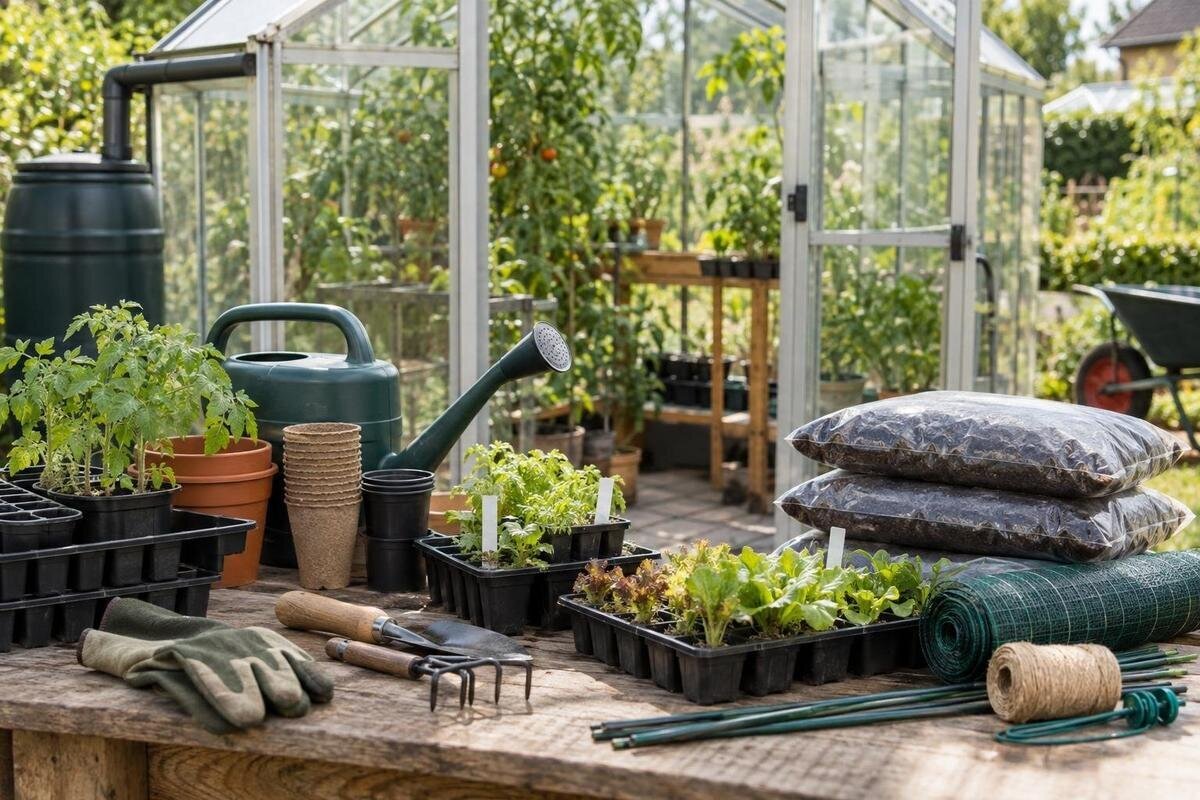
Buy containers and growing medium to suit your crop plan, not a generic starter bundle. If you will sow seeds in the greenhouse, allow for the trays and small pots you intend to use; if you are starting with young plants, most propagation trays can wait. Check crop guidance and the growing-medium label before buying a large quantity, since not every crop or container calls for the same choice. A few labels and a marker help keep varieties identifiable as pots move. Starting with a modest amount also leaves room to learn what suits your preferred growing method, without filling your storage space with supplies you do not need.
Count containers for the stages you intend to grow through, rather than treating greenhouse area as a number of planting positions. The Pyramid Greenhouse category lists options from 5.53 m² to 18.9 m²; use the exact model’s plan and your container dimensions to decide how many will fit. Distinguish trays needed for sowing from pots needed later, and note which containers you already have available for reuse. Leave room to reach and tend the plants. For hand tools, begin with those needed for filling, transplanting and trimming your chosen crops, with a convenient place to put them between tasks. Add duplicates or specialist tools only when you can name the job they will make easier, rather than buying a complete set by default.
Before you buy 4
Benches, shelving and storage
Treat benches and shelving as layout decisions, not universal first purchases. If your plan uses floor beds, larger containers or several kinds of crop, a full run of staging may take more space than it frees. Mark a proposed bench on the drawing, include the standing position in front of it, and check that it will not block the route or access to plants. A small movable surface can be tried first, allowing you to learn whether a permanent worktop, more shelves or a trolley would solve a real problem. Buy fixed furniture only when its job and position are clear.
If you want supplies close by, include their footprint in the drawing instead of adding storage after everything else is in place. The Limited-Edition Aluminium Greenhouses with Storage range is listed from 5.52 m² to 28.08 m². The category name identifies a storage option, but does not establish how much room or what arrangement the selected model provides; confirm those details for your exact choice. Compare storage with the space needed for crops and movement before paying for extra cupboards or shelves. Keep frequently used items reachable and avoid filling the growing area with things that can be stored elsewhere.
Supports and crop-specific protection
Plan supports around crops that need to grow upwards or climb. Canes, ties, clips or a freestanding trellis may suit a particular plant and arrangement; choose the type and quantity for that crop rather than buying an assortment of every connector. Position the support before a plant becomes difficult to handle, but do not assume the greenhouse frame is a suitable fixing point. If an accessory is meant to attach to the structure, confirm compatibility with the exact model and configuration before purchase. Choose a support that leaves room to inspect and harvest the plant, and follow the product guidance for its use.
Keep support compatibility separate from the question of whether a crop needs protection. The Bloomcabin Prestige Greenhouse page lists options from 3.77 m² to 28.08 m², but the model name and area range are not specifications for attaching supports. Resolve any proposed attachment before buying it. For protective materials such as crop covers, identify the plant, location and purpose first: what do you want the cover to do, and at which stage would you use it? A cover is not an automatic essential simply because you are growing under glass. If its purpose is still uncertain, leave it on the optional list; if it is part of your chosen growing method, include it with the supplies needed for that stage.

Before you buy 5
When heating, lighting and other controls are needed
Heating, supplementary lighting, powered fans, automatic vents and shade are not universal first purchases. They can matter when a specific crop, season or growing method depends on controlling conditions, but buying them without a defined purpose risks choosing an unsuitable item or paying for something you rarely use. Write down the problem first—for example, a planned propagation setup that needs more light—then check what equipment is appropriate for the selected greenhouse and plants. If your crop plan relies on controlled conditions, resolve that requirement before planting rather than treating it as a casual later upgrade. Otherwise, wait until observation points to a clear need.
When comparing controls, consider operation and maintenance as well as whether the equipment fits. The Spacious Greenhouse page lists options from 47 m² to 70 m², but area and product title do not establish which heater, lighting system or ventilation control is suitable. Compare the equipment information with the specification of your chosen greenhouse and the manufacturer’s guidance. Ask the supplier or a suitably qualified professional about unclear compatibility or installation requirements. For electrical work, use a qualified professional rather than treating general buying advice as DIY installation instructions. Before purchasing, make sure you understand how the control will be used in your growing routine and what attention it will need. An upgrade should address the condition you identified, not simply add another device.
Upgrades after the first crop cycle
Keep a short list of possible upgrades during the first crop cycle, recording the task behind each idea rather than just the product name. For a shelf, note what would go on it and where it would sit; for another tool, note the job your current tools do not handle conveniently. Separate an item needed for the next planned crop from one that would merely be useful to have. Before committing money, consider whether a temporary option would let you try the arrangement and whether the purchase would take up valuable growing or access space. This gives you a reasoned order for later spending without turning every inconvenience into an immediate shopping decision.
After the first crop cycle, review what remained unused, what was missing when you needed it and what made the plan awkward to carry out. A few notes beside your shopping list are enough; this is a purchase review, not a detailed record of every greenhouse task. Choose one upgrade to address the clearest issue, check that it fits the selected setup, and see whether it solves the problem before adding another. Buying in stages lets your next choice reflect how you actually grow, rather than a generic bundle or a list designed for a different crop plan.
Frequently asked questions
What do I need before planting in a first greenhouse?
Start with the items your chosen plants need: a workable way to water, suitable containers and growing medium if required, labels, and a few basic hand tools. A thermometer can help you observe conditions, particularly if your crop plan depends on them. Check the exact contents of your greenhouse order before buying anything that might already be included.
Should I buy shelving before the greenhouse is planted?
Not necessarily. First draw the growing areas and access route, then see whether shelves would give you useful space or crowd the layout. If you are unsure, try a movable surface before committing to fixed staging. The right arrangement depends on whether you plan to grow in beds, containers or a mix.
Do I need a thermometer in a greenhouse?
A simple thermometer is useful for observing conditions, especially when they matter to the crops you have chosen. Place it where it represents the growing area rather than in direct sun or against a surface. It measures conditions but does not regulate them, so use crop-specific growing guidance when deciding whether you need extra equipment.
When should I buy heating or supplementary lighting?
Buy these before planting if your chosen crop or growing method depends on them. Otherwise, wait until you can identify a specific need. Check that any equipment is suitable for the exact greenhouse and follow its manufacturer’s guidance. If installation or compatibility is unclear, ask the supplier or a suitably qualified professional.
How can I avoid buying greenhouse kit items twice?
Check the written contents for the exact model, size and configuration you have ordered. Mark each possible extra as confirmed in the order, confirmed separate or unclear. Ask the retailer about anything uncertain before buying it; do not rely on a broad category name or photograph to establish what your individual order includes.
Your first greenhouse setup does not need to include every possible accessory. Choose the crops, check the exact structure and usable layout, then buy the supplies needed to plant and care for them. Keep later purchases tied to a defined task, whether that is extra work space, storage, a plant support or environmental control. If you cannot yet explain what an item will do for your growing plan, it can usually wait until you have more experience of the space.
