
Greenhouse Automation Without Mains Electricity: What Is Practical?
Greenhouse planning guide
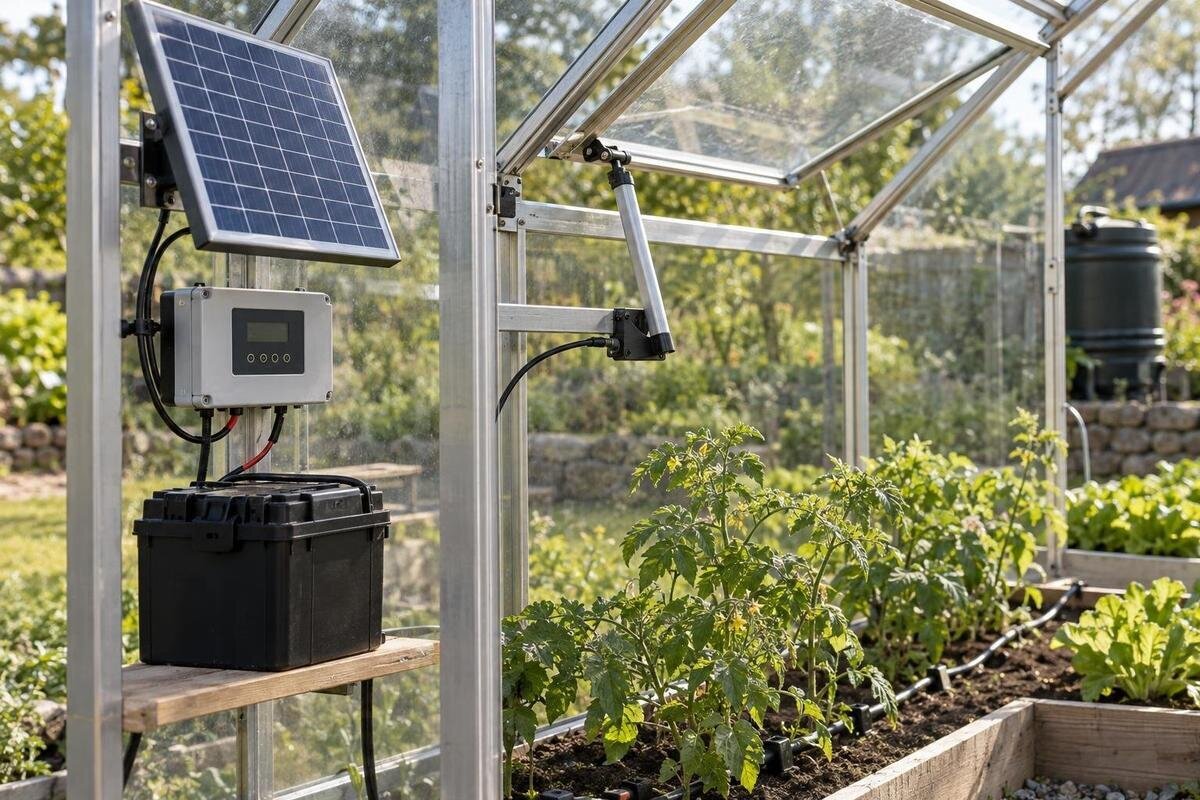
Taking mains electricity out of the plan does not mean every greenhouse task can be automated. Passive ventilation may work without a power supply; battery or solar controls can operate selected equipment, and watering still depends on a reliable source of water. The practical choice is to separate these jobs, match each device to its actual limits, and keep a straightforward manual fallback. An off-grid setup brings together several components; it is not a guarantee of unattended growing.

01
What “off-grid” means for greenhouse automation
“Off-grid” can mean no mains electricity at the greenhouse, but it does not tell you whether there is mains water, mobile coverage or someone available to check the plants. Record which constraint actually applies. A battery device may still rely on an app or network connection; a solar panel may still need a storage battery; a powered pump still needs a water source. If alerts matter, check the mobile signal at the greenhouse: local operation and remote notifications are separate functions. Decide which task you want to reduce—opening a vent, taking a reading, switching a fan or delivering water—rather than shopping for a general promise of automation. Each task has its own power demand and fallback if it stops.
Separate the greenhouse structure from the equipment in your plan. The catalogue lists Aluminium Greenhouses in sizes from 3.77 m² to 28.08 m²; that is a footprint range, not information about vent area, water collection or electrical compatibility. Draw where crops, paths, doors and stored water will go, then mark where each device must sense, move or deliver something. This can reveal practical conflicts: a control may not reach the area it is meant to monitor, or a tank may block access. Ask for the exact greenhouse configuration and separate equipment specifications before assuming the two are compatible.
Passive ventilation and its limits
Passive ventilation uses openings and natural air movement rather than a powered fan. Where the design provides suitable openings, warmer air can leave while outside air enters, but actual exchange depends on the openings' position and size, the weather and any obstructions. Plants, shelves or stored items can restrict a vent's travel or airflow. Ventilation cannot make incoming air cooler than outside air, and still conditions may limit air movement. Passive openings can help manage heat, but they do not guarantee a target temperature in every spell of sunny weather. A greenhouse without mains electricity still needs someone or something to open available vents and monitor conditions.
Decide how vents will be operated on ordinary days and when the weather changes. Manual vents use no electricity but require a visit at the right time; leaving doors open may expose the greenhouse to wind-driven rain or pests, depending on the site. Catalogue sizes for Bloomcabin Prestige Greenhouse range from 3.77 m² to 28.08 m², but floor area does not tell you how many vents are fitted, how large they are or which way they open. Check the exact configuration, unobstructed movement and any ventilation accessories for the model you are considering. Do not infer ventilation performance from a greenhouse's name or footprint.
02
Mechanical vent openers and compatibility
An automatic thermal vent opener can be a practical no-mains option for a compatible opening. Common mechanical designs respond as the greenhouse air warms and move a vent; as it cools, the vent can return. Because the mechanism rather than a powered motor does the work, it need not depend on mains electricity or a charged battery. That does not make it a general climate controller: it affects only the vent to which it is fitted and does not operate a fan or water supply. Humidity monitoring requires separate equipment. The response range and movement vary by product, so treat the opener as a specific component with its own operating limits.
Before buying, confirm that the exact opener is approved for the vent type and that the sash can move freely through its required travel. Ask about its operating range, opening distance, required number of openers, adjustment, closing behaviour and maintenance; use the maker's limits rather than estimating from the greenhouse's apparent size. The listing for the T-Shaped Orangery Greenhouse covers models from 16.52 m² to 30 m², but that range does not specify vent positions or opener compatibility. Obtain details for the chosen configuration. After fitting, observe a complete opening and return cycle while present, following the maker's instructions. Keep any manual opening accessible in case the mechanism jams.
Battery-powered controls: check what the battery runs
Battery-powered controls can handle a temperature reading, timer, moisture sensor or signal to a device, but the label alone does not reveal what the battery powers. Some products use a battery only for the controller while the fan, pump or motor needs a separate supply. Others rely on rechargeable batteries or a battery pack suited to a particular load. Check the documentation for the complete chain: sensor, controller, switching device and equipment being switched. A thermostat that can issue a command is not evidence that the connected fan can run without mains power. Likewise, a watering timer does not supply water or necessarily provide the pressure required by the irrigation equipment.
Ask how long the maker expects the batteries to last under the intended use, how low charge is indicated and what happens if power runs out or batteries are changed. Check whether settings are retained, whether the system needs an app or mobile signal, and how you will know if it stops responding. If comparing greenhouse footprints, the Pyramid Greenhouse listing covers 5.53 m² to 18.9 m²; use the actual growing layout to decide whether one sensor represents the area, rather than treating a size range as proof of device coverage. Check that replacement batteries are available and practical to change, and build a power check into routine visits instead of relying on a warning alone.

03
Solar power and the equipment it must run
Solar can recharge a battery for compatible controls, and a properly matched system may also supply a pump or fan. It is not a guarantee of uninterrupted power: available charging changes with light, shade, season and panel position, while equipment demand varies with use. A sensor and a pump should not be treated as equivalent loads, and a motor can draw power differently from a simple controller. List every device, how it is intended to operate and which functions matter most. Then ask the supplier or a competent installer to match the panel, battery and controller to those requirements, including periods when charging is poor. Avoid assuming a generic panel will run the whole greenhouse.
Check where a panel can be placed without assuming that the greenhouse roof or frame is suitable to carry it; the structure's rating and approved mounting method must be confirmed separately. Ask what the system does when the battery is low, whether it gives a warning and whether controls restart as expected after power returns. The Limited-Edition Aluminium Greenhouses with Storage listings span 5.52 m² to 28.08 m², but greenhouse floor area says nothing about solar exposure, a safe panel position or electrical compatibility. Test the complete combination rather than assuming that separately purchased components will work together. If fixed electrical work is involved, use a suitably qualified professional and follow the equipment manufacturer's instructions.
Water supply without mains electricity
Mains electricity and mains water are separate services. A greenhouse can have no electricity connection while still having access to an outside tap, but that depends on the site. Other choices include carrying water by hand or storing collected rainwater in a water butt or tank. A stored supply is only as dependable as its collection, capacity and refill routine; it may run low during a dry spell or be inconvenient to reach. Do not assume that a greenhouse includes gutters, a water butt or a connection point. Check what is actually present and how water will travel from source to the plants before purchasing a controller.
Gravity-fed watering can avoid an electric pump only when the available water level and pressure suit the chosen hose, valves and emitters. Some equipment has a minimum pressure requirement, so read its specification rather than assuming a raised container will work. A powered pump needs a compatible battery or solar supply as well as water. The Lean-to Greenhouses listing covers 3.69 m² to 14.34 m²; those footprint options may help you map access and tank placement, but do not show whether a collection system is included or compatible. Keep storage accessible for filling, inspection and cleaning, and site a full container on a stable surface suitable for its weight. Plan a hose or container route that does not obstruct doors or paths.
04
Watering methods and delivery checks
Hand watering is the simplest no-power fallback: it needs a person and a route to the crop, but it does not depend on a pump, timer or battery. A gravity-fed drip line can reduce repeated carrying where the equipment works at the available pressure. A battery-powered timer or pump can automate delivery only if its power source, water supply and irrigation components are all compatible. Test the system with the water source you intend to use: confirm that water reaches every outlet, including the last emitter on each line. Check how lines and filters are inspected and cleaned, and follow the equipment maker's guidance on pressure and filtration.
Separate beds with different watering needs rather than assuming one schedule suits every plant. Use a manageable number of zones, label valves or lines, and make sure each can be operated manually if its controller fails. Product listings show Limited Edition Aluminium Greenhouses across 3.77 m² to 28.08 m²; in any footprint, it is the planted area and water route—not floor area alone—that determine where a line must reach. Test each zone with the normal tank level and operating routine, and repeat after moving pots or changing the layout. Include routine checks for blocked lines: an automatic schedule can appear to be running even when no water reaches a plant.
Match controls to crops and growing zones
Controls work best when they reflect the layout and the crops rather than treating the greenhouse as one uniform space. Plants in separate containers or beds may dry at different rates, and a temperature reading beside a door or vent may not represent conditions around every crop. Place sensors as the manufacturer directs and where the reading answers the question you have. A single sensor reports one point; it cannot confirm that every corner, shelf or bed has the same conditions. Reassess its position when plants grow or the layout changes. If one schedule or threshold is unsuitable for part of the planting, split the area or use a less automated method there rather than assuming extra devices will fix a poor layout.
The catalogue lists the Spacious Greenhouse in sizes from 47 m² to 70 m². In a larger growing area, mapping sensor positions, water routes and manual access can be especially useful, but the listed footprint does not tell you how many control zones you need or what equipment is included. Draw the actual beds, doors and paths, then mark the points where you would check temperature or water delivery. Look for areas that may be blocked or difficult to reach, and decide which conditions genuinely need separate control. A simple system serving clearly defined zones is easier to test than several devices added without a specific job.

05
Trial the system and plan for failures
Trial each automated function while you can observe it, before depending on it during a period away. For ventilation, note whether the opener moves as expected and whether the vent returns freely; for watering, check the reservoir level, controller schedule and every outlet. Keep a short log of the date, weather, sensor readings, vent position, water delivery, battery or charge status and any manual intervention. The notes need not be elaborate: their value is in showing what actually happened under your conditions, rather than what a product description suggests. Repeat checks after changing a crop layout, moving a sensor, replacing a battery or adjusting the irrigation route.
Write down the likely failure for each component and the simple response. A vent can stick, a battery can run down, a tank can empty, an emitter can clog, and a connected alert may depend on a working network. Decide which faults you can spot locally, whether an alarm actually reaches you, and who can act if you are not there. Keep a manual way to ventilate or water when practical, and do not treat an app notification as proof that the plants are safe. A low-tech check is part of the system, not evidence that automation has failed; it can catch a small fault before it causes wider damage.
Questions to settle before buying
Ask for the exact equipment model and what is included: the vent or actuator, sensor, controller, batteries, pump, solar panel, battery storage, water tank and any required valves or cables. Ask for written compatibility with the greenhouse opening or irrigation components, operating limits, power requirements, minimum water pressure and expected behaviour on power loss. Request manuals and information on routine checks, replacement parts and whether an app or network connection is essential. These questions distinguish an item that can operate without mains electricity from a complete setup that can perform the task you want. If answers depend on assumptions about your site, share the layout and access conditions before purchase.
Choose one job to automate first, ideally one that happens often or is difficult to manage by hand, and keep a working manual alternative. Add another device only after the first has been tested through the ordinary conditions it will face. When comparing options, be wary of the word “autonomous” unless it states what is powered, how water is supplied, what happens during poor charging or a fault, and how the setup is checked. A greenhouse with no mains connection can still be practical to run; the useful measure is whether each component reduces a real task without hiding a new dependency.
Frequently asked questions
Can a greenhouse vent opener work without mains electricity?
A purely mechanical thermal opener can, provided that the exact model is compatible with the vent. It still has operating limits, needs a free-moving opening and will not run fans, manage watering or control every condition in the greenhouse.
Does a battery controller power a fan or pump by itself?
Not necessarily. The battery may run only the sensor and controller, while the fan or pump needs a separate power source. Check the full equipment specification and what happens if a battery runs low.
Will a solar panel make a greenhouse fully autonomous?
No. Solar output varies with light, shade and season, and the panel, battery and equipment need to be matched. Water still needs to be supplied, and the system needs a plan for low charge, faults and routine checks.
Can rainwater be used without a powered pump?
It can, if it can reach the irrigation equipment at the pressure that equipment requires. Rainwater also needs a suitable collection and storage arrangement, and the supply may need topping up or checking.
What still needs to be checked manually?
Check that vents move freely, batteries or solar storage have charge, water is available and irrigation reaches every outlet. If alerts rely on a mobile signal, confirm that they reach you; keep a manual way to respond.
Practical off-grid automation is selective: a compatible mechanical opener can operate a suitable vent, battery or solar equipment can serve chosen tasks once its limits are clear, and water must be planned as a separate supply. Test each component in real use, keep a straightforward manual response and note what still needs attention. A greenhouse is easier to manage when every automated task has a fallback; that is more dependable than assuming several devices will work together without supervision.
