
Greenhouse Bed Depth by Crop and Growing Method
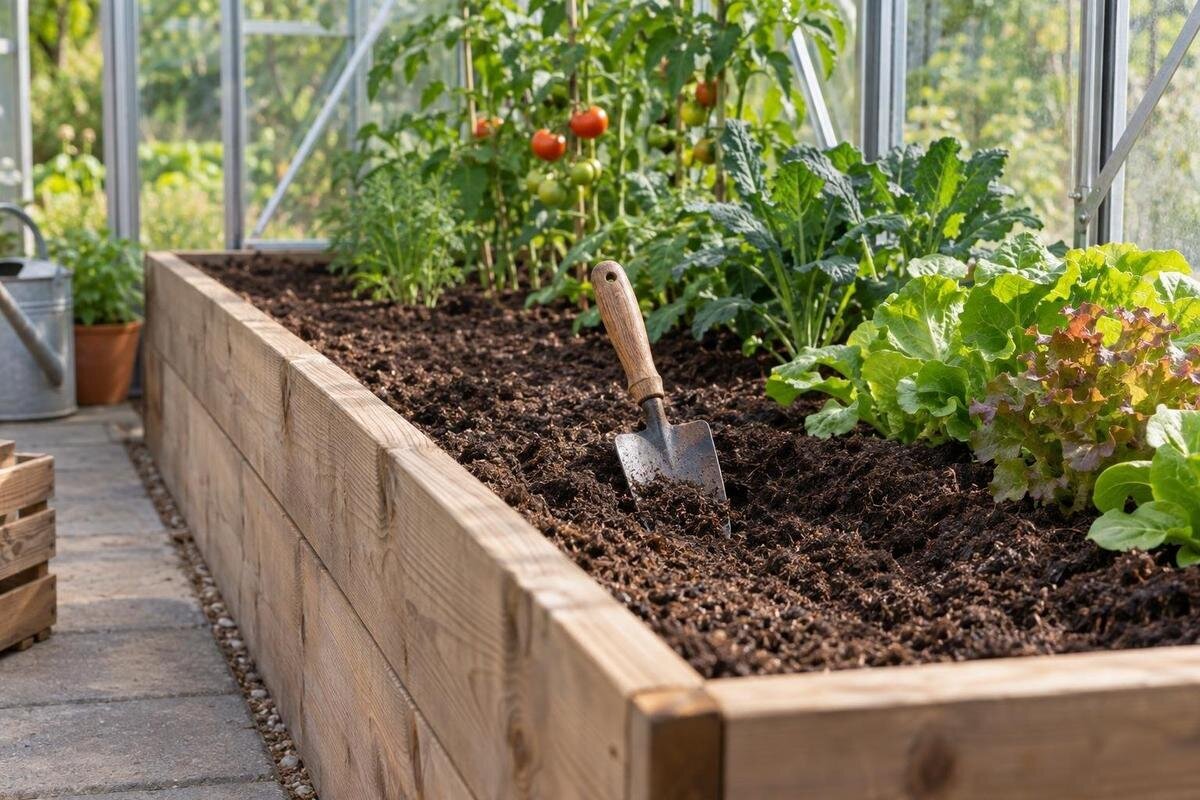
Greenhouse growing guide
Choosing a greenhouse bed depth is a question of usable root room, not simply how tall to make the sides. Salad leaves can grow in far less medium than long carrots or parsnips, while tomatoes and cucumbers need a useful volume to support a long season. The bed’s base matters just as much: roots may continue into open, healthy ground, but a sealed base means the medium must provide the full root zone. This guide compares practical depths, drainage and growing methods, then shows how to calculate the volume you need.

Usable root depth and bed height are different measurements
Measure from the finished growing surface down to the first barrier roots cannot pass: the bed base, an impermeable liner, concrete or hard, compacted soil. That is the useful depth. A 40 cm-high frame partly buried in the ground may contain less than 40 cm of imported medium, while a 25 cm frame on permeable, cultivated soil can have a deeper rootable zone. Do not confuse side height with root space, and do not count drainage rubble as growing medium. Take your measurement after the fill has settled, and note any base or lining that roots cannot cross.
Once you know the rootable depth, decide what the bed must hold: imported medium above ground, an improved layer over existing soil, or both. Greenhouse size is not the same as clear growing area; allow space for paths, the entrance, storage and plants at maturity. The Limited Edition aluminium greenhouse range lists options from 3.77 m² to 28.08 m², but those figures do not show how much space a particular model leaves for beds. Use the measurements for the exact greenhouse and planned bed rather than dividing a category’s largest area by an assumed bed width.
A 30 cm bed is a useful starting point for mixed crops
Around 30 cm of rootable medium is a practical baseline for many mixed greenhouse vegetables, not a biological rule. It gives short-rooted crops room to establish and offers more reserve than a very shallow strip, while remaining manageable to fill and reach across. If the bed sits on sound, open soil, roots may continue below its sides; on paving, they cannot. That difference can change the amount of imported medium you need more than adding a few centimetres to the frame. If you plan to rotate crops, consider the deepest-rooted crop you expect to grow, not just the first planting.
Move towards 35–45 cm where the bed itself must contain a long root zone, or where you are growing crops such as tomatoes and cucumbers over a long season on a sealed base. These are planning ranges: variety, medium and root spread all matter. Greater depth also means more fill, so compare the volume needed for each depth before choosing the frame. If you are planning several beds, the T-Shaped Orangery Greenhouse range lists sizes from 16.52 m² to 30 m². Sketch the individual beds and connecting paths within the dimensions of your chosen model, with the crops assigned to each bed.
Leafy greens and many herbs can grow in a shallower bed
Leaf lettuce, rocket, spinach, spring onions, young radishes and many short-cycle herbs can grow in around 15–20 cm of good, open medium if moisture is kept consistent. That depth is more suitable for quick crops than for a full-sized plant left to mature. A full lettuce head may benefit from more room than baby leaves, and herbs vary: basil and parsley have different needs from woody herbs that may be easier to keep in pots. Base the depth on the crop and harvest stage, not on the broad label of salad or herbs.
A 20–25 cm layer gives a mixed bed of leafy crops more moisture reserve than a very shallow one, but a deeper bed is not automatically better for these crops. Shallow medium may dry more quickly under cover, so check it rather than assuming it behaves like an outdoor border. For a small growing area, the Pyramid Greenhouse range lists sizes from 5.53 m² to 18.9 m². Plan the bed around the leaves or herbs you intend to harvest, with access to the whole planting surface. That access matters when successive sowings occupy different parts of the same bed.
Root vegetables need loose soil as well as depth
For short, round or stump-rooted carrots, about 20–25 cm of loose medium may be enough; longer carrot varieties generally call for around 30 cm or more. Parsnips usually need a deeper, stone-free profile, commonly around 35–45 cm, so the root is less likely to meet a hard layer. Beetroot and radishes are less demanding in depth, but still need an even, friable growing zone for well-shaped roots. These are bed-planning estimates, not guarantees. Check crop-specific guidance from the RHS or your seed supplier for the mature root length of the variety you have chosen.
A deep bed filled with clods, stones or compacted material does not provide an unobstructed root zone. If the bed is open to the ground, compacted soil below it can also limit the depth roots can use; improve the underlying soil where appropriate before filling, and avoid working it when wet enough to smear. If the base is sealed, size the medium for the full root zone. When planning a root-crop bed alongside storage, the Limited-Edition Aluminium Greenhouses with Storage are listed from 5.52 m² to 28.08 m². Mark the storage area separately on your layout so it is not included in the bed’s planting area or fill calculation.

Long-season crops need room for roots and plant growth
Tomatoes, cucumbers and peppers are often grown for many months, so their bed needs to hold a useful volume of medium, not just a thin layer beneath the stems. As a practical target for a contained bed, around 30–45 cm gives these crops a reasonable root zone. Where roots can move into cultivated ground, the raised portion need not provide all of that depth by itself. Roots also spread sideways, so a long, narrow bed can be deep enough but too cramped for the root balls and planting spaces. Follow the guidance for the variety and avoid crowding several large plants together.
Depth alone will not tell you how many plants fit. Vigorous crops can take up substantial surface area, while a compact pepper may need less space; allow for mature growth and access for tying in, harvesting and watering. Keep the bed edge reachable so that maintenance does not depend on stepping into the growing area. The Bloomcabin Prestige Greenhouse is listed in sizes from 3.77 m² to 28.08 m². When drawing a bed layout for your chosen size, mark plant positions as well as bed edges. This helps distinguish a bed with enough medium from one with enough room for the mature crop.
An open base changes how much new medium you need
In an in-ground bed, prepare the existing soil and add a suitable top layer if its structure needs improvement. A raised bed with an open base can work in a similar way if roots can pass into soil that is not compacted or waterlogged. In that situation, the sides might be only 15–25 cm high even though the effective root zone is deeper. This can reduce the amount of imported medium, but only if the ground below is genuinely usable. Check for a liner, hard layer or other obstruction before counting the underlying soil as part of the root zone.
On concrete, paving, a solid tray or an impermeable liner, assume roots stop at that barrier and calculate the medium depth accordingly. You also need a suitable route for excess water; adding more soil does not solve a drainage problem. For a larger layout, the Spacious Greenhouse is listed in sizes from 47 m² to 70 m². Record the base beneath each proposed bed rather than treating the whole growing area as one continuous root zone. Inspect the surface before building permanent beds, especially if you plan to line or alter an existing floor. Keep the depth of imported medium separate from any usable soil beneath it.
Drainage depends on the whole bed profile
A depth figure says little about drainage on its own. The growing medium, the bed base and the route excess water can take all matter. A deep bed can hold more water than a shallow one, but may stay wet for longer if the profile is dense or rests on a sealed surface. In an open-bottom bed, check whether water collects after ordinary watering or rain entering through an opening. On a hard surface, do not assume water can disappear below the bed. Roots need air as well as moisture, so the full root zone should not remain saturated.
A layer of gravel or rubble at the bottom is not a universal fix. A sharp change from fine medium to coarse stone can hold water above the boundary rather than drawing it away. Use a suitable growing medium through the root zone and make sure the base and drainage arrangement match the site; do not block any intended outlet with fabric or debris. If you need to alter a floor or add drainage to a permanent structure, have the arrangement checked by a suitably qualified professional. A greenhouse’s listed size, by itself, does not tell you what drainage conditions exist beneath it.
Pots and grow bags need their own depth calculation
Pots and grow bags do not make one continuous bed, so use each container’s stated volume or crop guidance rather than multiplying the whole greenhouse floor area by a bed depth. A broad container can provide more root room than a narrow one of the same height; a tall pot with a small diameter may be awkward to manage and unsuitable for a spreading crop. Check the container dimensions and recommended plant count, and remember that growing medium can settle. A shallow tray may suit quick leaves, while a long-lived tomato or cucumber needs a container with a volume and drainage arrangement intended for that crop.
Mixing containers with beds can make the growing area more adaptable. A fixed bed can hold crops that share a medium, while pots keep other plants separate or leave more of the floor open. Containers still take up space and need access for watering, training and harvesting, so mark their positions as well as the bed edges. The Classic Aluminium Greenhouses listing includes sizes from 3.77 m² to 28.08 m². For a mixed layout in your chosen model, keep two separate quantities in your plan: the volume required to fill the beds and the combined stated volume of the containers.

Calculate the growing-medium volume from internal dimensions
Multiply the bed’s internal length by its internal width and by the depth of medium, with all three measurements in metres. The result is cubic metres; multiply by 1,000 to convert it to litres. For example, a bed 1.2 m long, 0.9 m wide and 0.30 m deep holds 0.324 m³, or 324 litres. A 2.4 m by 1.2 m bed with the same depth holds 0.864 m³, or 864 litres. These are geometric volumes before settling, so measure inside the bed rather than using the outside dimensions of its frame.
Use the intended fill depth in the calculation, not automatically the full side height. Include any part below ground that you intend to fill with new medium, but exclude existing soil you are leaving in place, the space taken by a base, and any gap above the medium. For an L-shaped bed, divide it into rectangles and add their volumes; for sections with different depths, calculate each separately. If a bag contains 40 litres, the 324-litre example needs 324 ÷ 40 = 8.1 bags, so you would need nine whole bags. For bulk material, compare the quoted amount in litres or cubic metres and allow for settling where relevant.
Plan bed depth alongside access and greenhouse space
Once you know the depth and fill volume, sketch the greenhouse from above. Mark the entrance, paths, fixed benches or storage, and the mature spread of each crop. A bed that is too wide to reach across can make its centre difficult to tend; one that is too narrow may not suit the crop. Leave a workable route for carrying bags and turning with tools, and make sure the plan does not depend on stepping into the beds. Measure the clear space where the beds will sit rather than assuming the greenhouse’s listed area is all available for growing.
For a bed beside a path, show both widths on the plan and check that the route remains usable when the crops are fully grown. The Lean-to Greenhouses listing spans sizes from 3.69 m² to 14.34 m²; use the dimensions of the specific model to position the bed and access route. Add the finished depth beside each bed’s length and width, then record its calculated fill volume. This brings the growing-space and ordering decisions together without confusing floor area with root depth. Revise any awkward bed edges or access points on the drawing before committing to the frame and filling it.
Frequently asked questions
Is 30 cm enough for most greenhouse vegetables?
It is a useful baseline for a mixed bed, especially if roots can continue into open, healthy soil below. For a bed on a sealed base, long-rooted crops and full-season plants such as tomatoes may need around 30–45 cm of medium. Check the needs of the varieties you plan to grow.
Can roots grow below a raised bed?
Yes, if the bed has an open base and the soil beneath it is suitable for roots. Compacted ground, a liner, paving or concrete can stop them. Check what is under the bed before counting the soil below it as part of the root zone.
How deep should a bed be for carrots and parsnips?
Short-rooted carrots can often grow in about 20–25 cm of loose medium; longer types usually need around 30 cm or more. Parsnips commonly need roughly 35–45 cm of stone-free, friable soil. Cultivar guidance is a better fit than a single depth for every variety.
Does a gravel layer at the bottom improve drainage?
Not necessarily. A sharp boundary between fine growing medium and coarse gravel can hold water above the gravel rather than drawing it away. Drainage depends on the whole bed profile and where excess water can go.
How do I calculate the growing-medium volume?
Multiply the bed’s internal length, width and fill depth in metres to get cubic metres, then multiply by 1,000 for litres. A bed measuring 1.2 m by 0.9 m by 0.30 m holds 0.324 m³, or 324 litres, before settling.
The best bed depth is the shallowest one that still gives your chosen crops a reliable root zone in the bed you actually have. Start with root length and spread, check whether roots can continue into open ground, then consider drainage and calculate the medium from internal dimensions. Around 30 cm is a sensible baseline for many mixed beds, not a fixed rule. Long taproots or a sealed base may call for more, while a suitable open base can make the soil below part of the growing space.
