
Disinfecting a Greenhouse After a Serious Plant Disease Outbreak
Plant health
After a serious plant disease outbreak, an ordinary tidy-up is not enough: the response needs to follow the identified pathogen and suit the materials in the greenhouse. A disinfectant cannot compensate for a wrong diagnosis, and soil or plant debris can reduce the effectiveness of some treatments. A chemical suitable for one target may also harm glazing, seals, coatings, benches or tools. The practical order is to contain movement, remove infected material as advised, clean before disinfecting, and establish what needs treatment. Replacing the greenhouse is a separate decision, not a routine part of disease control.

01
Confirm what caused the outbreak
A widespread wilt, leaf spotting, rotting or unusual growth is a reason to pause routine work and identify the cause before choosing a disinfectant. Similar symptoms can come from fungi, bacteria, viruses, oomycetes, pests or non-infectious problems such as watering, temperature, nutrition or chemical injury. Different organisms persist in different places and respond to different control measures; a treatment aimed at the wrong cause can waste time, damage surfaces and leave the real source untouched. The pattern, timing and parts of the plant affected matter as much as a single leaf photograph. Visual resemblance is a clue, not a reliable diagnosis.
Record the crop and variety if known, when symptoms began, where they first appeared, how they spread, and any recent changes in water, stock or growing media. Take clear photographs and ask a horticultural adviser, crop specialist or plant diagnostic service how to submit a sample; follow its handling instructions rather than carrying suspect material through the garden. In Ireland, Teagasc is a useful source of crop-specific horticultural guidance. If a regulated plant-health organism is possible, contact the Department of Agriculture, Food and the Marine (DAFM) before moving or disposing of affected plants, and follow its current direction. Ask which organism is suspected and whether soil, water or plant debris needs particular attention.
Limit movement while diagnosis is pending
Reduce opportunities for contaminated sap, spores, soil or water to travel. Stop taking cuttings or moving plants, compost, trays and tools between affected and apparently healthy areas. If work in both areas is unavoidable, work with the cleanest plants first and finish in the affected area; do not return to the clean side in dirty gloves or footwear. Use dedicated, clearly marked hand tools where possible, and keep plant material from brushing against neighbouring crops as it is handled. Limit access to people doing essential work and explain which area is suspect.
Clearly separate clean supplies from the affected area. Keep unused pots, labels, seed and supplies out of the affected work area, and put used tools in a container where they cannot be mixed back into clean stock. Hand hygiene and a clean change of gloves or protective clothing can reduce transfer, but they do not replace the procedure for the diagnosed pathogen. Avoid splashing or washing soil across the floor. If a shared sink or hose is used, ask whether it could spread the suspected organism before using it for contaminated equipment. Mark containers so that their status remains clear throughout the cleaning work.
02
Remove infected plants and growing media carefully
Once removal is recommended, handle affected plants, fallen leaves, roots, weeds and growing media as potentially contaminated. Place material directly into a suitable, closable container or bag at the work point instead of carrying loose debris through the greenhouse. Avoid shaking plants or brushing off dry soil where it could spread dust; use the handling method advised for the diagnosis. Include disposable twine, clips, labels, potting mix and badly soiled mats only where the disease plan identifies them as a risk. Keep reusable trays separate until they have been cleaned and assessed, and do not pile suspect plants by a doorway used to move clean supplies.
Do not assume home composting, green-waste collection, burning or burying is appropriate; the safe route depends on the pathogen and current local advice. Keep suspect media out of other beds, and do not tip wash water or chemical solution into a drain or garden unless the product directions and local guidance permit it. Label and contain bags until disposal instructions are clear. If the outbreak has exposed a need to keep unused supplies apart from returned tools, include storage in your requirements for a replacement greenhouse. The Limited-Edition Aluminium Greenhouses with Storage range has built-in storage and listed floor areas from 5.52 to 28.08 m². Ask for a plan and cleaning information to assess whether the storage space would keep clean stock separate from items awaiting treatment.
Clean away residue before disinfecting
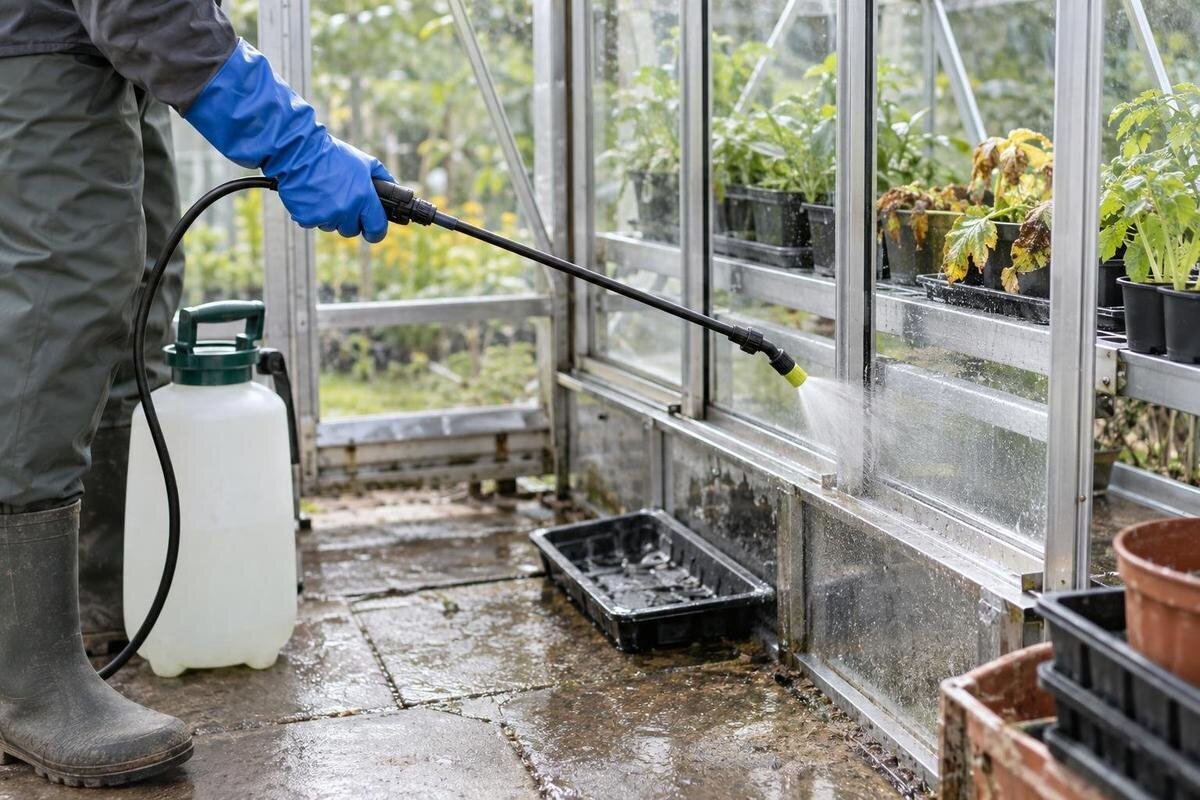
Cleaning and disinfection are different jobs. Cleaning physically lifts away soil, sap, algae, plant fragments and films; disinfection acts on a pre-cleaned surface when the chosen method is effective against the target organism. Organic residues can reduce the action of many disinfectants, while a surface that looks bright may still carry contamination in joints or under a bench. Remove loose debris first without spreading it. Use a cleaner and tools suitable for each surface, collect dirty cloths or wash water as directed, and avoid reusing a contaminated brush across an area that has already been cleaned.
Identify what is actually present before washing the structure: glass or plastic glazing, coated or bare metal, aluminium profiles, timber, concrete, rubber seals and silicone may all behave differently. Consult the greenhouse manual for permitted cleaning products and methods. Abrasive pads, solvents or high-pressure washing may damage finishes or drive water into joints, so avoid them unless the manufacturer specifically allows them. If replacement is under consideration, include material-care information in your comparison. The Aluminium Greenhouses range is listed in sizes from 3.77 to 28.08 m²; obtain the exact glazing, finish and seal details for the model you are considering, alongside its cleaning instructions.

03
Match the treatment to the pathogen and surface
Select a method from guidance for the identified pathogen, not from a general greenhouse-cleaning recipe. Check that the current product label names the intended use site and target organism, or that an adviser has confirmed the method. Follow its exact mixing instructions, application method, required wet contact time, any rinse requirement and stated protective measures. A product that disinfects a floor, tool or empty container is not automatically suitable for crops, growing media, irrigation lines or glazing. If no label or recognised guidance covers the intended use, do not invent a stronger mixture or leave it on longer; ask a horticultural or plant-health professional for an alternative.
Check material compatibility separately from effectiveness against the pathogen. Read both the disinfectant instructions and the greenhouse manufacturer’s care information; ask about glazing, frame finish, gaskets and bench surfaces, not just the main frame. A spot check may reveal immediate discolouration or damage, but it cannot prove long-term compatibility or that the method controls the organism. Never combine cleaning chemicals or disinfectants, and do not use an unlabelled concentration to compensate for uncertainty. When assessing the Bloomcabin Prestige Greenhouse with Metal Base, request maintenance guidance for the base as well as the rest of the structure. The product page identifies the metal base but does not specify every finish or compatible treatment.
Treat tools, pots and equipment as separate items
Treat movable equipment as its own work list rather than assuming one pass over the structure covers everything. Inventory pots, seed trays, benches, propagation cells, hand tools, knives, canes, clips, labels, watering cans, hoses, gloves and fabric or capillary mats. Wash off visible soil first, then disinfect only those items the pathogen-specific plan says can be retained and the product label covers. Pay attention to rims, joints and tool hinges where debris remains. If an item is cracked, porous or hard to reach, ask whether a suitable method exists for it; replacing a low-value contaminated item may be safer than guessing.
Complete any label-specified rinse and drying stage away from the affected zone, then store treated equipment so it cannot be confused with untreated items. Clean reusable tools between affected plants when the advice calls for it; wiping once at the end will not prevent transfer during the day’s work. If a new structure is being considered, assess the working layout as well as its floor area. The Spacious Greenhouse listing covers 47 to 70 m². Use a floor plan to check doors, bench positions and routes for clean and affected equipment, including where each set of items would be held during treatment. Floor area alone does not create separate work zones.
04
Check water routes and hidden reservoirs
If the suspected organism can spread or persist through water, overlooking that route can undo surface cleaning. Ask whether to inspect a water butt or tank, recirculating solution, filters, hoses, emitters, gutters, drain channels, capillary mats and places where water stands. Do not automatically pour disinfectant through an irrigation system or flush it into soil: products may not be labelled for that use, materials may be affected, and residues may move beyond the greenhouse. An adviser can tell you whether a system should be isolated, sampled, drained or treated. A clear-looking outlet does not establish that a reservoir or line is free of the pathogen.
Check whether runoff from washing could reach clean beds, stored pots or neighbouring plants, and plan collection or disposal in line with the product label. If the system cannot be cleaned without dismantling, ask the installer or manufacturer for an approved procedure rather than modifying pipework. For a replacement or redesign, get a layout showing water points and drainage. The T-Shaped Orangery Greenhouse listing gives an area range of 16.52 to 30 m²; when comparing it with your existing structure, use drawings to establish where connections and drains would be. Consider how washing water would be collected without crossing areas used for clean supplies.
Inspect the greenhouse before deciding on repairs
After residues have been removed, inspect accessible parts of the greenhouse for places that may have been missed: bench undersides, frame joints, door tracks, gutters, drainage channels and sheltered corners. Look for trapped debris, cracks, failed seals or surfaces that cannot be reached without removing components. Do not take out glazing or alter frame profiles as a cleaning shortcut. If glass is cracked, a panel is loose, or a component may be structural, keep clear of the hazard and arrange a qualified installer’s assessment. Record inaccessible areas and visible damage for the adviser; an inspection alone does not establish that the whole structure is contaminated or safe.
Before asking about a part, find the greenhouse’s model name, any serial or order record, clear photographs and the exact location of the item; manuals and manufacturer records help prevent incompatible substitutions. Do not assume a generic seal, pane or fixing will fit, or that a product from a newer model is interchangeable. Keep a repair enquiry separate from a replacement comparison. The Limited Edition Aluminium Greenhouse range lists floor areas from 3.77 to 28.08 m², but the range page cannot identify a spare part for your existing greenhouse. Use the records for your own model when requesting parts, and have glazing or structural work reviewed by an appropriate professional.

05
Decide whether whole-greenhouse replacement is justified
An outbreak by itself does not prove that the greenhouse has to go. Ask whether the affected material can be cleaned or replaced safely, whether the diagnosed pathogen persists in that material, whether the manufacturer has a compatible procedure, and whether a repair can restore the affected area without unsupported alteration. These are questions for disease guidance and, where structure or glazing is involved, an installer. A recurring problem may have a source in infected plants, growing media or water rather than in the frame. If surfaces are sound and accessible, pathogen-specific cleaning may be enough; if not, targeted parts replacement may be more proportionate than replacing the whole structure.
When full replacement is justified by condition or access, compare practical maintenance needs as well as appearance: space to reach panels, cleaning access, documented materials, spare-parts information, door and water routes, and the location of clean supplies. The Pyramid Greenhouse listing covers models from 5.53 to 18.9 m². Identify the model you are considering, then obtain drawings and material-care information to assess it against those needs. Neither the model shape nor its area is evidence of resistance to pathogens or compatibility with a disinfectant.
Set clear criteria before growing again
There is no universal number of days to leave a greenhouse empty after every outbreak. The time to restart depends on the organism, its survival route, the crop, the surfaces and the control method; visual cleanliness cannot show that a pathogen-specific interval has passed. Follow current advice on whether the space needs further cleaning, rinsing, drying, vacancy or checks. Before planting, confirm how to handle growing medium, pots and irrigation equipment, and whether the next crop needs particular precautions. Do not plant a susceptible crop simply because the structure looks clean; continue to watch for signs that the original problem has returned.
Write down the confirmed or suspected organism, affected zones, material removed, products used for cleaning and disinfection, label directions followed, contact time, rinse or disposal decisions, repairs and date of return to use. This record helps identify missed areas and avoid repeating a harmful or ineffective treatment. If you restart in a replacement greenhouse, update the record to reflect its layout and care requirements. For example, the Lean-to Greenhouses range is listed from 3.69 to 14.34 m²; check the exact plan and manual for wall clearance and access to glazing before choosing a model. Keep the maintenance information with the disease-control record so future cleaning follows the requirements of the structure actually in use.
Frequently asked questions
Can I use bleach to disinfect a greenhouse after a disease outbreak?
Not as a default. Household bleach formulations vary, and organic matter, glazing, metals and seals affect both results and compatibility. Use a treatment only when current pathogen-specific guidance and the product label cover the intended surface and use. Never mix it with another cleaner or improvise a dilution.
Do I need to replace the whole greenhouse?
Usually, no. A serious outbreak does not by itself show that the frame or glazing cannot be cleaned. First identify where the pathogen persists and whether affected parts can be treated or replaced safely. Consider full replacement only after manufacturer or installer advice if material is damaged, inaccessible or unsuitable for a recommended control method.
Can I reuse pots and growing medium?
Pots and trays may be reusable if the diagnosis-specific procedure covers them, they are intact and they can be cleaned before disinfection. Growing medium is a separate issue: do not assume it can be made safe by washing or soaking. Follow pathogen-specific advice for reuse and disposal, and keep retained items out of the clean area until the required treatment is complete.
How long should the greenhouse stay empty?
There is no single waiting period for every greenhouse disease. The interval depends on the organism, where it survives, the recommended control method and the crop that will return. Follow current advice for the identified disease; a clean appearance alone is not a reliable clearance test.
What should I do if I cannot identify the disease?
Stop sharing plants, cuttings, tools and growing media between areas, record symptoms and photographs, and seek advice from a crop specialist or diagnostic service. In Ireland, Teagasc is a useful source of horticultural guidance. If a regulated plant-health organism may be involved, contact DAFM before moving or disposing of suspect material.
A careful recovery follows the diagnosis: contain movement, remove infected material as advised, clean away organic residues, and disinfect only with a method suited to both the organism and the surface. Pots, tools, water systems and fixed greenhouse components may need different approaches; a single chemical or rinse should not be assumed to cover them all. Keep the manufacturer’s maintenance information with the disease-control record, and let evidence about contamination or physical condition—not the alarm of an outbreak alone—guide any repair or replacement.
