
What Does It Cost to Heat a Greenhouse?
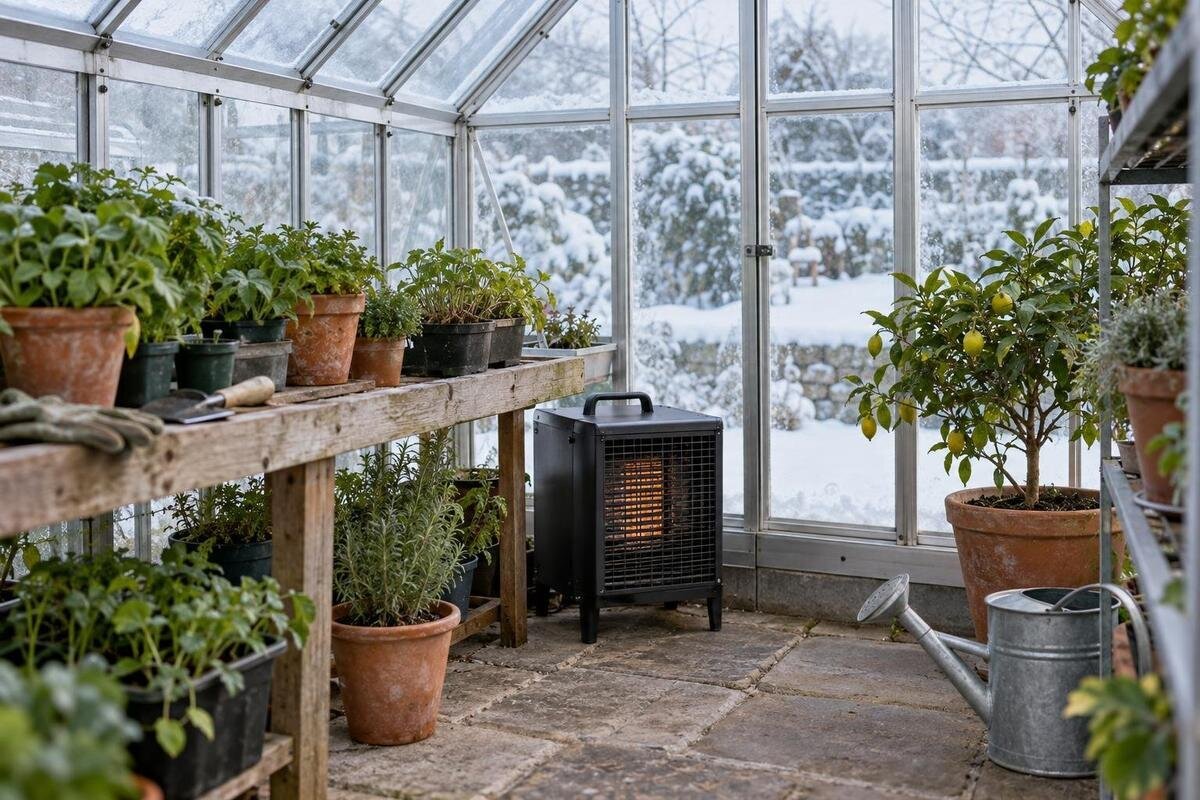
Greenhouse heating costs
Greenhouse heating costs in Ireland cannot be read from heater wattage alone. Your estimate depends on the temperature you want to hold, the weather at the site, how quickly the enclosure loses heat and the electricity unit rate charged during the heating hours. The worked calculation below uses explicit hypothetical inputs, so you can replace them with your own readings and bill rather than treating the result as a seasonal promise.

What determines a greenhouse heating bill?
Greenhouse heating costs are the product of heat demand, operating time and the electricity rate, not a fixed charge attached to a model name. Heat leaves through the enclosure and with air exchanged with outside; the heater replaces that loss if the chosen temperature is to be maintained. The size of the indoor–outdoor temperature difference, exposed area, construction, air movement and length of a cold spell all matter. A mild, bright afternoon and a cold, windy night will not produce the same hourly demand, even if both fall in the same billing month. For a month or winter period, distinguish daytime from nights when the heater may run and count those hours: continuous operation and frost-protection use create very different totals.
Decide whether you want a cost per night, per month or for a defined winter period. This article estimates the extra electricity used for heating; it does not include a heater’s purchase or installation, or the rest of your household consumption. Exact greenhouse dimensions are a useful starting point, but floor area alone does not give roof and wall area or air leakage. The Bloomcabin Prestige Greenhouse listing spans 3.77–28.08 m², so use the exact size you are considering rather than treating the whole product family as one case. Repeat the calculation for each footprint if you are comparing options; a single €/m² shortcut can conceal different exposed areas and operating patterns.
Choose a setpoint for the plants and the hours you heat
Your setpoint should reflect what you plan to protect or grow, not a generic idea of a warm greenhouse. Frost protection and maintaining a higher night temperature for active growth create different workloads, and acceptable temperatures differ by crop. Check reliable guidance for the plants and write down the lowest air temperature you intend to maintain. Compare like with like: an 8°C target for ten overnight hours is not the same heating plan as a 12°C target around the clock. For every heating hour, raising the target increases the indoor–outdoor difference. With H = 150 W/°C, a 2°C increase adds 300 W of modelled heat loss; over ten hours that is 3 kWh, or €0.90 at the example rate of €0.30/kWh.
Place the thermometer where it reflects conditions around the plants, rather than beside a heater, open door or cold draught. If a thermostat switches the heater off and on around its setting, the average temperature can differ from the setpoint; record what the control is actually doing if possible. The Spacious Greenhouse range is listed from 47 to 70 m². For any exact size in that range, use the selected dimensions, setpoint and schedule in your calculation rather than applying one cost to the whole family. Where plants have different temperature requirements, model the intended setpoint for the area being heated instead of averaging unlike requirements. A product name and floor-area range identify a choice; they do not determine its heating requirement.
Estimate heat loss before calculating electricity use
Represent heat loss with a whole-greenhouse coefficient, H, in watts per degree Celsius (W/°C). A simplified steady-state equation is heat loss in watts = H × (inside setpoint − outside temperature). If H is 150 W/°C and the temperature difference is 6°C, the modelled loss is 900 W, or 0.9 kW at that moment. The temperature difference in degrees Celsius is used directly; the result is a rate of heat loss, not yet an electricity bill. Multiply that rate by the number of hours to estimate kWh, then by the applicable unit price to estimate running cost.
A detailed coefficient needs the enclosure’s documented surface areas and heat-transfer properties, with air exchange considered too. Open vents, gaps, wind exposure and how the greenhouse is used can alter the effective loss; floor area alone cannot supply H. The Aluminium Classic Greenhouse listing gives a 3.77–28.08 m² range, but that range is not a coefficient or an energy rating. If exact thermal data are unavailable, state that H is an assumption and calculate a low, central and high case rather than disguising one guess as a fact. Since H feeds directly into the result, show how changing it affects your estimate. Use the same method for each greenhouse you compare, or the results will not be like for like.
Worked example: cost for a ten-hour heating period
Here is a worked overnight scenario, not a typical Irish tariff or a greenhouse specification. Assume a whole-greenhouse coefficient H = 150 W/°C, including the enclosure and the ventilation or leakage pattern for this example; a target of 8°C; an average outside temperature of 2°C across a ten-hour heating period; and a direct electric heater. The temperature difference is 8 − 2 = 6°C. Heat loss is 150 × 6 = 900 W, or 0.9 kW. If that average load persists for ten hours, energy use is 0.9 × 10 = 9 kWh. For this simplified direct-electric example, treat the electricity used as heat supplied to the space. The estimate assumes the heater can supply the modelled demand; if it cannot, the target may not be maintained.
At an assumed rate of €0.30/kWh, the period costs 9 × €0.30 = €2.70. If the same conditions occurred on 30 nights, simple multiplication gives €81, but that is an illustration, not a winter forecast. It treats heat loss as steady and does not separately model warm-up, sunlight or stored heat. The Aluminium Lean-to Greenhouse listing spans 3.69–14.34 m²; use the dimensions and technical details for the selected size before assigning it a coefficient. This example is a method to reuse, not an expected cost for that product or any other greenhouse.

Why heater wattage is not the same as running cost
The power printed on a heater is not the same as its electricity use over a night. In this simple comparison, assume a 2 kW direct electric resistance heater draws 2 kW while on. If it ran at full output for ten hours, consumption would be 20 kWh, costing €6 at the illustrative rate. If the greenhouse’s modelled average load were 0.9 kW and a thermostat kept the heater on for 45% of those ten hours, the arithmetic would be 2 × 10 × 0.45 = 9 kWh. That 45% is calculated from the example, not a guarantee about any thermostat, heater or greenhouse.
Actual operating time changes with outdoor temperature, wind, sunlight, doors, vents, sensor location and heat stored in the enclosure and its contents. Check the heater’s documented electrical input and, if available, its measured kWh; do not treat maximum heat output as ordinary consumption. The Limited Edition Aluminium Greenhouse range is listed from 3.77 to 28.08 m², but the precise greenhouse and the exact heater need to be assessed separately. If the appliance modulates or uses a different heat source, use its own documented input and operating data rather than applying the simple on/off example. The 45% figure is a share of elapsed time at full power, not a heater-efficiency figure.
Use the unit rate on your electricity tariff
Use the unit rate that applies during the heating hours. If your bill shows a price in cents per kWh, divide by 100 to express it in euros: 30 c/kWh becomes €0.30/kWh. That is only an illustrative rate, not a claim about the current Irish tariff. Check the actual unit price on your bill or account and use the plan that will apply during the period you are estimating. For the extra cost caused by heating, multiply the added kWh by that rate. A standing charge is not caused by running the greenhouse heater, so it should not be added to a marginal heating-cost estimate. If you want the full household bill, keep the heating estimate separate from the household’s usual consumption.
If the tariff has different prices at different times, estimate consumption in each time band and apply each rate separately: kWh used in the first band × that band’s rate, plus kWh used in the second band × its rate. Do the same for any other band rather than averaging without checking when the heater runs. The T-Shaped Orangery Greenhouse is listed from 16.52 to 30 m²; when comparing exact options, keep the tariff inputs unchanged while you vary the greenhouse assumptions. Otherwise, a change in the estimated bill could come from electricity pricing rather than the enclosure. Record the rate and the date you checked it, because tariffs can change.
Build a seasonal estimate from local weather
Weather is the biggest variable in a seasonal estimate. Use hourly or overnight outdoor temperatures for the actual site where possible: a sheltered garden and a windy, exposed one may not experience the same conditions as a regional forecast point. The average outside temperature over heater hours suits the simple equation better than the day’s high or the lowest reading. If conditions vary through the night, split the period into intervals, calculate H × the temperature difference for each, convert each interval to kWh and add them. Pairing the lowest reading with every hour can overstate how long that temperature lasts. If you have no local record, model a mild, middle and cold scenario instead of presenting one chosen temperature as an Irish winter average.
Keeping H at 150 W/°C and the setpoint at 8°C, an average outside temperature of −2°C gives a 10°C difference and 1.5 kW of modelled loss. Over ten hours, that is 15 kWh, or €4.50 at the hypothetical €0.30 rate. Thirty identical nights would total €135, compared with €81 for the 2°C example; the weather assumption alone changes the result. When estimating costs for a Bloomcabin Oasis Pyramid Greenhouse, use the listed 5.53–18.9 m² range to identify the size under consideration, not as a substitute for local weather data. For a seasonal estimate, group the expected nights by temperature and hours, calculate each group, then add the energy and costs. Count heating hours rather than assuming every calendar night is identical.
What can reduce greenhouse heating demand?
Reducing heat demand may be more useful than trying to predict a cheaper unit rate. First ask whether the setpoint or heated hours can be lower while still meeting the plants’ temperature requirements; check crop-specific guidance before changing either. Heating only a genuinely separated growing area may also change the volume to be warmed, but a curtain or partition must be suitable for the greenhouse and should not compromise required light or ventilation. Close doors after access and deal with obvious gaps using options approved for the structure. Do not block vents simply to improve the arithmetic.
Check that any insulation, thermal screen or draught-control option is documented for the exact greenhouse, and consider the trade-off with light and air exchange. Do not build an assumed saving into H until you have a defensible performance figure or a measured comparison; compare results for the same weather and setpoint before and after a change. The Limited-Edition Aluminium Greenhouse with Built-In Storage listing covers 5.52–28.08 m², but the name alone does not establish an insulated partition or a lower heating bill. Verify how the storage area is constructed and whether it is part of the heated space before using it to change the model.

Include ventilation, wind and everyday use
Ventilation and routine use can move the result substantially. Opening a door or vent replaces some warm air with outside air, so the heater may run longer afterwards; wind can also increase air movement through openings. Sunshine can warm the interior and reduce heater time, but do not subtract a guessed solar contribution from a winter estimate without measurements. Note when doors are used, whether vents open automatically and how long they remain open. Those details help explain why two nights with similar forecast temperatures can still produce different electricity use.
Do not make a cost-saving calculation by sealing every opening or disabling designed ventilation. Follow instructions for the greenhouse and heater, and include the actual ventilation pattern in the estimate. If vents must be open during the hours you intend to heat, treat that air exchange as part of the workload, not an error in the formula. For a useful comparison, keep ventilation assumptions the same while changing one variable at a time—setpoint, weather, H or tariff. Once the broad estimate is clear, test a different operating pattern separately and see what the changed kWh would mean on your bill.
Improve the estimate with actual readings
Once you begin heating, compare the estimate with actual electricity use. Keep a log of setpoint, outdoor temperature, heating hours and any ventilation or door-opening periods. If the heater or a suitably rated energy monitor records kWh, note the reading over a defined interval and follow the equipment instructions. For fixed electrical work, consult a qualified electrician rather than adapting an installation just to collect data. Measured use helps replace an assumed duty cycle with evidence from your own greenhouse and avoids the false precision of multiplying rated electrical input by every hour in the season.
Compare periods with similar outdoor temperatures, setpoints and ventilation. If measured kWh is higher than expected, check the hours of operation, control settings, draughts and assumed heat-loss coefficient. If consumption matches your estimate but the cost is higher, check the unit rate separately. If consumption is lower, consider whether sunshine or milder weather reduced heater time rather than expecting the same saving on colder nights. A few recorded periods will not guarantee a full-winter bill, but they show which inputs matter most and help you build a better range for the remaining season. Keep separate kWh totals for heating if practical; total household use can hide the greenhouse’s share.
Frequently asked questions
Can I use a heater’s rated kilowatts as its daily electricity use?
Only if you assume it runs at full power for the whole period. A 2 kW heater drawing that amount for ten hours would use 20 kWh. If a thermostat switches it on and off, use actual operating time or measured kWh instead.
Which electricity price should I use?
Use the unit rate that applies to your account during the hours you expect to heat the greenhouse. If your tariff has different time bands, calculate the cost for each band separately. The €0.30/kWh rate in this article is illustrative only.
Does a larger greenhouse always cost more to heat?
Floor area alone cannot tell you how much more a larger greenhouse will cost to heat. Heat loss also depends on exposed surfaces, construction, air exchange, weather and the temperature you want to maintain. Compare exact configurations using the same assumptions.
Should I include the electricity standing charge?
Not when estimating the extra cost caused by running a greenhouse heater. Multiply the additional kWh by the applicable unit rate. Include the standing charge only if you are estimating the full household bill on a basis that calls for it.
Can I multiply one cold-night estimate by the number of nights in winter?
That gives a simple illustration, not a reliable seasonal forecast. Outdoor temperatures, sunshine, ventilation and heater runtime vary. Use local weather information to group periods with similar conditions, estimate each group and add the results.
Use the calculation as a planning range, not a promise: choose a plant-appropriate setpoint, model heat loss against local weather, convert heating time into kWh and apply the rate on your bill. Keep the assumptions visible and update them with real readings. That gives you a more useful estimate of running cost—and a clear way to see whether temperature, enclosure performance, operating habits or electricity price is driving it.
