
Pet-Safe Greenhouse Planning: Access, Plants and Equipment
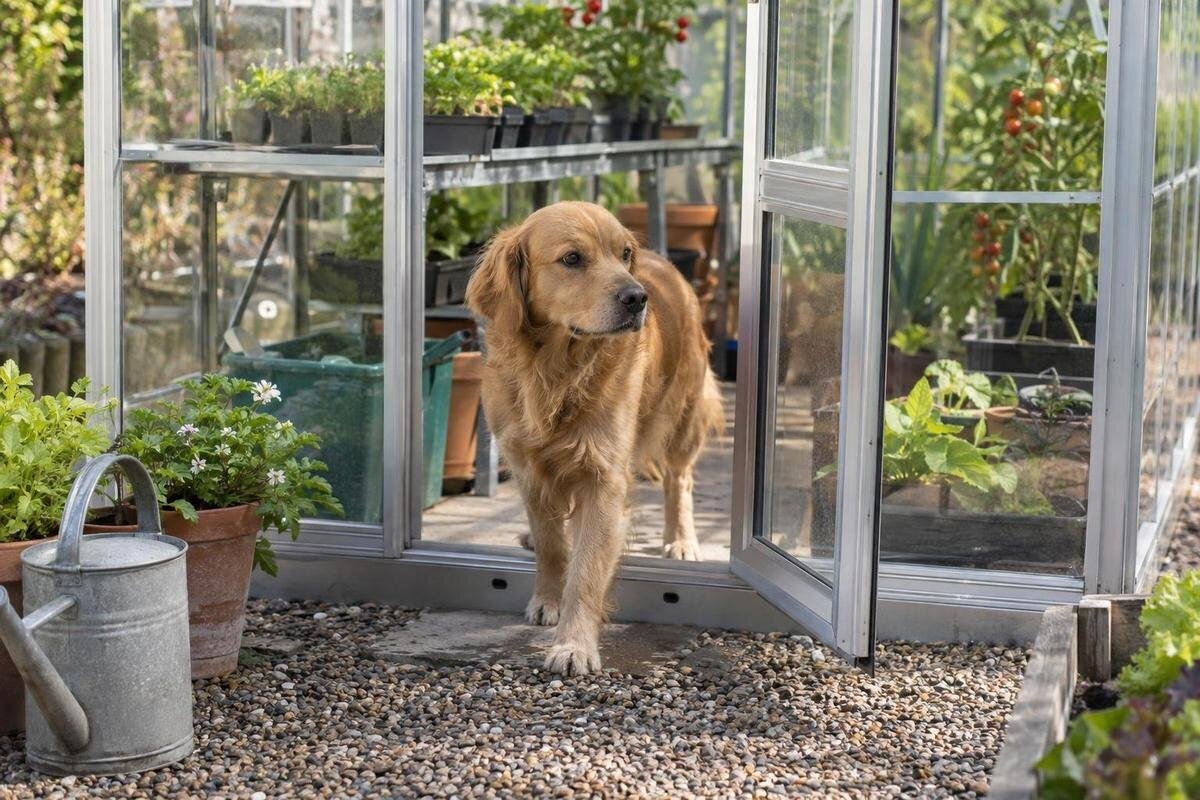
Greenhouse planning
A greenhouse brings plants, compost, tools and gardening products into a compact space that may be opened many times during daily work. If pets share the garden, safe planning is less about finding a universal list of acceptable plants and more about controlling access, identifying each plant and keeping supplies out of reach. Decide whether animals will be excluded or admitted only under supervision, then plan doors, openings and storage around that rule. Plant and product risks depend on the exact item and animal, so seek veterinary advice where the guidance is unclear before allowing your pet access.

Decide whether the greenhouse is off-limits or supervised
Begin by choosing a clear rule: pets never enter the greenhouse, or they enter only under direct supervision. Do not let the plant list make that decision for you. Even a carefully chosen collection sits alongside compost, labels, tools and equipment, and an ordinary gardening task can leave the door open while your attention is elsewhere. A greenhouse is a growing space rather than a pet room; do not plan to leave an animal there to wait or rest. Make the rule simple enough for everyone who uses the garden to follow, including someone helping for the first time.
Think about the particular animal and everyone who uses the garden. Could it follow you through a doorway, nose a gate, paw a latch, climb onto a bench or squeeze through a gap? Treat these as questions to test, not assumptions about every pet. Walk the route while carrying a tray or watering can and notice when your attention leaves the entrance. If the rule is exclusion, consider a second boundary outside the greenhouse; if supervised visits are allowed, decide who is responsible before opening the door. A rule that depends on spotting the pet after it has slipped inside is not a dependable routine.
Make the entrance routine reliable
Make opening and closing simple enough to follow on a busy day. Choose an entry arrangement that lets you close the door behind you, and check exactly how the latch works in the configuration you are considering. A catch convenient for people may not stop an animal able to nose, paw or push it. If you need a second gate, place it so it does not obstruct human access or create a spot where a pet waits against an open doorway. Ask the supplier about the hardware and any alternatives; do not assume a product name or photograph proves the latch is pet-resistant.
Practise the routine with your hands full: locate the pet, open the greenhouse, enter, close and secure the door, then begin work. Avoid propping it open while carrying several items; split the load or use a temporary barrier so exclusion does not rely on remembering an awkward step. Lean-to Greenhouses are listed from 3.69 m² to 14.34 m². If comparing this format, confirm the actual entrance and hardware for the chosen configuration rather than inferring them from the category name. Decide where keys or access controls belong so other household members can follow the same routine.
Plan the route from the garden to the door
Trace every route by which a pet could reach the greenhouse, not only the main garden path. Include doors from the house, side passages, patio gates and any opening from an adjoining area. A fence or hedge may mark the garden but should not be treated as the greenhouse boundary unless it actually prevents access for your animal. Keep the approach clear enough to close the door promptly, and avoid leaving pots, feed or packaging beside the entrance. If the structure is beside a well-used route, note whether people routinely leave a gate open as they pass; include those everyday shortcuts in the plan.
At the planning stage, mark the intended entrance, the path from the house or garden gate, and the space needed to approach without blocking the doorway. The Bloomcabin Prestige Greenhouse range is listed from 3.77 m² to 28.08 m²; use the chosen floor area as a drawing input, not evidence that a safe buffer or pet-free zone is included. Confirm the entrance position and room around it for the exact version under consideration. A paper plan can reveal a route that crosses a pet’s usual path before the greenhouse is installed, when changes are easier to consider.
Account for vents and other openings
Include every opening in the access plan. The main door is only one route: vents, windows, service gaps or a door left ajar can change how people and pets move through the space. Do not assume an opening is too high or too small to matter; animals vary in how they reach or pass through gaps. List which openings must be used during ordinary work and whether using one changes your boundary. Ask about exact positions and operation for the chosen version rather than relying on a product photograph or general category description. If you cannot confirm that a route is secure, treat it as accessible until advised otherwise.
The Aluminium Greenhouses range is listed from 3.77 m² to 28.08 m². When comparing configurations, ask the supplier which openings are included, where they are positioned and how they are operated and secured. Record which ones will be open while you work and how you will maintain the pet boundary at those times. Do not add improvised mesh, wedges or other alterations, or block ventilation to keep a pet out, without first checking the change with the supplier or a qualified installer. The access plan needs to cover normal use of the openings, not just the greenhouse when everything is closed.

Lay out benches and work areas with pets in mind
Plan the internal route around the jobs you actually do: reaching a bench, carrying a watering can, moving trays and taking prunings out. Keep a clear working path, and put small tools, seed packets and plant labels away as soon as they are no longer in use. A shelf is not a pet barrier; an animal may climb or knock items down. If a plant is awaiting identification, do not rely on placing it higher up. Keep it outside the pet’s reach or behind a barrier designed for that purpose until you have checked it. Leave enough room to close the door without moving pots out of the way.
Draw benches, storage and the human walkway on the selected floor plan before buying accessories, then check where the pet boundary would sit without blocking work. The Spacious Greenhouse range is listed from 47 m² to 70 m², but additional floor area alone does not create separate, secure zones. Decide whether the intended layout leaves room to move trays, reach supplies and close the door without shifting pots. Verify any divider or fitted item with the supplier. Assess the arrangement as a working space: separating areas on a drawing is useful for planning, but does not establish that pets cannot reach their contents.
Check the exact identity of every plant
Identify plants by their full botanical name where possible, rather than a shop label that gives only a broad common name. Common names can refer to different plants, and a similar-looking photograph is not a dependable identification. Before buying, check an authoritative veterinary plant-toxicity source for the exact plant and the species of pet in your home. If the reference is unclear, ask your vet or a recognised veterinary poison-advice service. Do not assume a plant is suitable for an animal because it is popular in gardens or edible for people; confirm it for the pet concerned.
Advice can depend on the exact identity and may distinguish between plant parts or types of contact, so use the source’s precise guidance rather than a general internet list. Keep the original label and, if useful, a clear photograph linked to the pot so you can identify it later. Ask about an incomplete label or uncertain identification before allowing access. If the plant or the advice remains unresolved, choose another option or keep the item completely outside the pet’s reach. Do not treat a seller’s informal description or a social-media list as the final authority for a safety decision.
Keep plant labels and records up to date
Keep a simple plant register alongside the greenhouse plan: botanical name, the label or source, date brought in and where the pot is kept. Update it when you divide a plant, take a cutting, start seedlings or accept a gift; a new pot can lose the label that identified it. Mark trays before sowing and keep the labels with their plants when moving them. A photograph can help match a specimen to a record, but should not replace written identification because appearance changes as a plant grows. This makes a plant easier to recheck if advice or a product label is needed later.
The Pyramid Greenhouse range is listed from 5.53 m² to 18.9 m². When comparing footprints, mark plant locations on a drawing and check that there is room to keep unverified arrivals somewhere genuinely inaccessible. A separate bench or painted line is not a safety boundary. Review the register whenever you change the planting plan: remove obsolete labels, match unidentified pots to their records, and check new plants for the pets that use the garden before placing them in an accessible area. If an item cannot be identified, keep it out of reach while you look for its label or seek help with identification.
Store tools and garden products behind a barrier
Treat tools and gardening products as a separate storage problem from plant choice. Put sharp hand tools, blades, secateurs and small accessories away immediately after use, rather than leaving them on a bench or beside the door. Keep fertilisers, compost additives, pest-control products, seed treatments and rooting products in their original containers with labels intact, and follow each product’s storage directions. Do not decant them into drink or food containers. If a label is missing or damaged, do not guess what is in the container; keep it out of reach while you obtain appropriate advice. Clear up before leaving, not only at the end of the growing season.
A greenhouse described as having storage does not, by itself, establish that the compartment locks, closes securely or is inaccessible to a particular pet. The Limited-Edition Aluminium Greenhouses with Storage range is listed from 5.52 m² to 28.08 m² and includes built-in storage; ask for the exact details and do not treat built-in as synonymous with pet-proof. If an item must be kept away from animals, use a separate closed or locked storage arrangement that follows its product label. Close it after every use, and do not leave scoops, caps or opened packets on work surfaces.

Manage water, waste and powered equipment
Include ordinary equipment in the same access review. Hoses, watering cans, trays and buckets can be left on paths or within reach; return them to a set place so they do not become obstacles or something a pet can pull down. Gather cuttings, seed heads, plant labels and empty packaging promptly, and put them in a waste container the pet cannot open. Do not leave an animal alone with a plant or product whose identity or handling requirements are uncertain. A tidy routine also makes it easier to notice when something has been moved or spilled before the next gardening task begins.
Allow space for equipment without letting it encroach on the entrance or the area used for keeping plant records. The Limited Edition Aluminium Greenhouses range is listed from 3.77 m² to 28.08 m²; compare the exact footprint with your planned storage and working path. Include equipment both where it is used and where it is put away, so neither position obstructs access. For fans, lights, pumps or other powered kit, keep controls and cords away from pets and ask a qualified electrician or supplier about any fixed installation. Do not improvise wiring or alter ventilation, and store equipment in accordance with the manufacturer’s instructions.
Review the arrangement when circumstances change
Review the plan whenever something changes: a new plant arrives, benches move, a door or vent is repaired, a pet joins the household, or another person takes over gardening. Recheck the latch, alternate routes, storage and plant register instead of assuming last season’s arrangement still works. Before repairs or additions, ask the greenhouse supplier whether the proposed change affects doors, panels or openings; use a qualified professional for work involving fixed equipment or structural details. Keep the review brief enough to repeat after a change, and make sure visitors know the access rule before helping.
The T-Shaped Orangery Greenhouse range is listed from 16.52 m² to 30 m². If you are considering this option, use the stated floor area to draft a layout, then confirm actual entrances, openings and storage for the exact configuration. Keep the drawing with your plant register so changes to pot locations, work areas and access routes can be recorded together. When someone else takes over gardening, show them where the plant and product records are kept and agree who closes the greenhouse after each visit. The practical test is whether the arrangement remains manageable during ordinary, distracted gardening, not only when the space is newly arranged.
Frequently asked questions
Can any plant be assumed safe for every pet?
No. Plant identification and the animal in your home both matter, so use the botanical name to check a reliable veterinary plant-toxicity source. If the name is incomplete or the advice is unclear, ask your vet and keep the plant out of reach until you have guidance. A familiar garden plant or a plant people eat is not automatically suitable for pets.
Is a closed door enough to keep a pet out?
Only if it stays closed and the animal cannot open it, and there is no other route through a vent, gap or adjoining space. Assess the particular pet and check the door hardware for the exact greenhouse configuration. If needed, plan a second barrier; do not infer that a latch is pet-resistant from a product name or photograph.
Can my pet stay in the greenhouse while I work?
There is no universal answer for every animal or greenhouse. If you allow supervised visits, identify the plants and supplies first, keep the entrance routine clear and make sure you can actively watch the pet. Excluding pets while the door is open or gardening products are in use may be simpler. A greenhouse should not be treated as a place to leave an animal unattended.
Does built-in storage make garden products pet-safe?
Not by itself. A product description that mentions storage does not confirm that a compartment locks, closes securely or is inaccessible to your pet. Check the details for the selected configuration and follow each product label’s storage directions. Until you have confirmed the arrangement, use a separate secure place for items that must be kept away from animals.
What should I do if my pet may have chewed a plant or product?
Contact a vet promptly for advice specific to the animal and possible exposure. Keep the plant label, product packaging or a clear photograph available, and explain what may have been involved and when. Do not rely on a common name or an online list to identify the item.
Pet-aware planning works best when the boundary and the routine agree: plants are identified, access is controlled, and tools, treatments and equipment have a defined home. Revisit the arrangement after a change rather than treating a label, high shelf or storage compartment as a guarantee. If a plant, product or fitting remains uncertain, keep the animal away while you seek advice from the appropriate veterinary professional, supplier or qualified installer.
