
Greenhouse Powder Coating Scratches: Repair Options
Greenhouse repair
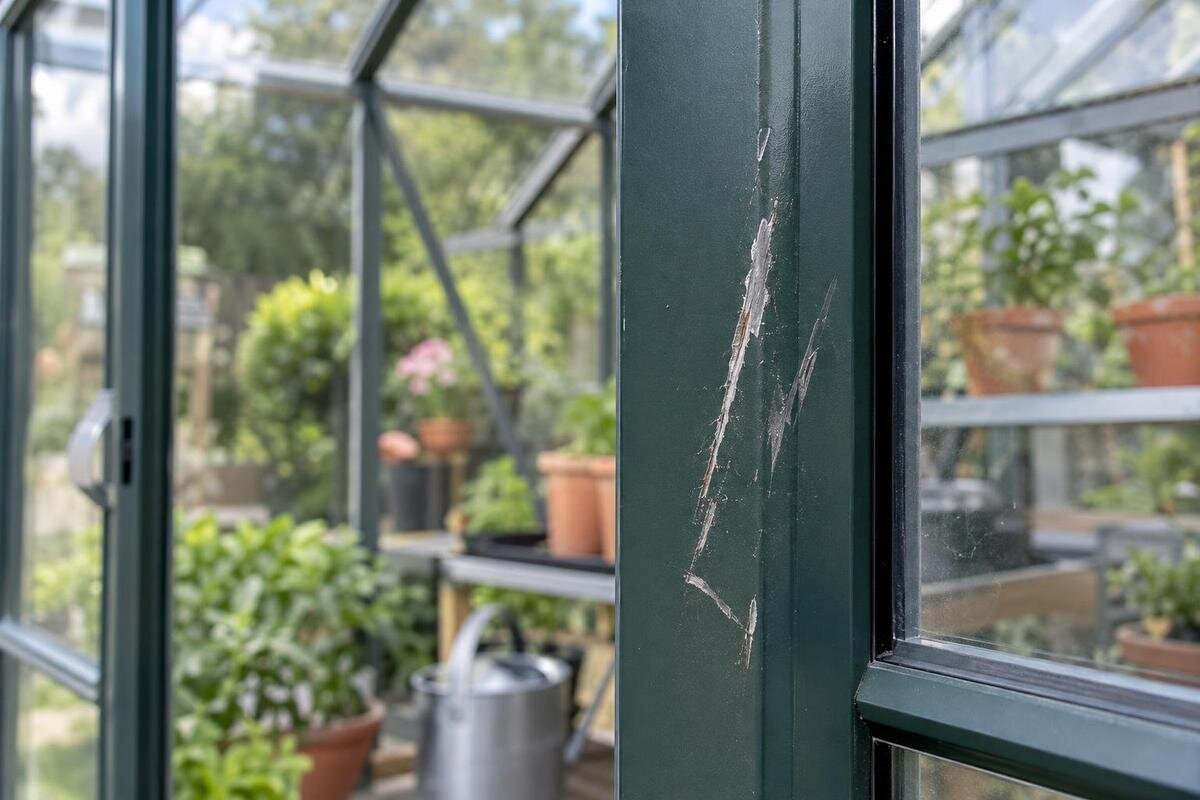
An apparent scratch on a powder-coated greenhouse frame may be transferred dirt, a surface scuff or damage through the finish. Those marks call for different responses. Clean and inspect cautiously, identify the greenhouse and record the mark, then seek the manufacturer's approved touch-up method before applying paint or an abrasive treatment.

A mark on the frame is not always a coating scratch
Powder coating forms the finished surface of a greenhouse frame, but a line across it does not automatically mean that the coating has been cut. Soil, plant residue, rubber transferred from a hose or wheel, or a mark from a tool can sit on top. A scuff can change the sheen without removing the coating; a deeper scratch may leave a visible gap or expose the material beneath. Dust, reflections and narrow frame profiles can make these look alike, especially in a phone photograph. Light surface rubs can leave a dull or polished stripe even where no material has come away.
That distinction affects the remedy. A transfer mark may come away with approved gentle cleaning, whereas painting over it could leave an unnecessary patch. A confirmed break in the finish may call for an approved touch-up; wider or repeated damage needs assessment rather than a quick cosmetic cover. The location matters too: a scrape around a joint may need different follow-up from a line on a flat surface. If two different marks are present, describe them separately rather than assuming one cause or one repair will suit both. The aim is to identify the appropriate response without making either mark worse.
How to distinguish a scuff from coating loss
Look at the dry area in even daylight from more than one angle, and compare it with the adjacent undamaged surface. A mark that shifts, softens or disappears after gentle cleaning is more likely to be residue than missing coating, although appearance alone cannot confirm this. A persistent line with a clear edge, a chip or a small patch where the frame material is visible is stronger evidence of a coating breach. Note whether the surface feels different only if you can do so with a light touch; do not use touch to test its depth. Colours can shift with light, and shadows in a narrow channel can look like a dark cut. The most useful comparison is an undamaged area on the same member, not a different part catching another angle of light.
Do not scrape with a fingernail, coin, blade or screwdriver, and avoid scouring pads, wire brushes, abrasive paper, metal polish and strong solvents. Those tests can create a second scratch, spread the damaged area or remove material that a repair professional needs to assess. If the finish looks blistered, flaking or powdery over a wider patch, record that separately from a single line and ask the manufacturer or installer what it means. These are observations rather than a diagnosis. Where a mark lies beside a joint or glazing channel, note its position instead of trying to inspect behind the frame. Do not use adhesive tape to lift a flake or a marker to outline the scratch.
Identify the greenhouse and its finish before asking for advice
Before seeking touch-up advice, identify the greenhouse as precisely as you can. Check the original order confirmation, invoice, manual or any frame label for the manufacturer, model or range, approximate purchase date and any model or serial reference. Write down the selected finish name or colour code if it appears in the paperwork. For a model such as the Bloomcabin Prestige Greenhouse, record the full catalogue name alongside the references in your own records. A product-family name alone does not establish the coating code, production version or correct repair material. If the greenhouse has changed hands, its paperwork may refer to a version that differs from the current listing.
Treat a colour description as supporting information rather than a match. Note what your paperwork calls the finish and whether you know of an earlier repair, but do not choose a touch-up from a screen image or from the colour of a neighbouring member. Daylight, shade, camera settings and weathering can alter how the frame appears. If there is no label or invoice, say so and provide broad and close-up photographs; do not guess at a model from shape alone. A finish reference in the manual is more useful than a verbal colour description. Do not remove a label, trim or fitting to search for extra information.
Clean the mark without worsening it
Start by removing loose grit without dragging it across the coating. Follow the care instructions for the specific greenhouse; if they permit, use a soft, clean cloth with water or the stated mild cleaner, applying light pressure. Wipe lightly over the area rather than scrubbing the line. Change or rinse the cloth so dirt is not rubbed back over the frame, then allow the area to dry before judging its appearance. A dry surface is easier to inspect and photograph than a wet, reflective one. If the cloth catches on a flake or rough edge, stop rather than pulling it across the finish. You need only clean enough of the area to assess the mark safely.
Do not assume a cleaner safe for glass, pots or garden furniture is suitable for a powder-coated frame. Avoid household scouring creams, abrasive pads, paint thinners, bleach, acids, solvents and polishing compounds unless the greenhouse manufacturer specifically approves them. When searching for a care document, use the model wording in your records; the Spacious Greenhouse listing may help you recognise a catalogue name, although an older version may have different documentation. Do not apply a degreaser to test whether a dark stripe is residue. If the care instructions are missing or unclear, ask before trying a chemical. Cleaning here is for revealing the condition, not for stripping or blending the coating.

Record the damage so support can assess it
Take one image showing which side or frame member is affected and another close-up in even light. Include a ruler beside the mark if its approximate length would help, but do not press it against a sharp edge or scratch the frame while positioning it. Photograph the surface before cleaning and again once it is dry, keeping the angle and lighting as similar as possible. Note the location in plain language: for example, a particular corner, door upright or roof bar, using the manual's part name if available. If the scratch crosses a seam, meets a fitting or runs beside glazing, show that relationship clearly without moving or removing the glass. Avoid filters or digital edits that change the apparent colour or depth.
Record how many marks there are, when you first noticed them, any likely contact such as a moved pot or tool, and what you used to clean the area. Label the photo set with the model name from your records: if they identify an Aluminium Classic Greenhouse, use that wording alongside any order or frame reference. Send a broad view with the close-up rather than a cropped image alone, so support can see whether the damage is isolated or extends along a member. Keep the original photos, as a compressed copy may lose detail. If you do not know how the mark happened, say so rather than assigning a cause. For a second-hand greenhouse, include only the history you can confirm.
Use touch-up only when the manufacturer approves it
Touch-up can be an option for a limited, confirmed break in the coating when the manufacturer supplies or approves a matching product and gives a method for that exact frame finish. Its purpose is a local finish repair; it must not be presented as a repair to a bent, loose or otherwise damaged frame member. Even a correct colour can look different in gloss, texture or ageing once applied, so ask whether a visible patch is likely and whether the maker recommends treating that location at all. If the mark is only a scuff or transfer, leave paint out of the decision until cleaning has shown coating loss. The manufacturer may advise against touch-up if it is unnecessary or likely to make the appearance worse.
Before applying anything, obtain instructions covering the approved product name or reference, surface preparation, application method, drying or curing conditions, and what must be kept clear, including nearby glazing, seals and hardware. Ask whether the instructions vary by part. For an Aluminium Lean-to Greenhouse, for example, identify the affected member rather than requesting paint by model name alone. Do not infer preparation steps from generic paint advice or a label that says suitable for metal. If the maker cannot confirm a match, leaving a cosmetic mark alone may be preferable to experimenting. Keep the product name and instructions with the maintenance record, and do not extend the repair beyond the specified area or method.
What to ask when contacting the manufacturer or installer
Keep the enquiry focused: give the model and finish details you have, the location and approximate size of the mark, clear photos before and after cleaning, and any earlier touch-up or cleaning product. Ask whether the finish is actually breached, whether an approved touch-up exists for that exact version, and whether an installer should inspect it instead. Request the approved preparation and application instructions, including any cautions near glazing, seals or moving hardware. If a part may be needed, ask for its exact identifier and confirmation that it belongs to your model. Also clarify whether the recommendation concerns the finish only or whether any wider inspection is needed.
Where your paperwork uses a family name such as Limited Edition Aluminium Greenhouses, include the order or frame reference so support can identify the version before you buy paint or parts. If the label is missing or the model is older, state what is uncertain. List anything already applied to the mark, because it may affect the advice about what to do next. If the reply leaves you unsure whether to clean, touch up or arrange an inspection, ask for that distinction to be clarified. The enquiry should leave you with a recommendation for the specific damage, rather than a general suggestion to try a paint labelled for metal.
When a damaged component may need replacing
A touch-up is not always the appropriate route. If a long section has lost coating, several areas are affected, the finish is flaking beyond one small mark, or the frame has been struck or deformed, ask for an assessment rather than painting over the evidence. The manufacturer may advise whether a local finish repair is suitable or whether a particular component should be replaced. Ask for the exact spare-part identifier and confirmation that it applies to your model and version. A piece that looks similar is not necessarily interchangeable, and a generic length or colour description may not identify the right section. Ask where the identifier appears in the documentation if you need help finding it.
Do not remove glazing, force a joint apart or alter a member to make a repair fit. If replacement is recommended, use the manual and a qualified installer to determine the scope of the work, especially where glass is next to the affected frame. If your records identify a T-Shaped Orangery Greenhouse, include that model name with the requested part identifier rather than ordering a visually similar component from another range. Ask whether the proposed remedy addresses appearance only or an issue the installer has found. If a component needs to be removed, establish who should carry out that work rather than relying on a video for a different model.

When a full replacement is worth discussing
Discuss a full replacement only when the damage and repair options justify widening the decision: for example, if the finish is damaged across many sections, several components need attention, or the manufacturer cannot identify a suitable approved repair or part. One isolated scratch is not, on its own, a reason to replace the greenhouse. Nor does a colour patch show whether the frame is structurally sound; ask an installer to assess distortion, movement or damage around a joint. A professional assessment can separate an appearance concern from a frame issue. Begin by finding out what is damaged and whether that part can be maintained or replaced, rather than starting with a new model.
If replacement remains worth considering, compare the work required on the existing greenhouse with the requirements of a new one. A different design, such as the Oasis Pyramid Greenhouse, should be assessed as a new purchase rather than assumed to be a like-for-like replacement. Check dimensions, layout, glazing, finish and installation needs against your site with the appropriate supplier or installer. Include the existing foundation and any accessories you hope to retain in that discussion. Similar appearance or a shared material name does not guarantee compatibility, so do not assume that a new frame will accept existing components.
Reduce the chance of new scratches
Once the mark has been assessed, consider what contacted the frame. Moving pots, metal tools, ladders, hose fittings or storage items can rub against narrow members; lift rather than drag objects alongside the greenhouse, and store tools so they cannot fall or catch the finish. Do not lean equipment against the frame. If you use temporary covers or ties, do not fasten them to the frame unless the manufacturer allows it: movement, trapped grit or unsuitable adhesive can leave further marks. When arranging benches or containers, leave clearance to avoid repeated knocks during routine work.
During routine cleaning, remove loose grit before wiping and use only the method allowed by the care guide; do not polish a small mark until it changes shape. Keep a simple record with the model name, finish details, photographs of any repaired area and the approved touch-up product and instructions. Record the configuration too: if your paperwork names Limited-Edition Aluminium Greenhouses with Storage, retain the full description rather than shortening it to a general range name. Include the location and date of any treatment so a future enquiry can distinguish a new impact from an older touch-up.
Frequently asked questions
Can I use an automotive touch-up pen on a greenhouse?
Only if the greenhouse manufacturer confirms that the exact product suits your frame finish and provides the preparation and application method. A pen labelled for metal may still differ in colour, sheen or formulation. Do not try it on the frame just to see whether it matches.
How can I tell whether the coating is actually broken?
Clean only as the care instructions allow, then inspect the dry mark in even light. A line that remains with a clear break or visible material beneath may indicate coating loss, but a photograph cannot always show its depth. Do not scrape or use solvents to test it; send photos and model details to the manufacturer.
Will a colour-matched touch-up disappear?
Not necessarily. A close colour can still differ in gloss, texture or apparent shade because the surrounding coating has aged or the light falls differently. Ask the manufacturer whether a local repair is expected to remain visible and whether touch-up is advised. Do not choose a match from a screen image.
Should I sand the scratch before applying touch-up paint?
Do not sand unless the manufacturer-approved instructions for your exact greenhouse specifically call for it. Abrasive preparation can extend the damage into sound coating and alter the surface. If the instructions do specify preparation, follow their method rather than adapting general paint advice.
Could a scratch affect the frame or its warranty?
A scratch in the finish is not, by itself, proof of frame damage. If a member is bent, a joint moves or the damage is extensive, ask an installer to assess it. Warranty terms vary, so check the product documentation and ask before using an unapproved product.
An apparent scratch does not automatically need paint. Distinguish a removable mark from coating loss with gentle, approved cleaning, then use the greenhouse's exact model and finish details to obtain a manufacturer-approved method. A touch-up addresses the finish, not frame distortion. If the frame is distorted, the coating loss is extensive or the correct component cannot be confirmed, pause DIY work and ask the manufacturer or a qualified installer whether touch-up, component replacement or a new greenhouse is appropriate.
