
Adding Greenhouse Shelves and Hanging Baskets Safely
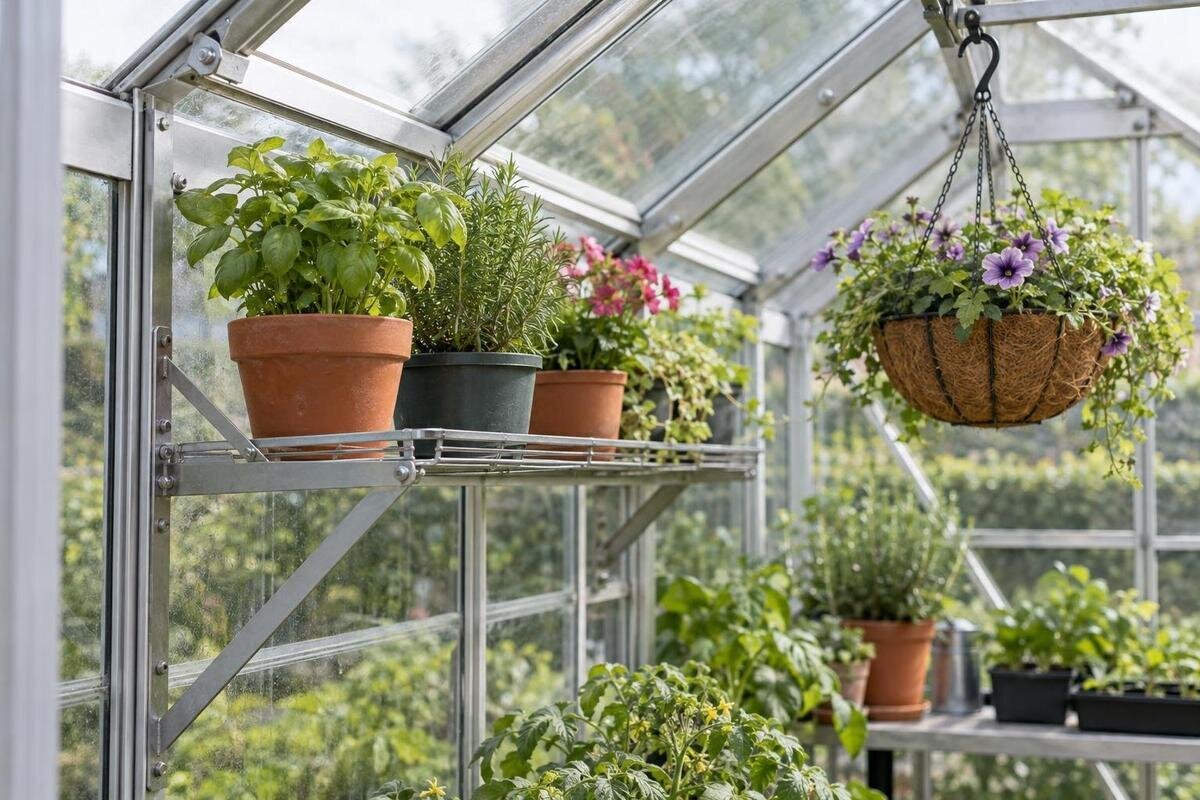
Greenhouse accessories
Adding a shelf or hanging basket can free bench space, but a greenhouse member that looks sturdy is not automatically an approved support. A roof bar, ridge or glazing rail may have been designed for the greenhouse’s own components, not for extra suspended weight. Before fitting anything, identify the exact model and find the manufacturer’s instructions for the proposed accessory, attachment point and complete load. This guide explains what to check, how shelves differ from baskets and what to do if the available documentation is unclear.

What to verify before adding an accessory 1
Approval for shelves and hanging baskets
The frame is designed as part of a particular greenhouse; the fact that it holds glazing does not show that a rail, ridge, rafter or joint is approved for an extra shelf or suspended pot. Added weight acts through the point where it is attached, and a small contact area is not equivalent to a load spread across a designed support. A bracket can also place force on a connection that is not obvious from outside. A shelf fixed to a wall rail and a basket suspended from a roof member are different arrangements; approval for one cannot be transferred to the other. Do not treat appearance, another owner’s successful installation or a similar-looking frame as proof of capacity. The useful question is whether the exact manual names that point and accessory.
Before shopping, write down what you want to support, where you expect it to go and whether it will stay there or be moved often. One small pot, several trays and a row of loaded shelves are different arrangements, so an answer about one accessory may not cover all of them. If you are comparing Lean-to Greenhouses, include your proposed shelf or basket layout in the product enquiry. Note the number of accessories and what each will hold, rather than asking only whether shelves can be added. Keep the plan provisional until model-specific guidance is available. This avoids buying brackets that physically fit but are not approved for the intended arrangement.
Identify the exact greenhouse and fixing point
Locate the greenhouse manual and match it to the structure in front of you. Record the model or range, size, any variant, and the approximate purchase or assembly year. Keep an order reference, product label or original assembly sheet if available, and note any later changes that might affect whether the current assembly matches the instructions. A catalogue photograph or a manual for a close relative may show a different frame layout or accessory system. Do not transfer a fixing diagram from another model or size unless the manufacturer confirms that it applies. If the label is missing, describe the structure to the supplier rather than guessing its identity.
Then find the approved fixing point itself, not just a part that can take a screw or hook. The instructions should identify the rail, channel or member and show the matching accessory or fastener, if that system exists for your model. When looking for accessory information for Limited Edition Aluminium Greenhouses, match the size and version as well as the range name. An instruction may approve an accessory only in one position; do not shift it along a similar-looking rail to make room without confirmation. If a document shows an accessory only in a photograph, ask whether the illustrated position is approved for your exact greenhouse.
What to verify before adding an accessory 2
What the manual must say
The relevant manual, accessory sheet or technical drawing should identify the approved accessory and its precise fixing position. Check which rail or member is named, what hardware it requires, whether a limit applies at that position, and whether installation is restricted to certain parts of the structure. Look for conditions on the arrangement, such as whether the load must be spread across a particular shelf or set of supports. A general statement that the greenhouse is sturdy is not a usable limit for an accessory. If the document is silent on a detail, do not fill the gap with a guess based on the frame’s shape or how solid it feels.
Read the wording closely: a figure may apply to one accessory, a single attachment, a section or the whole greenhouse, and those meanings are not interchangeable. Confirm whether the stated load includes the shelf or basket and its contents, and whether conditions apply when more than one accessory is fitted. For a model on your shortlist, such as the T-Shaped Orangery Greenhouse, request the relevant fixing diagram and load information alongside the product details. If the wording is unclear, ask the manufacturer or supplier which limit applies to your exact model and proposed layout, preferably in writing. Keep that answer with the manual so it remains available when you fit or rearrange the accessories.
How a shelf transfers its weight
A freestanding shelf sends weight through its legs to the floor or base rather than suspending it from the roof. That can avoid an unapproved hanging point, but it does not prove that the supporting surface can take concentrated weight or that the shelf will stay stable. Check the shelf’s own instructions, the surface under each leg, and whether it can sit without rocking or obstructing doors and drainage. Do not wedge it against glazing or use a pane, glazing bar or frame member as an improvised support. Follow the shelf maker’s load guidance, and consider whether its position will remain suitable as plants grow.
A frame-mounted shelf needs approval for both the shelf and its attachment to the greenhouse: a limit for the shelf alone does not establish the rail’s capacity. Use only a position and matching parts named for the exact model; do not assume a bracket is approved because it slips into a groove. For the Pyramid Greenhouse, check the model’s shelf-fixing details rather than copying an arrangement from another frame. The way a shelf projects from its support also matters, so do not replace specified brackets or spacing with a convenient alternative. If the instructions do not show the fixing system or its load conditions, ask before installing.

What to verify before adding an accessory 3
Why roof bars are not default hanging points
Treat a roof fixing as unapproved unless the manual for the exact greenhouse identifies that part as a hanging point and states which accessory and load it can take. Do not hang from a ridge, roof bar, rafter, gutter, roof vent, glazing clip or glazing itself because it appears strong. These parts may serve other structural or weathering functions, and a hook, clamp or cord does not turn them into a rated support. Never drill, clamp or suspend something from glass or its retaining parts. An approved position for one accessory is not automatic approval for a different hook or a heavier arrangement.
A basket’s mass changes when its pot, growing medium, plant and water are added, and it may swing or strike glazing when moved or disturbed. Use only a documented hanging position, then check that the basket will not interfere with ventilation openings, doors or moving roof vents. When considering baskets for a Bloomcabin Prestige Greenhouse, ask specifically about approved hanging accessories and their positions, rather than relying on general shelf guidance. If a basket cannot hang clear without touching a pane or blocking an opening, change the layout. Do not move the hook to a nearby unsupported member simply to gain clearance.
Count what the accessory will actually carry
Assess the shelf or basket in its normal working state, not empty. It may carry containers, growing medium, plants, trays, water reservoirs, tools or harvested produce; wet compost and retained water add weight compared with an empty, dry setup. Include the accessory and any brackets in your plan, and think about what it will hold after watering or during normal use, not just on the day it is installed. Use the manufacturer’s stated basis for any load limit rather than a guessed average. Do not rely on how much a similar arrangement held once or on an estimate made from how heavy it feels.
Check whether each limit applies to one fixing, one shelf, a section of frame or the whole greenhouse, and whether the manufacturer requires the weight to be spread across a specified arrangement. Those figures are not interchangeable, and separate limits cannot automatically be added together. Several shelves and baskets may form a combined arrangement that the documentation does not cover. If you are comparing Spacious Greenhouse options for a larger growing area, describe the full proposed arrangement when asking about accessory loads. More space does not resolve how the limits apply. Send any unclear layout to the manufacturer or installer rather than attempting your own structural calculation.
What to verify before adding an accessory 4
Place shelves and baskets without blocking the greenhouse
Capacity is only one part of a useful position. Mark the shelf footprint and the basket’s full hanging position on a simple plan, then check that doors and windows open, vents can operate, and the main route through the greenhouse remains clear. Keep a basket from striking glazing or hanging where routine watering, pruning or harvesting will push it. Leave room for plants to grow and for you to work without catching a chain or knocking the shelf. A position may be approved for a fixing but still be inconvenient if it blocks access to benches or equipment.
Look at how the proposed items relate to panes, seals, gutters and moving parts; they should not press on glazing or obstruct components that need to operate. Consider where you will stand to water and tend the plants, and whether a basket could be knocked while you move through the greenhouse. When comparing Aluminium Greenhouses, use your layout plan to assess access as well as the space available for plants. Mark where you would work and which openings need to remain clear. This can expose clearance problems before you buy accessories, but it does not establish whether a particular frame member can accept a bracket or hanging load.
Use only approved fittings and installation methods
Once a fitting is approved, follow the manufacturer’s sequence and use the specified accessory and fasteners. A part that physically fits a slot or clamps onto a member is not automatically approved. Do not substitute a longer screw, drill a new hole, bend a rail, cut a member or disturb glazing to make a shelf or hook fit. Avoid improvised wire, ties or adhesive as structural supports. Instructions for a different greenhouse, or a generic online guide, are not a safe basis for altering the frame. If the supplied accessory is missing or does not match the instructions, pause and check before trying an alternative.
If the manual is incomplete, the approved accessory is unavailable, or the proposed fixing would alter the structure, ask the manufacturer or a qualified greenhouse installer to review it. Send the model, size and version, the relevant manual pages, details of the accessory and what it will carry. A photograph of the proposed position can help, but take it from a safe place without climbing on the structure or disturbing glazing. Ask for confirmation of the fixing point, matching hardware, load definition and any conditions. A professional review is especially important if the frame or glazing already shows damage; a generic fitting guide cannot fill a gap in model-specific evidence.

What to verify before adding an accessory 5
What to do when guidance is missing or the frame is damaged
If you cannot find the documentation, check the assembly pack, order records or product label, and ask the manufacturer or supplier for the relevant manual or drawing. Explain which information is missing: the accessory’s identity, its fixing position, the required hardware or the load conditions. Include any applicable spare-part identifier so the enquiry concerns the correct component. If the reply provides only a catalogue image or general product description, ask for clarification of the proposed arrangement rather than treating it as approval. Keep unresolved parts of the plan separate from any accessories that are clearly documented. Until you have an answer for the proposed attachment, leave that extra load off the frame.
Do not add a shelf or hanging basket to a frame that is bent, loose, cracked, visibly corroded or otherwise damaged at the proposed support point. Damage, missing fixings or previous alterations may mean that the original instructions no longer describe the structure as assembled. Stop and have its condition assessed by a competent installer or the manufacturer. Do not straighten or reinforce a member as a workaround, or remove or work on glazing to reach a fixing. If a component needs replacement, confirm its exact identity and compatibility before arranging the repair.
When a different storage plan or greenhouse is needed
When the manufacturer does not document a suitable hanging point, consider storage that transfers weight to a suitable floor surface. Check the shelf maker’s limits and the surface it rests on: changing where the weight goes does not make every greenhouse base suitable for concentrated loads. Reducing the number of items, keeping pots at bench level or using an approved accessory may be enough. If you are considering Limited-Edition Aluminium Greenhouses with Storage, distinguish the supplied storage arrangement from any shelves or baskets you intend to add. The model name does not establish an allowance for those additions; check the instructions for the exact model and accessory.
If a retrofit cannot meet your needs, a model-upgrade or replacement enquiry is more sensible than inventing a roof fixing. Ask about accessory support while comparing options: which accessories are approved, where they attach, what the published limits mean, and whether those details apply to the size and version you are considering. A product’s name or appearance cannot confirm its load capacity. Choose a different arrangement only when its practical storage and documented support match the job; extra floor area alone does not answer whether a particular point can carry a shelf or basket.
Frequently asked questions
Can I hang a basket from a roof bar?
Not unless the manufacturer’s instructions for your exact greenhouse identify that part as an approved hanging point and state the applicable load and conditions. A bar that looks strong, or supports glazing, is not evidence that it can carry a basket. If the guidance is silent, leave it unused and ask the manufacturer.
Is a freestanding shelf automatically safe?
No. It avoids suspending the shelf from the greenhouse frame, but its legs still put weight onto the floor or base, and the shelf must remain stable. Follow the shelf manufacturer’s instructions and check that the supporting surface is suitable for the intended load.
How do I know whether a load limit covers wet pots?
Check how the manufacturer defines the limit and whether it includes the accessory and its contents. Pots, growing medium and retained water add to the load. If the documentation does not make clear what the figure covers, ask for model-specific clarification rather than estimating a safe limit.
Can I drill a hole or use a clamp if no fixing point is shown?
Do not make a new fixing point or use an improvised clamp unless the manufacturer approves that method for the exact model. Drilling, bending or disturbing glazing to fit an accessory can alter the structure. Ask the manufacturer or a qualified greenhouse installer to review the proposed arrangement.
What information should I send when asking for advice?
Provide the greenhouse model, size and version if known, its approximate purchase or assembly year, and any relevant manual pages or labels. Include a safe photograph of the proposed fixing position, details of the accessory, and what it will hold. Ask which point and hardware are approved and what load conditions apply.
Use the instructions for your exact greenhouse to establish which storage accessories you can add. Confirm the approved position, accessory and load conditions, including what the shelf or basket will carry after watering. Keep uncertain attachments off the frame, and do not create a fixing by altering a member or disturbing glazing. If the documented options do not suit your needs, choose storage with suitable independent support or compare models with confirmed accessory guidance rather than improvising a roof attachment.
