
How to Grow Cape Gooseberries in a Greenhouse
Greenhouse growing guide
Cape gooseberries (Physalis peruviana) are an appealing greenhouse crop, but in Ireland they need more than a warm afternoon: the plants must have a long enough season to flower and ripen fruit. A greenhouse can bring an early start and shelter the crop from weather, yet an unheated structure cannot guarantee mild nights or a ripe autumn harvest. Here is how to plan sowing, support, pollination and picking—and how to judge whether the crop suits your growing space.

Can Cape gooseberries crop well in an Irish greenhouse?
Cape gooseberry (Physalis peruviana) is a tender perennial in climates without frost, but in Ireland it is safest to plan it as a long-season annual unless you can provide proper winter protection. Despite its name, it is not a true gooseberry: its berries form inside loose, papery husks. The plant grows leafy and branches freely, while its fruit needs sustained warmth from early growth through flowering and ripening. It is not a quick crop to tuck in after summer begins. An early start, a sunny site and time for the fruit to colour matter more than simply having glass overhead.
An unheated greenhouse can produce a worthwhile crop in a sunny, mild year, especially when plants are started early, but cool nights can slow growth and leave berries green in autumn. Glass adds shelter and daytime warmth; it does not promise mild conditions after dark. Decide whether a variable harvest is acceptable before adding a crop that may need extra heat, and weigh that against the length of the season and ongoing energy use. The Bloomcabin Prestige Greenhouse range is listed from 3.77 m² to 28.08 m²; use an actual floor plan to allow for a branching plant, independent support and a clear route past other crops.
Allow a long, warm growing season
In Ireland, sowing in late winter or early spring gives plants more time to grow and fruit before autumn, but only if seedlings can receive enough warmth and light. February or March can suit a bright, warm propagation space; if seedlings would sit in dim conditions and become thin, a slightly later sowing is more practical than chasing the earliest date. Count backwards from planting after local frost risk has passed, leaving time to raise sturdy plants. Local exposure and greenhouse conditions affect when it is safe to move plants into their final growing position, so use the calendar as a guide rather than relying on a fixed date.
An unheated greenhouse may work in a sunny, mild season, but its temperature can fall close to outside conditions overnight. If you use heat, distinguish warmth for germination and young plants from heating the whole greenhouse through flowering and fruiting; those are different commitments. The Spacious Greenhouse range is listed from 47 to 70 m², but one Cape gooseberry does not require that footprint: choose the space for all planned crops and uses. A larger floor area does not, by itself, provide a longer warm season.
Sow seeds early, but keep seedlings bright
Sow seeds in clean seed compost in trays or small pots, cover them lightly and keep the mix moist but not saturated. A warm spot around 20°C is a useful starting point for germination; follow packet instructions if a named seed strain gives different guidance. Seeds may not emerge together, so label the sowing and give it time rather than clearing the tray after a few days. As soon as seedlings appear, move them to the brightest suitable position. Warmth without enough light encourages long, weak stems, while waterlogged compost can undermine young roots. Sow only as many plants as you have room to pot on.
Pot seedlings on once they have developed true leaves and can be handled without damaging the stem, giving each plant its own pot and fresh compost. Keep young plants growing steadily rather than leaving them cold and wet. Before final planting, acclimatise them gradually to brighter light, airflow and cooler conditions over several days; hardening off does not mean exposing a tender crop to frost. If trays and mature plants will occupy the same protected area, the Aluminium Greenhouses range spans 3.77 m² to 28.08 m². Check the actual beds and paths, since total floor area is not all usable growing space.
Choose a sunny planting position
Choose the brightest practical position, ideally with direct sun for much of the day. In shade or cold soil, growth is slower and the fruiting window narrows. A greenhouse bed should drain freely; improve poor ground with well-rotted organic matter rather than planting into waterlogged soil. A large container is useful where a bed is occupied, but it needs drainage holes, enough compost for a substantial plant and closer moisture checks than open soil. Set plants out after local frost risk has passed and conditions are consistently mild: one sunny afternoon does not make a cold spell harmless.
Leave room around the plant for branches, a support and access for harvesting. Avoid a position that will be shaded by taller crops or block a path as the plant widens. Decide where a pot will stay before filling it, as it becomes awkward to shift once large. When considering the Lean-to Greenhouses range, assess how much sun the proposed position receives and whether it has adequate airflow. Judge the site and layout directly rather than assuming a nearby wall will keep the crop warm or that a compact footprint is automatically easier to manage. Allow space to reach the plant as it grows.

Support the branching plant
Plan support while the plant is still small enough to handle. Cape gooseberries develop several branching stems and can spread into neighbouring crops; as fruit develops, unsupported shoots may sprawl across a path or bend under their own weight. A sturdy cane, freestanding frame or cage can keep the main growth upright. Put the support in place before the plant becomes difficult to work around, tie stems loosely with soft ties, and guide new shoots before they tangle. Leave enough room around flowers and husks for light and inspection. The aim is an open, accessible plant, not a tightly pruned single stem.
Allow for the support’s footprint as well as the pot or root area: a cage can make a narrow bed awkward if there is no room to reach the far side. Remove dead or damaged growth, but avoid severe pruning that removes flowering shoots or too much leaf at once. The Limited Edition Aluminium Greenhouses range is listed from 3.77 m² to 28.08 m²; a floor-area figure is not a measure of internal height or fixing points for plant supports. Check the chosen plan and use a freestanding support unless the greenhouse instructions explicitly allow another arrangement.
Pollination in an enclosed greenhouse
Cape gooseberry flowers are generally self-fertile, so you do not normally need a second plant just to set fruit. Insects moving between flowers can help transfer pollen, however, and a closed greenhouse may receive fewer visitors than an open garden. When the weather allows, give pollinators access through suitable openings rather than keeping every flower isolated. Watch newly opened flowers to see whether fruit begins to develop; a lack of berries does not automatically mean the plant needs a companion. Temperature, light and the plant’s general condition also affect whether blossoms set and develop.
If blossoms open but little fruit forms, gently tap or vibrate the flowering stems while flowers are open and dry; a soft, clean brush can also transfer pollen between flowers. Work lightly to avoid damaging blooms, and repeat as new flowers open. Check that the plant is not cold-stressed or wilting before treating pollination as the only issue. The T-Shaped Orangery Greenhouse range is listed from 16.52 m² to 30 m²; the name and total area do not show whether flowering stems are easy to reach, so inspect bed positions and routes on the plan.
Water, feed and ventilate consistently
Keep the root area evenly moist through active growth, flowering and fruit set. Check soil or compost rather than watering by a fixed calendar: a container dries faster than a bed, while saturated ground can harm roots. Water at the base where practical and avoid repeatedly wetting foliage late in the day. Once flowering begins, use a fertiliser intended for fruiting crops and follow its label. Too much nitrogen can encourage leafy growth at the expense of flowers and fruit, so do not respond to every slow week by adding extra feed. Empty standing water from container saucers rather than letting roots sit in it.
Ventilate on warm days to limit excessive heat and still, humid air; close openings as conditions cool, without assuming daytime warmth will carry through the night. Watch plants during heat spells, because greenhouse air can become hotter than outdoors and containers may need more frequent checks. The Pyramid Greenhouse range is listed from 5.53 m² to 18.9 m²; floor area alone does not show the position or number of ventilation openings. Check the product details and place the plant where air can circulate without subjecting it to a cold draught.
Wait for the husk and berry to show ripeness
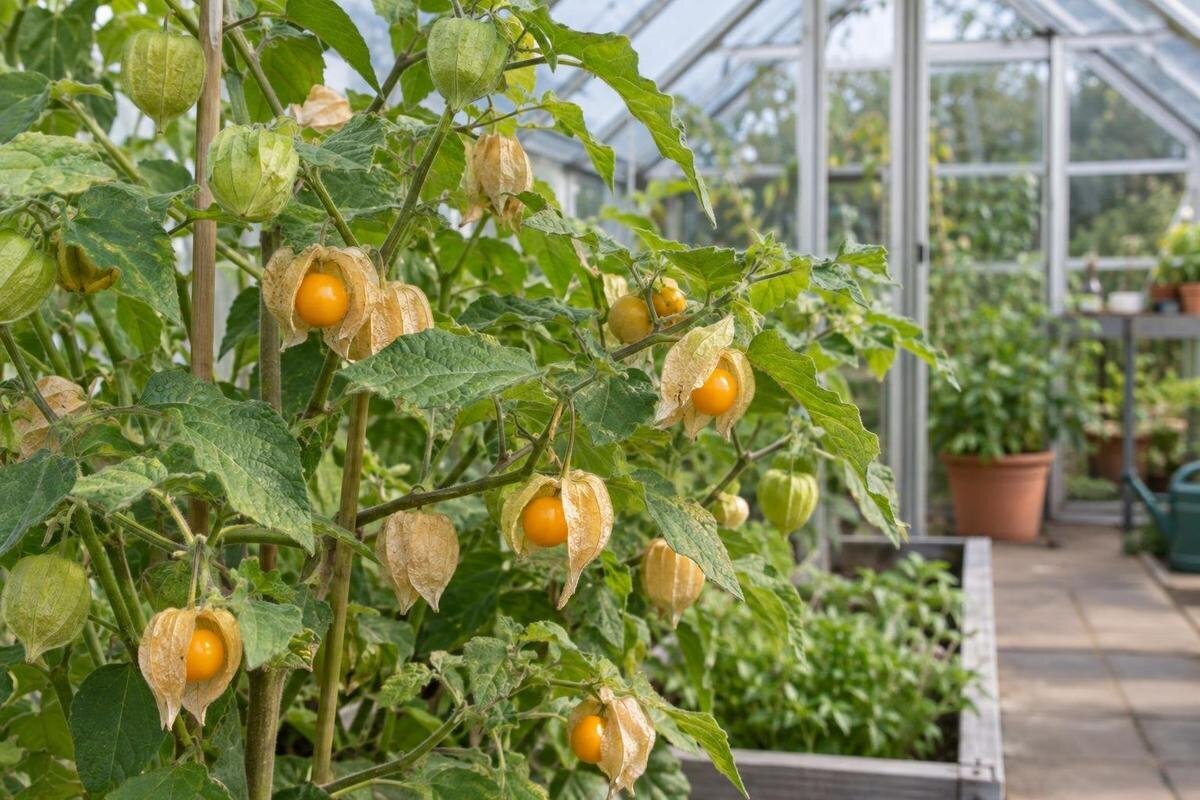
Fruit starts green and turns yellow-orange or golden as it ripens. The papery husk usually changes from green to pale straw and dries, and ripe berries often fall from the plant. Use the fruit and husk together as clues: a dry husk around a green berry does not make it ready. Open a sample husk if the colour is unclear, and taste only a fully ripe berry. Ripening is gradual rather than simultaneous, so check the plant regularly as the first fruits colour instead of stripping every husk at once.
Collect sound fruit that has fallen and remove the husk before eating; only fully ripe fruit should be used. Leave green fruit on the plant while conditions remain suitable, but do not count on a cold autumn to finish it. Ripe berries can be kept in their husks in a clean, dry place for short-term use; use damaged or damp fruit promptly. The Limited-Edition Aluminium Greenhouses with Storage range is listed from 5.52 m² to 28.08 m². A storage label does not establish food-storage conditions, so handle harvested fruit separately and check product details for any intended use of that space.

Troubleshoot poor fruit set and slow ripening
Flowers that drop before fruit forms can point to changing conditions rather than a single missing nutrient. Review cold nights, excessive heat, dry compost, persistently wet soil and whether insects can reach the flowers. Make one adjustment at a time and watch fresh flowers; heavy feeding or pruning will not correct a temperature problem. Check leaf undersides for common greenhouse pests such as aphids or whitefly, particularly if growth is distorted or sticky. Remove badly damaged material and clear fallen leaves and fruit from the base so you can spot changes early.
If fruit has formed but remains green late in the year, the likely constraint is the length and warmth of the season. Note when sowing and flowering began; next year, sow earlier only if there is enough light, or choose a sunnier position if one is available. Review feeding too, as abundant soft growth can indicate excess nitrogen. There is no reliable last-minute feed or pruning cut that will make immature berries ripen. Assess the season honestly before deciding whether extra heat would be worthwhile or another crop is a better fit.
Can you overwinter Cape gooseberry?
In frost-free climates, Cape gooseberry can live for more than one season, but it is vulnerable to cold. An unheated greenhouse in Ireland should not be treated as a guaranteed winter shelter: temperatures can still fall low enough to damage the plant. Overwintering requires a bright place that remains frost-protected and a plan to move or protect the plant before cold weather arrives. A pot is easier to relocate than a greenhouse-bed specimen, though a large, branching plant can be awkward to move and may bring pests indoors.
For many growers, planning a fresh sowing each year is simpler than expecting an unheated greenhouse to preserve the previous plant. Judge the crop by the amount of ripe fruit, not by how many berries formed while still green. A few notes on sowing, first flowers and first ripe fruit can show whether an earlier start or warmer position is worth trying next season. If you cannot supply a long, warm growing period, keep Cape gooseberry as an experiment rather than relying on it for a predictable autumn harvest.
Frequently asked questions
Can I grow Cape gooseberries in an unheated greenhouse in Ireland?
Possibly, particularly in a sunny, mild year and with an early start. An unheated greenhouse gives shelter but cannot guarantee warm nights or enough time for fruit to ripen before autumn. Treat the crop as a trial if you cannot provide extra warmth.
When should I sow Cape gooseberry seeds?
Sow in late winter or early spring if you can give seedlings warmth and good light. February or March may suit a bright propagation space, but a later sowing is better than raising weak, stretched seedlings in poor light. Plant out only when local frost risk has passed.
Do I need more than one plant for pollination?
Cape gooseberries are generally self-fertile, so a second plant is not normally needed just to set fruit. Insects can help transfer pollen, though, and a closed greenhouse may receive fewer visitors. If flowers open without setting, gently tap the flowering stems while the blooms are open and dry.
How can I tell when a Cape gooseberry is ripe?
Look for a yellow-orange or golden berry inside a husk that has turned pale and papery. Ripe fruit often falls from the plant. A dry husk around a green berry is not enough to show that it is ready; use both the berry’s colour and the husk as signs.
Do Cape gooseberry plants need support?
Support is useful because the plant branches and can spread into paths or neighbouring crops. Put a sturdy cane, freestanding frame or cage in place while the plant is still small, then tie stems loosely as they grow. Avoid severe pruning, which can remove flowering shoots.
Allow a full growing season for Cape gooseberries rather than fitting them into space left over in summer. Start early in bright warmth, give the branching plant independent support, keep flowers accessible and wait for golden fruit with a drying husk. An unheated greenhouse may deliver a worthwhile harvest in a favourable year, but if fruit regularly remains green by autumn, adjust sowing and siting first. Add heat only if the crop justifies the extra commitment.
