
How to Grow Cucamelons in a Greenhouse
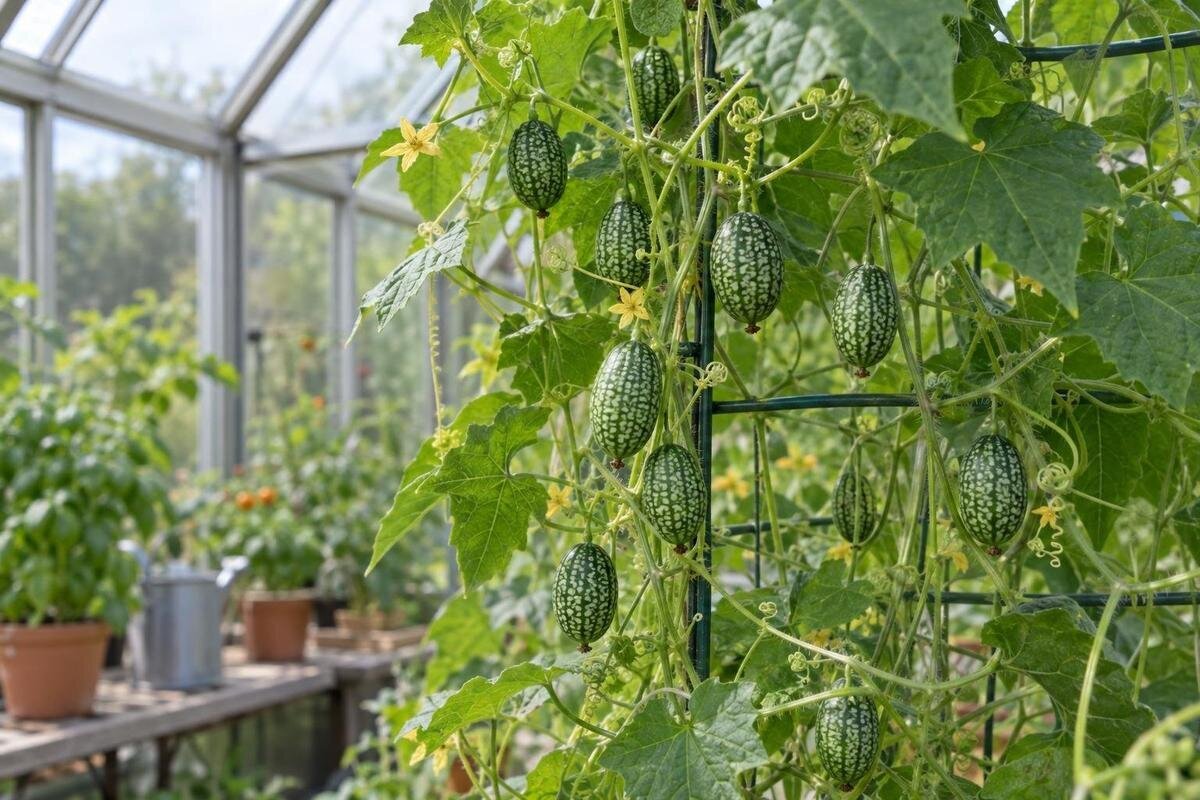
Cucamelon growing guide
Cucamelons are small, cucumber-like fruits on vigorous climbing vines, so a greenhouse can make them easier to train and pick. In Ireland, though, an unheated greenhouse does not guarantee a warm growing season: it can heat in sunshine and cool again overnight. Success depends on sowing in warmth, delaying planting until conditions are suitable, providing secure vertical support and picking fruit while it is still small and crisp. This guide covers the crop from seed to the final harvest, with space-saving advice for a modest protected growing area.

Will an unheated greenhouse suit cucamelons in Ireland?
Cucamelons (Melothria scabra), also called mouse melons, are tender, warm-season climbers. They need warmth and a reasonably long, bright spell to flower and ripen fruit; long periods of low light can hold them back even when the leaves look healthy. A greenhouse shelters plants from much of the rain and wind and warms quickly in sunshine, but that warmth is not stored indefinitely. Temperatures may fall at night, especially during a run of cool, cloudy weather. An unheated structure is not automatically frost-free or suitable for early planting. Treat it as protection from exposure and a way to use sunny spells, not as a heated growing room.
Use a minimum/maximum thermometer in shade at the height of the future plants and check overnight readings across several days; a comfortable midday temperature says little about the coldest part of the day. Keep the thermometer away from direct sun and cold glazing so its readings better reflect the plants’ surroundings. Delay planting if nights inside remain chilly or the growing medium feels cold, even if seedlings are large. Timing varies with the greenhouse, local exposure and the season, so a fixed date can only be a guide. If warmth is unreliable, keep young plants in a bright, sheltered place until conditions improve.
Choose a bright site and plan the floor space
Choose the brightest practical position for the greenhouse, away from shade cast by buildings, walls and trees wherever possible. Cucamelons need good light to flower and ripen; a shaded corner may produce plenty of leafy growth but delay fruit. Check the site at different times of day, and think about how nearby trees will shade it when they are in leaf. If you are growing other tall crops, consider their mature canopy too, so the vines do not shade smaller plants. Keep the crop reachable for watering and picking, and leave doors and vents accessible for ventilation on warm days.
Mark out the bed or pots, trellis base and the route you need for access before choosing planting positions. You can use empty pots to test whether the planned layout leaves enough room to move and pick. Allow space around the vine for harvesting and airflow; do not count the whole floor as crop area. Models in the Aluminium Greenhouses range are listed from 3.77 m² to 28.08 m², but that range alone cannot show how a bed, pots and aisle will fit in a particular size. Compare the specific dimensions and layout of the version you are considering. One well-positioned vine is more manageable than several plants squeezed into the brightest strip.
Allow room for roots and a climbing support
A cucamelon climbs above ground, but it still needs room at its base for roots, watering and airflow. In a bed, use the seed supplier’s spacing guidance and leave enough room to inspect and pick each plant; avoid packing several vines shoulder to shoulder. In a container, choose a roomy pot with drainage and generally grow one vine per pot rather than sharing a small volume of compost. Container-grown plants can dry out sooner than those in a bed, so plan to check them more often. Place the pot where its support will not block a path, door or vent, and make sure you can reach the fruit once the vine is established.
Install a strong trellis, netting or other suitable vertical support before the vine becomes tangled. Make it high enough for the growth expected from your seed variety and stable enough to remain upright as foliage and fruit develop. The Lean-to Greenhouses listings cover 3.69 m² to 14.34 m² of floor area; that figure does not tell you the usable height or whether a greenhouse frame can carry a crop support. Check the specific measurements and manufacturer’s guidance before attaching anything to a structure. If permitted fixing points are unclear, use a separate support that stands securely without relying on the frame.
Sow indoors when you can keep seed warm
Start seed indoors in late spring, counting back roughly four to six weeks from when you expect to plant out. That is more useful than sowing very early to a fixed date, because young cucamelons can become leggy or root-bound while waiting for a cold greenhouse. Sow in individual small pots of fresh seed compost, about 1 cm deep, and keep them warm—around 20–25°C is a useful germination range—and evenly moist, not waterlogged. Cool compost can slow emergence even when the air feels comfortable. One seed per pot avoids later root disturbance; if you sow extra for insurance, remove weaker seedlings by snipping them at compost level.
After emergence, move pots into the brightest place you can provide while keeping them warm; turn them if growth leans towards the light. Keep compost just moist and do not leave the pots sitting in water. Germination may be uneven, so follow the seed packet and allow time before deciding a pot has failed. Seed raising takes little room, while mature plants need a permanent position, trellis and access. The Limited Edition Aluminium Greenhouses are listed from 3.77 m² to 28.08 m²; compare the plan for a particular size to distinguish bench space from the area needed for mature vines.

Harden off seedlings before planting out
Harden seedlings off over seven to ten days by introducing them gradually to brighter light, cooler air and more movement while protecting them from cold nights. If you raised them indoors, begin in a sheltered, bright place or in the greenhouse during mild daytime conditions, then bring them back to warmth if nights turn cold. Hardening off is not a reason to expose tender plants to frost. Wait until frost risk has passed and the greenhouse remains mild overnight; an unusually sunny day is not enough. A gradual change reduces the shock of moving plants from steady indoor warmth to a less predictable growing space.
Water the pots before transplanting and handle each rootball gently. Set the plant at about the same depth it was growing, firm the compost or soil around it and water at the base. Choose either a bed or a large container with drainage; do not crowd the stem against a wall or into the aisle. Set the vine beside its support from the start, rather than trying to thread it through later. When comparing room for a bed, containers and a path, the T-Shaped Orangery Greenhouse listings range from 16.52 m² to 30 m². Identify the growing area within the chosen layout and leave enough clearance to carry pots to their positions without catching seedlings on the support.
Water consistently and feed with restraint
Rain does not reach plants under cover, so you are responsible for watering even when the garden has had a shower. Check compost or soil with a finger rather than following a fixed daily schedule; water when the root zone is beginning to dry, then let excess drain. Containers can dry quickly on a bright day, so check them more often in warm weather. Pay particular attention after a sunny spell or when the greenhouse has been ventilated. Water at the base rather than routinely wetting leaves, and avoid leaving pots standing in runoff. Large swings between very dry and saturated compost can stress the plant and contribute to poor growth.
Once plants are established, feed modestly with a fertiliser suitable for fruiting crops, following its label for dilution and frequency. Heavy feeding is not a shortcut to harvest: too much nitrogen can favour leafy growth over flowers, while excess feed can build up in a container. Apply liquid feed to moist compost rather than a bone-dry rootball. If storage is part of your greenhouse comparison, the Limited-Edition Aluminium Greenhouses with Storage are listed from 5.52 m² to 28.08 m². Check the specific layout so you can distinguish the storage provision from the growing footprint, and use fertilisers only as labelled.
Train vines while keeping the canopy open
Guide new stems towards the trellis every few days while they are soft enough to position. Cucamelons use tendrils to grip, but a loose, soft tie can help a leader stay on course; leave slack so it does not bite into a growing stem. Weave or spread growth across the support instead of letting several stems bunch into one dense patch. Keep fruit-bearing growth reachable from the aisle, and check that ties have not tightened as stems thicken. Routine hard pruning is not needed for a small crop; remove dead or damaged material and redirect healthy stems rather than cutting them back heavily.
For a vertical crop, compare internal height as well as floor area. The Spacious Greenhouse is listed in sizes from 47 m² to 70 m², but those figures do not state headroom, and a few cucamelon vines do not in themselves require a large footprint. Open vents or doors on warm days where conditions allow, and keep the path clear so the canopy does not become a barrier to air movement. Close the greenhouse as the day cools while continuing to monitor temperatures. A loose, well-spaced canopy is easier to inspect and less likely to stay damp.
Pollination and fruit set under cover
A cucamelon plant typically bears separate male and female flowers on the same vine, so one plant can set fruit if pollen reaches the female flowers. Insects usually transfer the pollen; under cover, they may have fewer opportunities to reach flowers if doors and vents stay shut. The female flower is identifiable by the tiny swelling behind its petals, which becomes the fruit; a male flower has no swelling. Look at several flowers before deciding a plant has failed to set. Flowers can be easy to miss among leaves, so check along the trellis rather than looking only at the plant tips.
If flowers appear but the tiny fruits do not develop, check warmth, light and watering as well as pollination; poor set is not automatically a feeding problem. If pollination appears to be the problem, touch a small, clean brush to a freshly opened male flower, then gently to a freshly opened female flower to transfer pollen. Repeat with newly opened flowers if needed, taking care not to damage the petals. When choosing a greenhouse for insect-pollinated crops, check how its openings work. The Pyramid Greenhouse listings range from 5.53 m² to 18.9 m², but floor area alone says nothing about insect access or ventilation.

When and how to harvest cucamelons
Pick cucamelons while they are small, firm and bright green with darker stripes. A ripe fruit is usually around 2–3 cm long, roughly grape-sized; wait too long and it may turn yellow, soften and lose its crisp texture. Judge by firmness and colour as well as size, since fruit can develop at different rates on one vine. Try an early fruit to learn the stage you prefer, then lift leaves gently to check the lower parts of the plant, where ripe fruit is easily missed. Remove fruit that has become soft or yellow rather than leaving it to age on the vine.
Once the plant is producing, check it every day or two during a warm spell and pick promptly. Regular harvesting keeps the fruit at its best and avoids leaving older fruit hidden in the canopy. Use small scissors or snips if stems resist, supporting the vine with your other hand rather than tugging it down from the trellis. Frequent picking also makes it easier to notice flowers and new fruit before they are buried in foliage. Make sure there is room to turn and reach both sides of the plant. The Bloomcabin Prestige Greenhouse listings span 3.77 m² to 28.08 m²; check the chosen plan for a usable picking route, not just planted area.
Troubleshoot poor fruiting and finish the crop
If a vine produces lots of leaves but few fruits, review its light, night warmth and pollination before changing the feed. Cold nights, too much shade, irregular watering or unpollinated flowers can each hold back cropping. Inspect leaf undersides for aphids or other sap-feeding insects, and look for powdery mildew or persistently damp foliage. Improve spacing and ventilation where possible, and remove badly damaged leaves with clean tools without stripping healthy growth. Identify a pest before choosing a treatment. Use any plant-protection product only for the stated crop and problem, following its label; avoid spraying flowers when pollinators are active.
In a typical unheated Irish greenhouse, plan for cucamelons as a tender annual rather than assuming the plant will survive winter under cover. Production slows as light and warmth decline, and frost can end the crop even inside a greenhouse. Harvest what remains while fruit is firm, then remove the vine when it has finished or been damaged by cold. Healthy plant material can go to an appropriate compost system; dispose of diseased material according to local guidance. For another season, consider whether your sowing and planting dates gave the crop enough warm growing time.
Frequently asked questions
When should I sow cucamelon seeds in Ireland?
Sow indoors in late spring, roughly four to six weeks before you expect to plant out. Use that as a guide rather than a fixed date: wait until your greenhouse is staying mild overnight and frost risk has passed before moving seedlings into their final position.
Can cucamelons grow in an unheated greenhouse?
They can, if the growing season is warm and bright enough, but an unheated greenhouse does not guarantee mild nights. Use a minimum/maximum thermometer and delay planting if conditions remain cold. A later crop is more realistic than leaving young plants to struggle.
Does one cucamelon plant need another for pollination?
A plant typically produces separate male and female flowers on the same vine, so it can set fruit on its own. Insects usually transfer the pollen. If fruit fails to develop, try hand-pollinating freshly opened flowers with a small, clean brush.
How tall should a cucamelon support be?
Choose a support tall enough for the growth expected from your seed variety and stable enough to stay upright. Check the greenhouse’s internal height and guidance on attachment points; do not assume its frame is designed to carry a crop support.
When are cucamelons ready to pick?
Pick them when they are firm, green with darker stripes and about 2–3 cm long. They become less crisp as they grow larger and may turn yellow and soften. Check the vine often once fruiting begins.
The best results come from matching sowing and planting dates to conditions in your greenhouse, then keeping the vine reachable from first flower to final pick. In a cool year, a later start and a modest harvest are sensible outcomes; cucamelons still make an enjoyable use of vertical space when the season cooperates.
