
Preventing Hard-Water Blockages in Greenhouse Emitters
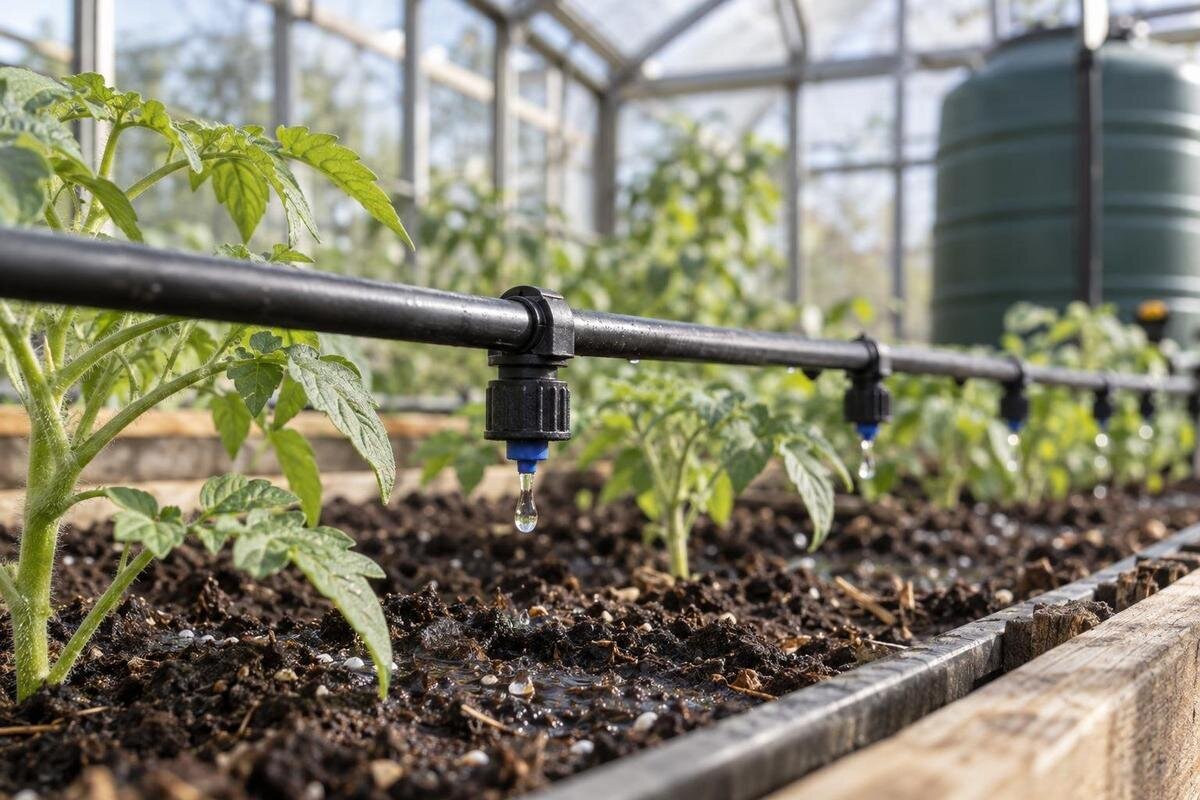
Greenhouse irrigation
Hard water can contribute to restricted greenhouse emitters, but a slow dripper does not prove that mineral scale is the cause. Test the water feeding the system, compare flow at matching outlets and distinguish dissolved minerals from debris, pressure problems or damage. Once the cause is clearer, use the maintenance method approved for the exact filter, line and emitter in place.

Why hard water can affect greenhouse emitters
Hard water contains dissolved calcium and magnesium. While these minerals remain in solution, they are not particles that a mesh filter can catch. A deposit forms only when some dissolved material leaves the water and settles on a surface. Whether that happens depends on the wider water chemistry and operating conditions. Hardness is relevant, but alkalinity and pH help explain the potential for certain mineral deposits. A high hardness result is a reason to look more closely, not proof that a blocked emitter contains scale. Two supplies with similar hardness can behave differently, and low flow can have another cause.
Emitter outlets have narrow passages, so a deposit that builds at or inside an outlet can reduce the opening and change the amount of water delivered. The effect may develop unevenly: one outlet can slow before another, rather than every dripper stopping together. That pattern is not unique to scale. Fine sediment, organic matter or biofilm can also restrict flow, while a kink or damaged tube can change delivery further upstream. A filter designed for suspended particles generally does not remove calcium and magnesium already dissolved in water. A clean screen therefore does not rule out mineral deposits, and a dirty screen does not establish that minerals are the problem.
How to recognise a blocked emitter
A weak stream, intermittent drips or no output can indicate an emitter problem, but one observation is not enough to identify the cause. Compare several outlets of the same type, in the same irrigation zone and under the same operating conditions. Record whether the issue affects isolated points, the end of one line, a whole branch or every zone. Note the position of each affected emitter rather than relying only on plant appearance; a plant showing signs of water stress does not identify where an irrigation fault lies. A pattern across matching outlets is more useful than a single comparison between different lines.
Give affected outlets simple identifiers so you can return to the same points for a second comparison. Include a nearby outlet that appears to be working normally, and note whether the weak output persists or was only a brief observation. For a new Prestige Greenhouse with Metal Base, available in areas from 3.77 to 28.08 m², use the selected footprint to mark where these observation points will sit among the beds or pots. The purpose is to make each outlet easy to find again, not to infer how many emitters the greenhouse needs. Keep notes on visible symptoms separate from possible causes: “less water than the neighbouring outlet” records an observation, whereas “blocked by scale” assumes a diagnosis. Check any user-serviceable parts only as their maker permits.
Test the water entering the system
Take a sample from the water that actually feeds the emitters. If irrigation uses a mains supply, a well, stored rainwater or a blend, sample the relevant source; a convenient tap elsewhere may not represent it. Ask for water hardness, alkalinity and pH. Hardness describes calcium and magnesium, while alkalinity helps interpret carbonate and bicarbonate chemistry; pH is another part of the picture. Electrical conductivity (EC) or total dissolved solids (TDS) can indicate the overall amount of dissolved material, but neither identifies which minerals are present. No single reading tells you everything about scaling risk.
Use a water test kit as directed or arrange a suitable laboratory analysis if results are unclear or you are considering equipment changes. Keep the report, units, date, source and sampling point together; results are easier to compare when the method and units are consistent. If a tank is blended with mains water, test the blend supplied to irrigation as well as the separate sources when that difference matters. When planning water supplies for the Spacious Greenhouse, which has listed areas from 47 to 70 m², identify the intended sampling point alongside the supply arrangement. This keeps the water record tied to what will actually feed the lines. Label results clearly as source water or blended irrigation water rather than filing both under “greenhouse water”. Retest after a material source change, and retain the earlier report for comparison rather than assuming it still describes the current supply.
Use the irrigation layout to locate the fault
Use the irrigation layout to distinguish a local blockage from a shared restriction. Trace the path from the supply through any tank, filter, valve or regulator to each branch and emitter. Mark where the flow problem starts and whether affected outlets sit before or after a shared component. If several emitters on one branch are low, the issue may lie in a part common to them; if one differs from its neighbours, a local obstruction or faulty outlet is possible. These are leads for checking, not diagnoses. Changes in pressure or a restriction elsewhere can create a similar pattern.
An equipment diagram, if supplied, can clarify which parts belong together; otherwise make a simple labelled sketch and update it as the system changes. Avoid assuming that visually similar lines have the same parts or maintenance requirements. If you are considering the Aluminium Classic Greenhouse, its listed area options of 3.77 to 28.08 m² provide a starting point for drawing the planned growing space. Add the irrigation route separately, showing branch connections, filters and any approved test points. A greenhouse outline and an irrigation diagram serve different purposes: one locates the growing areas, while the other lets you trace what several weak outlets have in common. Use the same branch names on the drawing and in your flow records, so a fault described in your notes can be located without retracing every pipe.

Compare flow and pressure consistently
Compare flow with a repeatable method. Collect water from several similar emitters in identical marked containers for the same timed interval, with the system running in its normal configuration. Use matching outlets in the same zone and keep controller and valve settings unchanged during the comparison. Record which point each sample came from and repeat a reading that looks unusual. These relative measurements can show whether output differs along a line; they are not a substitute for the emitter maker’s specified operating conditions. A baseline from a clean, normally working system makes later changes easier to spot.
Pressure and flow are related but are not the same measurement. If the manufacturer provides a permitted pressure range and a measurement point, compare actual readings with those instructions rather than adopting a generic figure. Do not attach a gauge or alter fittings unless the equipment guidance allows it; ask an irrigation professional where measurements are uncertain. The listed footprints for Lean-to Greenhouses range from 3.69 to 14.34 m². When arranging irrigation within your chosen footprint, leave access to permitted measurement points and enough room to place collection containers beneath the outlets being compared. Record pressure and timed output separately, including the units used for each. Also note whether other zones were running, so a later comparison uses the same operating conditions. If those conditions differ, flag the difference rather than treating the readings as a direct measure of deterioration.
Check the filter and the equipment instructions
Before cleaning anything, identify the make and model of the filter, tubing and emitter, then find the instructions for each component. Check whether an emitter is intended to be cleaned or replaced and whether a filter screen or disc is user-serviceable. The method for opening, rinsing or reinstalling one part may not suit another, even if the fittings look alike. Keep manufacturer labels or records where possible, especially if the system contains components added at different times. This avoids treating all blocked outlets as if they had the same design.
Some systems permit a specified clean-water flush or a particular rinse; others give different instructions. Follow only the process allowed for the exact system, and do not push a pin or wire into an outlet unless its maker explicitly directs it, as changing the opening could affect delivery. If you are choosing from the Limited Edition Aluminium Greenhouses, listed from 3.77 to 28.08 m², keep the greenhouse specification separate from the information for any irrigation equipment you select. For each serviceable irrigation part, record its model, permitted maintenance method and replacement reference together. This is particularly useful when a filter and emitters come from different manufacturers. After maintenance, compare output with the earlier measurements and note what was actually done. If a part needs replacement, use its component details to check compatibility rather than choosing a fitting solely because it looks the same.
Avoid guessing at chemical treatments
Do not choose a chemical treatment from a hardness number or an online recipe. Vinegar, acids, household descalers, chlorine products and other chemicals are not interchangeable, and materials used in emitters, seals, filters, valves and pipes may respond differently. A substance that dissolves one type of deposit could damage a component or change the water in a way the system is not designed to handle. Even if the deposit looks chalky, appearance alone does not confirm its composition. Keep chemical soaking, injection or flushing off the maintenance plan unless the relevant equipment maker approves it.
If analysis suggests mineral scaling, give the water report and a parts list to the system manufacturer or a qualified irrigation specialist before considering treatment. Ask whether a proposed method addresses the specific water problem, is compatible with every wetted component and has a clear way to assess the result. Do not guess at concentrations or contact times. For irrigation planned in a T-Shaped Orangery Greenhouse, with listed area options from 16.52 to 30 m², build that parts list as the system is selected rather than trying to reconstruct it after a blockage. Include filters, valves and seals as well as the visibly affected emitters. Approval for treating one removable component should not be read as approval to circulate the same substance through the whole system. Keep any approved treatment instructions with the relevant component record, including whether they apply to cleaning a separate part or to an installed system.
Account for the water source and the full system
Check how water reaches the system as well as where it originates. Mains water, well water, stored rainwater and blended supplies can have different mineral and particle profiles, so a result from one is not automatically valid for another. With collected rainwater, distinguish the collection route, storage and final irrigation supply: leaves or sediment introduced along that route are a different issue from dissolved hardness. Note any switching or blending of sources so that a change in output can be compared with the supply in use at the time. Changing to another source does not, by itself, establish that an existing restriction has cleared. The outlets still need to be assessed under comparable operating conditions.
Review every component between source and outlet: storage, filters, valves, pressure-control equipment, tubing and emitters. A filter selection should follow the irrigation maker’s requirements; filtration for sediment does not equal treatment for dissolved hardness. For a Pyramid Greenhouse, listed in areas from 5.53 to 18.9 m², consider the route from the intended water supply to the growing space when planning irrigation. Include components outside the greenhouse on the system drawing, rather than starting the record at the first indoor branch. This gives you a complete route to follow when several outlets lose flow together. Use the supplied system diagram or confirm compatibility with the equipment supplier rather than pairing parts by appearance. If you change the source or replace an upstream component, note exactly what changed and take fresh flow readings so the record describes the new arrangement.

Set a maintenance routine from your records
Keep a maintenance log that gives you a comparison point instead of relying on memory. Note the water source and any test results, date, zone, emitter positions sampled, timed output, pressure readings if taken, filter condition and work carried out. Record whether flow improved after a manufacturer-approved cleaning or part replacement. These details can reveal a gradual decline or show that a blockage follows a particular supply. Use the equipment maker’s recommended inspection and service intervals, adapting attention to observed changes rather than assuming one calendar suits every water source and system.
Use the log to separate routine observations from events that warrant another comparison. An isolated poor reading, a repeated decline at the same outlet and a drop across several branches are different patterns; record them as such rather than simply marking the system “blocked”. If you are planning irrigation for one of the Limited-Edition Aluminium Greenhouses with Storage, listed from 5.52 to 28.08 m², assign zone and outlet identifiers once the chosen layout is installed and use them consistently in the log. Recheck after a source change, system alteration or maintenance task, using the same measurement method where possible. Keep the original baseline as well as subsequent readings, so an improvement after cleaning remains visible in the record. There is no universal cleaning frequency that can be inferred from floor area or a hardness result alone; the useful interval is grounded in the equipment guidance and the changes you observe.
When the same emitters block again
If the same emitters become blocked again soon after permitted cleaning, pause before repeating the same intervention. Compare new flow measurements with the original baseline and check whether failures cluster by branch, emitter type or source. Review the latest hardness, alkalinity and pH results alongside any recent water-source change; confirm that the filter, pressure conditions and emitter model match the instructions. A recurring pattern may point to a common upstream issue or an unsuitable component rather than a need for stronger cleaning. Record both the work already carried out and how long any improvement lasted, so a supplier or specialist can assess the sequence rather than just the latest symptom.
When asking for help, provide the water report, a labelled irrigation sketch, component make and model, and comparable pressure or flow readings. Ask whether the evidence points to mineral scale, sediment or a wider delivery problem, and which maintenance step is approved for the exact parts. This gives a professional something concrete to assess without assuming a treatment in advance. Prevention is a cycle of testing, observing and following equipment guidance: the cause should explain both the water results and the pattern of reduced output.
Frequently asked questions
Can a standard filter remove dissolved hardness?
A screen or mesh filter can catch particles within its design, but dissolved calcium and magnesium pass through many physical filters. Check what your filter is intended to remove; do not assume that a finer screen removes dissolved hardness.
Will rainwater stop greenhouse emitters from blocking?
Not necessarily. Rainwater can have a different mineral profile, but collection and storage may add debris, and the supply may be blended with another source. Test the water that actually enters the irrigation system and follow the equipment maker’s filtration guidance.
Does a white deposit prove that hard water caused a blockage?
No. A pale residue can suggest mineral deposits, but appearance alone does not identify its composition. Sediment or organic matter can also restrict an outlet. Check the water and compare emitter flow before choosing a maintenance method.
Can I use vinegar or descaler to clear a dripper?
Do not assume either is safe. Emitters, seals, filters and tubing may use different materials, and a treatment suitable for one part may not be approved for another. Use a chemical only if the relevant equipment maker confirms it is compatible.
How often should I clean or flush emitters?
There is no universal interval for every water source and system. Follow the maker’s service guidance, keep a record of flow and maintenance, and review the system if measurements change. Flush only where the instructions permit it.
Preventing hard-water blockages is a monitoring process, not a one-off cleaning trick. Establish what is in the water, record normal output and use the service method approved for the equipment. If restrictions return, investigate the source and flow pattern instead of repeating an unverified treatment. Matching the water results to the observed fault helps separate mineral deposits from debris or a wider delivery problem.
