
Heated Propagator or Heated Greenhouse for Sowing Seeds?
Seed-starting equipment
Whether a heated propagator or a heated greenhouse is the better place to sow depends on how much space needs warmth, how many sowings overlap and where seedlings will go after emergence. A propagator concentrates heat around a limited number of trays; heating a greenhouse means managing a much larger environment. The useful comparison is not simply which option feels warmer. It is whether your setup covers germination, provides suitable conditions afterwards and does so across only the area you need.

A propagator heats trays; a greenhouse warms a wider space
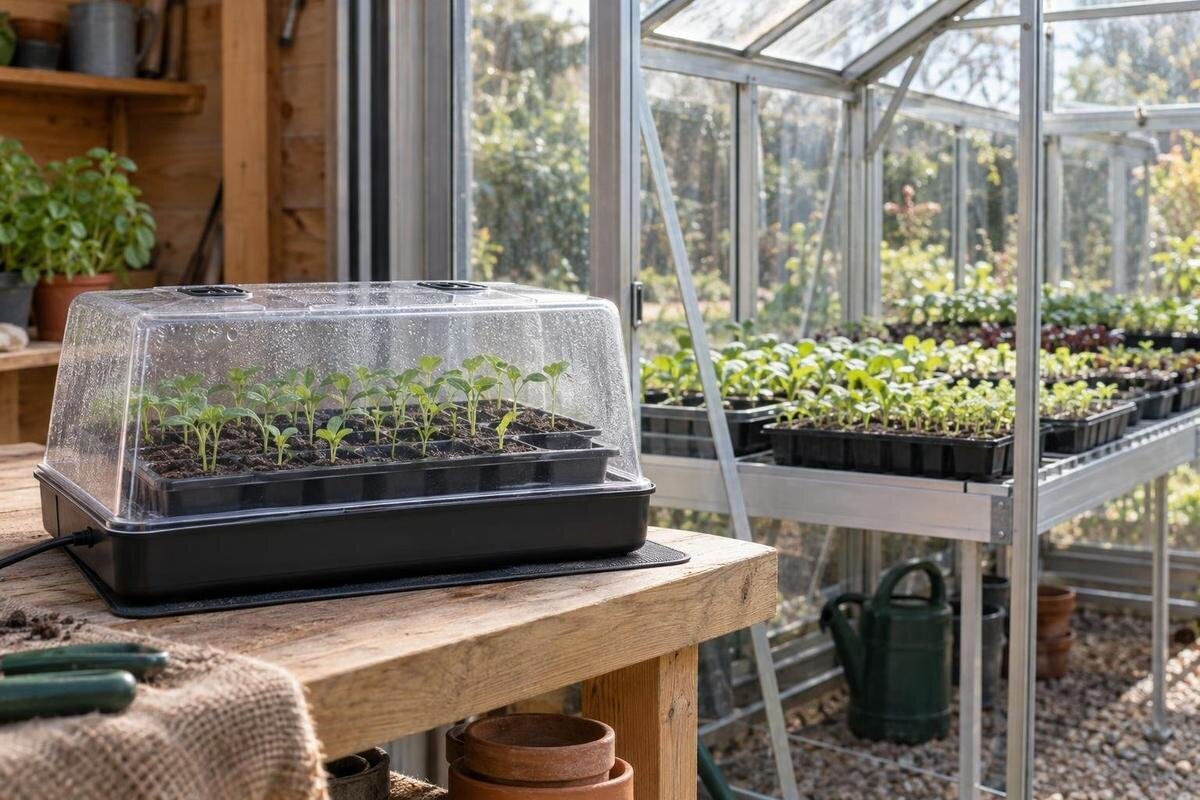
The main difference is the area being heated. A propagator heats a compact tray area, often through a warmed base, but models differ. Check the tray footprint, temperature controls and operating instructions rather than assuming every unit works in the same way. It can create a sowing environment warmer than the surrounding room without heating an entire greenhouse. It does not provide extra bench space, and it cannot solve a lack of light after germination. Its value depends on the number and size of trays that fit, and on whether you already have somewhere suitable to keep the seedlings once they emerge.
A heated greenhouse warms a much broader environment, with air and surfaces to manage as well as trays. That can suit a nursery used for successive batches, but it involves more space to heat and monitor. The Aluminium Greenhouses range from 3.77 m² to 28.08 m², offering different enclosure sizes to consider. The important distinction is between buying that growing space and equipping it for heated propagation. A greenhouse provides the enclosure; your trays, benches, heater and controls determine how you use it. Compare the listed area with the nursery you need, rather than treating a larger greenhouse as a direct substitute for a larger propagator.
Estimate how many trays need warmth at the same time
Count the trays you expect to have in the warm zone at once. Sowing dates can overlap if one batch has not left the propagator when the next is due, so a list of seeds may understate the space you need. Check each tray’s outside dimensions, not just its cell count, and allow practical access to lift covers, label rows and water carefully. A tight fit can make routine inspection awkward. If only a few trays need warmth, whole-greenhouse heating may provide more heated space than the sowing task requires.
For a greenhouse, compare the stated footprint with the space available on site, then assess bench surfaces and access separately. The Lean-to Greenhouses range from 3.69 m² to 14.34 m², but the stated area is not the same as clear bench space. Use your tray dimensions to sketch the intended arrangement, including room to lift covers and remove a tray without disturbing its neighbours. Leave a route for checking seedlings without moving other batches. Note how the intended sowing area relates to light and draughts: space that is physically available may not be a suitable position for every tray.
Check the propagator’s controls and tray capacity
A propagator is most useful when you need a local warm start for a limited number of trays. Before choosing one, check whether the tray base fits, whether a cover is included, how temperature is controlled and how many trays it can accommodate. Do not assume that every model has an adjustable thermostat, a particular temperature range or a light source. Read the instructions for the exact unit. A cover can help retain humidity, but it does not remove the need to check compost moisture and inspect seedlings. Condensation under a cover is not, by itself, a sign that the tray is receiving the right care.
Use crop-specific sowing guidance rather than one universal setting. Seeds differ in how much warmth they need, and compost temperature can differ from the surrounding room temperature. If the unit has an adjustable control or probe, follow the maker’s instructions on setting and monitoring it; a dial position from another grower may not measure the same thing. Keep crops with similar requirements together where possible and label each tray with the crop and sowing date. Once growth appears, reassess the cover and temperature in light of the crop guidance and available light. Germination is the propagator’s main job; it is not automatically the right environment for every seedling indefinitely.
Whole-greenhouse heating needs a separate assessment
Heating a greenhouse changes both the scale and the goal. It can maintain warmer air around pots and work surfaces, which may help when several batches need a protected growing-on area. But the enclosure exchanges heat with the outside. Its size, glazing, gaps, door openings, ventilation and intended conditions all affect how it behaves. A greenhouse may feel warmer near a heater than elsewhere, and the number on a control does not prove that compost on every bench matches it. Plan whole-space heating for the exact enclosure rather than choosing equipment by a general rule based only on floor area.
The Limited Edition Aluminium Greenhouses cover areas from 3.77 m² to 28.08 m². When considering an option in that range, distinguish the greenhouse specifications from the requirements of the proposed heating setup. The stated floor area does not establish heat retention or heater capacity. Have the proposed heater and controls assessed for the chosen enclosure by a qualified professional, taking account of the conditions you intend to maintain. If electrical equipment is involved, ask a qualified electrician to confirm that the supply and installation are suitable, and follow the equipment maker’s instructions. This assessment belongs with the heating plan, rather than being inferred from the greenhouse model name.

Germination and seedling growth have different requirements
Germination and seedling growth are related stages, but their temperature requirements can differ. Use the seed packet or reliable crop-specific guidance to understand what a batch needs before emergence. Once seedlings appear, light, air movement and suitable moisture matter alongside temperature. Warmth is not beneficial without limit: seedlings kept warm in dim conditions can become leggy. Different crops may also have different needs in the same sowing period, so one greenhouse setting should not be treated as right for every tray simply because it helped one batch germinate.
Ask what the heat must do, and for how long. If the aim is to warm compost in a small area until germination, a propagator targets that task. If several trays also need managed warmth after emergence, a heated greenhouse may make sense, provided it can offer the other growing conditions they need. Some growers use a propagator for germination and then move seedlings to a suitable bright space. That avoids heating the whole enclosure solely for the first stage, but requires a plan for changes in temperature and light. Let crop guidance inform the transition rather than relying on an assumed date.
Plan light, ventilation and growing-on space
A larger greenhouse growing area does not guarantee sufficient light for young plants. Available daylight varies with the time of year, weather, shading and the greenhouse’s position. A warm, dim space can encourage lanky growth, so include light in the decision rather than treating it as a separate afterthought. Supplemental growing lights may be appropriate for some crops or sowing periods; requirements depend on the crop, stage and area. Choose equipment for the actual situation and follow its instructions. Do not assume that heating alone makes a greenhouse suitable for raising seedlings.
Ventilation and humidity need attention as well. A covered propagator can hold moist air around a small tray, whereas a greenhouse has a larger air space and its own balance between retaining warmth and exchanging air. Follow seed and equipment guidance on when to remove covers, and watch for condensation, drying compost or seedlings becoming drawn out. A heater reading will not show every condition. If you are considering the T-Shaped Orangery Greenhouse, available in areas from 16.52 m² to 30 m², identify where the seedlings would sit within the planned layout. Assess their access to light and ventilation there, rather than judging the nursery conditions by the overall size alone.
Heating equipment and running costs
List the equipment needed for each option before comparing costs. For a propagator, establish what the unit includes and what you must supply separately, such as trays or a cover. For a heated greenhouse, list the enclosure, a suitable heater, temperature controls and a way to monitor conditions where seedlings are growing. Add benches, trays or growing lights where your plan requires them. Separate the equipment you already own from items you would need to buy, and check the exact product listings for included accessories. This gives you a clearer comparison than setting the price of a complete propagator against the price of a greenhouse enclosure alone.
Running costs are a separate part of that comparison. A propagator targets a smaller area, but its energy consumption depends on the model and how long it operates. A greenhouse heater serves a larger enclosure, with demand affected by weather, heat loss, ventilation and the conditions you aim to maintain. For the Pyramid Greenhouse range of 5.53 m² to 18.9 m², the stated areas help identify the enclosure under consideration; they do not provide an energy-cost estimate. Compare the intended operating period as well as the equipment: brief use for germination is a different commitment from maintaining warmth through the growing-on stage. Use manufacturer information and professional advice for realistic running estimates.
Decide where seedlings will go after emergence
The propagator decision is incomplete until you know where seedlings will go after they emerge. If the greenhouse is unheated, its conditions may be cooler or more variable than the warm propagation space. A sudden change can be difficult for some crops, so use crop-specific guidance when moving seedlings to different light, temperature or airflow. If there is no suitable space afterwards, a warm propagator may only postpone the problem. Before sowing, decide whether a bright indoor position, a protected greenhouse area or managed greenhouse heating can provide the next stage, and make sure there is room for it.
Heating the greenhouse can avoid repeated movement between a warm indoor unit and a cooler enclosure, but only if it offers suitable conditions beyond the brief germination stage. Plan a growing-on area that remains accessible when other plants and equipment are in place. You need to be able to inspect and water seedlings, not merely fit their trays into the building. The Limited-Edition Aluminium Greenhouses with Storage range from 5.52 m² to 28.08 m². Check the exact layout to understand how the storage area relates to your proposed nursery space. Keep room for trays distinct from room for supplies when comparing layouts; the product name alone does not tell you how much clear bench space remains.

Greenhouse floor area is not bench capacity
A greenhouse floor plan and a bench plan answer different questions. The floor plan shows where benches, paths, door access and established plants will fit; the bench plan shows the surfaces available for trays. Keep both in view when choosing the enclosure. A layout may accommodate your sowing trays but leave little accessible space for the same batch after it moves into pots. Include that growing-on space in the comparison without assuming every part of the greenhouse must be heated. If you intend to heat only one area, do not assume that a partition or a particular temperature pattern will make it independent of the rest of the enclosure.
The Bloomcabin Prestige Greenhouse offers areas from 3.77 m² to 28.08 m². Use those figures to shortlist enclosure sizes, then compare the detailed dimensions with your proposed layout. In your buying notes, keep three things separate: the greenhouse footprint, the bench surface you plan to provide and the area that needs managed warmth. This makes it easier to see whether you are choosing a larger greenhouse for propagation or for other gardening plans. There may be good reasons to want the additional space, but they do not automatically justify heating it all. A handful of trays can still need only a compact heated area within a larger gardening setup.
Choose the heating scale for your sowing pattern
Write down your planned crop sequence and identify which batches need warmth only for germination and which also need it while growing on. Compare that pattern with the equipment you are considering. If a propagator can accommodate the overlapping sowings and seedlings have somewhere suitable to move afterwards, it may cover the heated part of the work. If several batches repeatedly need managed warmth beyond emergence, assess whether greenhouse heating would serve that wider nursery role. Where crop requirements differ, a combination may be more useful than expecting one setting to serve every tray. Make the choice for the sowings you actually intend to raise, rather than a hypothetical maximum.
A large enclosure makes the distinction between growing space and heated space especially important. The Spacious Greenhouse range covers 47 m² to 70 m², but choosing that floor area is a separate decision from heating it for seed sowing. Compare the nursery area you expect to use with the rest of your gardening plans before committing to whole-space heating. If only a small part of the sowing schedule calls for warmth, consider how a propagator would fit into that plan; if the wider nursery needs managed conditions, include it in the heating assessment. The useful measure is whether the setup supports seedlings after they emerge, not simply whether it can warm the compost at sowing.
Frequently asked questions
Can I sow every type of seed in a heated propagator?
No. Seeds have different germination requirements, so check the guidance for each crop rather than applying one setting to every tray. Where crops need different conditions, keep them separate if practical. A propagator provides a compact warm space; it is not a universal setting for every seed.
Does a heated greenhouse make a propagator unnecessary?
Not necessarily. Greenhouse heating manages a much larger area, and the air temperature may not match the temperature of compost in each tray. A propagator can still be useful for a small number of sowings, while a greenhouse may suit a wider nursery area. Some growers use both.
Should seedlings stay in a propagator after they emerge?
Reassess their needs once they emerge. Depending on the crop, a cover or the sowing temperature may no longer be suitable, while light and ventilation become increasingly important. Follow crop-specific guidance and make sure there is a suitable growing-on space before sowing.
Can I heat just one part of a greenhouse?
A propagator is one way to keep warmth around a compact group of trays. For other greenhouse heating arrangements, check that the equipment is intended for the conditions and ask a qualified professional about the setup. Do not assume that a heater or temporary enclosure is suitable without checking.
What should I check before buying a greenhouse for seed sowing?
Compare the usable area and bench layout with your trays, and consider access, light and ventilation. Check the exact product details to see what equipment is included; do not infer that a heater, thermostat, benches or lights come with a greenhouse. Have whole-space heating assessed for the actual enclosure.
Compare the two options by the stages they support. A propagator can provide targeted warmth for a small sowing area, while a heated greenhouse is a commitment to managing conditions across a larger space. Before choosing, account for the trays that need warmth at once and decide where seedlings will go after germination. If greenhouse heating is part of the plan, confirm the equipment requirements for the exact enclosure and consider light and ventilation alongside temperature.
