
One Large or Several Smaller Greenhouse Glass Panes?
Greenhouse glazing guide
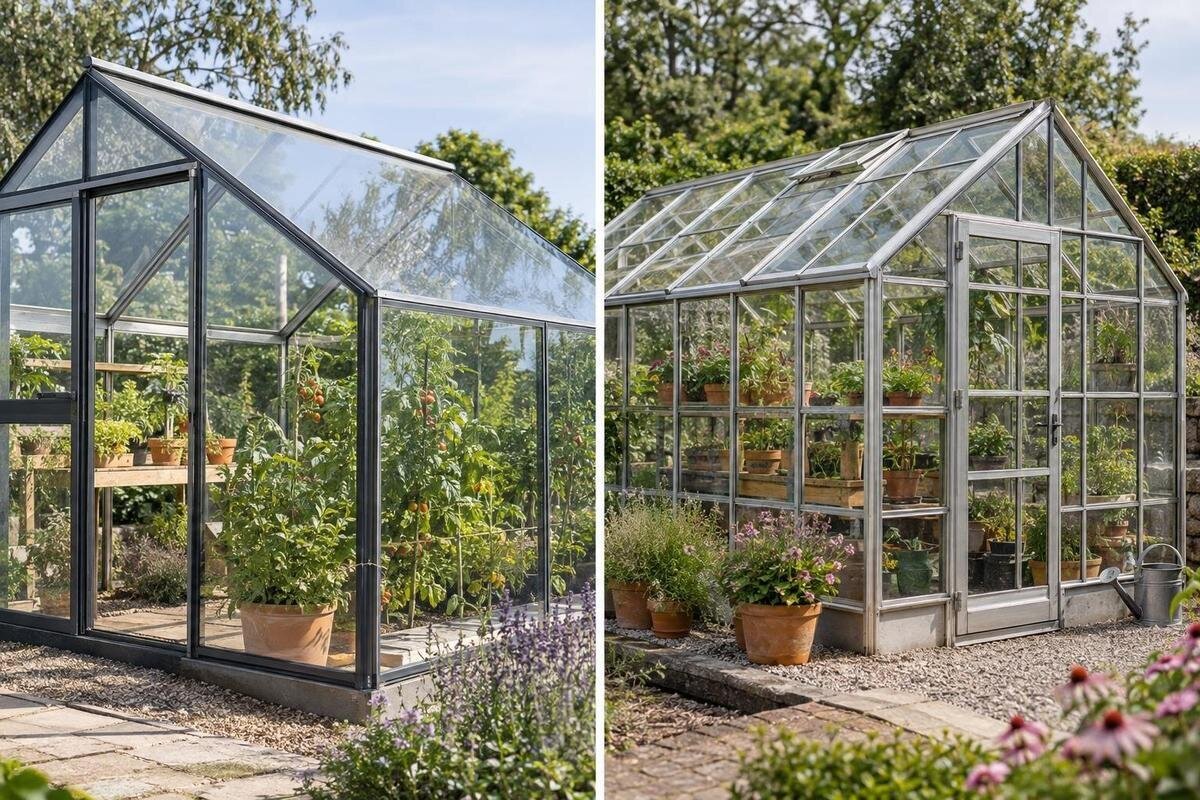
Choosing between one large greenhouse pane and several smaller ones is chiefly a decision about the frame pattern and the practicalities of moving, fitting and replacing the glass. A broad pane can give a less interrupted view; smaller panes create more visible divisions and may be easier to manage individually. Neither format is automatically safer, cheaper or better suited to every greenhouse. Compare drawings for the same model size, frame and glazing specification before judging the pane layout. Then weigh the look you want against access for delivery, routine care and the possibility of future breakage.

Identifying individual glass panes
Start by identifying the actual glass units, rather than counting apparent bays in a photograph. A wide frame opening may look like one uninterrupted area even when it is divided by bars or joints; conversely, visible frame lines do not always mean that every section is a separate pane. Use a front, side or roof elevation, plus a glazing schedule if available, to see how many pieces are fitted. Compare the same part of a greenhouse and the same overall size. Roof panels and side panels can have different counts, so do not extrapolate one wall across the whole structure.
Keep the glazing specification constant as well. Pane layout is separate from the choice of glass type, thickness or another covering, and those choices affect appearance and practical performance in their own right. Record the frame arrangement, doors and vents, and whether a quoted measurement refers to the glass itself or to the opening around it. A pane in a door or opening vent may have different dimensions and fitting details, so do not treat every piece as interchangeable. Ask which layouts are approved for the exact model and size; do not assume its frame accepts an unapproved change from several pieces to one, or vice versa.
How pane size changes the view
With the same overall glazed area, one large pane usually means fewer visual interruptions across that section. The view through a side or end wall can feel more open, allowing you to see plants and the garden without as many divisions. From outside, fewer dividing bars may give the elevation a simpler appearance. The effect is most obvious where you look through the glass at eye level, but roof bars, corners, doors and vents still break up the structure. The frame itself continues to occupy part of the view, and reflection and viewing angle affect what you notice. A large pane does not make a framed greenhouse look like a frameless glass room.
Several smaller panes create a more visible grid. Some owners prefer that ordered pattern; others find that more bars draw attention away from plants or the view. A neat grid may suit a greenhouse whose frame is an intentional feature, while someone looking across beds or a seating area may prefer fewer divisions in the main sightline. Check the spacing and alignment across the full side and roof, not just the count on one wall. When reviewing a model such as the Pyramid Greenhouse, use the drawing for the exact selected configuration to judge its glazing pattern; a product name or perspective photograph cannot confirm how individual panes are arranged.
The frame pattern matters as much as the glass
Pane size cannot be judged apart from the frame. In some designs, bars define each piece; elsewhere, a door, opening vent, ridge or roof member interrupts an otherwise broad glazed section. A larger sheet removes visual divisions only where the frame has been designed for it. Simply changing the glass while leaving its supports and retaining details untouched is not a like-for-like option. A section made up of a door or opening vent is not directly comparable with fixed glazing, because its frame contains moving parts. Note which members sit across eye-level views and how they meet the doors or vents.
Look at both the outside elevation and the view from the places where you will actually stand or work. A bar across a plant bench may matter less to one owner than a crossbar in the main view from a path; there is no universal preference. For a candidate such as the Spacious Greenhouse, compare a scaled drawing or clear elevation with the greenhouse's intended position in the garden. Check whether the roof and wall patterns align, and whether the divisions are evenly spaced or interrupted beside a door. Also consider how shelves and benches affect the view through the glass. A catalogue image is useful for style, but not a reliable pane schedule.
Use drawings to compare exact layouts
Ask for the pane layout for the exact greenhouse size and configuration, not just a general product image. Useful documents show elevations of each glazed side and roof, indicate doors and vents, and distinguish frame bays from individual panes. A pane schedule should identify quantities and dimensions; confirm whether these are glass dimensions or reference dimensions for the opening. The drawing should also make clear whether a proposed large pane changes the frame or retaining system. Roof plans matter too: a front elevation alone cannot tell you whether the same pane count continues overhead. If details are missing, do not calculate a replacement size from the visible opening or a photograph.
Compare two options side by side and mark what actually changes: pane count, the position of bars, glass specification, opening sections and any frame components. A drawing can reveal that two products with a similar silhouette have quite different layouts, or that the layout varies with model size. For a model such as the Bloomcabin Prestige Greenhouse, request the specification for the size you are considering and ask whether any alternative pane arrangement is manufacturer-approved. Establish whether the options differ only in pane layout or also in their doors, vents or frame. That distinction makes the comparison more useful than simply choosing the drawing with fewer rectangles.

What a large pane means for handling
A larger sheet is generally more awkward to control while being moved, even when the total amount of glass is no greater. Its weight depends on its size and glass specification, and its width can make doorways, turns, steps and narrow side access harder to negotiate. Large formats may also need more room to manoeuvre around corners than the finished greenhouse needs to stand. The important point is not to guess whether a pane can be carried by one person: ask for its individual dimensions and handling guidance, then consider the route from the delivery point to the greenhouse. Space to set down and protect a large piece matters too.
Several small pieces can be easier to bring through a tight route one at a time, but that does not make glazing work risk-free. Each sheet has fragile edges and needs to be kept secure; repeated lifting also adds more handling and more pieces to keep track of. If a Lean-to Greenhouse is on your shortlist, check the route to its intended location as carefully as you would for any other design, and ask the supplier or installer what the supplied pane sizes require. Confirm how the glass is packaged and handled rather than assuming. Use their instructions and competent help instead of improvising a lifting method.
What smaller panes change during assembly and cleaning
During assembly, smaller panes may be more convenient to move individually, but they increase the number of separate pieces to identify and fit. Check that the delivery schedule states the pane count and location clearly, particularly where roof, side, door and vent pieces differ. More components mean more opportunities to set the wrong piece aside or confuse one position with another. Count the pieces against the schedule before fitting, and keep the instructions with them. This is a comparison about handling and organisation, not a guarantee that one layout takes less time or is easier to install overall.
Cleaning has a similar trade-off. A small pane may be easier to reach as a single surface, while a large pane has a wider area to clean; neither removes the need to access the glass safely. More separate panes also mean more edges and frame junctions to look after, while fewer divisions may leave a broader uninterrupted surface. More junctions can make cleaning around each division slower, but that is a question of access, not a claim that dirt or water will inevitably collect there. For a candidate such as the Limited Edition Aluminium Greenhouse, check the actual bar and pane arrangement for the chosen size before assuming what routine cleaning will involve. Follow the care advice for the specified glass and frame.
Replacing glass after damage
If a large pane breaks, the replacement is one substantial unit to identify, source, transport and fit. A smaller-pane layout may allow only the damaged piece to be changed when each pane is independently retained and the surrounding frame is sound. That can limit the area of glazing involved, but it does not guarantee a quicker or cheaper repair: matching glass still has to be available, and labour and access matter. Do not assume that all glazing on one side must be replaced, or that one broken pane can always be isolated; the frame design determines the scope. For roof panes, confirm how replacement access and fitting would be managed.
Before ordering a replacement, confirm the model, the exact configuration and the pane's position, then match the specified glass type, thickness, shape and any required edge or retention details. A rough measurement of a gap is not enough to identify a suitable unit. If the Limited-Edition Aluminium Greenhouse with Storage is under consideration, ask how panes are referenced in the drawing and what information is needed to identify a replacement. The distinction between a wall pane, a door pane and a roof pane matters when describing the damaged piece. Keep people away from damaged glass and arrange help from the supplier or a competent glazier rather than improvising a substitute.
Replacement availability and records
Ask about replacement arrangements before purchase, rather than after damage. Find out whether individual panes can be ordered separately and how the supplier handles replacement enquiries for the configuration you are considering. Availability can depend on the model and exact specification, so do not assume that a generic pane of similar dimensions will fit or that a matching piece will always be held locally. Distinguish the ability to replace one pane from the availability of that pane: a layout may allow a separate unit to be changed without making it readily available. This is worth considering alongside the appeal of replacing a smaller area of glass.
Keep the final drawing, glazing schedule, order details and any markings or identification supplied with the greenhouse together. A dated photograph of each intact side can also help show which pane is which, especially where roof, door and wall pieces are not interchangeable. For an Aluminium Classic Greenhouse, as for any model, file the record against the exact size and configuration rather than relying on the range name alone. Update the record if a pane is replaced, and store it somewhere accessible after assembly. Those details give a supplier a clearer starting point than a general description such as the pane on the left.

Check the frame and glass specification together
Pane count is not a measure of structural suitability. The glass, its dimensions, the frame and its retaining details are designed to work together; a bigger sheet may require a different support arrangement, but the approved drawings—not a general rule about pane size—show what is suitable. Confirm the specified glazing for the site and intended greenhouse with the manufacturer or a qualified installer, especially if the site is exposed or the structure is unusual. Do not alter a supplied layout or substitute a different thickness or type without approval. This applies to both one-pane and multi-pane designs; neither is automatically more suitable.
Request comparable quotations only after the options are defined. A price difference could reflect the glass specification, frame changes, manufacturing, delivery or installation rather than the number of panes alone. Ask what is included and whether replacement glass can be specified by position. If a T-Shaped Orangery Greenhouse is one of the models you are considering, use its exact configuration and drawings in that comparison; the model name by itself does not establish pane dimensions or cost. Put the confirmed specifications beside each quote so that a difference in price is not mistaken for a difference caused solely by pane size.
Choose the layout that suits your priorities
Choose one large pane if an uninterrupted view is a genuine priority and the manufacturer offers an approved layout that can be moved, fitted and replaced through the access available. Choose several smaller panes if you prefer their grid, or value the possibility of replacing a separate unit, while accepting more visible bars, pieces and joints. These are tendencies, not promises: the right answer depends on the complete frame and glazing specification, plus replacement arrangements. Pane count alone does not tell you which greenhouse is safer, more durable, more energy-efficient or cheaper to own. Give those other priorities their own checks.
When the approved options meet your practical requirements, decide which differences matter most to you. Look at the greenhouse from the garden and from inside, using the same viewpoint and overall area. Someone mainly concerned with the view may place greater value on fewer divisions; someone who likes the frame pattern may prefer the smaller-pane layout. Weigh either preference against the handling route and replacement arrangements already established, rather than assuming the appearance settles every practical question. If the comparison remains close, the exact layout around the doors, vents and main sightline may be more useful than the total number of panes.
Frequently asked questions
Can I choose a large pane for any greenhouse?
No. The frame and retaining system must be designed for that pane, and a manufacturer may offer only specified layouts. Ask for the drawing and glazing schedule for the exact size; do not assume a wider piece can be substituted into an existing frame opening.
Will a large pane let more light into the greenhouse?
Not necessarily. For the same glazed area and glass specification, pane count alone does not establish light transmission. Frame bars, glass type, coatings, orientation and shading also matter. Compare the approved glazing details rather than treating a larger sheet as a light-performance upgrade.
Are smaller panes safer to handle?
They can be more manageable individually, especially where access is tight, but there are more pieces and edges to control. Safety depends on the glass, packaging, frame and handling method, not just the number of panes. Follow the supplier's instructions and use competent help where needed.
Are several small panes cheaper to replace?
Not automatically. An independently retained small pane may limit the area to be replaced, but availability, glass specification, delivery, labour and access affect the total. A large replacement pane can be more difficult to source or move, but only a like-for-like quote can settle the comparison.
Can I replace a pane with a different size or glass type?
Only if the greenhouse manufacturer or a qualified professional confirms it is an approved match for the frame and retaining details. A pane that seems to fit the opening may not be the specified size or construction. Keep the exact schedule and model details for future replacements.
The best layout is the one that suits your preferred view and works with the greenhouse's approved frame, the access available and a realistic replacement plan. Compare complete specifications rather than pane counts in isolation: that makes it easier to judge what you will see, handle and maintain over the life of the greenhouse.
