
Can Passion Fruit Crop in an Irish Greenhouse?
Edible greenhouse growing
Passion fruit can grow as a striking climber under glass, but a leafy vine and showy flowers do not guarantee an edible crop. In Ireland, success depends on whether the chosen Passiflora edulis gets enough warmth and light to flower and ripen fruit, and whether its flowers receive compatible pollen. A greenhouse gives shelter and can extend the season; an unheated structure does not recreate a warm-climate growing season.
Can an Irish greenhouse ripen passion fruit?
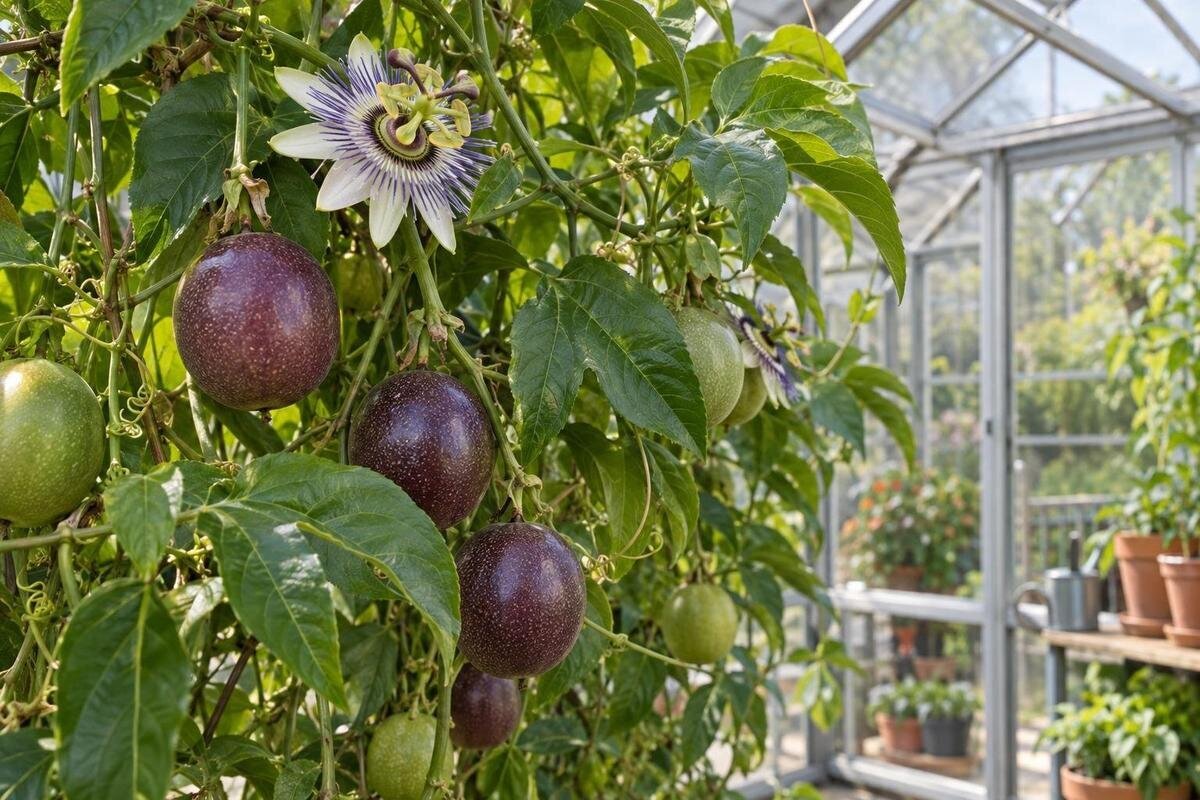
The realistic answer is yes, but not reliably in every greenhouse. Passion fruit (Passiflora edulis) is a vigorous climber in warm conditions, and under glass it may establish and flower in Ireland. Lush leaves and tendrils show that the vine is growing; they do not prove it has enough warmth and light for regular flowering or a complete crop. A healthy-looking plant can remain ornamental if cool conditions slow it at the flowering or fruit-ripening stage. Surviving in a sheltered spot and finishing edible fruit are different tests.
Think of cropping as a sequence: the plant must mature, produce flowers, set fruit after pollination and then ripen each fruit. A failure at one stage has a different cause; flowers that fall without setting are not the same problem as fruitlets that start growing and stall. Late-set fruit may have too little warm, bright time left before autumn and winter. If foliage and flowers are the main attraction, that uncertainty may be acceptable. If eating the fruit is the goal, plan for all stages rather than judging success by summer growth alone.
Choose an identified Passiflora edulis cultivar
Buy for fruit, not just under the common name passionflower. Passiflora edulis is the main cultivated passion fruit species; other Passiflora are often grown for their striking flowers, and their fruits are not interchangeable in flavour or purpose. Choose a correctly identified edible P. edulis cultivar from a reputable grower, and favour a named plant over a seedling of unknown parentage. Seed-grown vines can vary in vigour, fruit quality and time to maturity, so a seed taken from a passion fruit does not guarantee a timely crop under glass. Ask how the plant was propagated and whether it was selected for fruiting.
Ask specifically whether the cultivar is self-compatible and what winter conditions it needs. Purple-fruited P. edulis forms are commonly self-compatible, whereas many yellow-fruited forms are self-incompatible and need pollen from a compatible plant; there are exceptions. Self-compatibility does not guarantee pollination: pollen still has to reach the stigma. Check the cultivar rather than deciding from flower or fruit colour alone. If another plant is needed, ask the grower to identify a compatible partner rather than choosing a second vine simply because it is available. Current Royal Horticultural Society guidance for Passiflora can help with general care, but follow the supplier’s notes for the edible cultivar; advice for a hardy ornamental species may not suit P. edulis.
Warmth and light limit cropping
Passion fruit needs a long stretch of active growth in warmth and strong light for dependable flowering and fruit development. Irish weather can bring bright, warm spells, but an unheated greenhouse still cools at night, and prolonged dull periods reduce useful light. Glass provides shelter, not a uniform tropical climate. A plant may grow quickly in spring and summer while fruit set or ripening falls behind. Look for cultivar-specific growing requirements, including winter minima, rather than relying on broad advice that a plant enjoys a sunny position. If the required conditions cannot be maintained, expect a less predictable crop; heating cannot make up for limited light or a short season.
To understand conditions where the vine will grow, keep a min/max thermometer near the canopy and note readings through sunny and dull periods; an afternoon reading does not show the night low. Ventilation on sunny days is still needed to prevent excessive heat, so winter heating and summer air management are separate tasks. If maintaining suitable crop conditions would require installed heating, ask a qualified professional about appropriate equipment and installation. The Aluminium Classic Greenhouse range is listed from 3.77 to 28.08 m²; its floor-area options do not specify heat retention, light levels or heating provision.
Plan for winter protection
Passiflora edulis is frost-sensitive, so an unheated greenhouse should not be treated as frost-free. On a cold night, a greenhouse can lose daytime warmth quickly; exposed leaves and shoots may be damaged, and severe cold can kill or set back a vine. A plant that survives winter is not necessarily ready to crop well the following season: lost growth takes time to replace, delaying flowering and ripening. Check the minimum conditions for the actual cultivar and consider protection before planting a permanent, border-grown specimen.
A container makes a young plant easier to move to a bright, sheltered place, but that option becomes less practical once the vine has a large rootball and a long trained framework. Keeping it in a warm but very dim room may also produce weak growth; winter protection needs suitable light as well as temperature. In cooler conditions growth slows, so water carefully and avoid leaving roots persistently wet. The Lean-to Greenhouse listing covers 3.69 to 14.34 m²; its model name and area are not a frost rating, so assess the actual site and winter conditions.
Pollination determines fruit set
Pollination is a separate requirement from warmth. Greenhouse doors and vents may allow insects in, but visits are not guaranteed, and a flower may not set if compatible pollen does not reach its stigma. First check the cultivar information: a self-compatible plant can set using its own pollen, while a self-incompatible one needs pollen from a compatible plant flowering at the same time. Adding a second vine helps only if the plants are compatible and their flowering overlaps. Do not assume that two plants will solve the problem without checking their pollination requirements.
Watch fresh flowers as they open because passion fruit flowers are short-lived. If insect access is poor, hand-pollination can be tried: use a clean, soft brush to collect pollen from the anthers and lightly transfer it to the receptive stigmas, following the cultivar’s instructions. For a self-incompatible variety, use pollen from a compatible plant, not simply another flower on the same vine. Mark treated flowers and note whether they swell; this helps distinguish a pollination issue from a later ripening problem. With two vines, label each clearly so you know which plant supplied the pollen. Before committing to a cultivar that needs a partner, consider whether you can check both plants during flowering and reach their open flowers. A second plant takes up growing space, but its presence alone does not complete the pollination task. Check that flowers will be reachable in your chosen layout. The Limited Edition Aluminium Greenhouse options are listed from 3.77 to 28.08 m².
Allow for the vine’s mature size and support
A passion fruit vine needs room above its pot or planting bed as well as floor space. Tendrils attach to nearby supports, while the main stems and side shoots can quickly form a dense canopy. Plan where the framework will run, how high it can be maintained and how to reach leaves, flowers and fruit without leaning against glazing. Dense growth can shade other crops and obstruct vents, so account for a mature canopy rather than the small plant bought at the nursery. The support must suit the chosen greenhouse and be fixed in a way approved for that structure; do not assume glazing bars can carry a mature vine.
Choose between a permanent border position and a container after considering winter management. A border gives roots a stable home but leaves the plant in place; a container can be moved while the vine is small, though it needs careful watering and becomes heavy and awkward as the plant grows. Keep a clear working route and decide where pruning waste and fruit can be handled. On a sketch, mark the root position, support line and the space you will stand in when tending the vine. Include neighbouring pots and beds rather than drawing the climber in an otherwise empty greenhouse. If moving the container for winter is part of the plan, trace its route to the doorway and consider how the trained stems would be released from their support. This makes the practical limits of a movable plant easier to recognise before it becomes established. The T-Model Orangery Greenhouse is listed in floor areas from 16.52 to 30 m²; confirm internal dimensions and how a support can be accommodated in the selected layout instead of inferring headroom from its area.
Position the vine for light and steady root conditions
Give the vine the brightest practical position, with direct light for much of the day where possible. A shaded corner or a position behind tall plants can leave a vigorous vine short of light for flowers and ripening. The greenhouse itself may shade parts of the growing area at different times, so observe the site through the day before choosing a permanent spot. Keep flowering shoots reachable for inspection and pollination, and avoid letting the vine shade smaller crops or cover ventilation openings. Bright sun through glass can make the air hot even when outdoor conditions feel mild, so provide suitable ventilation.
Use a fertile growing medium that holds moisture but drains freely. Aim for even access to water, not waterlogged roots or repeated drying followed by soaking. Containers can dry faster than a greenhouse border on bright days, so check the root zone regularly and adjust watering to the plant and weather. Feed according to a suitable fertiliser label; excessive nitrogen can encourage leaves and long shoots at the expense of flowering. The Bloomcabin Oasis Pyramid Greenhouse range is listed from 5.53 to 18.9 m²; compare the selected floor plan with room for a pot or border, trellis and access.
Train and prune the vine carefully
Train the main stems along the planned support while they are young, guiding rather than pulling them around the framework. Keep side growth distributed so flowers remain visible and reachable, and remove shoots that tangle with vents or block the working route. Tendrils can grip a trellis, but they are not a reason to let the vine spread uncontrolled across the roof. A manageable framework makes it easier to inspect flowers, handle pollination, spot damaged growth and pick fruit without disturbing neighbouring plants. Check the support as the vine grows rather than waiting until the canopy is dense.
Prune to manage the framework, not to make a large vine small in one severe cut. Passion fruit generally flowers on fresh growth produced from established stems, so indiscriminate cutting can remove shoots that would bear flowers. Remove dead, damaged or badly placed growth and shorten overlong laterals in stages, using the supplier’s cultivar guidance for timing. Avoid encouraging tender regrowth just before cold conditions. If storage is part of your greenhouse comparison, the Limited-Edition Aluminium Greenhouse with Built-In Storage range lists floor areas from 5.52 to 28.08 m²; consult the actual plan to understand the space available for cultivation and access.

Why flowers or fruit fail to develop
Use the point of failure to narrow the cause. If the plant produces leaves but no flowers, consider maturity, light, temperatures, excessive nitrogen and whether recent pruning removed too much of the framework. A young seed-grown vine may take longer than a named nursery plant to reach flowering size. If flowers form but fall without swelling, revisit cultivar compatibility and pollen transfer, then consider whether conditions were too cool or hot while they were open. Change one factor at a time where possible; adding more feed will not fix absent pollen or poor light.
If small fruits set and then fall or stop developing, review changes in watering, sudden temperature swings and how late in the season they formed. Fruit needs a warm period to mature, and its final colour varies by cultivar; green fruit is not automatically ripe. For many types, a change to the characteristic mature colour is a useful clue, but check the cultivar’s own ripeness cues. Note flowering dates, pollination attempts, fruit growth and greenhouse night lows in a simple diary. The Bloomcabin Prestige Greenhouse range is listed from 3.77 to 28.08 m²; use the exact chosen plan when considering room to inspect and maintain the plant.
Decide whether you want flowers or a harvest
Before dedicating greenhouse space, decide whether success means an attractive flowering climber or fruit you intend to eat. For the first goal, an uncertain crop may be a fair trade if the plant is correctly identified and can be overwintered. For the second, work backwards: confirm a fruiting cultivar, plan compatible pollination, check how much warmth and light it needs, then decide whether you can provide those conditions for long enough. If you cannot, choose another crop for harvest and enjoy passion fruit as an experiment rather than relying on it. Decide how much growing space and ongoing care you are willing to devote to that experiment. Consider what would occupy the same area if you did not plant the vine, especially where a permanent framework would limit future planting choices. You can value the flowers while still setting a separate goal for fruiting. Keeping those aims distinct helps you decide whether to retain a healthy but unproductive vine or use the space differently.
A long-lived vine also competes for headroom, light and access, so sketch its mature framework before selecting a greenhouse or planting position. Do not size a structure from the vine’s height at purchase, and do not treat catalogue floor area as a statement of internal height or climate. For comparison, the Bloomcabin Orangerie Spacious Greenhouse is listed in sizes from 47 to 70 m²; that larger area is an option to assess against a whole growing plan, not a requirement for one passion fruit vine. Check exact dimensions, openings and the intended support arrangement for the model and configuration you are considering.
Frequently asked questions
Can passion fruit crop in an unheated greenhouse in Ireland?
It can, but a dependable crop is uncertain. An unheated greenhouse may protect the vine from some weather without providing the warmth and light needed for fruit to set and ripen. A named cultivar and a favourable season improve the prospects, but do not guarantee them.
Do I need two passion fruit plants?
That depends on the cultivar. Some are self-compatible, while others need pollen from a compatible plant flowering at the same time. Even a self-compatible plant needs pollen to reach its flowers’ stigmas. Check the cultivar’s pollination information before buying another vine.
Can I eat fruit from any passionflower?
No. Passionflower is a broad common name for different Passiflora species, and ornamental plants should not be assumed to produce fruit with the same qualities as edible passion fruit. Confirm the species and cultivar before growing a plant for food.
Why does my passion fruit vine flower but not set fruit?
Possible causes include a lack of compatible pollen, poor pollen transfer, or unsuitable conditions while the flower is open. Check the cultivar’s pollination needs and whether insects are visiting. If fruits begin to form and then fall, review watering and temperature changes as well.
How long does passion fruit take to ripen?
It varies with cultivar and growing conditions. Fruit needs time after pollination to mature, and cool or dull conditions can slow that process. In Ireland, late-set fruit may not ripen before the season turns. Check the cultivar’s ripeness cues rather than relying on a single rule for colour.
Passion fruit can crop in an Irish greenhouse when the cultivar, warmth, light, pollination and growing time all come together. The main uncertainty is that a sheltered, leafy vine may still fail to ripen fruit, particularly without winter protection or enough heat and light. Choose the plant for its edible-fruit credentials, plan its mature framework and judge the project by the conditions you can actually maintain, not by flowers alone.
