
Planning Greenhouse Grow Bags: Root Volume, Drainage and Support
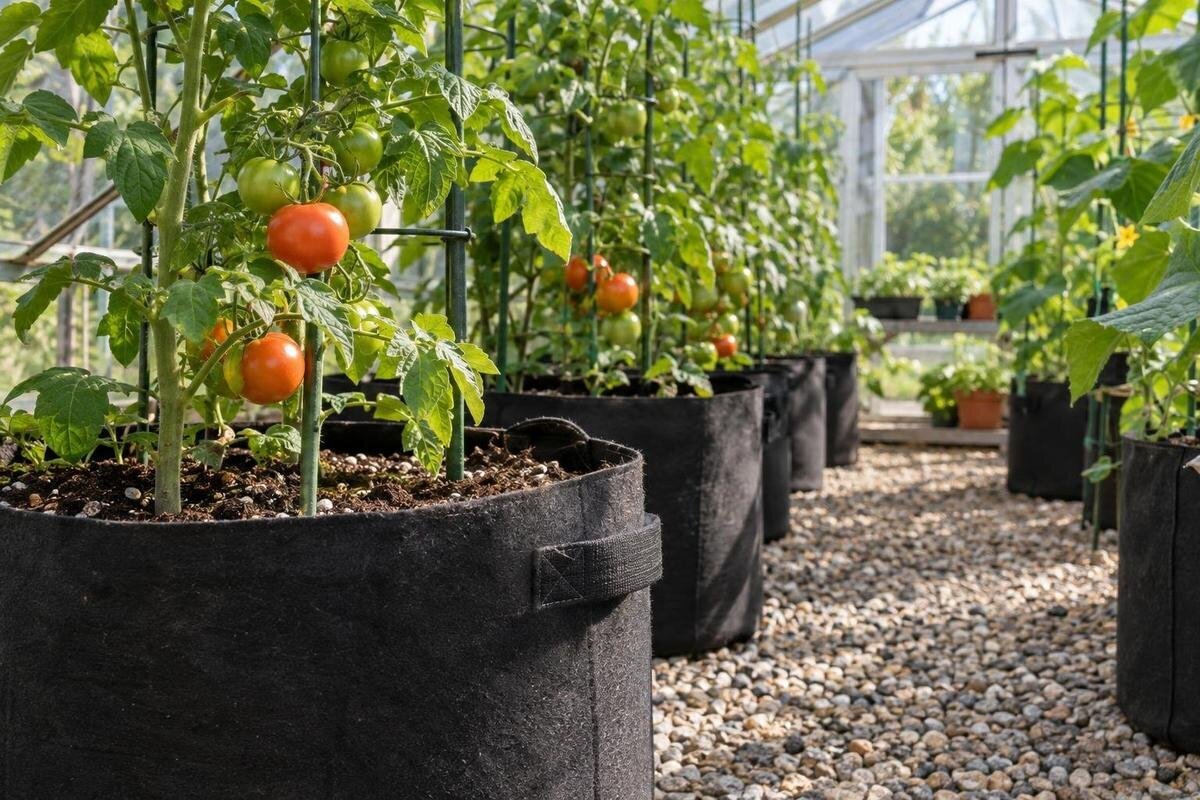
Greenhouse growing guide
Grow bags can make a greenhouse planting plan easier to change, but each bag puts a boundary around a crop’s root space. A bag label, its outside measurements and a greenhouse’s floor area describe different things. Calculate the fillable litres first, compare them with the crop’s root needs, then make room for paths, drainage and support. The worked figures below are hypothetical: they show how to compare bags with a permanent bed, not how much growing medium a particular crop requires.

Root volume depends on the crop
Root volume means the amount of growing medium roots can explore, not the number of bags or the greenhouse floor area. In a permanent bed, roots may extend through a connected soil profile where conditions allow; a bag confines them to its filled space. That boundary affects the moisture and nutrient reserve available around each plant, and neighbouring plants cannot use the same medium unless they share a bag. A larger volume on paper is not automatically better if the medium settles, compacts or stays saturated. Treat each bag as a separate root zone when you plan.
Work back from the crop, cultivar and intended plant count. Consult crop-specific horticultural guidance for rooting depth, spacing and container volume; there is no dependable litres-per-plant figure for every vegetable or variety. A long bag does not automatically suit several vigorous plants, just as a shallow bag may not provide enough depth for a crop that roots deeply. Read the label carefully: it may state a nominal capacity, outside dimensions or maximum fill. If it gives only dimensions, ask how much medium the bag holds in its normal filled shape. Use that fillable capacity for the volume comparison, rather than assuming every litre in a nominal figure will be available to roots. Record the intended plant count alongside it so that a shared bag is not mistaken for several separate root zones.
How much medium will each bag hold?
Where a bag is close to rectangular, estimate its gross capacity by multiplying its filled length, width and depth in centimetres, then dividing by 1,000. The result is litres. For example, 60 cm × 30 cm × 25 cm gives 45,000 cm³, or 45 litres. This is only a geometric estimate: a flexible bag may taper, bulge or have rounded corners, and it may not be intended to be filled to the rim. Use the maker’s stated capacity where available, then distinguish that figure from the amount of medium you will actually add. The bag’s shape, headspace and settled fill all affect practical volume.
For a like-for-like layout, imagine two permanent beds, each 0.6 m × 3 m and 25 cm deep. Together they contain 0.9 m³, or 900 litres. Eight bags with the dimensions above hold at most 360 litres at 45 litres each; if filled to 22 cm, their calculated total is 316.8 litres. The beds and bags use the same two growing strips in this example, but the bags hold less medium. These figures are illustrative, not a crop recommendation: the media, usable depth and root access differ. The next section shows how the eight bags fit on paper.
Paths change the number of bags that fit
Use the internal clear measurements for the exact greenhouse size, not its outside footprint. Mark the door opening, vents, existing shelves or benches, and the route you need to reach the back row. The Classic aluminium greenhouse range is listed from 3.77 m² to 28.08 m², but floor area is not a bag-capacity guide: it does not tell you the usable width or how doors and fixed features affect planting space. Get the measurements for the selected size and draw them before deciding how many containers will fit.
Here is a simple plan, not a recommended greenhouse size. Imagine an internal width of 1.8 m and a length of 3 m. Keep a 0.6 m centre aisle and assign the remaining 0.6 m strip to each side. Put one row of 60 cm × 30 cm bags along each outer edge, with the 60 cm side running down the length. With 15 cm between bags, four fit in each row, using 2.85 m, so the plan holds eight. The remaining 30 cm between each row and the aisle is reach space, not another planting row. Check it against mature foliage and everyday access; door clearance and space at the ends may reduce the count.
Grow bags compared with permanent beds
Bags and beds offer different kinds of control. In bags, each crop or group has a defined quantity of medium; you can set out different sizes and leave unplanted areas. The boundaries also separate root zones, so plants do not draw on a larger shared bed. A permanent bed provides a continuous profile for roots to explore where conditions allow, but its position and depth are fixed. It is worth comparing the effective depth and volume, rather than just the length of a planting row. A bed may also be simpler to manage as one growing area, while bags require you to fill and place separate containers.
The Lean-to greenhouse range is listed from 3.69 m² to 14.34 m². Compare the exact internal plan for the size you are considering with both the bed and bag footprints. Draw each option on the same plan, retaining the same aisle and door clearance, so that the comparison does not give one system more planting space than the other. For bags, mark each container separately; for beds, show the continuous growing area and its usable depth. If either arrangement sits along one side, check that you can reach all the plants without stepping into the growing area or shifting containers. Compare the eight-bag example with the two beds on that basis: both occupy the same side strips, but they provide different volumes and leave different gaps within those strips. Those gaps matter for handling containers even though they do not add root space.

Drainage and runoff in a greenhouse
Drainage depends on both the filled bag and the surface beneath it. A bag may release excess water through openings or through its material, depending on its design, so check the maker’s instructions rather than assuming how it drains. Keep any outlet clear of folds or a surface that blocks it. A tray can catch runoff, but it should not leave the bag’s base standing in collected water. Check the arrangement after watering, when you can see whether water is escaping as intended and whether the bag remains stable.
Decide where runoff will go before filling several bags. If they drip into a narrow aisle, the floor can become awkward to use; if you use trays, plan how to check and empty them without lifting full containers. The Limited Edition Aluminium Greenhouses range is listed from 3.77 m² to 28.08 m². On the plan for your selected size, draw the trays as well as the bags: their edges may extend beyond the container footprints. Leave access to the part of each tray you will use for emptying it, and consider whether a neighbouring bag or support would obstruct that task. Check the arrangement after watering rather than assuming that an empty tray will remain easy to reach once plants have grown. If water pools or an outlet is blocked, inspect the placement and bag guidance before changing your watering routine.
Watering each bag as a separate root zone
Treat every bag as its own moisture zone. Two bags filled from the same mix can dry at different rates if one gets more sun or airflow, contains a larger plant, or sits near a door or vent. A dry surface does not necessarily show how moist the medium is around the roots, and the nearest bag is not a reliable guide to the rest. Check within the root zone using a consistent method suited to the medium, and note which positions dry first. The aim is to respond to the crop and its growing conditions, not to follow one timetable for every container.
Watering access belongs on the floor plan. Make sure you can reach the farthest bag and see whether water has wetted the medium evenly. If using a hose or drip system, check both near and far points rather than assuming each outlet behaves alike. The T-Model Orangery Greenhouse is listed from 16.52 m² to 30 m². Map the watering route for your chosen size and arrangement, including where you will stand to reach each row. A route that works with empty bags may become awkward when foliage and supports occupy the space above them. Keep the watering points accessible without moving full containers or reaching through another crop. Label the bags on your plan and use those same labels in your watering notes; this makes it easier to distinguish a consistently drier position from an occasional difference between plants.
Support for taller greenhouse crops
Plan support for a mature crop, not just a seedling. Tall or climbing plants may need a stake, trellis or another support, with the choice depending on growth habit and crop guidance. A support pushed into soft medium can tilt if the bag moves or the crop pulls against it; inserting a stake after roots are established can also disturb them. Decide where the support will sit before filling and planting. Keep it clear of drainage outlets and make sure the filled bag remains stable. Do not treat a handle or rim as an anchor unless the bag maker says it is designed for that purpose.
Do not use a greenhouse frame as a support point simply because it is nearby. Suitability for crop ties or a separate trellis depends on the model and its designated fixings; ask the greenhouse supplier or a qualified installer before attaching loads. The Oasis Pyramid Greenhouse range is listed from 5.53 m² to 18.9 m², but its area range does not identify attachment points or load capacity. A support spanning several bags can also transfer movement between them, so check bag stability as well as the fixing method.
Wet bags and floor capacity
Litres measure volume, not weight. Growing medium becomes heavier when wet, and its weight depends on the mix and the water it holds. A bag that is easy to carry dry may be awkward to move after watering, so decide on its final position before filling where possible. Do not assume a bench, shelf or suspended staging can take several wet bags just because one container fits on it. The combined load of a group of bags is a separate question from the root volume each crop needs.
The Limited-Edition Aluminium Greenhouses with Storage range is listed from 5.52 m² to 28.08 m²; neither the area figures nor the model name state a floor or bench rating. Check the relevant documentation for the greenhouse and any raised surface you plan to use. If load information is not available, ask the manufacturer or a qualified professional before placing wet growing medium on a bench or shelf. Check the supporting base or floor as well if its capacity is uncertain.

Access for crop changes and bag handling
Grow bags offer more layout flexibility when empty than when planted and wet. Plan how you will remove old plants, supports and used medium, and where a bag can be set down during that work. A row that uses every corner may look efficient on paper but leave no route to clean or refill the next container. Keep a clear work area near the door or aisle, and label bags so you can identify their crop and medium when changing the planting plan. If a bag is meant to stay in place, allow room to do the work there without blocking the route through the greenhouse.
The Bloomcabin Prestige Greenhouse with Metal Base is listed in areas from 3.77 m² to 28.08 m². Check the selected size against the carrying route from the door to each row, not just the total floor area. Measure the width of any tub or container you plan to use when handling medium, and keep the route clear of supports and plants. Think through the order of the work: where you will put removed supports, how you will take used medium out, and how you will bring fresh medium to the empty bag. These temporary handling spaces need not remain empty all season, but they must be available when you change crops. A workable layout lets you reach and remove a bag without stepping through another growing area or dismantling unrelated supports. Test that route for the back row as well as the containers nearest the door.
Match the growing layout to the greenhouse
Bring the measurements together in one plan: crop and plants per bag; target root volume from crop-specific guidance; actual fillable litres; bag footprint; number of bags; aisle and access; runoff destination; and support location. Keep gross estimates separate from figures taken from a bag label or measured plan. This lets you compare alternative arrangements, including a permanent bed, without confusing floor area with root volume. If the crop needs more medium than the bag can provide, fewer plants or a bed may be more suitable than trying to fit extra plants into each container.
The Spacious greenhouse range is listed from 47 m² to 70 m². Use the internal dimensions for the selected size to test your arrangement, keeping the volume calculation separate from the floor plan. For the worked example, record eight bags, their intended fill depth and the resulting total litres beside the drawing; record the two bed dimensions and their 900-litre total beside the alternative. This makes the trade-off visible without suggesting that either total is a universal crop requirement. If you change the bag size, fill depth or plant count, update the comparison rather than carrying the original figures into a different layout. Confirm support and load questions separately. The finished plan should explain not only how many bags fit, but also how you will reach, water, support and eventually empty each one.
Frequently asked questions
What does a grow bag’s usable volume mean?
It is the amount of growing medium the bag can hold in its intended filled shape, rather than the capacity suggested by its outside measurements. Check whether a stated litre figure is a fillable capacity or a nominal calculation, and allow for the bag’s shape, headspace and settled medium.
How many plants should go in one grow bag?
There is no reliable number for every crop. Plant count depends on the species, cultivar, mature size, root habit and the bag’s actual volume. Use crop-specific spacing and container guidance; a long bag does not automatically provide enough root space for several vigorous plants.
Do grow bags need drainage trays?
A tray can catch runoff, but it should not leave the bag standing in collected water. Keep drainage outlets clear, check the bag maker’s instructions and decide where excess water will go before filling the bags.
Are grow bags better than permanent greenhouse beds?
Neither is automatically better. Bags provide separate root zones and can be rearranged when empty; a permanent bed provides a continuous volume of growing medium. Compare crop needs, usable depth, total volume, access, watering and the work involved in changing the growing system.
Can I attach crop supports to the greenhouse frame?
Only if the greenhouse manufacturer confirms that the chosen model has suitable fixing points for that purpose. Do not infer load capacity from the frame’s appearance or the greenhouse’s floor area. Otherwise, choose an appropriate independent support and check that it will keep the crop and bag stable.
Good grow-bag planning works from the crop back to the greenhouse: establish the root space needed, calculate the medium each bag will actually hold, then test the bag footprints against the internal plan. A permanent bed may provide a larger connected volume; bags divide the medium into separate root zones and can be rearranged when empty. The practical choice is the layout that leaves access, gives water somewhere to drain and provides stable support without relying on an unverified fixing point.
