
Growing Under a Rain Shelter or in a Greenhouse?
Growing conditions
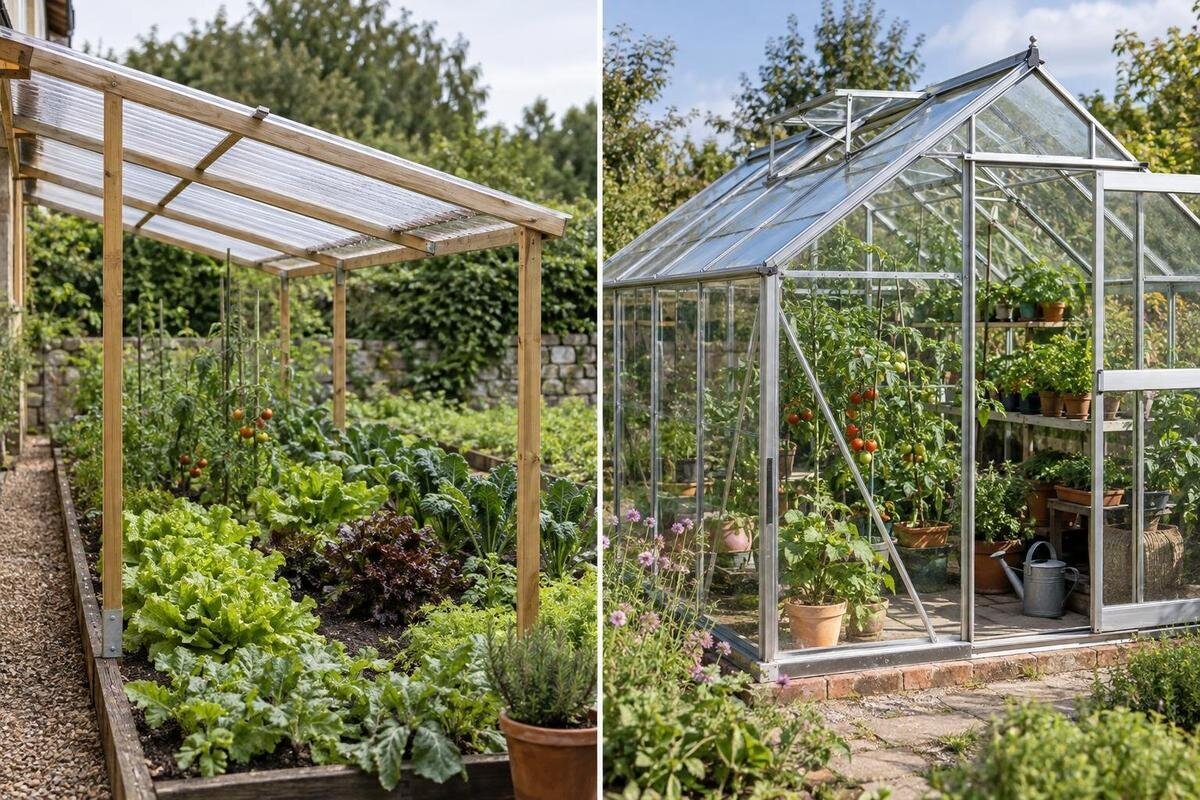
Both a rain shelter and a greenhouse can keep direct rain off crops, but they create different growing conditions. A simple crop shelter usually covers a bed from above and leaves its sides open; a greenhouse encloses a growing space and gives you more ways to manage air exchange. The first can solve a specific problem with rainfall. The second may provide a more sheltered place to raise and tend plants, and can extend the useful growing period for some crops. Neither guarantees warmth, dryness or frost protection. The crop, site, daily routine and actual structure matter more than the label.

Before you choose 1
The difference is how much of the crop area is enclosed
In this comparison, a rain shelter means a roofed crop cover with open sides, rather than a sealed tunnel or a small cloche. Designs vary, so check the drawing for the structure you are considering. A shelter intercepts rainfall that would otherwise land directly on the planting area, while wind and outdoor temperatures still reach the crops. A greenhouse has a roof and sides around a growing space, with a door and, depending on its design, vents or other openings. That enclosure reduces exposure to some weather but creates a space whose heat and humidity can differ from those outside.
Think of the choice as a difference in purpose, not a ranking. If your priority is to keep direct rain off a particular crop while retaining outdoor conditions, a shelter may be enough. If you want somewhere to start plants, work in poor weather or reduce exposure to wind and rain, a greenhouse offers more scope, with more active management. Greenhouse sizes also vary: the Aluminium Classic Greenhouse range is listed from 3.77 m² to 28.08 m². Consider whether you need cover for one bed or an enclosed space for several growing tasks before comparing sizes.
What a rain shelter protects and what it leaves exposed
An open-sided shelter can prevent much of the direct rainfall reaching the crops beneath it, which is useful when wet weather is the problem you want to address. It may reduce rain splash onto leaves or fruit, depending on the shelter’s width, height and exposure. The protection remains local: water can blow in at the sides, and a roof does not block low temperatures, strong wind or sudden changes in outdoor conditions. An exposed edge may leave plants less protected than those in the middle. Judge the cover by the crop area it reaches and the weather it can intercept, rather than treating the name rain shelter as a guarantee that plants will stay dry.
Less rain on the bed also means you cannot assume natural rainfall will keep the root zone moist. Water arriving under the edges may be uneven, so it is not a reliable substitute for watering. Check how water leaves the covered area and where it collects; do not assume the structure directs it away. Open sides usually allow freer air exchange and make access straightforward, but they also leave crops exposed to outdoor wind and temperature. For crops that can grow outdoors through the main season, that trade-off may suit the job. For tender plants needing more protection, an open cover may not be enough.
Before you choose 2
A greenhouse changes the growing environment
An enclosed greenhouse excludes more direct weather, but it does not make conditions constant. Sunlight passing through the covering can warm the interior, sometimes quickly, while plants and damp soil add moisture to the air. When the greenhouse is closed, heat and humidity can build; when it is open, outside air and wind enter. At night, an unheated structure can cool down, and wind-driven rain may still enter through open doors or vents. Conditions can also vary between sunny and shaded parts of the space, so one reading may not describe what every plant experiences. Actual conditions depend on construction, glazing, openings, siting and operation.
The useful difference is that you have more ways to manage air exchange and shelter plants from some weather. That is not the same as guaranteed temperature control or complete weatherproofing. When considering the Limited Edition Aluminium Greenhouse, compare the glazing and ventilation arrangement of your chosen configuration with the conditions your crops need. Include any requirement for supplemental heat in that comparison. The question is not simply whether plants will be enclosed, but whether you can maintain suitable conditions as the weather changes.
Ventilation changes the daily routine
Ventilation deserves attention because a greenhouse can become warm and humid when air exchange is limited, particularly in bright conditions. Moist air and condensation do not mean the greenhouse has solved the crop’s climate needs; they are reasons to review ventilation and watering. Follow the operating guidance for the particular vents and doors, and check conditions inside rather than assuming the outdoor weather tells you what plants experience. The appropriate amount of ventilation varies with the crop, the weather and the design. A general rule to leave every vent open or closed will not suit every day, and changing an opening can affect both temperature and airflow.
A rain shelter needs less intervention to exchange air if its sides are open, but that openness is also why it offers less protection from cold air and wind. The roof may reduce direct rain without changing the surrounding air as an enclosed space does. This difference affects the work involved: greenhouse growing means keeping an eye on openings and responding to changing conditions, while under a shelter you still need to monitor outdoor weather and moisture in the bed. Include those regular tasks in your comparison. A structure may suit the plants in theory but prove awkward if its day-to-day management does not fit your routine.

Before you choose 3
Season extension depends on crop and temperature
Either cover can be used during the main growing season, but a greenhouse may support earlier propagation or later cropping by shielding plants from some outdoor exposure. That is an opportunity, not a guaranteed extension of the calendar: sowing dates depend on the crop and the conditions you can maintain. A rain shelter chiefly removes direct rainfall and does not provide the same enclosed buffer from wind or cold. If an earlier start is your aim, plan where seedlings will go after they outgrow their trays and whether the growing space can provide suitable conditions at that stage. Check the crop’s requirements before relying on a structure to make the season longer.
Do not equate a larger greenhouse with a warmer one or assume an unheated structure will keep tender plants safe overnight. Temperatures change with sunlight, ventilation, the building and conditions outside. The T-Model Orangery Greenhouse is listed from 16.52 m² to 30 m²; that area range says nothing about heating or winter performance. Decide which crops you want to grow, then check the details of the exact configuration, including glazing and ventilation. If a crop needs heating, confirm what provision is required with the supplier or a qualified professional rather than assuming the greenhouse alone will provide it.
Choose cover according to the crop
Start with the crop and the problem, not the structure name. If plants are suited to outdoor growing and the main concern is rain landing directly on leaves or fruit, a roof-only cover could meet that brief. If crops are tender, need a more sheltered environment or require space for propagation, consider whether an enclosure and its management suit them. Height and spread matter too: climbing plants, tall supports, benches and containers use space differently. Check the crop’s growing requirements, then compare them with the usable area, headroom and access in the exact structure. A generous area figure does not tell you whether a particular arrangement will work.
For mixed planting, consider whether all the crops need similar conditions. A greenhouse can hold different growing areas, but it does not automatically create them; light, moisture and airflow vary within a space. The Pyramid Greenhouse range is listed from 5.53 m² to 18.9 m². Plan where each crop would sit alongside pots and paths, and consider whether its needs are compatible with neighbouring plants. If a crop depends on insect pollination or particular airflow, account for that when planning an enclosed space. The cover can change how those tasks are carried out, so include them in the plan rather than treating every crop as interchangeable.
Before you choose 4
Check the site, footprint and access
Compare the site before comparing structures. Note how much sun reaches the bed over the day, whether buildings or trees cast shade, how exposed the area is to wind, and where water already runs or pools. Both structures can alter the light reaching crops, and each needs room around it for access. A rain shelter may cover a defined bed, while a greenhouse needs a route to its door and clear space to open it. The exact layout depends on the model. Sketch the growing area, approach and nearby obstacles before treating a headline area figure as the full footprint.
For a lean-to layout, check how the exact footprint and placement relate to the adjacent wall, drainage, windows and access; do not assume every wall or site is suitable. The Lean-to Greenhouses range is listed from 3.69 m² to 14.34 m², but that area does not describe every clearance needed around the structure. For either option, establish where water from the cover will go and whether maintenance access remains possible. A permanent greenhouse also needs a suitable base and secure installation for its site. Have the model’s requirements confirmed with the supplier or a qualified installer rather than relying on general advice.
Allow for working space as well as growing area
Usable growing space is less than a bare footprint suggests once you allow for paths, pots, benches, supports and room to reach plants. Decide whether you want to work from outside, step inside, or bring a wheelbarrow and supplies to the crop area. Check the door position and clearance, internal height, and how a row or bench would affect access. If you plan to start seedlings as well as grow full-sized plants, account for both at the busiest point of the season, not only when the structure is empty. A layout that looks spacious on paper can feel cramped when plants and equipment are in place.
Storage can be useful, but include it in the space plan rather than treating it as an addition with no effect on planting. The Limited-Edition Aluminium Greenhouse with Built-In Storage is listed in sizes from 5.52 m² to 28.08 m². Use the exact layout to see how the storage is arranged and how much room remains for crops and movement; do not count the whole published area as planting space by default. Also decide where watering equipment, trays and tools will go, so ordinary tasks do not block the route through the greenhouse. Keeping access clear matters when you need to reach plants throughout the season.

Before you choose 5
Compare configuration details, not just the name
Product names can suggest a style, but drawings and specifications establish what that means for the space. Compare the overall dimensions, door location, roof form, ventilation openings and ground area required for the exact configuration. A shape that looks compact may still need clear access; a wider layout may give more bed space but also need room to walk and work. Use the same assumptions for each option: crop list, paths, support structures and intended layout. This makes an area comparison more useful and helps reveal practical differences that a product name or photograph cannot settle.
The Prestige Greenhouse with Metal Base range is listed from 3.77 m² to 28.08 m². Its product name identifies a base configuration but does not establish that it suits your ground or exposure. Check the specific base and installation information for the model, and ask the supplier or a qualified installer about any site-dependent requirement. Apply the same care to a rain shelter: its covering, frame and installation need to suit the intended location. Do not assume that two structures covering the same area have interchangeable placement or support requirements.
Choose the cover that solves the main problem
Write down the job you need the cover to do and what you will still manage yourself. If the main job is to keep direct rain off a small group of crops that can grow outdoors, a rain shelter may avoid providing more enclosure than you need. If you want to raise plants, work under cover and reduce exposure to wind as well as rain, a greenhouse may justify its greater enclosure and the ventilation checks that come with it. If a crop needs warmth an unheated greenhouse cannot provide, neither option alone resolves that requirement. This simple test keeps the decision tied to your growing plan rather than the appearance of the structure.
Choose a scale that fits the time and space you can use, not just a best-case future plan. The Spacious Greenhouse is listed from 47 m² to 70 m², an example of a much larger area range. Consider how much of that space you would use through the season, rather than choosing by capacity alone. A realistic plan includes planting, watering, access, cleaning and changes through the season. Once those needs are clear, compare the exact rain-cover design or greenhouse configuration against them, leaving enough room for the work that follows.
Frequently asked questions
Does a rain shelter extend the growing season?
It may help you keep certain crops drier, but an open-sided shelter leaves them exposed to much of the outdoor temperature and wind. It does not provide the same enclosed buffer as a greenhouse, or guarantee frost protection or an earlier planting date. Base timing on the crop’s needs and the conditions you can maintain.
Is a greenhouse warm enough without heating?
Not reliably. Sunlight can warm a closed greenhouse during the day, but an unheated structure can cool at night. Conditions depend on the structure, its glazing and openings, its position and the weather. If a crop needs a particular temperature range, check the crop guidance and the specification for the exact greenhouse rather than assuming enclosure will provide it.
Can I grow tomatoes under a rain shelter?
Potentially, if the crop can grow outdoors in your conditions and your main aim is to keep direct rain off it. Check that the cover suits the plants’ height and supports, and remember that wind-driven rain can enter at the sides. A greenhouse is not automatically better: ventilation and watering still need attention.
Does a rain shelter remove the need to water?
No. A roof excludes much of the direct rainfall from the covered soil, and water reaching the area from the sides may be uneven. Check soil moisture and water according to the crop’s needs and conditions. Do not rely on roof run-off as irrigation, or assume an open-sided shelter keeps every plant dry.
Is a rain shelter cheaper to own than a greenhouse?
Not necessarily. The overall cost depends on the structure, its installation, upkeep and any replacement parts, as well as how much attention it needs. A greenhouse has different setup and maintenance requirements from a simple cover. Compare like-for-like costs and care requirements rather than assuming the least enclosed option will always cost less over time.
Use a rain shelter when direct rain is the main exposure to remove and outdoor conditions remain suitable for the crops. Choose a greenhouse when you need an enclosed growing and working space, and are prepared to manage its ventilation and watering. Before deciding, compare crop requirements with the real footprint, access and operating needs, rather than relying on a general promise of a longer season. The best fit is the one that solves the problem you actually have without creating new tasks you cannot manage.
