
Heating a Seedling Bench, Not the Greenhouse
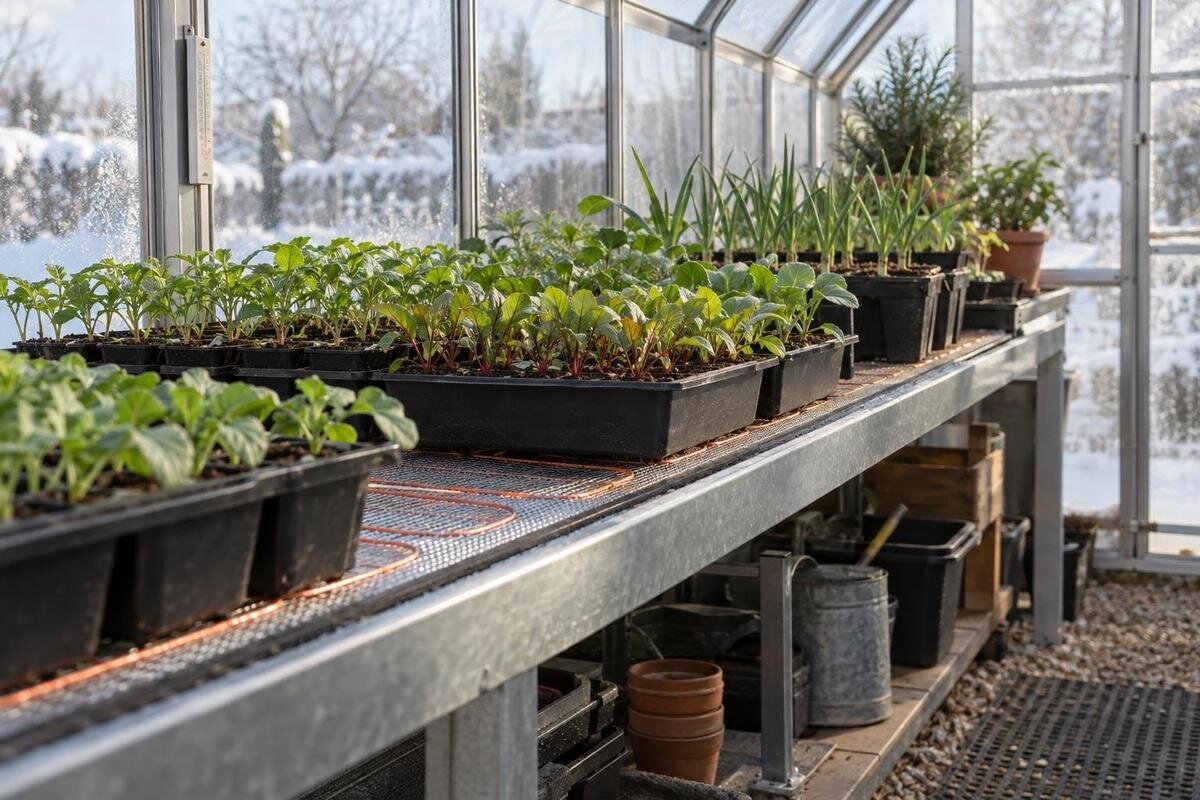
Greenhouse heating
For propagation, the useful question is often not whether to heat the greenhouse at all, but which part needs warmth. Seeds and cuttings sit in compost on a bench; warming that small growing zone can be more targeted than raising the temperature of all the air and surfaces around it. That may suit a dedicated sowing area, but it does not make the rest of the greenhouse warm. The choice depends on the plants’ requirements, how much you are propagating, the greenhouse’s heat loss and how long the system must run.

Why heat the bench rather than the whole greenhouse?
An unheated greenhouse may warm in daylight, but its air can cool after sunset. A heater maintaining a chosen air temperature must replace heat lost through the structure and through ventilation. If you are raising only a few trays, heating the whole greenhouse may extend well beyond the area used for propagation. A heated bench delivers warmth to the compost or rooting medium beneath those trays. It can make sense when the greenhouse has one active sowing area, or when different parts of the structure have different jobs. In a larger growing space, bench heating lets you concentrate heat where the trays are. This is especially relevant when propagation happens in batches, with a defined bench area and a clear end point.
This is a difference in where heat is delivered, not a guarantee of a lower bill or more reliable germination. The bench, pots, medium and surrounding air all affect heat loss, while whole-space demand changes with glazing, draughts, ventilation, outdoor conditions and the chosen air temperature. Most importantly, warm compost does not warm every leaf or cutting above it. List the plants and stages you are managing, then decide whether their roots, shoots, or both need warmth. If a crop needs a mild air environment as well as a warm root zone, bench heating alone leaves part of the requirement unmet. The two methods can be combined when you have separate, clearly defined needs.
What root-zone heating changes
Root-zone heating supplies warmth to the growing medium, where seeds germinate and cuttings develop roots. The relevant requirement is crop-specific: some seeds need warmer compost to germinate, while others prefer cooler conditions, and many need a different regime once shoots emerge. A heated bench therefore makes most sense when you can group plants with similar requirements. Read seed-packet guidance or a reliable crop-specific propagation guide rather than applying one setting to every tray. Label batches by crop and sowing date, so you can distinguish a genuine need for heat from a habit of keeping every tray on the warmest setting. Cuttings may have different needs from seeds even when they share a bench.
Root-zone equipment does not necessarily heat evenly by itself. Container contact, tray material, moisture, bench surface and position can change readings, so assess the compost in representative trays, not only the device surface or room thermometer. Purpose-made propagation mats, cables and heated benches differ in the area they cover, power input, controls and permitted use; confirm those specifications and the maker’s operating conditions before comparing them. Do not assume an ordinary household warming mat is suitable for a damp growing environment. For fixed electrical equipment or any uncertain installation, have a suitably qualified professional confirm safe selection and fitting rather than improvising a setup from unrelated parts. The device’s temperature control is also distinct from the greenhouse’s air thermostat.
When a heated propagation bench makes sense
A heated bench is a strong candidate when propagation is concentrated into small, repeatable batches: seed trays, plug trays or cuttings that need warmer medium while the rest of the greenhouse can remain cooler. It lets you focus control on the tray zone instead of chasing a target in every corner. This can suit a greenhouse used for occasional sowing rather than continuous tender growth. It also gives a practical boundary: only the containers on the warmed section receive the intended benefit, so the full batch must fit there and leave room for trays to be shifted as plants grow. If you sow several crops, plan separate batches or zones rather than assuming one bench temperature will suit all.
Plan the maximum tray area you will use at once, not just the average number of trays in a quiet week. Include space to handle, label and inspect them, plus a nearby unheated area for crops that need cooler conditions or later acclimatisation. Compare that working layout with the greenhouse’s internal dimensions. For context, Limited Edition Aluminium Greenhouses are listed from 3.77 m² to 28.08 m², a broad range of overall floor areas. The catalogue figure does not show the usable bench length or the room left for access, so use the specific plan. Matching bench capacity to your busiest sowing period gives you a clearer basis for choosing both the greenhouse size and the area to heat.
When the whole greenhouse needs heat
Whole-space heating is relevant when the leaves, stems and surrounding air also need a controlled environment. That may be the case with tender plants kept in the greenhouse, young plants after they outgrow covered trays, or a crop expected to continue growing there rather than being moved on. A warm growing medium cannot protect exposed foliage from cold air, and a bench heater does not remove draughts or warm the paths and shelves between benches. Match the air target to the crop’s stage and reliable growing guidance. A propagation bench is not a substitute when the crop needs warmth throughout the plant: root-zone and air temperatures are separate conditions, and both may matter at the same stage.
Space heating must make up losses across the greenhouse, not just deliver heat to one row of pots. The required output depends on the actual structure, ventilation, insulation, external weather and the temperature you are trying to maintain, so floor area by itself is not a heater specification. The T-Shaped Orangery Greenhouse is listed from 16.52 m² to 30 m², but that stated range does not establish its air volume, heat loss or heating capacity. For a whole-space system, use documented structure and heater specifications, and get a suitable assessment where sizing is uncertain. Do not transfer a heater’s published rating to a different greenhouse without checking the conditions. A rated output is not a guarantee of a particular temperature.

Measure the heated area and bench layout
Separate the greenhouse footprint from the area you actually intend to warm. Sketch the bench positions, tray footprints, doors and regular working routes; then identify which trays are on heat, which remain unheated and how many fit during a peak sowing period. This helps avoid a mismatch, such as buying a unit sized for a bench that is partly blocked or assuming a small mat can serve a full propagation run. Leave enough access to check moisture and remove individual trays without disturbing the whole batch. If you need two different root-zone regimes, make that a deliberate control and layout question, not a reason to stretch one heated surface across incompatible crops.
Greenhouse floor-area listings help with initial comparisons, but they cannot answer the bench-planning question. The Pyramid Greenhouse is offered in sizes from 5.53 m² to 18.9 m²; use the plan for your chosen configuration to identify usable internal space and possible bench positions. Account for shelving, storage, plant height and paths before choosing a heating system. Then compare the intended tray area with the heating equipment’s stated coverage. A larger greenhouse may offer more room, but space assigned to access or storage is not heated propagation capacity. Keep the external footprint, usable internal layout and heated bench area separate in your comparison.
Check the bench and heating equipment together
Heat transfer at the bench depends on how the equipment is designed to support and warm the trays, so the description ‘heated bench’ is not enough to judge performance. Check the stated coverage, whether trays or pots are meant to sit directly on the heated surface, and how the controller is intended to be used. Gaps between containers, different tray materials or a bench that conducts heat away can make one reading unrepresentative. Follow the supplied operating instructions, keep water and equipment within the maker’s stated limits, and avoid improvised coverings or extra layers that could change the intended setup. Use a qualified professional where a fixed system needs fitting. Testing a small, representative group can help you understand how the setup behaves before filling the whole bench.
Storage affects how a growing area is organised: tools and spare pots may be convenient nearby, but their space should not be counted as propagation surface. The Limited-Edition Aluminium Greenhouses with Storage are listed from 5.52 m² to 28.08 m². For a particular size, review how the plan divides the available space between storage and growing areas. Mark the heated trays and the routes you will use to reach them, so routine handling does not depend on moving stored items. This separates the greenhouse’s overall capacity from the bench area that needs heat. The storage option itself does not establish any heating or ventilation provision.
Insulation and ventilation change the comparison
Whole-space heating makes insulation and ventilation part of the same decision. A greenhouse that loses heat quickly may need more input to hold a given air temperature; keeping it sealed at all times is not a sound substitute for the ventilation needed to manage moisture and warm spells. Look for documented information on the exact model, including which ventilation or insulation options are available and how they affect light and use. Do not assume that a greenhouse category or frame material has a particular heat-loss performance. Where a heater has to maintain a set air temperature, the structure’s specification matters as well as the heater’s stated output. These factors still affect the surrounding air and plant canopy when heat is focused on a bench.
The Bloomcabin Prestige Greenhouse is listed from 3.77 m² to 28.08 m². When comparing sizes and options, consider how the available ventilation and insulation would fit your propagation routine, rather than treating the floor-area range as a guide to heating performance. A whole-space estimate should make clear what it assumes about heat loss and ventilation; otherwise, its predicted temperature or cost remains uncertain. With bench heating, the same questions concern the air around the shoots even if the compost has its own heat supply. Compare the conditions needed above and below the tray separately.
Manage humidity as seedlings emerge
Root heat and humidity should be considered together. Warm compost can dry at a different rate from unheated compost, while a covered tray can hold moisture around emerging seedlings; the effect varies with crop, medium, cover and airflow. Check the compost itself and follow crop-specific watering guidance rather than using a fixed calendar or assuming a heated tray always needs more water. Open or remove a propagation cover as the crop guidance and equipment instructions indicate. A cover changes the local microclimate, but it is not an air heater and should not be expected to provide a stable temperature on its own. Watch for condensation and persistent dampness rather than relying on the feel of the cover.
After germination, the growing shoot is exposed to the greenhouse air even when its roots remain on a warm bench. Acclimatisation should reflect the crop and its next growing conditions; moving seedlings straight from a humid, protected tray to a colder, drier area can be a bigger change than the root temperature alone suggests. Keep ventilation in the wider greenhouse in view, and do not shut openings simply to retain bench warmth if crops need air movement. In a larger structure, plan where seedlings will go after leaving the propagation bench. The Spacious Greenhouse is listed from 47 m² to 70 m², offering a useful scale comparison when allocating separate growing areas. Its floor area alone does not establish ventilation capacity.

Monitor compost and air separately
Measure root-zone and air conditions separately. A thermometer in greenhouse air cannot tell you what is happening inside the compost, and a probe in one tray cannot show the temperature around the leaves. Use suitable monitoring for both, place and operate it according to its instructions, and compare representative trays and canopy areas over the periods that matter to your crop. Keep a simple record of readings, weather, ventilation and heater operation; a record helps reveal whether the bench is meeting its task or whether the air is the limiting factor. Avoid treating a single reading as proof that every pot is at the same temperature. The aim is to observe the growing zone, not to chase a display number.
Controls should match the heating method and the area being controlled. A bench thermostat can regulate local heat, while a separate greenhouse control may be needed for air; neither should be assumed to manage the other. Where crops with different needs share a structure, mark out the zones and confirm that the equipment supports that arrangement. The Aluminium Greenhouses range is listed from 3.77 m² to 28.08 m². Use the actual layout to identify the tray groups and canopy areas you need to monitor, rather than assuming one reading represents the entire floor area. Follow the relevant equipment instructions when choosing monitoring and control positions.
Compare costs and choose a heating combination
Compare running costs using evidence from the equipment and the place it will run, not a claim that bench heating is automatically economical. Equipment with a lower rated input can still operate for long periods, and a space heater has to replace heat lost through the structure and required ventilation. Check the stated electrical input, expected pattern of use and control behaviour, then compare actual consumption with your current tariff. Rates and use vary, so there is no universal saving figure. For a meaningful forecast, state the assumptions about outdoor conditions, internal target, ventilation and greenhouse construction. Treat the result as an estimate, not a promised bill, and use a representative period that includes the colder part of your propagation schedule.
Choose bench heat alone when warmth around the roots is the only heating requirement; choose space heat when the foliage and greenhouse air also need it. Combine them where each has a defined purpose and suitable controls. If you are choosing the greenhouse at the same time, Lean-to Greenhouses are listed from 3.69 m² to 14.34 m². Compare the exact configuration with the bench capacity and wider growing conditions your crops need; that area range cannot establish heater size or suitability for a particular location. The final choice should account for both the propagation space you will use now and where those plants will grow after leaving the heated bench.
Frequently asked questions
Can a heated seedling bench replace a greenhouse heater?
Only if warmth around the roots is the main requirement. Bench heating does not keep the greenhouse air or foliage warm. If plants need a controlled air temperature as well, you may need space heating or a clearly planned combination of both.
Is bench heating always cheaper to run?
No. It may avoid heating unused space, but energy use depends on the equipment’s input and running time, the growing medium and bench, greenhouse heat loss, ventilation and your tariff. Compare actual use or transparent estimates rather than assuming one method will cost less.
Do all seeds need a warm root zone?
No. Germination preferences vary by crop, and the needs of seedlings can change after they emerge. Check crop-specific propagation guidance and group trays with similar requirements instead of using one setting for every seed.
Should the bench stay heated after germination?
That depends on the crop and its next growing stage. The shoots are exposed to greenhouse air even when the compost remains on a warm bench. Follow crop guidance and the heating equipment’s instructions when changing the heat regime.
Can I use any heat mat in a greenhouse?
No. Check that the equipment is specified for the intended growing environment, surface and coverage, and follow its operating instructions. Ask a suitably qualified professional to confirm the selection or fitting of fixed electrical equipment if you are unsure.
The useful comparison is between the crop’s root-zone requirement and the air conditions it needs at each stage. If only a few trays need warmth, heating their bench may avoid warming unused greenhouse space, but it cannot protect foliage from cold air. If plants need warmth throughout, assess space heating against the structure’s documented heat loss and ventilation. In either case, measure compost and canopy separately, compare actual energy use with the local tariff, and use equipment specified for the job. That makes the heating choice follow the propagation plan, rather than the other way around.
