
Why Greenhouse Tomato Flowers Fail to Set Fruit
Tomato fruit-set troubleshooting
Tomato flowers can be bright and plentiful yet leave no swelling fruit behind. In a greenhouse, successful fruit set depends on healthy flowers, viable pollen being released and conditions that allow it to reach the stigma. Heat, cold, humidity and wider plant stress can interrupt different parts of that process, so no single symptom proves the cause. Start by checking what happens to the ovary beneath each flower, then compare temperature and crop conditions over several days. This is more useful than assuming every fallen blossom needs hand pollination or extra fertiliser.

Check whether a small fruit has started to swell
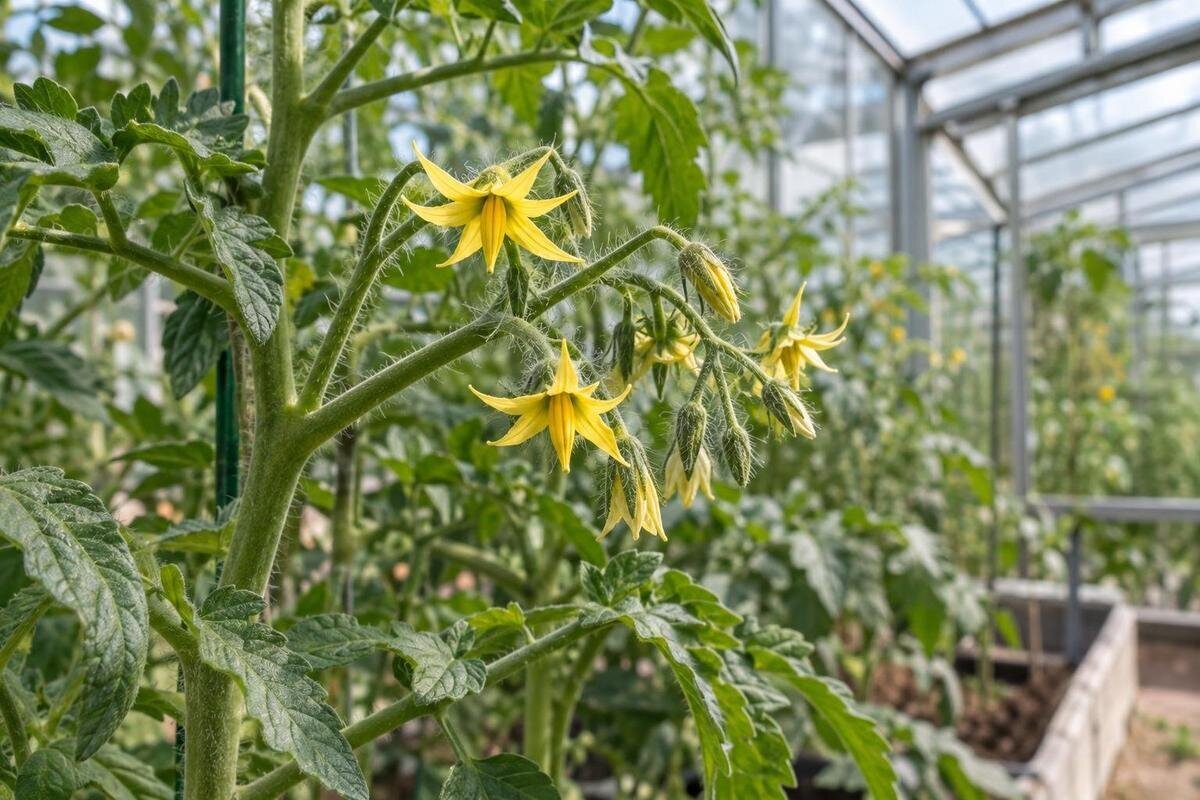
Tomato flowers are complete flowers: each has male and female parts, and most garden tomatoes can set fruit using their own pollen. The green ovary sits at the base of a fresh yellow flower. When set succeeds, that base starts to enlarge while the petals fade; petals falling on their own is normal. Look for a small green swelling still attached to the flower stalk before deciding that the blossom has failed. If the flower falls without a swelling, or the base shrivels, it did not leave a developing fruit behind, although very young fruit can also stop growing.
Choose several flowers on more than one truss and note when each opens. Check them every few days rather than judging the whole plant from a distance. A fruit may be hard to spot at first, and cool conditions slow visible growth. Photograph the same marked truss so you can compare it later, and note the plant and date. One failed blossom is not unusual; a succession failing at similar stages is more useful evidence. Also separate buds that never opened from open flowers that faded: those patterns can point to different parts of the problem. Keep a simple record with separate entries for unopened buds, open flowers, swelling ovaries and fallen blossoms. This prevents a truss containing flowers at different stages from being recorded as a complete failure. When you return to it, compare each marked flower with its own earlier appearance rather than with a neighbouring flower that opened on another day.
Measure temperatures beside the flowers
Temperature is one of the first checks because pollen development and release are sensitive to both extremes. As a rough guide, repeated daytime readings around 29–30°C or higher, or nights around 21°C or warmer, can make fruit set unreliable. Cool spells can also interfere, particularly nights near or below 13°C. These are not pass-or-fail limits: cultivar, exposure time, humidity and the plant’s condition all matter, and one brief peak does not prove why a flower failed. Conditions before a blossom opens may affect its pollen too, so consider the days leading up to flowering as well as the day you notice a dropped flower.
Use a min–max thermometer or data logger at flower height, in shade and away from glass, a heater or a sunlit wall. Direct sun can heat the instrument itself, so it will not then reflect the air around the truss. Record the high and low over several days, and take a second reading at the far end if temperatures seem uneven. If repeated readings show hot pockets and you are considering a replacement greenhouse, use the T-shaped orangery greenhouse listing to examine the position of its openings alongside your proposed crop rows. Compare that arrangement with the area where your current readings are highest. Floor area alone cannot predict the temperature around the flowers, so the useful comparison is between the proposed layout and the conditions you have recorded.
Look for conditions that limit pollen release
Tomato flowers do not need a second plant, but pollen still has to leave the flower’s anther cone and reach its stigma. Small vibrations from moving air or insect activity can help release it. A tightly enclosed, still greenhouse may offer little movement, but a lack of bees on its own does not prove that pollination has failed. If some flowers set and others do not, compare what was happening around them as they opened rather than assuming every flower needs to be pollinated by hand.
Persistently humid, poorly moving air can make pollen less free-flowing, while very hot, dry conditions can also reduce pollen function. Condensation on glazing is only a clue, not a direct measure of conditions at flower height. Note whether flowers are wet when they open and whether the air feels close and damp. If these conditions recur and you are assessing greenhouse options, examine the stated openings on the Pyramid Greenhouse in relation to where you would grow tomatoes. Include the paths and neighbouring crops in that comparison, rather than looking at the empty structure alone. This keeps the buying decision focused on the air around the planted crop, without assuming that the greenhouse’s shape will control humidity.
Compare healthy and failed blossoms
Inspect an affected flower before removing it. A normal spent blossom has faded petals, while a failed flower may have a dry stalk or a shrivelled base with no swelling. Buds that yellow and fall before opening suggest a different issue from open flowers that fade without setting. Grey, fuzzy growth on a dead flower or nearby stem can indicate mould, but a brown petal alone does not diagnose disease. Look for spreading marks on stems or leaves, as well as damage elsewhere on the truss.
Compare affected and successful flowers at similar heights. Are flowers dropping across the plant, only in the sunniest corner, or only on one truss? Photograph a whole truss and a close view, with the date, so you can compare new flowers with earlier ones. Include a healthy flower in the record where possible: it gives you a reference for changes in the petals, stalk and base. Keep photographs of unopened buds separate from those of spent flowers, so you do not confuse damage before opening with failure to set afterwards. If damage appears to be spreading beyond the blossoms, or stems become spotted or soft, seek a local plant diagnosis rather than treating a single symptom as proof of a particular disease. A photograph is most useful when it shows both the detail and the part of the plant it came from.

Check the rest of the plant for signs of stress
Look at overall growth as well as the flowers. Very lush, dark foliage with few flowers can follow excessive nitrogen or strong feeding; a small, pale or weak plant may be short of light, underfed or root-stressed. None of these appearances identifies one cause by itself, and flower failure alone is not a reason to add fertiliser. Consider whether new leaves look typical for the variety, whether growth is balanced and whether earlier trusses set successfully. If you have another plant receiving similar care, its condition can provide a useful comparison.
Recent transplanting, root disturbance, hard pruning or a sudden change in growing conditions can temporarily stress a plant. Crowded stems can also make it harder to inspect flowers and maintain access around the crop. Note what changed and when, rather than trying to correct everything at once. If stored tools or equipment are obstructing the crop row and you are considering a different structure, compare the limited-edition aluminium greenhouse with built-in storage with your current arrangement. Check how the storage space relates to the growing area and paths. The practical question is whether you can store what you need while still reaching each truss comfortably, without squeezing past or disturbing the plants.
Check root moisture before changing the feed
Inconsistent moisture can add to general plant stress. A root ball that dries out and then receives a heavy soak goes through repeated changes; persistently waterlogged growing medium can deprive roots of air and impair uptake. Check below the surface and compare pots or sections of a bed rather than assuming every plant received the same amount. Aim for steady moisture appropriate to the soil or container, with drainage intact. A dry-looking leaf or a failed flower is not, by itself, evidence that the plant needs more water.
Review feeding at the same time, but base changes on the wider condition of the plant. Overfeeding can produce abundant leafy growth, while a watering or root problem can make nutrients unavailable even when they are present. Do not apply calcium, high-potash feed or general fertiliser solely because flowers have fallen; blossom drop does not diagnose a deficiency. Consider a growing-medium or soil test if a wider nutrient problem seems plausible, and follow the fertiliser label. If you are planning beds or containers in a new structure, use the dimensions in the Prestige Greenhouse with Metal Base listing to sketch their positions and the space needed for watering access. Plan drainage separately, keeping the root-zone checks distinct from the choice of greenhouse.
Consider light, crowding and greenhouse layout
Light and crowding are slower clues than a hot afternoon, but they can matter across several trusses. Check whether flowers on a shaded side or within dense foliage set less readily, and whether nearby plants block the crop. Prolonged low light can affect plant growth and flowering; heavy leaf removal to expose every blossom may create further stress. Ventilation also helps manage excess heat and damp air, but putting a fan beside a plant does not by itself correct every pollination problem. A consistent difference by position is useful evidence to record.
Sketch where light falls and where rows, paths and openings sit before changing a growing layout; floor area alone does not show how much room is usable around plants. The Spacious Greenhouse listing covers models from 47 to 70 m². To compare that range meaningfully, draw your intended rows and access paths within the actual dimensions of the model you are considering. Include space to reach the flowers, not just the footprint of beds or containers. Then assess the openings and the light available at your site. A larger floor area is a layout choice, not evidence of better fruit set, crop-row capacity or ventilation.
Test whether gentle vibration changes fruit set
A small pollination test can show whether insufficient vibration is a plausible factor. Mark two groups of newly opened, dry flowers on similar parts of the same plant. On a warm, dry part of the day, lightly tap the support or truss of one group so it vibrates; leave the other group untouched. Avoid tugging the stem or brushing pollen between plants. Repeat on a few flowers as they open, then inspect the ovaries over the following days. This is a comparison, not a guarantee: flowers on one plant can still experience different shade, temperature or stress.
If the tapped group sets more fruit, limited movement may have contributed, but that does not rule out temperature or humidity as factors. If neither group sets, return to the temperature record, flower condition and plant stress rather than tapping harder. Keep the result with your other observations so that a small test does not outweigh a wider pattern across the crop. If you are comparing structures because still air is a recurring concern, examine the openings described on the Aluminium Classic Greenhouse product page and where they would sit relative to your tomato rows. Compare those details with your existing arrangement; the frame material alone does not tell you what air movement the planted layout will provide.

Compare flowering dates, varieties and positions
Record when flowers open and where they are on the plant. If several plants, including different varieties, lose flowers during the same hot or cool spell, shared conditions become more plausible, though that does not prove the cause. If only one variety or one plant is affected, look more closely at its growth, root zone and flower condition. Varieties can differ in how readily they set under less favourable conditions, so compare like with like where possible. Notes from an earlier truss or growing period can show whether the pattern is new. Keep flowering dates alongside the temperature record rather than comparing all plants on the day you notice the problem. Flowers that opened at different times may not have experienced the same conditions. Where dates overlap, compare both successful and failed flowers; recording only failures can hide useful differences between plants and positions.
Map the affected row or corner as well as the date. A plant beside a wall, near a door or in a shaded end of the greenhouse may experience different light and air movement from one in the centre. If you are considering a lean-to structure, the aluminium lean-to greenhouse listing gives a floor-area range from 3.69 to 14.34 m². Compare the dimensions of your chosen model with the wall, access route and crop positions you have in mind. Mark the shaded areas on that plan too. This connects the product comparison to the differences you have observed, while keeping the effects of your particular site separate from the model name and size range.
Adjust one factor and assess the next truss
Once you have a likely factor, change one controllable condition and judge the next flowers to open. Use the greenhouse’s designed ventilation to manage excess heat or damp air when conditions allow, while avoiding an abrupt chill during cold weather. Keep watering consistent and do not change feeding, watering and pruning together, as you will not know which change mattered. Failed flowers are unlikely to recover, so mark fresh blossoms and allow time to see whether their ovaries enlarge. Keep recording day and night temperatures rather than relying on a single reading. Note the date of the adjustment beside the flowering dates, so you can distinguish blossoms already open from those that opened afterwards. If the next truss sets better, compare the accompanying temperature and plant-condition notes before attributing the improvement entirely to your change.
Seek local horticultural advice if repeated flowers fail despite steady conditions, buds drop across the plant, or marks and mould appear to be spreading. Share the variety, planting date, photographs, temperature readings and watering notes; these details help distinguish possible causes. If your records point to a recurring limitation in space, openings or access and you are considering alternatives, compare the Limited Edition Aluminium Greenhouses range against that specific limitation. Use the full product information to assess the relevant dimensions and layout for your site. Keep this separate from the immediate crop diagnosis: choosing a different structure is a longer-term planning decision, not a remedy for flowers that have already failed.
Common questions
Do greenhouse tomatoes need hand pollination?
Usually not. Tomato flowers can set fruit with their own pollen, but it needs to be released and reach the stigma. If the greenhouse is very still, gently vibrating a few open, dry flower trusses can help you test whether pollen movement is part of the problem.
Can temperature stop tomato flowers setting fruit?
Yes. Repeated hot days, warm nights and cool spells can all interfere with fruit set. Use readings taken beside the flowers over several days: one temperature reading or one failed blossom is not enough to identify the cause.
How can I tell whether a tomato flower has set?
Look at the green ovary at the base of the flower. If it begins to swell while the petals fade, a small fruit is developing. Faded petals alone do not mean the flower failed; check again over the following days, particularly in cool conditions.
Should I add fertiliser when tomato flowers fall?
Not without other evidence of a nutrient problem. Heat, humidity, poor pollen release, water stress and root conditions can all affect fruit set. Check the plant and its growing medium before changing the feed, and avoid treating blossom drop as proof of a deficiency.
Will opening a greenhouse door solve the problem?
It may help manage excess heat or damp, still air when conditions allow, but it will not correct every cause. Cool nights, plant stress and flower damage can also prevent set. Compare temperature and flower condition before deciding that ventilation is the main issue.
Flowers alone do not show whether a tomato plant has set fruit or whether conditions are supporting it. Follow a few blossoms from opening to swelling, compare day and night temperatures at truss height, and note any pattern across the plant. Try gentle vibration only if limited pollen movement seems plausible; otherwise, focus on the stress your observations point to. A repeatable pattern across fresh trusses is more useful than trying several changes at once.
