
Why Do Greenhouse Tomatoes Split? Causes and Clues
Greenhouse crop care
Tomatoes that split inside a greenhouse are usually responding to a rapid change in water uptake, often after the root zone has dried and then been watered heavily. Fruit near full ripeness is more vulnerable because its skin has little spare capacity to stretch. The crack’s direction, the fruit’s stage and what happened to the growing medium over the previous few days can narrow down the possibilities, but none proves a single cause. A useful diagnosis compares several fruits and plants, then checks watering, heat and growing conditions before changing feed or watering dramatically.

Why tomato skins split as the fruit expands
Tomato flesh can swell faster than the skin can expand. When roots take up a sudden increase of water after a dry spell, the fruit may enlarge quickly and the skin can split under the pressure. This is why cracking is often associated with a change in water availability, not simply with a large total amount of water. Fruit close to full size or ripeness has less room to accommodate sudden expansion. Steady moisture matters more than following an identical watering schedule every day. A greenhouse keeps much of the rain off, but it does not hold soil, pots or grow bags at a constant moisture level; warmth, container size and watering habits still create swings.
Look back over several days, not only at the last watering. Note whether the growing medium was dry before a heavy soak, whether a hot, bright spell increased demand, and whether several plants split after the same change. A cluster of cracks after a dry-to-wet shift supports a moisture-fluctuation explanation; one ripe fruit on an otherwise healthy plant is weaker evidence. Also note whether affected fruit is concentrated in one part of the greenhouse. Awkward access can make some plants harder to water consistently. When planning a replacement structure, map beds and paths within the available footprint: Limited Edition Aluminium Greenhouses lists options from 3.77 m² to 28.08 m². Include the space needed to reach each root area, rather than comparing total floor area alone.
Radial and concentric tomato cracks
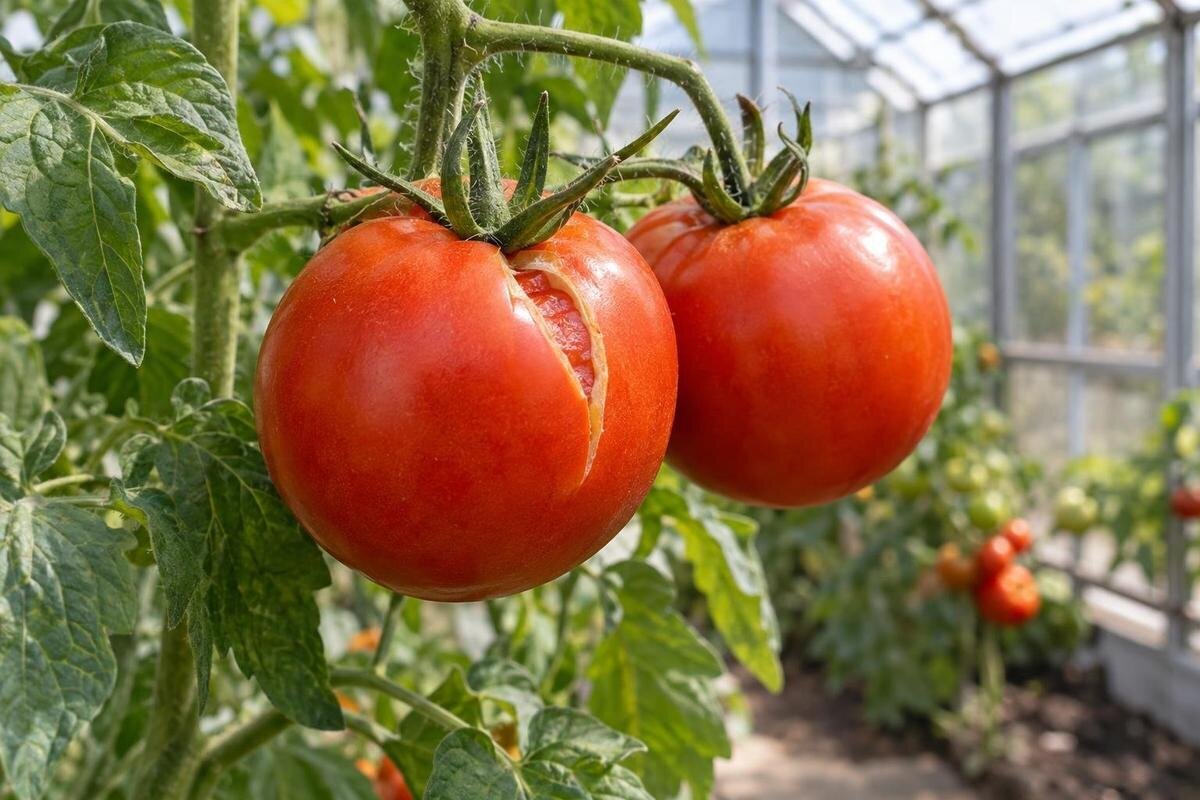
Two common growth-crack patterns are radial and concentric. Radial cracks start near the stem and run down the side; concentric cracks form curved rings around the stem end or shoulder. A fruit can have one pattern, both, or only a shallow scar. Either pattern can occur when internal growth gets ahead of the skin’s ability to stretch, but shape alone cannot identify the cause. A crack that has begun to heal may look dry and corky, while a fresh opening is moist. That difference can help you judge when the damage occurred, but it does not prove what changed in the growing conditions.
Compare fruit at similar maturity and from the same plant before drawing a conclusion. If a few fully coloured tomatoes have rings but younger fruit are sound, stage and variety may matter; cracks across different plants after a shared dry spell point more towards root moisture. Rubbing or handling damage is more likely to be localised at a contact point, though appearances can overlap. Being able to inspect fruit throughout the growing space helps you make these comparisons. For anyone also choosing a greenhouse, the T-Shaped Orangery Greenhouse listing gives options from 16.52 m² to 30 m². Sketch where plants would stand and how you would reach their fruit, including those furthest from the entrance.
Check moisture below the surface
Do not judge by the top centimetre alone. The surface of a bed or pot can feel dry while the root zone remains moist, or look damp after deeper layers have dried. Check the growing medium a little below the surface, near the roots, before watering and again later; use the same point and depth if comparing conditions over time. Feel can be informative, and a moisture meter may help when used consistently, but a reading at one edge does not represent every plant. Check several places where cracking has occurred and where fruit remains sound. Avoid judging by a reading taken immediately after pouring water into one spot.
Look for a repeatable pattern: one dry corner, a blocked or leaking line, or a container that dries earlier than its neighbours may explain why only some plants are affected. Confirm that water reaches the root area rather than running down a gap at the edge of a dry bag. A slow or uneven flow can make a timer seem regular while plants receive different amounts. Keep notes on when you watered, how dry the medium felt and which fruits split. Allow room to check the growing medium as well as to water it. If you are comparing the Pyramid Greenhouse, its listed footprint options range from 5.53 m² to 18.9 m²; consider bed placement and reach when drawing up a planting layout.
Pots, grow bags and beds can dry at different rates
A plant in a small pot or grow bag has less growing medium to buffer changes in moisture than a larger bed, so it may dry more quickly. The difference can become more noticeable as the plant grows and its demand for water changes. Adjacent containers may vary in size, fill level, drainage and root growth, even if you water them at the same time. Check them individually rather than assuming the whole greenhouse shares the same conditions because an aisle or the top of a bed feels damp. Conversely, a pot that stays wet is not safer: poor drainage and waterlogging can harm roots and complicate water uptake.
Give containers and beds separate checks, and make sure excess water can drain away. When a growing medium is dry, re-wet the root area evenly rather than pouring a large amount into one spot; do not leave pots sitting in runoff. Keep watering equipment accessible without blocking your route to the crop. If you want storage within a new structure, Limited-Edition Aluminium Greenhouses with Storage lists options from 5.52 m² to 28.08 m². Compare the stated storage and growing areas, then mark where containers, beds and equipment would go. This keeps the layout comparison focused on the space you would actually use for plants and their care.

Heat can make moisture swings more pronounced
A warm spell inside a greenhouse can raise water demand even when the soil looked fine the previous evening. On bright days, the air and exposed containers warm quickly; smaller volumes of growing medium can dry sooner, while leaves may use water faster. Heat is usually an indirect contributor to cracking: it can make the root-zone supply uneven while ripening fruit is already vulnerable. If available, record temperature at plant height with a maximum-minimum thermometer and note the time. A reading at a doorway may not reflect conditions around the fruit. One hot afternoon alone does not prove that heat caused a split.
Ventilation can help limit excess heat, but it cannot compensate for a dry root zone or an erratic watering pattern. Use the vents provided for the structure as conditions require, and observe whether temperatures remain high on bright days. Keep those observations alongside your moisture notes so that you can compare changes in the air with changes around the roots. When buying a greenhouse, look at ventilation details separately from its dimensions. The Bloomcabin Prestige Greenhouse is listed in sizes from 3.77 m² to 28.08 m², but that area range does not describe airflow or temperature control. A useful comparison considers both the growing space and the ventilation arrangements.
Nearly ripe fruit is more vulnerable
Fruit stage changes the likelihood of cracking. As a tomato nears full size and begins to colour, its skin must accommodate any further expansion while having less room to stretch. A sudden increase in available water may then show up as a split. Some cultivars are more prone than others, so compare fruit from the same variety and at a similar stage. Keep planting labels or notes if you are unsure which tomatoes are being compared. If only a few mature fruits split while younger ones remain sound, that is a useful clue, not proof that watering is irrelevant. Check whether a change in watering coincided with the fruit beginning to colour.
Harvesting fully sized fruit as it starts to colour can reduce the time it remains exposed to further growth on the vine, though it will not mend a crack or guarantee that later fruit stay sound. Do not pick undersized green fruit just because one tomato split; judge each fruit by its maturity and condition. Plan harvesting access alongside watering access if you are choosing a larger growing space. The Spacious Greenhouse listing covers 47 to 70 m². Within that area, sketch the rows and the route you would take to inspect and pick ripening tomatoes. More floor space alone does not make every row equally easy to reach.
Distinguishing cracks from other fruit damage
Blossom-end rot usually appears as a dark, sunken, leathery patch at the blossom end, opposite the stem. It is different from a radial crack, even though both problems can occur in a crop affected by uneven water uptake. A hole, scrape or scar at one contact point may be physical damage, while a crack can later develop rot. Do not treat every damaged tomato as a nutrient deficiency: the mark’s location, texture and progression matter. A blossom-end patch can be mistaken for a crack at first glance, and a photograph may not show the detail clearly enough to distinguish them.
If a crack is clean and the rest of the fruit is firm, the original problem may be physiological rather than infectious. If it turns mouldy, becomes soft or leaks, secondary decay has set in. Look at nearby fruits and leaves for a wider pattern, but do not diagnose a specific disease from one mark. Record whether damage occurs at a contact point or appears across several plants. For a separate greenhouse purchase, the Aluminium Greenhouses listing gives sizes from 3.77 m² to 28.08 m². Use those dimensions to sketch plant positions and working space, including room to inspect fruit without brushing against neighbouring plants.
Adjust watering before adding fertiliser
Once the root-zone pattern is clearer, aim for moisture that is steady rather than alternating between very dry and saturated. Water the growing medium near the roots and adjust the interval to the weather, container size and crop demand; a fixed calendar can overwater during cool, dull spells and under-water during hot, bright ones. If watering by hand, wet the root area evenly without flooding it. Check that irrigation lines are working and that water penetrates the medium instead of running off. Increasing every watering without checking is not a reliable response to a split, as persistently wet roots can cause a different problem.
Change one part of the routine at a time and watch the next developing fruits. Follow the fertiliser label and the needs of the crop; extra fertiliser or calcium will not close a crack, and splitting alone is not proof of a deficiency. Avoid changing feed, shade and watering all at once, as you will not know what made a difference. If poor access is part of the problem and you are considering a replacement, include your watering route in the layout comparison. The Lean-to Greenhouses listing gives footprint options from 3.69 m² to 14.34 m². Assess how each option would fit the site and leave access to the plants, rather than expecting a different greenhouse style to prevent cracking.

What to do with tomatoes that have split
Pick a split tomato promptly, especially if the opening is deep or the fruit is beginning to soften. A small, fresh crack does not automatically mean the whole fruit is spoiled, but inspect it carefully and use it soon if it is otherwise firm and sound. Discard fruit that is mouldy, leaking, slimy or soft with decay; do not leave damaged tomatoes among healthy ones where they may deteriorate further. Even if a crack becomes dry and corky, the fruit has been damaged. Harvesting removes the vulnerable tomato from the plant but does not correct the growing conditions that caused it to split.
Handle nearby fruit gently and check for the same pattern on other clusters. Separate fruit with fresh openings from tomatoes showing older, dry scars, and assess each tomato's condition rather than treating all cracks alike. Note which cluster the damaged fruit came from before removing it, so that you can compare the remaining tomatoes at your next inspection. Leave sound fruit to continue developing; one split tomato is not a reason to strip the plant or prune healthy foliage. The immediate aim is to use sound fruit promptly and limit losses, while keeping track of whether further cracks appear on that plant or elsewhere in the crop.
Keep a record of cracking and growing conditions
A short record is often more useful than a guess based on one photograph. Note the variety, whether fruit was green, changing colour or fully ripe, the direction of the crack, the plant’s position, how the medium felt before watering and any recent hot spells. Mark when you first notice symptoms rather than relying on memory. Compare several plants in the same area and, if possible, one with sound fruit grown in the same way. If cracks follow a dry period and a heavy soak across several plants, fluctuating moisture is a strong suspect; if they are limited to ripe fruit on one variety, stage or susceptibility may matter more. Treat the conclusion as provisional because these clues can overlap.
Repeat the observations after your next normal watering cycle rather than making a drastic change and judging it the next morning. If the root zone stays consistently moist but splitting continues across different stages, check drainage, root health, the irrigation system and the variety. A local horticultural adviser can inspect the plants and growing medium if the cause remains unclear. A photograph can record whether cracks are radial or ring-shaped, but it cannot show moisture at root depth or the sequence of care. Diagnosis is strongest when the fruit pattern, growing conditions and watering history agree.
Frequently asked questions
Are split tomatoes always caused by overwatering?
No. A heavy watering can contribute if the root zone was dry beforehand, but the problem is often a sharp change in water availability rather than a high total amount. Check the growing medium, container and timing before reducing water; keeping the roots too dry can create the same kind of fluctuation.
Why do only the ripe tomatoes split?
Fruit nearing full size or ripeness has less room to accommodate sudden expansion, so a change in water uptake may show up first on mature tomatoes. Varieties also differ. If only ripe fruit splits, maturity may be part of the explanation, but check the watering history before settling on a cause.
Can I use a tomato that has split?
A small, fresh split on a firm tomato does not automatically mean the fruit is spoiled. Inspect it carefully and use it promptly if it remains sound. Discard fruit that is mouldy, leaking, slimy or soft with decay, and check nearby tomatoes for similar damage.
Will extra calcium or fertiliser stop the cracking?
Not usually. Splitting is commonly linked to rapid fruit expansion and changing water availability, while blossom-end rot is a different problem. Extra fertiliser or calcium will not close a crack, and adding nutrients without evidence of a need can cause other problems.
Do radial and circular cracks mean different things?
Radial cracks run out from the stem end, while concentric cracks form rings around the shoulder. Either pattern can accompany rapid fruit growth, but neither identifies the exact trigger. A photo can show the crack, not whether the root zone was dry beforehand.
One split is a clue; a repeated pattern is stronger evidence. Compare the crack type and fruit stage with root moisture, recent watering and temperature, then make one measured adjustment. If those clues do not fit a water fluctuation, look again at the fruit itself and check for other kinds of damage rather than assuming every mark has the same cause.
