
Can Water Barrels Warm a Greenhouse Overnight?
Greenhouse heating and winter energy
Water barrels can soften an overnight temperature drop, but they cannot create heat: they release energy absorbed earlier, usually during the day. Whether they keep a greenhouse above a useful minimum depends on the water’s volume and temperature at dusk, how long the night lasts, and how quickly heat leaves the enclosure. A heat-capacity calculation shows the upper limit of stored energy; temperature records show whether that limit makes a practical difference in your greenhouse.

Before choosing a greenhouse 1
How water barrels affect overnight temperatures
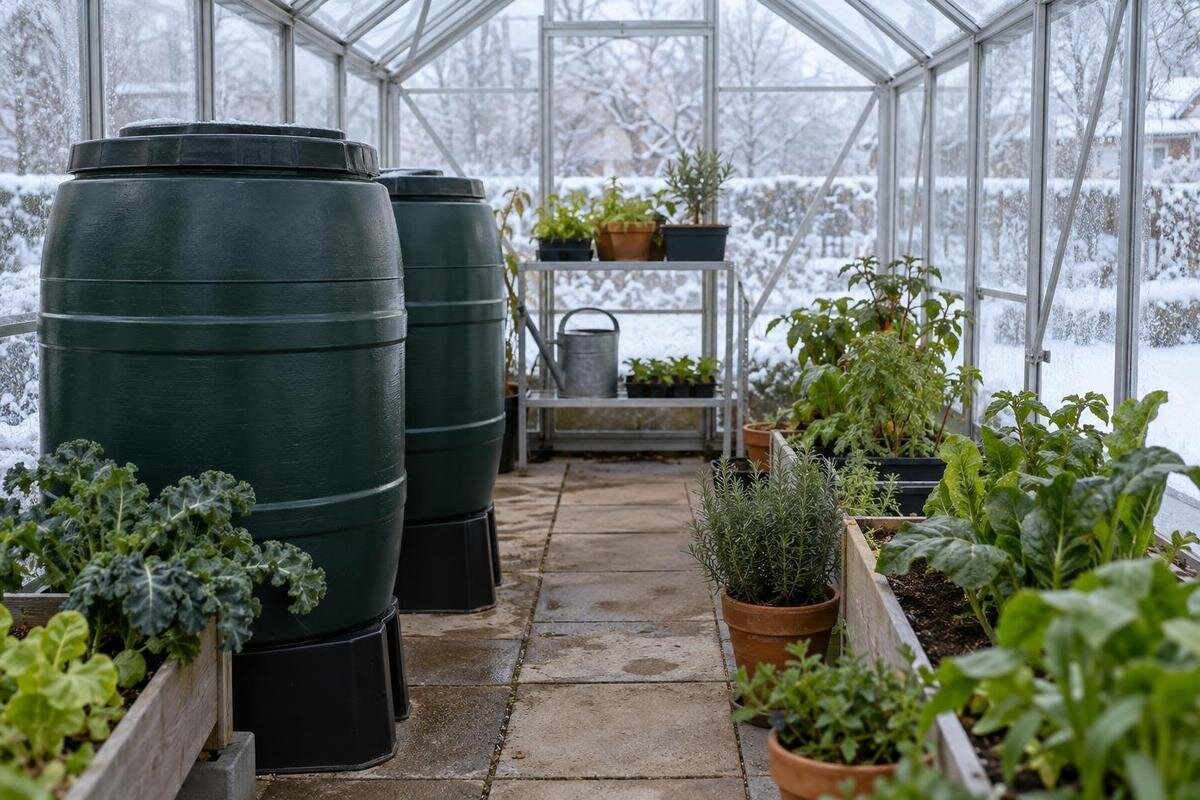
Water has a high specific heat capacity: a large volume takes considerable energy to warm, then releases energy as it cools. During the day, sunlight warms greenhouse surfaces and air; a barrel can absorb some of that heat through its container. After sunset, water that is still warmer than the surrounding air transfers heat back to the greenhouse. This can slow the temperature decline or soften a short dip, provided the water absorbed useful heat earlier.
That is thermal buffering, not heat generation. A barrel has a finite store of energy to offset heat lost through glazing, air leaks or ventilation; it cannot maintain a set temperature indefinitely. As the water cools towards the air temperature, the difference driving heat transfer shrinks, so the useful output tails off. Air near a barrel may also be warmer than the air at the far end or around the plants. A reading beside the water does not show what the whole greenhouse experienced overnight.
Calculate the heat stored in the water
Use the approximate formula Q ≈ V × ΔT × 0.00116 kWh, where V is water volume in litres and ΔT is the actual fall in water temperature in degrees Celsius. The factor comes from water’s specific heat capacity of about 4.18 kJ per kilogram per degree, with one litre treated as roughly one kilogram. Dividing the result in kilojoules by 3,600 converts it to kilowatt-hours. For example, enter 200 for a 200-litre volume and 10 for a fall from 15°C to 5°C: 200 × 10 × 0.00116 gives 2.32 kWh. Use the amount of water actually in the container, not its maximum capacity if it is partly filled. For several barrels, calculate each separately if their volumes or temperature changes differ, then add the results. This estimates stored energy, not how quickly the barrels can release it.
For a 10°C fall, 100 litres holds about 1.16 kWh, 200 litres about 2.32 kWh and 500 litres about 5.81 kWh. These are theoretical amounts, not guaranteed heat delivered to the plants. The useful temperature fall depends on the air temperature you need to maintain: water cannot keep warming air once it is no warmer than that air. Record the water temperature at the beginning of the night, rather than using the barrel’s capacity alone as a measure of available heat.
Before choosing a greenhouse 2
Estimate overnight heat loss using a stated assumption
For a first comparison, express heat lost over the dark period as an assumed average loss in kilowatts multiplied by the number of hours. Over ten hours, an average loss of 0.25 kW would mean 2.5 kWh; 0.5 kW would mean 5 kWh; and 1 kW would mean 10 kWh. These are deliberately hypothetical examples, not typical greenhouse figures or predictions. Keep the units distinct: kW describes the rate of heat loss, while kWh describes the total energy lost over the period. The barrel calculation also gives kWh, so those are the figures to compare. Write the assumed rate and duration beside the result; a total without those inputs conceals how it was reached. Stating the assumed rate makes the comparison with barrel storage transparent.
An actual heat-loss rate cannot be read from floor area alone. It varies with exposed surfaces, glazing, air movement, open doors or vents, outdoor conditions and the indoor temperature being sought. If a documented heater is the only heat source, its specified heat output and logged operating time on comparable nights can provide a rough cross-check; distinguish heat output from electrical or fuel input. The Limited-Edition Aluminium Greenhouses with Storage range is listed from 5.52 m² to 28.08 m², so use the exact selected size rather than the full range as a heat-loss figure. The word storage in a product name does not establish barrel capacity or overnight heat performance.
Worked example: 200 litres against a hypothetical night
Suppose 200 litres of water is at 15°C at dusk, and the calculation counts only the fall to 5°C. That 10°C difference gives about 2.32 kWh before practical limits. Now suppose, independently, that the greenhouse loses an average of 0.5 kW for ten hours: the assumed loss is 5 kWh. In this illustration, the water contains at most about 46% of the assumed overnight loss. The remaining difference is about 2.68 kWh, but that is an energy shortfall within the example, not a prediction of how many degrees the air will cool. Nor does 46% mean that the barrels will protect the plants for 46% of the night: the calculation does not describe when the stored heat becomes available. Neither the heat-loss rate nor the 5°C endpoint is a recommendation or a prediction for a particular greenhouse.
With 500 litres and the same 10°C fall, the theoretical store is about 5.8 kWh, just above the example’s assumed 5 kWh loss. That still does not guarantee the air will stay at its target: the water must remain warmer than the air to transfer heat, its output declines as it cools, and real heat loss changes over the night. The Bloomcabin Prestige Greenhouse is listed in sizes from 3.77 m² to 28.08 m²; make any comparison for the particular size under consideration, not an average across that range.

Before choosing a greenhouse 3
Why the greenhouse changes the comparison
The same barrel bank has the same theoretical heat capacity wherever it is placed, but it may cover a different share of the greenhouse’s overnight losses. Floor area describes the footprint, not the full envelope that loses heat. Height, shape, exposed roof and wall surfaces, air leakage and ventilation all affect the comparison. Two greenhouses with similar floor areas can therefore behave differently, and a floor-area figure cannot supply a reliable heat-loss rate by itself.
The Spacious Greenhouse listing covers 47 to 70 m². Those figures identify a floor-area range; they do not say how many barrels a particular version needs or how warm it will stay. For any chosen enclosure, use its exact dimensions and available construction information, then compare those with monitored conditions. Do not assume that a familiar barrel count will cover the same proportion of heat loss in a different-sized or differently shaped space.
How daytime warming recharges the barrels
The water stores heat only when its temperature rises. For example, a 200-litre volume warmed by 5°C stores about 1.16 kWh; warmed by 10°C, it stores about 2.32 kWh. If the water begins the day cool and the greenhouse receives little sunlight, it may not reach the temperature assumed in an overnight calculation. Consecutive days with limited sunshine can also leave less heat available to release on subsequent nights.
Sunlight, shade and the barrel’s position all affect how much the water warms, so measure its temperature rather than assuming that warm greenhouse air has warmed the water sufficiently. The Aluminium Greenhouses range is listed from 3.77 m² to 28.08 m². When planning a layout within your chosen size, consider where the barrels would sit in relation to the available sunlight and any shade. Note whether a container is shaded throughout the day or receives sunlight for part of it, and record changes in its position during your trial. Comparing its morning and dusk readings shows how much it warmed that day. If you move it, keep that change in the record so that you do not attribute a different result solely to the weather. The dusk reading is the starting point for that night’s calculation.
Before choosing a greenhouse 4
Allow for barrel weight, access and usable floor space
More water increases theoretical storage in proportion to volume if it reaches the same temperature rise. It also adds substantial weight: 200 litres is roughly 200 kg of water, before counting the container. Do not assume that a shelf, staging or greenhouse base can carry a full barrel. Use a stable, suitably supported location and seek qualified advice if you are unsure about the support available.
Barrels also take up room. Keep routes to doors and vents clear and consider whether containers will obstruct plant care or cast unwanted shade. The Lean-to Greenhouses listing spans 3.69 m² to 14.34 m²; those area figures do not show the unobstructed space in a chosen layout. On a plan of the exact footprint, mark the actual container dimensions alongside the beds, staging and access routes. Include the space needed to reach plants behind or beside a barrel, rather than treating every gap as usable storage. You should also be able to reach the containers for the temperature measurements on which the trial depends. This helps you compare a proposed increase in water volume with the growing space and access it would displace.
Monitor greenhouse air as well as water temperature
Use a minimum thermometer or data logger in the plant zone, at a representative height for the plants. Keep it out of direct sunlight and away from the barrel, glazing, a heater and doorways, where readings may not represent the surrounding air. Keep its position consistent between tests. In a large or irregular greenhouse, a second air sensor can reveal whether the area near the barrels differs from the far end.
Record the water temperature at dusk and before dawn, the greenhouse minimum and, if possible, how long the air remains below the chosen threshold. Note the outdoor conditions and whether doors or vents were open. Use a consistent record with a date, measurement times, water volume, water readings and air readings, so that you can compare nights without relying on memory. Label each sensor location if you use more than one. A minimum thermometer provides the lowest reading, whereas a temperature log lets you examine when that low occurred and how long it lasted. Keep those two types of record distinct when interpreting results. The Limited Edition Aluminium Greenhouses range is listed from 3.77 m² to 28.08 m²; record the selected size and arrangement alongside the readings so that each result remains tied to the setup tested.

Before choosing a greenhouse 5
Compare readings from similar nights
One mild night is not enough to judge a barrel system. Compare several nights with similar starting water temperatures, outdoor conditions and door or vent positions. Look at the temperature through the night, not only at dawn: a short-lived low point and several hours below a desired threshold present different conditions for plants. Keep the sensor in the same place so that a change in reading reflects the conditions, rather than a change of measurement position. When reviewing the records, identify what changed between nights before drawing a conclusion. If you increased the water volume but also moved the sensor or changed the vent positions, the comparison does not isolate the effect of the extra water. Group comparable nights together and keep unusual nights separately labelled rather than combining all the readings into one apparently representative result.
If the air falls below the chosen threshold while the water is still appreciably warmer, the stored amount, heat transfer or distribution may be inadequate for that setup. If the water barely warms during the day, the issue may be limited recharge. In a space with more than one area, record where the sensor and barrels are relative to the plants. The T-Shaped Orangery Greenhouse listing covers 16.52 m² to 30 m²; total floor area alone does not describe how readings may vary between locations.
Decide whether barrels meet the temperature requirement
Compare the monitored air temperature with the minimum required for the plants, rather than assuming that any rise in temperature is enough. If readings on representative cold nights fall below that requirement, barrels alone are not a dependable way to maintain it. They may still moderate temperature swings, but that is a different outcome from maintaining a minimum. State which outcome your records support: slower cooling, a higher recorded minimum, or temperatures remaining above the chosen threshold during the nights tested. Do not extend that conclusion to colder or longer nights that were not part of the comparison. The theoretical energy figure should not be treated as a safety margin: some of the heat is difficult to use as the water approaches the air temperature, and the night’s losses may be higher than the assumed average.
When comparing enclosures, check information for the exact chosen size, including dimensions and available details about glazing, ventilation and compatible insulation options. A catalogue area range is not a heat-retention specification. The Pyramid Greenhouse listing covers 5.53 m² to 18.9 m²; those figures help identify size options but do not establish overnight performance. If you are assessing a heater as well, use its documented output or energy consumption and the relevant local tariff rather than estimating cost from barrel volume.
Frequently asked questions
Will water barrels keep a greenhouse frost-free?
They may slow a temperature drop if the water has absorbed enough heat, but they cannot guarantee a frost-free night. The result depends on stored energy, heat loss and how long the cold lasts. Check the minimum temperature where the plants are, rather than relying on the water’s temperature or the air beside a barrel.
How many litres of water do I need?
There is no useful universal barrel count. Estimate the energy from the volume and the water’s actual temperature drop, then compare it with an explicit or measured estimate of overnight heat loss. Also allow for the fact that the water must stay warmer than the greenhouse air to keep transferring heat.
Do black barrels hold more heat?
A dark surface can absorb more sunlight when it is exposed to it, but colour does not increase water’s heat capacity. Volume and the water’s temperature rise determine the amount stored. Shade, placement and sunlight vary, so a thermometer reading at dusk is more informative than assuming a colour will provide a particular result.
Do barrels still help after several cloudy days?
They can release heat that remains in the water, but cloudy weather may provide less daytime warming to replace what was released on earlier nights. The water’s starting temperature at dusk is the key check. Do not assume the same overnight contribution after a run of cloudy days as after a sunny day.
Can water barrels replace a greenhouse heater?
Barrels are passive heat storage, not a dependable heat source. If a particular minimum temperature must be maintained, compare monitored greenhouse temperatures with the heat required and consider a suitably specified heating system. Use documented heater information and qualified advice where needed; the barrel calculation alone cannot confirm that a target will be met.
Water barrels can help slow an overnight temperature fall when they have been warmed, but their contribution is limited by the energy stored and the heat the greenhouse loses. Estimate that store from litres and the measured temperature drop, compare it with a clearly stated loss assumption, and check the result in the plant zone over several nights. Treat the barrels as thermal buffering, not a guarantee of a particular minimum temperature.
