
Why Are Strawberries Misshapen in a Greenhouse?
Greenhouse growing guide
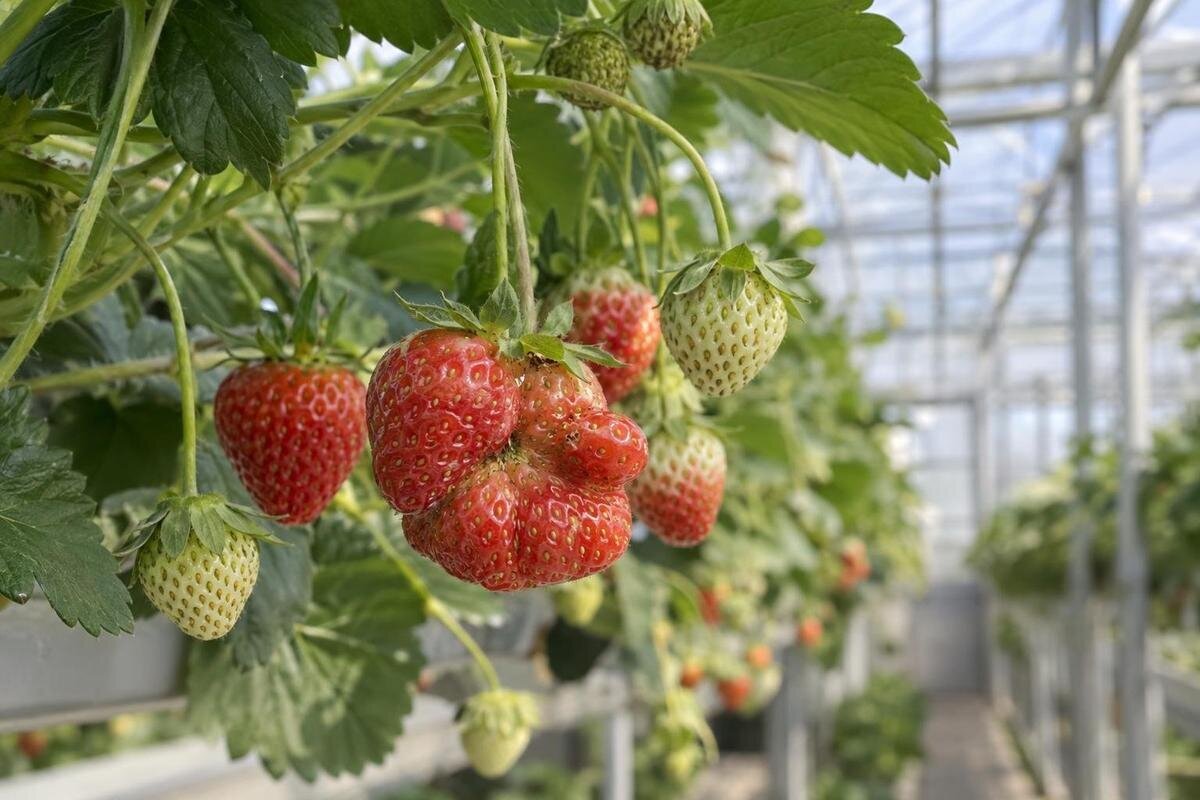
An oddly shaped strawberry usually reflects something that happened while its flower was open or the young fruit was forming. Uneven pollination is a common explanation, but a lopsided berry on its own cannot prove it. Look at the achenes—the small seed-like dots—compare several fruits from the same flowering period, and check for flower damage and greenhouse conditions at the time. The pattern across flowers and plants matters more than one unusual berry.

How flowers affect strawberry shape
The edible red part of a strawberry is the flower’s enlarged receptacle. The small dots on its surface are achenes, the plant’s actual fruits, each containing a seed. A flower carries many pistils and ovules across its centre. When pollen reaches a receptive stigma and fertilisation succeeds, the developing achene helps stimulate nearby receptacle tissue to grow. If success is uneven across the flower, the flesh beside poorly developed achenes may expand less. The result can be a berry with a narrow tip, a flat side, a hollow-looking patch or an irregular outline. The visible fruit therefore records events from the flowering stage, not only conditions at harvest.
Strawberry flowers are usually self-fertile, so a second cultivar is not needed to supply pollen. That does not mean every stigma is automatically pollinated: pollen still has to move from anther to stigma, and air movement or visiting insects can help. A greenhouse may reduce both compared with an open bed, depending on how it is managed. Cold or heat during bloom, damaged flower parts, water or root stress, pests and cultivar traits can also affect later fruit. These causes may overlap, and two berries on one plant may not share the same history. Treat poor pollination as a possibility to test against the flowers, plant and growing conditions, rather than as a conclusion from appearance alone.
What the achenes and fruit surface reveal
Look for a relationship between the shape of the flesh and the achenes nearest it. A patch that remains shallow or pinched while adjacent parts swell, especially where the achenes are tiny or poorly developed, is consistent with incomplete fertilisation. Compare berries at a similar stage of ripeness: cultivar and maturity affect colour and size, so one pale dot is not evidence. Note whether the whole fruit is small or only one region has failed to fill. Pollination-related distortion is often uneven, but that pattern is not unique to it; injury to the flower and some environmental stresses can produce a similar outline.
Examine more than one berry, and record whether the same kind of patch appears repeatedly. Take photographs from above and from the side so that both the outline and the distribution of achenes are visible. Keep the angle reasonably consistent when photographing other berries for comparison. Include a label or note for the plant, cultivar, date and stage of ripeness; otherwise, differences between crops or flowering periods can look like a single recurring problem. Record whether the affected surface is smooth, scarred or discoloured, rather than describing every irregularity simply as a dent. The photographs document the fruit’s development, but they cannot show what happened to each stigma while the flower was open.
Compare berries by truss and greenhouse position
Keep track of which truss produced each berry and, where possible, which flower opened first. The earliest flower on a truss often produces a larger berry than later flowers, so smaller fruit alone does not necessarily indicate a problem. Compare shape at a similar stage of ripeness and note whether deformation is at the tip, on one side or spread across the fruit. A consistent record of cultivar, date and flower position makes the comparison more useful than a memory of the best and worst berries after picking.
Mark affected plants on a simple sketch of the greenhouse, keeping the labels consistent with your fruit records. If one corner or row produces more misshapen berries, note the nearby shade, openings and routes used to reach the crop. Compare plants of the same cultivar in different positions before attributing the pattern to location. If affected fruit occurs throughout the house, look instead at factors shared by the plants during flowering. This sketch can also help you assess a future growing space. The T-Shaped Orangery Greenhouse has a listed area range of 16.52–30 m². For the size you are considering, sketch the intended rows and paths on its plan and check whether you could inspect each truss without leaning across other plants. Total area is less useful than a clear view of how the crop and access routes would fit.
Pollination inside a greenhouse
Watch flowers while they are fully open, rather than trying to infer pollen transfer only from ripe fruit. Strawberry flowers have both pollen-producing anthers and receptive stigmas, but pollen still needs to reach those receptive parts. Insects may do this as they visit flowers; air movement can also help. A closed or still greenhouse may offer less natural movement than an open growing area, although the effect depends on its conditions. Note which flowers insects visit and whether observations differ between rows or times of day. A brief check with no visitors is only a snapshot, so record the observation rather than treating it as proof of failure. Equally, a few insects or visible pollen do not establish that every part of every flower was pollinated.
Keep pollination observations separate from signs of flower damage. Record whether the blossom was intact and fully open, and note the position of nearby doors or vents at the time. That gives you a clearer basis for deciding whether a small assisted-pollination comparison would be useful. If you are choosing a greenhouse, examine the proposed layout for access to the flowers as well as access into the structure. The Pyramid Greenhouse is listed in sizes from 5.53–18.9 m². Use the chosen configuration to check where plants, paths and openings would sit; the product name and area range alone do not describe insect access or pollen transfer. Being able to see and reach the flowers makes observation easier, without implying that a particular greenhouse shape will solve a pollination problem.

Inspect the flower for injury
Where possible, examine blossoms before the petals fall. A darkened or dead-looking centre after a cold night raises the possibility of frost injury, particularly if several flowers from the same period show it. Cold damage to a flower can affect the developing fruit later, so the first clear sign may be a misshapen berry rather than an obviously damaged blossom. Record the weather and photograph affected flowers at the time; a dark centre alone is not conclusive, but it gives more useful context than the ripe fruit by itself.
Also look for crushed or rubbed flowers, torn petals, browned areas and scarring on young fruit. Physical injury or feeding damage can affect the flower or developing berry and leave a different surface pattern from a smooth, underfilled patch. Note whether damage occurs beside a busy path or where flowers touch neighbouring plants or stored items. Check the position before moving anything, so the original arrangement remains part of your record. When planning growing space, keep room for handling tools and reaching plants without catching the trusses. For the Limited-Edition Aluminium Greenhouse with Storage, distinguish the storage space from the area intended for crops on the selected plan. Decide where equipment would go and how you would carry it past the strawberry plants; the overall footprint should not be treated as uninterrupted planting space.
Flowering-time temperature, humidity and airflow
Conditions while a flower is open can affect pollen and its transfer. A cold spell may limit insect activity and can injure flowers; very warm conditions can also interfere with flower development or pollen performance. High humidity may make pollen less free-flowing. These effects vary with the timing and duration of the conditions, as well as the plant, so there is no single temperature or humidity reading that identifies the cause of a misshapen berry.
Measure where the flowers are, not only at the greenhouse door. A minimum–maximum thermometer or a simple written record can help you compare flowering periods, especially if the crop occupies different parts of the house. Note the date, the position of the instrument and which flowers were open, then record when vents or doors were open. Keep readings from different locations clearly labelled rather than combining them into one greenhouse figure. This helps you relate a warm, still or shaded position to a particular group of flowers. If you are assessing the Bloomcabin Prestige Greenhouse, whose listed sizes range from 3.77–28.08 m², consider where the crop and monitoring points would go in your chosen configuration. Assess its opening details separately: floor area does not describe temperature or airflow at flower height.
Water, roots and nutrients: signs of plant stress
Water or root stress is more likely to affect the plant and its crop broadly than to produce a neat, isolated patch on one berry. Look for a run of small fruit, wilting, poor growth or leaves that look different from those on healthy plants. Dry spells during fruit development can limit growth, while persistently wet growing conditions can affect roots. Check the moisture in the root zone rather than relying on the surface alone, and compare affected plants with others receiving the same general care.
Do not respond to misshapen fruit by adding fertiliser without other evidence. Nutrient problems are more convincing when several parts of the plant show a consistent pattern, and a soil or growing-medium test can help distinguish a shortage from an excess. Avoid adding trace elements simply because a berry looks unusual; too much can harm plants. Keep a record of watering and feeding so that you can compare affected plants with healthy ones receiving similar care. If you are planning a larger crop, access for these checks deserves attention. The Spacious Greenhouse is listed in sizes from 47–70 m². Mark the intended beds or containers and the paths between them on the selected plan, then consider how you would reach the root zone throughout the crop. A large area is not, by itself, evidence of even watering or consistent plant care.
Pests, disease and cultivar shape
Inspect flowers, young fruit and leaves for evidence beyond the berry’s outline. Scarring, bronzing, spots, mould, distorted new growth or visible insects may point towards another problem, although no single mark identifies a pest or disease. Check several parts of the plant and compare affected and unaffected plants. If you find a possible pest, keep a clear photo and look for it on the plant as well as on the fruit; a malformed berry without supporting signs is not enough to justify a pesticide treatment.
Cultivar also matters. Some varieties naturally produce fruit with a different outline or size, and the first and later berries on a truss need not look alike. Keep cultivar labels with the plants and compare fruit from similar flower positions before deciding that a shape is abnormal. If an unusual outline recurs on otherwise healthy berries of one cultivar, record that separately from fruit showing scarring or decay. Planning inspection access can make these distinctions easier to see. When considering the Aluminium Classic Greenhouse, sketch where the strawberry plants would stand and whether you could reach their flowers and inspect the undersides of leaves. Leave room in the plan for the plants as they grow, rather than judging access only from the size of newly planted specimens. The structure is a growing space, not a treatment for pests or irregular fruit.

A small comparison can test a pollination theory
A simple comparison can help you investigate suspected poor pollen transfer. Choose open flowers from the same cultivar and, as far as possible, similar positions on comparable trusses. Gently move a clean, soft brush over some flowers without pressing on or bruising them, and leave the others untreated. Mark both groups, recording which received brushing, the date and the conditions. Follow the marked flowers through to fruit rather than selecting the best-looking berries at harvest. Compare the proportion with underfilled patches as well as the overall shape, keeping first flowers separate from later ones where you can. Repeat with another group if possible. Natural pollen movement may reach both groups, and flowers can differ for other reasons, so this is an observation exercise rather than a definitive test. A repeated difference is more informative than a single well-shaped berry.
Keep the location of each comparison group in your notes. If plants stand close to a wall, record how shade and warmth at flower height change during the day, rather than assuming that all flowers experience the same conditions. Otherwise, a difference between two positions could be mistaken for a response to brushing. This is particularly relevant when planning a lean-to growing space. The Lean-to Greenhouses are listed in sizes from 3.69–14.34 m², but the relationship between the wall, the proposed planting positions and the openings needs to be considered for the actual site. Sketch where the flowers would sit and compare that with your observations of the location. Keep the site assessment separate from the pollination comparison so that each record answers a clear question.
Choose a response that matches the evidence
A patch of poorly developed achenes beside underfilled flesh makes incomplete pollination plausible, especially if the pattern repeats and a small assisted-pollination comparison produces better-shaped fruit. A darkened flower centre after a cold spell points towards possible flower injury. A whole plant with poor growth or many small berries calls for a closer look at roots, moisture and general plant health. Similar shapes on otherwise healthy fruit from the same cultivar may be normal. Each clue narrows the possibilities, but none should be read in isolation.
Once a pattern is clear, adjust the relevant part of the routine and observe the flowers that open afterwards; an already misshapen berry is unlikely to become symmetrical. Date the change so that fruit from earlier flowers does not obscure the result, and avoid changing watering, feeding and pollination practices together. If a fixed shade or access problem repeatedly affects the same area, consider whether moving the plants within the existing space would address it before comparing replacement structures. The Limited Edition Aluminium Greenhouse is one catalogue option for that comparison. Use the recorded problem to assess its proposed planting positions, access routes and ventilation details, rather than expecting a new structure to correct fruit shape by itself. The useful question is whether a different layout would address the specific difficulty you have observed.
Frequently asked questions
Can strawberries pollinate themselves?
Strawberry flowers are usually self-fertile, so they do not need a separate pollinating variety. Pollen still has to reach the flower’s receptive parts, though; insects and air movement can help. A lack of insect visits does not, by itself, prove that pollination failed.
Does every misshapen berry mean poor pollination?
No. Unevenly developed achenes can support that explanation, but flower injury, growing conditions, pests and cultivar traits can create similar shapes. Compare several berries and inspect flowers and plants from the same flowering period before settling on a cause.
Should I hand-pollinate every greenhouse strawberry flower?
Not automatically. If poor pollen transfer seems plausible, try a small comparison: gently move a clean, soft brush over a few open flowers and leave similar flowers untreated. Mark them and compare the fruit later. This can offer a clue, but it is not a definitive test.
Can I eat a misshapen strawberry?
An unusual shape alone does not make a berry unsuitable to eat. Check that it is ripe and has no signs of mould or decay, then follow normal washing and food-handling practices. Discard fruit that is spoiled rather than judging it by shape alone.
Will a berry become symmetrical as it ripens?
It may continue to grow, but established differences in the berry’s shape generally do not correct themselves as it ripens. If you change a growing condition, assess flowers that open afterwards and the fruit they produce.
Misshapen greenhouse strawberries are best assessed alongside the flowers and growing conditions that produced them. Unevenly developed achenes support a pollination explanation, while damaged blossoms, a recurring problem in one part of the greenhouse or wider signs of plant stress may point elsewhere. Fruit from the same cultivar and flowering period gives the most useful comparison. Keep a record of the pattern, make a targeted change where the evidence supports it, and judge the response in fruit from newly opened flowers—not in berries whose shape is already established.
