
Why Do Young Greenhouse Cucumbers Turn Yellow?
Greenhouse cucumber growing guide
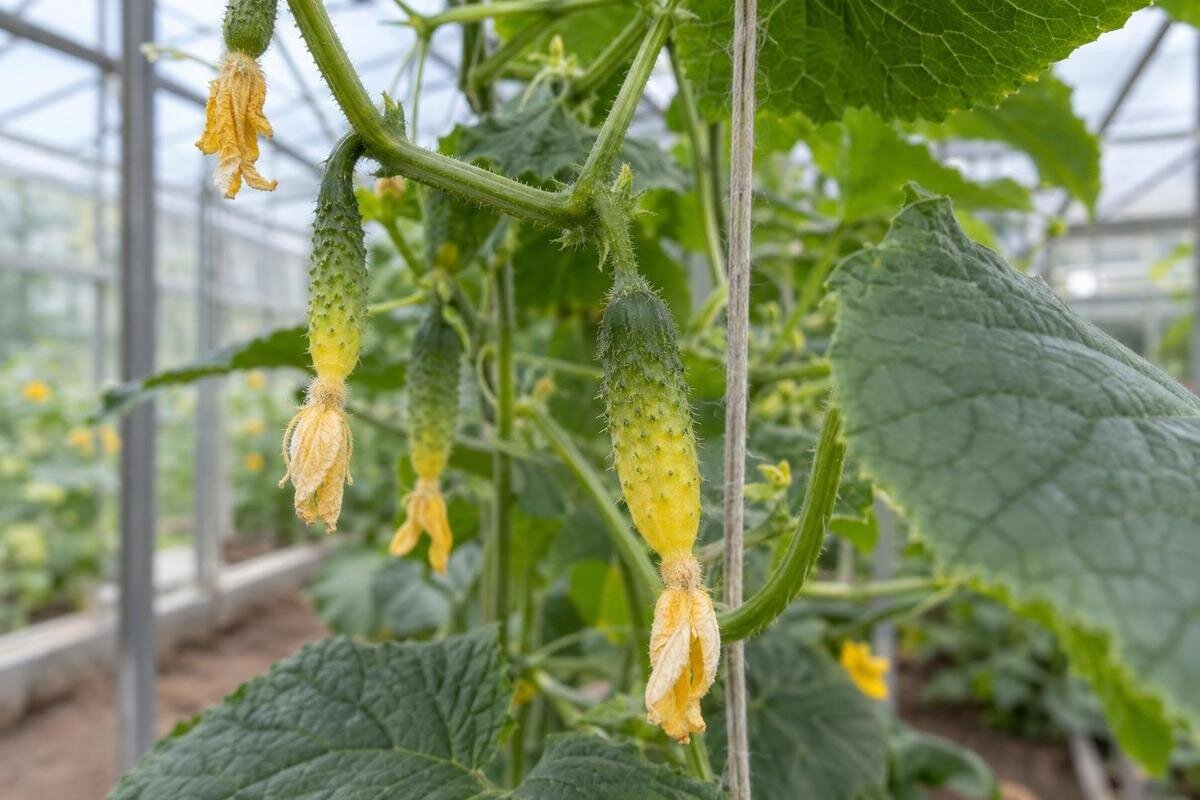
When a cucumber’s tiny fruit turns yellow, stops lengthening and shrivels, the plant is often aborting a fruit that has not established successfully. Poor pollination can be responsible when the variety needs it, but crop load, root-zone moisture, temperature and light can produce similar losses. The cultivar and the pattern across the greenhouse matter: one yellow fruit cannot identify the cause, and yellow leaves call for a separate diagnosis.

What a yellow young cucumber usually signals
A female cucumber flower has a tiny, cucumber-shaped swelling behind its petals. This is the developing fruit. If it starts to enlarge after flowering but then turns pale yellow, stops lengthening and shrivels, the plant has probably aborted it. The change can begin while the flower is still attached or after its petals have fallen. Once a young fruit has collapsed and yellowed, it will not turn green and resume growing. One fruit alone does not prove disease or a nutrient shortage: plants do not retain every flower or fruitlet in all conditions.
Look at nearby growth as well. One or two failed fruitlets on an otherwise vigorous vine may be a temporary setback; repeated losses at several points, or across many plants, call for a closer check. Note whether the leaves remain normally coloured and firm, whether the stem is growing, and whether other cucumbers are enlarging. Yellow leaves, wilting or spotted growth suggest that there may be a wider plant problem. If a fruit is already shrivelled, remove it gently when it comes away easily. Do not tug at it if that risks damaging the stem.
Distinguish flower loss from failed fruit development
Male cucumber flowers have no swollen, miniature fruit behind the petals. They release pollen and then fall, so a dropped male flower is not a failed cucumber. A female flower has the small swelling at its base; its petals may fall after flowering while that swelling continues to grow. If the swelling turns yellow and stops, the fruit has failed to develop. This distinction matters: a greenhouse can have many fallen blossoms but few cucumbers simply because many of the blossoms were male.
Follow a female flower from opening through the first signs of fruit growth rather than judging by a single visit. A healthy young cucumber should continue to lengthen; a failed one stays small, yellows and may soften or shrivel. Choose a flower you can readily find again and note the small fruit’s appearance while the petals are still present. On subsequent visits, compare its length and colour with your first observation. This helps distinguish petals falling from the loss of the developing cucumber itself. If a fruit grows to its expected harvest size and only then turns yellow, consider overripening or a variety-specific trait instead. Check the variety’s harvest guidance, as the right size and colour vary. Keep these larger fruits separate in your notes from tiny fruitlets that never enlarged: advice about failed young fruit does not necessarily apply to cucumbers that have already developed.
Check the variety’s pollination requirement
Do not assume every greenhouse cucumber needs bees. Many varieties grown under cover are parthenocarpic, which means they can set fruit without pollination. Other varieties need pollen to reach their female flowers. The seed packet or the supplier’s notes should say which applies; check the specific variety rather than relying on a general rule about greenhouse cucumbers. If the label is missing, look up the cultivar name before deciding that a lack of insects is the cause.
For a variety that needs pollination, poor transfer of pollen can contribute to fruitlets turning yellow and failing to grow. That is one possibility, not a diagnosis: a pollinated fruit can still be shed when the plant is under stress or carrying a heavy crop. Do not hand-pollinate automatically. Some parthenocarpic varieties can develop seeded or uneven fruit if pollinated, so follow the variety’s guidance. Where you grow several cultivars, keep their labels beside the plants and assess each variety separately. A pollination routine intended for one cucumber may be unnecessary for another. For a future growing area, the Classic aluminium greenhouse range offers areas from 3.77 m² to 28.08 m². When comparing layouts, allow access to read plant labels and inspect flowers without disturbing neighbouring vines. Keep the cultivar information with your planting plan so that pollination decisions remain tied to the plants, rather than the structure.
Watch whether pollinators can reach the flowers
If your cucumber variety needs pollination, observe the flowers while they are open. Check whether male and female flowers are present at the same time and whether insects visit them. Seeing insects is evidence that they can reach the flowers, but it does not prove that every female flower was pollinated. Equally, not seeing a visit during a short check does not prove that pollen transfer never happens. Compare the pattern over several flowers rather than drawing a conclusion from one blossom.
If the variety needs pollination and visits appear limited, check the growing space and its access points before deciding what to change. Note whether the flowers you are observing are near an opening or behind dense foliage, and whether you can see them clearly enough to judge insect visits. Hand transfer from a male flower to a receptive female flower may be an option when the variety’s guidance supports it, but it is not a universal fix. Keep a note of which flowers you treated so you can compare their development with other flowers on the same variety. For a future layout comparison, the lean-to greenhouse range covers areas from 3.69 m² to 14.34 m². Look at the proposed positions of plants and access points on the selected plan. The useful question is how flowers can be reached and observed in that arrangement, rather than whether a particular floor area guarantees pollination.

A heavy crop can overwhelm a young or stressed vine
A cucumber vine has to support its leaves, stems and developing fruit. A young plant still establishing itself, or a vine carrying several enlarging cucumbers at once, may not retain every fruit. Low light or a recent change in growing conditions can add to that pressure. Look at the whole vine: a steady supply of healthy new growth and some enlarging fruit tells a different story from a plant that is weak and losing fruit repeatedly.
Harvest cucumbers at the size recommended for their variety rather than leaving them to become oversized. Check the plant’s training guidance too; there is no single fruit count or pruning rule that suits every cultivar and growing system. Avoid stripping healthy leaves in an attempt to make the plant redirect energy. When assessing crop load, distinguish enlarging cucumbers from tiny swellings that have only just appeared behind flowers. Record whether older fruit is still on the vine when younger fruitlets begin to yellow. This gives you a clearer account of what the plant was carrying, without assuming that every visible fruitlet will mature. For future planting, the Limited Edition aluminium greenhouse range lists areas from 3.77 m² to 28.08 m². Plan spacing and harvesting access around the selected layout, leaving a route from which you can see and reach developing cucumbers. Easy access makes it simpler to follow the variety’s harvesting guidance and notice fruit hidden among leaves.
Check moisture at the roots, not just the surface
Cucumbers can be affected by swings between dry and very wet root conditions. Dry growing media can restrict water uptake, while persistently waterlogged roots can struggle to function. Either may contribute to poor fruit development, but yellow fruit alone cannot tell you which is happening. Check the growing medium near the roots, not only the surface, and consider how quickly it dries. Containers and beds can behave differently, so a routine that suits one setup may not suit another.
Aim for reasonably even moisture rather than watering by the calendar or soaking a dry plant in response to each failed fruit. Check the medium before watering and make sure excess water can drain from containers. Also consider whether the plant’s watering routine changed recently. Record what you found before watering, not simply that water was applied: the same watering entry can describe a dry container or one that was already wet. If neighbouring plants behave differently, compare their growing media rather than assuming they all need the same adjustment. When planning beds and containers, the T-shaped orangery greenhouse offers areas from 16.52 m² to 30 m². Use the selected layout to work out where you can reach each root zone for inspection and watering. Bed depth and container volume need separate consideration; the overall greenhouse area does not describe the amount of growing medium available to each cucumber.
Look for temperature, light and airflow stress
Conditions inside a greenhouse can change over the course of a day. Cold conditions, excessive heat or sharp changes can interfere with flower and fruit development, including pollen function in varieties that require pollination. Reduced light can also leave a vine with less energy to support its crop, especially if plants are crowded or shaded. Note what has happened in the days around flower opening and early fruit growth instead of assuming that the greenhouse feels comfortable to you, so it must suit the crop.
Observe conditions where the plants are growing, and consider how light and ventilation vary across the space. Ventilation can help manage excess heat, but opening a greenhouse without regard to outside conditions can expose plants to an abrupt chill. Note when openings were used and whether the affected plants were in a shaded or crowded part of the greenhouse. Compare those observations with the period when flowers opened and fruitlets began to enlarge, rather than only with conditions on the day you noticed yellowing. This keeps the investigation focused on the relevant growing period. If you are comparing the Pyramid greenhouse range, with listed areas from 5.53 m² to 18.9 m², examine the chosen configuration alongside your intended planting positions. Consider where neighbouring plants might shade the cucumbers and how you would manage ventilation. A model name or area figure is not a substitute for understanding those arrangements.
Use whole-plant symptoms to check for other causes
Yellow fruit is not a reliable sign of a particular nutrient deficiency. Before adding fertiliser, check the plant’s overall growth, growing medium and recent feeding. Too much nitrogen can encourage leafy growth at the expense of fruiting, and extra feed will not correct failed pollination or irregular watering. If several plants are affected or the problem persists, a suitable test or advice from a horticultural professional can help assess the growing medium; do not try to diagnose it from fruit colour alone.
Look for other signs such as yellow or mottled leaves, distorted new growth, lesions, rot, pests or widespread wilting. These suggest a wider issue and do not identify a specific disease by themselves. Photograph the fruit, flower base and whole plant, and note when symptoms appeared before seeking local horticultural advice. Describe what you can actually see: for example, whether yellowing affects fruit alone or also the leaves. Keep suspected explanations separate from these observations so that an adviser can assess the pattern without having to disentangle assumptions from symptoms. If future space planning includes the limited-edition aluminium greenhouse with storage, listed in areas from 5.52 m² to 28.08 m², check how the selected option divides storage and growing space. Plan access around the beds as well as space for stored items, so that plant inspection remains practical once the greenhouse is in use.

Compare plants and record the pattern
The distribution of the problem can narrow the possibilities. If one vine loses fruit while neighbouring plants continue to grow, inspect that plant’s roots, moisture and crop load. If several plants lose fruit at the same time, look for a shared change such as temperature, light, watering or feeding. If losses occur only on certain branches or in one part of the greenhouse, consider whether shade or local conditions differ there. Compare like with like where possible: note the cultivar and whether each plant is still establishing itself or already carrying enlarging cucumbers. Otherwise, a difference between plants may be mistaken for a difference between positions. Include unaffected plants in the comparison, as their condition helps describe how widespread the problem is. These patterns are clues, not proof of a single cause.
Keep a short record of the cultivar, which flowers produced fruit, how many cucumbers were developing, and any recent change in watering or greenhouse conditions. Date each entry and identify the plant so that observations from different vines do not become mixed together. A photograph of the same plant over time can show whether the loss is isolated or spreading; include the flower or fruit and the surrounding leaves. Use a similar view for successive photographs, with a wider image when you need to show the plant’s position. A picture cannot establish the cause without information about the variety and care. When comparing future layouts, the Prestige greenhouse range offers areas from 3.77 m² to 28.08 m². Mark intended crop positions on the selected plan and consider whether each vine will be visible from the access route. This links the layout comparison to the practical task of monitoring plants throughout the crop.
Make one careful change and assess the next set
Once you have checked the cultivar, flowers, crop load and root moisture, address the most plausible issue rather than changing everything at once. Correct a clear watering inconsistency, follow the variety’s pollination guidance, or harvest mature cucumbers as recommended. Avoid blanket hand-pollination or extra fertiliser when there is no evidence that either is needed. Give new flowers time to develop and compare their fruit with the earlier losses; a change in the next set is more informative than trying to revive a collapsed fruit.
Remove fruit that has clearly yellowed and shrivelled, but leave healthy leaves and developing cucumbers in place unless the variety’s care guidance says otherwise. Record when you adjusted care, then assess fruit developing after that change separately from fruit that had already failed. An earlier collapsed cucumber cannot show whether the adjustment helped; the useful comparison is the development of subsequent fruit. If fresh fruit continues to fail or whole-plant symptoms spread, share your notes and photographs with a local horticultural adviser, including both the original pattern and what happened after the change. If planning a larger growing space, the Spacious Greenhouse range lists areas from 47 m² to 70 m². Consider how you would organise crop positions, watering access and inspection routes across the selected layout. Keep that purchasing decision separate from the immediate response to yellowing fruit: choose space for the crop you intend to manage, not as a remedy for an unexplained loss.
Frequently asked questions
Can a cucumber plant shed tiny fruit naturally?
Yes. A plant may not retain every fruit, particularly when it is young or carrying several cucumbers. Occasional losses can be normal; repeated yellowing across several plants is a reason to check pollination and growing conditions.
Do greenhouse cucumbers need bees?
It depends on the variety. Many greenhouse cultivars can set fruit without pollination, while others need pollen transferred to female flowers. Check the seed packet or supplier’s guidance before changing pollinator access.
Should I hand-pollinate every cucumber flower?
No. Hand pollination is only worth considering if the variety needs it and pollen transfer seems limited. It is unnecessary for parthenocarpic varieties, and pollination can affect fruit quality in some of them.
Will a yellow young cucumber turn green again?
If it has stopped growing, yellowed and begun to shrivel, it is unlikely to recover. A cucumber that reaches its usual harvest size before turning yellow may instead be overripe or have a variety-specific colour.
Should I add fertiliser when young cucumbers turn yellow?
Not on that symptom alone. Check the leaves, roots, watering and recent feeding first. Extra fertiliser will not correct poor pollination or irregular moisture, and excess nitrogen can encourage leafy growth.
A yellowing young cucumber is a symptom, not a diagnosis. First confirm whether it is a female flower’s developing fruit, then check the variety’s pollination needs and look at crop load, root moisture, light and temperature. Comparing several plants and recording what changed is more useful than reacting to one fruit with extra feed or unnecessary hand-pollination. If fruit loss continues alongside wider plant symptoms, seek advice with clear photographs and growing details.
