
How to Stop Greenhouse Seedlings Becoming Root-Bound
Greenhouse growing guide
Root-bound seedlings are often a scheduling problem as much as a pot-size problem: the crop has been sown too far ahead of a suitable planting-out date, or too little nursery space has been reserved for larger pots. Root growth varies by crop and conditions, so no single cell size or sowing date suits every tray. A reliable plan begins with the window when each crop should be ready to leave the propagation space, then works backwards through acclimatisation, potting-on time, module size and bench capacity. The aim is not to keep roots small; it is to give seedlings enough room for the time they must wait.

Nursery capacity planning 1
How to recognise root-bound seedlings
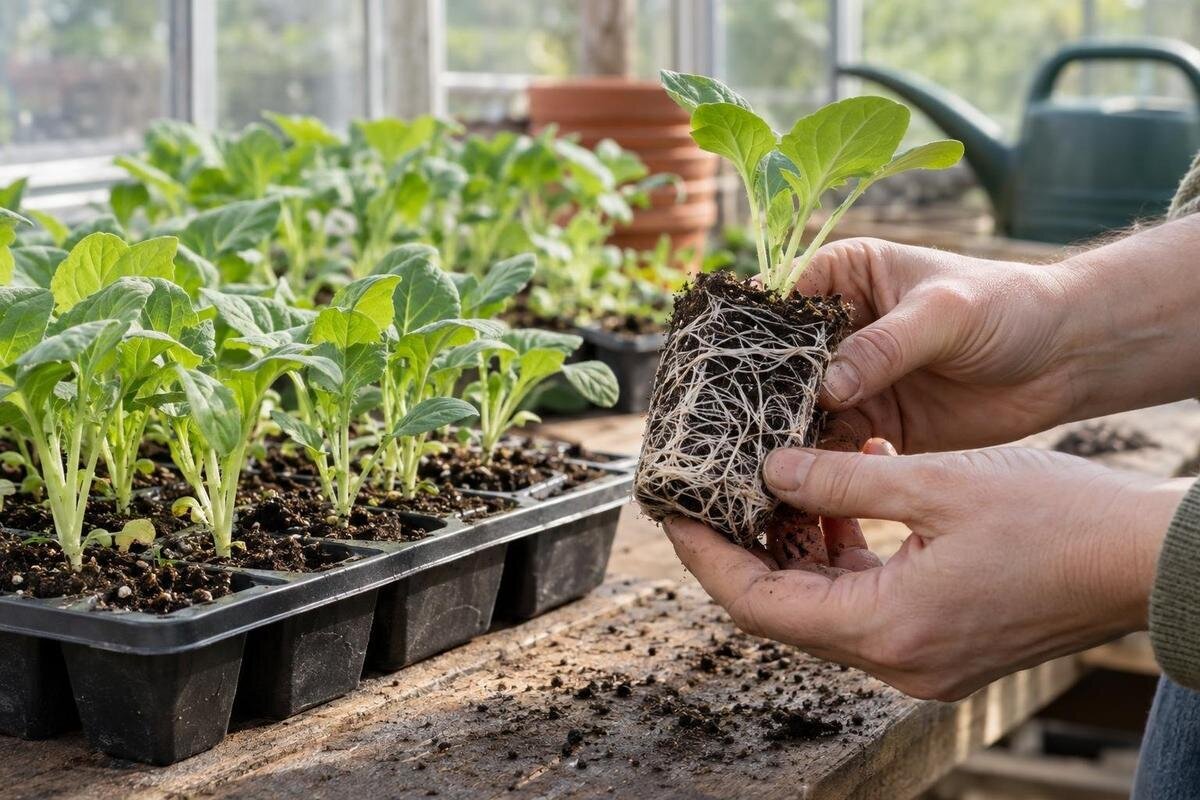
A seedling is root-bound when its roots have used most of the compost volume in the cell or pot and are beginning to circle the edges or form a dense mat at the base. When lifted carefully, the plug may hold together as a tight net with very little loose compost visible. That is different from a few fine roots reaching a drainage hole: roots naturally explore the edges as they grow, and one root tip alone does not set a potting-on deadline. The useful question is whether enough open compost remains for the plant to grow while it waits.
Check more than one sign before changing the plan. A closely woven outer surface, circling roots, compost drying much faster than in similar cells, or growth slowing despite suitable care can point to crowding. Wilting, yellow leaves and weak growth are not proof on their own; watering, light, temperature and other problems can cause similar symptoms. Root-bound describes a plant’s relationship with its container, not its age or readiness for planting out. A seedling can be large but not ready for outdoors, or small but already cramped in a very small cell. Different crops also tolerate root restriction differently, so inspect a representative plug gently rather than pulling every plant from its tray.
Work backwards from the planting-out window
Begin by deciding where each crop will go after propagation: an outdoor bed, a container or a permanent greenhouse position. Set a realistic window for planting out around the crop’s needs, the intended growing place and the conditions there. A convenient date in the diary is not enough if the soil is cold, the site is not ready or unsettled weather makes the handover unsuitable. Use the seed packet and crop-specific guidance for the variety and likely transplant stage. Treat the stated interval as a guide, not a promise, because growth changes with conditions.
Work backwards from that window. Allow for germination and the time to reach a transplantable stage, then include acclimatisation if plants raised under cover will go outdoors. What remains is the likely time in a module, which helps determine cell volume and sowing date. If the planned wait is longer than a small cell can accommodate, schedule potting on or sow later instead of hoping growth will pause at the right size. If the greenhouse will also house the nursery, sketch benches before setting sowing quantities: assess the T-Shaped Orangery Greenhouse by the usable interior layout, rather than assuming its name reveals how much bench space will fit. Give crops with different planting windows separate lines in the plan instead of choosing a compromise date.
Nursery capacity planning 2
Allow for hardening off and planting delays
Hardening off belongs in the schedule, not at the end of it. Seedlings raised under protected conditions need a gradual transition suited to the crop before they face outdoor conditions; reaching a preferred leaf or height stage does not automatically mean they are ready to plant out. During acclimatisation, trays may still occupy the propagation bench or need a sheltered holding place. Include that overlap when deciding whether another batch can start, and leave enough clearance to lift trays without crushing foliage or disturbing neighbouring plugs. Follow crop-specific advice for the transition rather than applying one rigid routine to every plant.
Make room for a change in weather or an unfinished bed. If planting out has to wait, check whether seedlings still have space for further root growth. Those with room can remain in their modules briefly under appropriate care; those nearing a dense root mat may need potting on. Do not hold them back by withholding water or giving them unsuitable conditions. Allow for a short delay, but avoid sowing so early that it creates a long wait. When considering the Pyramid-type greenhouse, listed in sizes from 60 to 203 sq ft, include somewhere to return trays if outdoor acclimatisation is interrupted. A temporary hardening-off area should not be counted as permanently available nursery space while plants still need to come back under cover.
Choose cell size for the expected holding time
Choose a cell by the expected time before planting out, how quickly the crop grows and how it responds to root disturbance. Crop-specific directions may favour direct sowing, an individual module or a particular transplant stage; follow these where available instead of forcing every plant through one tray system. A small cell saves bench space during germination, but contains less compost, so a fast-growing seedling or a delayed handover can fill it quickly. A slower-growing plant may not need the same volume. Think about the whole stay in the nursery, not just the seedling’s size on sowing day.
More compost volume can give developing roots extra room and make a short delay easier to manage, but a larger module cannot remove the need for a schedule. Its watering needs may differ from those of a small cell, and a tray with fewer, larger cells may require more trays for the same number of plants. Compare cell volume, depth and number of cavities as well as the tray’s external dimensions. If considering the Classic aluminium greenhouse, use your actual tray measurements to compare possible bench arrangements. Two trays with the same footprint need not hold the same number of seedlings or provide the same root space. If timing is uncertain, trial a small batch in the proposed module and note when roots reach the cell edges.

Nursery capacity planning 3
Match sowing numbers to available planting space
Work out how many plants to raise from the final planting space and the number you can care for at the largest potting-on stage, not from the empty tray in front of you. Use the seed packet’s sowing advice and your own germination records to allow for some failures, but avoid producing a large surplus with no destination. Extra seedlings use bench space and can compete for light and root room while the chosen plants wait. If sowing several seeds in one module, thin them at the crop-appropriate stage rather than leaving every seedling in place until planting out.
Several smaller sowings can be easier to fit around limited bench space than one large early batch, particularly when the crop can be planted in succession. Tie each batch to a likely planting window, but check the overlap: a new sowing may arrive before the previous batch has left its larger pots. When comparing options in the Prestige greenhouse range, map the number of plants present during that overlap rather than just the number sown on one date. Keep a small replacement allowance only if those plants have space to develop too. Once you know which seedlings you will keep, thin or separate them as appropriate for the crop; an unplanned surplus should not crowd the plants intended for planting out.
When to pot on seedlings
Pot on when a seedling is established but its plug is approaching the limit of the current cell, rather than waiting until roots form a hard coil. Depending on the crop, a plug may be ready to move when it holds together well enough to handle; a loose plug may need more development. Lift one representative cell carefully and examine the sides and base. A few visible roots are useful evidence, whereas a dense mesh around the outside, circling roots and little visible compost suggest that waiting carries more risk. Do not rely on a fixed leaf count alone: growth and transplant stages vary, so check crop-specific guidance, especially for seedlings that dislike root disturbance.
Have the next container ready before lifting plants, and choose a size that provides room for the next planned stage without making watering difficult. Moving up to a suitably sized pot is generally easier to manage than placing a tiny root system into a very large volume of compost; the right choice still depends on the crop. Keep roots supported, use the planting depth recommended for that species, and water in so compost settles without becoming saturated. To assess a Limited Edition greenhouse for this stage, arrange the intended pots on a measured surface and allow for foliage spreading beyond their rims. The footprint of touching pots alone can underestimate the space needed later. Keep plants accessible for watering and leave room to remove one without disturbing its neighbours.
Nursery capacity planning 4
Handle crowded roots with care
Prepare pots and suitable potting compost before moving seedlings so roots are exposed for as little time as possible. Ease a plug from its cell by supporting the compost, not by pulling on the stem; if the plant needs steadying, handle it by a leaf. A dry plug may crumble, while saturated compost can fall apart under its own weight, so aim for a moist plug that is manageable without squeezing it. Keep the root system as intact as the crop permits. If roots are tightly coiled, do not automatically tear them apart or cut them: tolerance varies, so use crop-specific advice rather than a universal rescue technique. Discoloured, soft roots or an unpleasant smell suggest a problem beyond simple crowding and need separate assessment.
A seedling that has already become root-bound may recover after potting on, but extra volume cannot undo all stress or guarantee that growth will catch up before planting out. Give it care suited to the crop and conditions, avoid waterlogging, and watch for renewed growth rather than assuming the move has solved everything. Keep its label with it so a delayed plant is not confused with the next batch. For a potting area, the aluminium greenhouse with built-in storage is an option to examine, but check the storage and working layout before deciding where supplies will go. Pots, compost and tools need their own allocated space; leaving them on the propagation bench can take up the room needed for recovering seedlings.
Calculate nursery capacity at the largest stage
Measure nursery capacity at the stage when each plant takes the most room. A tray of small cells may fit comfortably at sowing, while individual pots after potting on occupy much more bench space. Measure the outside footprint of the actual trays and pots, then map how many can sit on the usable bench without blocking doors, ventilation or the route for carrying plants. A greenhouse’s total floor area is not all growing surface: space is needed to reach plants, turn with a tray and do potting-on work. If you plan benches or shelving, verify that the selected structure’s layout can accommodate them.
Next, plot which batches overlap. Include new sowings, seedlings waiting to harden off, freshly potted plants and any crop delayed by weather; peak demand is what determines whether the schedule is feasible. For a lean-to greenhouse, check the selected model’s dimensions against the bench arrangement you have drawn. Then mark each batch’s expected arrival and departure on that plan. Test what happens if the oldest batch stays while the next one germinates: this exposes a space shortage before the trays exist. Do not count the same surface twice simply because different batches are intended to use it. If peak demand exceeds capacity, reduce or postpone the next sowing, or arrange another suitable growing space. Potting on alone will not solve a shortage of bench space.

Nursery capacity planning 5
Monitor root growth as conditions change
Use regular observation to update your estimate. Growth speed can change with the season, light, warmth, variety and general care, so the same number of weeks in a plan may not produce the same-sized seedlings every time. During routine watering and tray checks, look at a representative plug, note whether the root mat is developing and compare how quickly its compost dries with that of neighbouring cells. Avoid lifting every seedling repeatedly; checking a sample is less disruptive. If roots are using the cell sooner than expected, bring the potting-on date forward or adjust the next sowing rather than waiting for the calendar to catch up.
Do not try to prevent root-binding by keeping seedlings too dry, too dark, crowded or otherwise in poor conditions. Slower visible growth is not a substitute for adequate root space. Keep care appropriate for the crop and respond to its actual development. In a larger nursery, make the checks manageable by grouping trays by sowing date and module size, while allowing for differences between crops. If considering the Spacious Greenhouse, listed from 506 to 753 sq ft, plan a route that lets you inspect every batch rather than placing frequently checked trays behind other plants. Mark batches approaching potting-on time on their labels or plan. This helps you prioritise attention without assuming that all seedlings on one bench will develop at the same rate.
Keep a batch plan from sowing to planting out
Keep a compact plan for each crop rather than relying on memory or one general calendar. Record the variety, intended window for planting out, sowing date, module size, estimated potting-on date, number of plants with a destination and the space they need at each stage. Add a note when roots reach the cell edges or a delay changes the plan. These observations show which crops consistently outgrow their modules and which batches were started too early. Record what actually happened, not only the dates you intended to follow, and review the notes once the batch has been planted out.
Use the plan to distinguish a timing error from a container-size problem. If a batch was ready long before its destination was available, a later sowing may be more useful than routinely giving every seedling a larger pot. If the planting window was realistic but roots repeatedly became crowded beforehand, reconsider the module size or allow for an intermediate potting-on stage. Record the actual transfer date and how many larger pots were needed, then compare these with the space reserved. Keep different varieties separate where their growth differs noticeably. These few batch-specific details make the next sowing estimate more useful without turning the nursery plan into a lengthy diary, and help you avoid repeating the same space shortage.
Frequently asked questions
Does a root showing through a drainage hole mean a seedling is root-bound?
Not on its own. Roots naturally reach the edges of a cell as they grow. Check whether they form a dense mat or circle the plug, and whether little compost remains. A single visible root is a reason to inspect, not an automatic signal to pot on.
When should I pot on greenhouse seedlings?
Pot on when a seedling is established but its plug is nearing the limits of its cell, before roots form a dense, circling mass. The right stage varies by crop, so consider the roots alongside crop-specific guidance and how long the plant must wait before planting out.
Will a larger cell stop seedlings becoming root-bound?
A larger cell can give roots more room and make a short delay easier to manage, but it will not prevent crowding indefinitely. Choose its volume for the expected holding time, then keep the potting-on and planting schedule under review.
Should I plant a root-bound seedling outdoors straight away?
Not automatically. The crop and outdoor conditions still need to be suitable, and seedlings raised under cover may need hardening off. If planting must wait and the roots are crowded, potting on is usually a more sensible option than rushing the plant outside.
How often should I check seedling roots?
There is no single interval that suits every crop. Look at a representative plug during routine tray checks, especially when growth is quick or planting is delayed. You do not need to lift every seedling; repeated handling can disturb roots unnecessarily.
Preventing root-bound seedlings means managing the gap between sowing and a suitable planting place. Set a planting-out window for each batch, choose cells for the time plants may need to wait, and count space at the largest potting-on stage. When weather or planting arrangements change, use the roots and remaining bench capacity to decide whether to pot on, hold briefly or delay the next sowing. That makes crowded modules a scheduling signal you can act on, rather than a surprise at planting time.
