
Buying a greenhouse for a windy garden: site assessment and specifications
Greenhouse buying guide
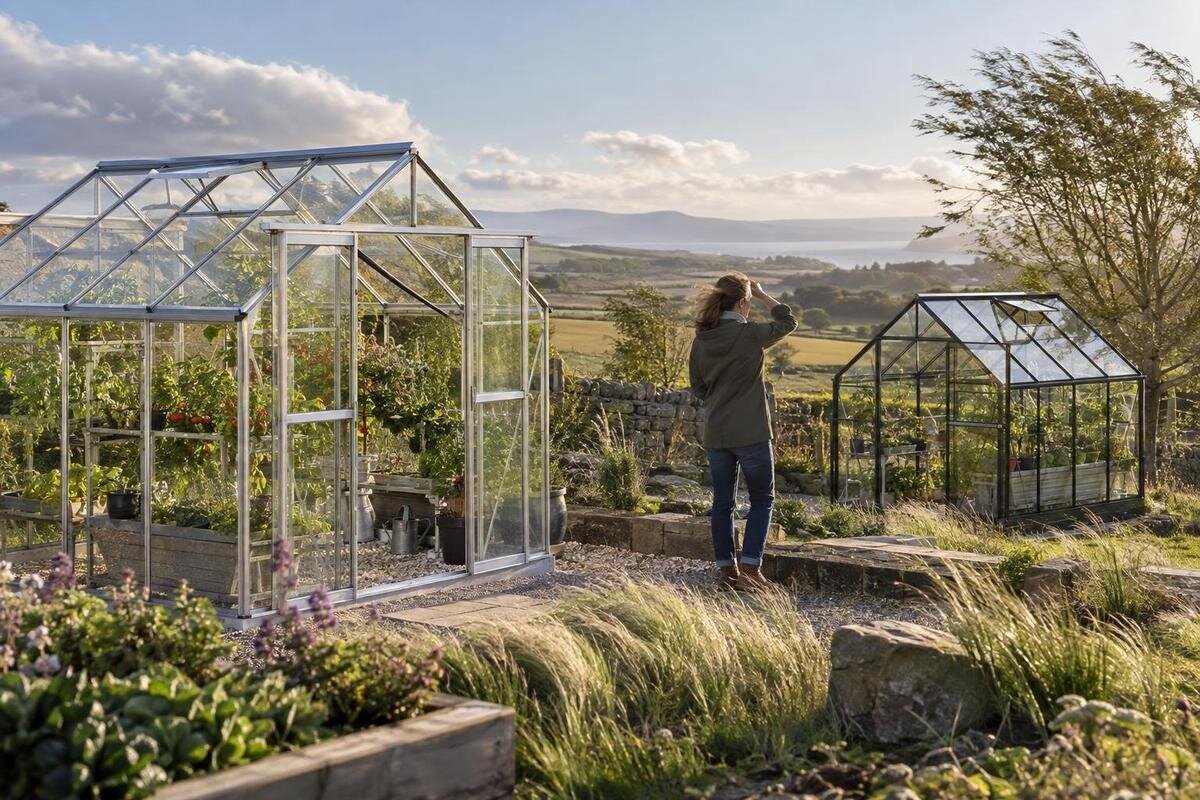
Buying a greenhouse for a windy garden is not simply a matter of choosing the heaviest-looking frame or tucking it beside a boundary. Wind can reach different parts of one plot from different directions, and a fence or wall may shelter one spot while making another more turbulent. Before choosing a model, assess the proposed position, ground and access, then compare documented wind criteria, fixing requirements and details of the complete structure. The aim is to establish whether a model’s stated conditions match your site, rather than assume a product name or photograph proves it will cope.
Map the wind at the proposed greenhouse position
Start with a sketch of the garden and mark the exact greenhouse footprint under consideration. Note open boundaries, nearby buildings, changes in level and any gaps that may channel air between structures. Mark the intended door side as well, because the most convenient approach may not be the least exposed one. A site can be exposed from one direction yet sheltered from another, so describing the whole plot as windy is not enough to choose a position. Record which way strong winds usually arrive, where they seem to accelerate and which parts of the proposed space feel most exposed.
Observe the spot in different conditions, not just on a calm viewing day. A simple diary over several weeks can note wind direction, strength in broad terms and whether gusts arrive in bursts. Ask people who use the garden regularly about conditions they have noticed in other seasons. A forecast or nearby weather station provides useful context, but it does not measure wind at the proposed greenhouse position or confirm that a model is suitable. Treat your observations as a brief for the supplier or a competent professional, not as a wind-rating calculation.
Check what nearby shelter actually does
Houses, fences, hedges, sheds and changes in ground height can interrupt wind, but the effect depends on their height, length, gaps and position relative to the greenhouse. Neither a solid boundary nor a permeable screen is automatically better. Wind can flow over or around an obstacle and become unsettled behind it. Shelter may also differ at roof level from conditions near the ground. Check the centre and edges of the proposed footprint, particularly near corners, narrow passages and the ends of fences. There is no universal spacing that makes a wall or hedge a guaranteed windbreak for every garden.
Include seasonal and future changes in your assessment. A deciduous hedge may offer a different screen when bare, while pruning or removing a tree can change exposure; a boundary structure planned for later is not protection today. A sheltered position still needs suitable light, drainage, access and room for upkeep, so do not trade one basic requirement for an assumed benefit. If you consider adding a screen, consider how it might affect wind around the site, and do not treat it as a substitute for specifications that suit the greenhouse position.
Check the ground and the greenhouse base
Inspect the ground across the whole footprint, not only where a corner would sit. Record whether it is paved, uneven, sloping, soft or prone to standing water, and note where rain runs after a downpour. Check whether roots, old foundations or changes in surface material cross the intended area, as these can affect preparation. The manufacturer’s instructions should describe the required base arrangement and surface or anchoring conditions; compare these with the actual plot. Find out whether a base is supplied or optional, which fixings are specified and whether those fixings suit the ground. If ground work is planned, identify buried services and seek competent help where the preparation is uncertain.
For an exposed site, the connection between base and ground is an important buying question. A model title such as Bloomcabin Prestige greenhouse with metallic base does not tell you the base dimensions, how it connects to the greenhouse or how it should be secured to your ground. Check the complete written specification and installation information, including any separate parts required. If the ground is loose, sloping, waterlogged or altered, have the base and anchoring approach reviewed by a suitably qualified installer or structural professional before ordering. Do not select a model on the word “base” alone.
Compare freestanding and wall-adjacent positions
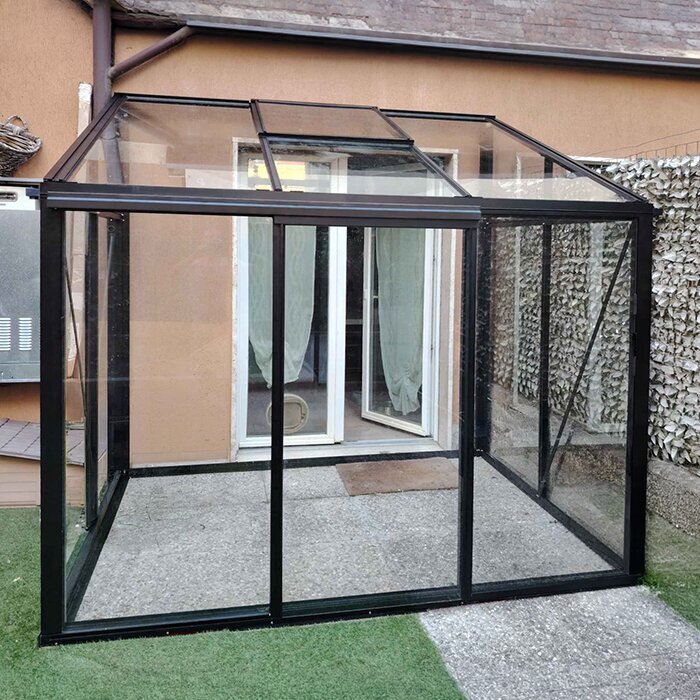
A freestanding greenhouse and a wall-adjacent design raise different site questions, not a simple choice between strong and weak. A wall may screen some wind directions, yet air can be funnelled around an end, along a narrow gap or over a roof edge; the result depends on the building and site. Think about rainwater falling from the building as well as wind moving around it. Check whether the proposed position is clear of roof runoff, leaves room for maintenance and allows practical access to the door. Consider how the greenhouse might be exposed when wind arrives from either end of the wall, not just from the direction you first expect.
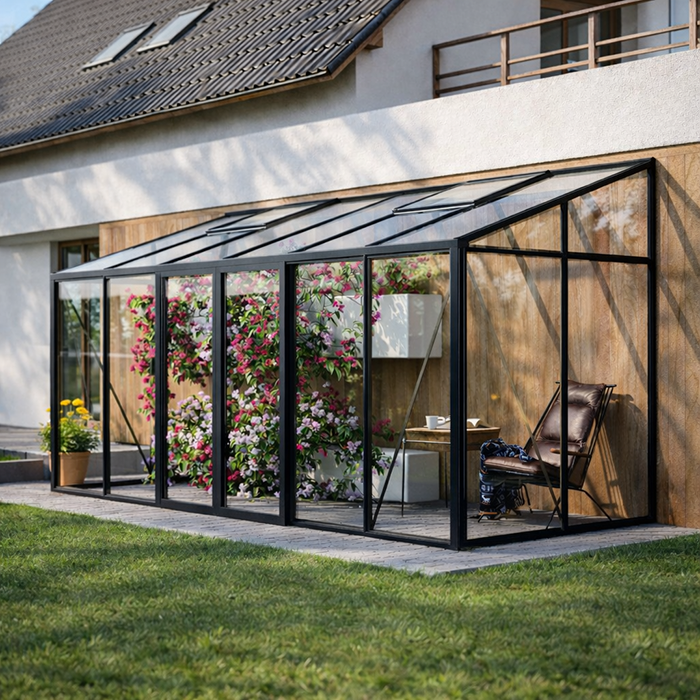
For a model listed as an aluminium lean-to greenhouse, confirm the attachment details in its specifications and installation information rather than reading “lean-to” as a wind rating. Check which wall types and fixings are specified, whether your particular wall is suitable for the connection, and what clearance or weatherproofing the installation requires. A general diagram may not establish that your wall is appropriate. If you cannot confirm its suitability from the documentation, ask an installer or building professional to assess the wall and connection instead of relying on the neighbouring structure as shelter.
Ask what the wind-resistance claim means
Look for a stated wind design criterion or a test or assessment document, not just a broad description such as robust. Find out whether any stated figure refers to gust speed or another measure, how it was established, and what exposure, orientation, anchoring and operating conditions it assumes. Check the date and exact model covered by the document, particularly if options or configurations are available. A value for a fully assembled greenhouse with specified fixings may not apply if a different base or fixing method is used. Ask whether the assessment covers the complete structure, including panels, frame, doors and roof, and whether it sets limits on the sites where the greenhouse can be installed.
Compare like with like rather than treating wind-resistant as a complete specification. If a page for the aluminium classic greenhouse gives no wind criteria, its model name and material label are not a substitute; request the relevant documents or a clear explanation. Do not assume a generic figure from another product or a brochure photograph applies. For an exposed plot, a qualified professional can help interpret declared criteria against site conditions. If the basis or limitations cannot be explained, treat that uncertainty as part of the buying decision.
Read the frame, panel and connection specifications together
A material name alone does not describe how a greenhouse is constructed. Look for details about the frame profiles, member dimensions, bracing and the way joints are connected. For the panels, check which type is specified, how the edges are retained and what fittings hold them in place. It is also useful to establish whether the documents identify optional components separately from the standard structure. These parts work as an assembled structure, so a description of one component cannot establish how the whole greenhouse performs. Ask for a specification sheet or dimensioned drawings if the listing does not make the construction clear.
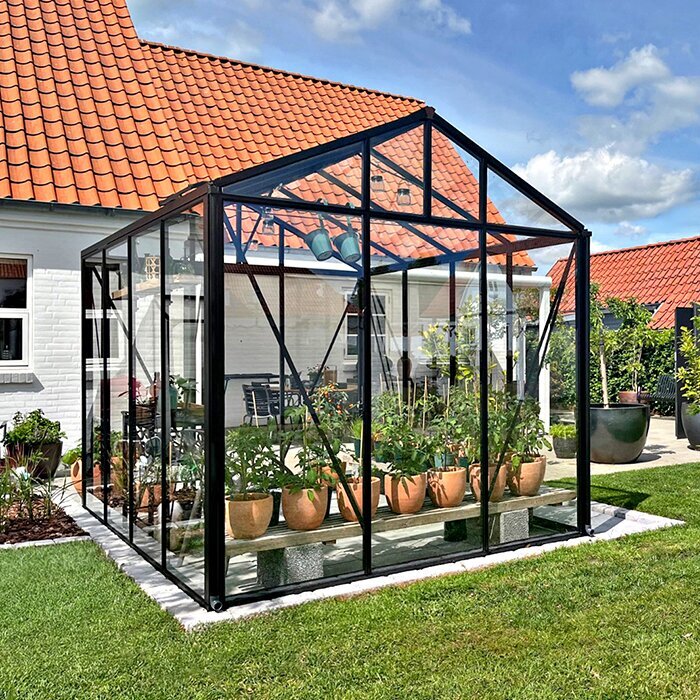
The name aluminium limited edition greenhouse does not establish its frame sections, panel type, bracing or connection system. Check those details in the current product information rather than inferring them from the word aluminium or from an image. Confirm that the assembly instructions match the configuration you intend to order, including any specified fasteners or supports. If the documents do not explain how panels and frame members are retained, ask for clarification before purchase, especially where the greenhouse will be exposed to strong winds.
Check doors and vents for windy conditions
Doors and vents affect how you use a greenhouse as well as how you manage it in changing weather. Check where openings are positioned, how they latch when closed and how they are held when open. Consider the direction in which a door opens and whether gusts could make normal entry awkward. Consider whether you can reach and operate them safely without leaning across the frame, and whether the door opening works with paths, fences and nearby structures. Do not assume a door or vent can be left open in gusty weather simply because it is convenient on a calm day.
For the Bloomcabin Oasis pyramid greenhouse, as with any model, the name does not show where openings sit or how they are secured. Look for these details in the drawings and instructions, and ask what the manufacturer recommends for doors and vents when wind conditions change. Ventilation remains part of everyday greenhouse use, so consider both access when it is calm and the documented way to secure openings when it is not. Do not assume a vent closes automatically or that a latch has a particular wind capability unless the specifications say so.
Use the full footprint when judging fit
Set out the external dimensions on a garden plan rather than judging by the growing area alone. Include any base, door-opening space, paths and room to reach the sides for inspection and maintenance. Allow for the tools or equipment needed to keep gutters, panels and surrounding ground accessible where the instructions require it. Check that the greenhouse will not leave a narrow gap where panels or fixings are difficult to access. A tight fit can also make normal use awkward, even if the structure appears to fit on paper. Follow the manufacturer’s stated clearances and account for the route you will use to get to the door.
A name such as Garden orangery T is not a dimensioned plan. Check the actual overall width, depth and height, along with any projections, door position and the shape of the external footprint. A nominal floor area may not make irregular sections or access needs obvious. Footprint and height help you assess whether the greenhouse suits the space, but they do not prove wind performance. If the proposed position is unusually constrained or exposed, have the complete layout considered alongside the installation requirements.
Treat storage and extras as secondary to wind fit
Before comparing convenience features, write down the essentials for your site: a suitable position, clear installation requirements, relevant wind information and a footprint that leaves room for access. Separate essential requirements from preferences so that missing technical information is easy to spot. Then consider which additional features matter to your growing plans. This order helps prevent an attractive extra from distracting you from an unanswered question about the base, panels or wind criteria. It also makes it easier to compare different product listings on the information that affects your purchase.
A title such as aluminium greenhouse with built-in storage signals a feature to investigate, but does not show how the storage is arranged or how much space it occupies. Check the dimensions and the specification to see whether it affects the overall footprint, access or installation requirements. Confirm which parts are included and whether any accessories are separate. Do not assume that a storage feature adds wind protection or tells you anything about the structure’s suitability for an exposed position.
Confirm the documentation and installation details before ordering
Before placing an order, make sure the product page and supporting documents refer to the exact model and configuration you are considering. A listing such as Bloomcabin Orangery still needs to be assessed using its specifications, not its name or gallery images. Keep copies of the information you used so you can compare it with the order details and installation instructions. Look for the dimensioned drawing, frame and panel details, base and anchoring requirements, any wind information and a clear list of what is included. If a key document is missing, request it rather than filling the gap with assumptions.
Also check the practical arrangements for getting the greenhouse to its position and assembling it. Confirm the access route from the delivery point, review the instructions and establish whether professional installation is appropriate for your site. Find out how missing or damaged parts are reported and how replacement components are identified; do not assume availability or terms that are not stated. If the documentation leaves the wind criteria, ground preparation or connection unresolved, pause the purchase until those questions have a clear answer.
Frequently asked questions
Can a fence or hedge protect a greenhouse from wind?
It may reduce exposure from some directions, but the effect depends on its height, length, gaps and position. Wind can also flow over or around a boundary and become unsettled behind it. Observe the proposed site in different conditions and treat a fence or hedge as part of your assessment, not proof that a greenhouse is suitable.
Is a lean-to greenhouse automatically a better choice for a windy garden?
No. A nearby wall may shelter the greenhouse from some winds, but the effect varies with the building and the direction of the gusts. Check the specified attachment requirements, the suitability of your particular wall and the model’s wind information. Get professional advice if the wall or connection cannot be verified from the documentation.
What wind rating should I look for?
There is no single figure that can be judged without knowing how it was established and what site conditions it assumes. Ask whether the stated value refers to gusts or another measure, and whether the assessment covers the complete greenhouse, its panels and its specified anchoring. A qualified professional can help relate the information to an exposed site.
Does a heavier frame mean a greenhouse is more wind-resistant?
Not necessarily. Weight or a material name does not tell you how the frame is connected, how panels are retained or how the structure is fixed to the ground. Compare the published specifications for the complete assembly rather than using apparent heft as a substitute for wind-performance information.
Would a smaller greenhouse be safer in an exposed position?
Not automatically. Size affects the space the structure occupies, but suitability also depends on its design, connections, anchoring and the wind conditions assumed in its documentation. Choose a footprint that works for your garden and growing plans, then check that the available performance information applies to the proposed site.
A good match is one where the intended position, ground, attachment, usable footprint and documented wind assumptions all make sense together. Shelter is useful context, not proof of suitability, and a model name, material label or apparently substantial frame cannot replace relevant specifications. If your site is unusually exposed or the documents do not explain the fixing and wind criteria, treat that as an unresolved buying question and get appropriate professional input. That makes the decision specific to your garden rather than a guess based on appearance.
