
Buying a Greenhouse Kit: Assembly Skills and Tools
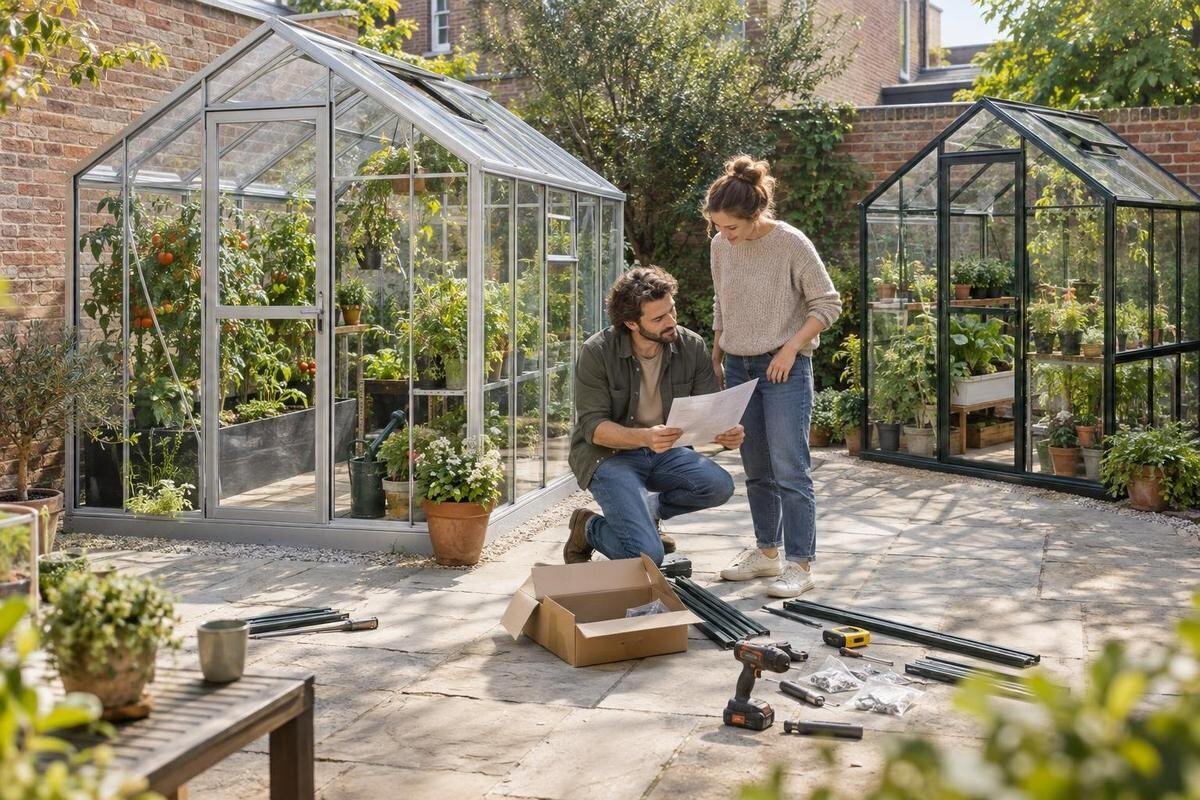
Greenhouse buying guide
Buying a greenhouse kit means buying a set of tasks as well as a structure. Assembly can involve sorting fixings, aligning a frame and handling glazing, while the base and site preparation may sit outside the kit. Before ordering, find the instructions for the exact model and check the stated tools, team size, parts supplied and preparation required. Then compare those demands with your practical experience, available time and working space; a product photograph alone cannot show whether the build will suit you.

What a greenhouse kit build involves
Most greenhouse kits involve a sequence of distinct jobs, not simply joining a few pieces. Depending on the design, you may identify and sort parts, assemble frame sections, check alignment, fit glazing or other panels, then finish details such as doors and vents. The order matters because later components can depend on earlier sections being positioned correctly. The instructions should set out the actual sequence and any model-specific handling. Do not assume that two kits with similar photographs use the same fixings, or the same way of holding glazing in place. Pictures rarely show how components are labelled, where fixings sit or how much work happens before the first panel goes in.
Separate assembling the greenhouse from preparing its location and base. The contents list may distinguish the frame and glazing from a base, anchoring components or items needed for groundwork, so confirm what is included rather than treating the word kit as a complete package. Read the manual for the surface or base it requires and check whether site work is included in any assembly estimate. Allow clear ground to lay out parts without blocking the route between boxes and the work area. If larger sections need to be assembled before being moved, make sure there is room to turn them. Keep small fixings grouped and packaging labels until you have checked the inventory; this helps avoid losing time over a missing part.
Get the exact assembly instructions before buying
Ask for the assembly manual and parts list for the exact model before you buy; a generic video or guide for a similar greenhouse is not a reliable substitute. A listing such as the aluminium classic greenhouse identifies a product, but the matching instructions are what reveal the work. Check that the document names the model or code you are considering and shows the build in a clear order. It should tell you which components and fixings are needed, what tools to prepare, whether a helper is specified and which items are not supplied. If the documents are not available online, ask the retailer for them and confirm they match the kit you intend to order.
Read enough of the guide to understand the stages, not just the first diagram. Look for a labelled parts inventory, illustrations that show component orientation, notes about fitting the panels and clear instructions on where preparation ends and assembly begins. A large number of pages does not automatically mean a difficult job, and a short booklet is not proof that assembly is simple. Notice any vague step, unexplained tool or reference to an extra component; get the answer before paying. If the instructions also cover optional items, identify whether they are included in your package. For models with variations, check that the parts list and guidance match the precise version rather than just its family name.
Check the frame and glazing method
Appearance offers only limited evidence about how a kit goes together. A lean-to profile, for example, does not by itself reveal whether sections are bolted, clipped or assembled in another way. Check the manual for the frame-joining method, how pieces are identified, whether alignment is checked at each stage and how the glazing is held in place. For the aluminium lean-to greenhouse, as for any named kit, the exact assembly guide—not the category label—should answer those questions. Product photographs may omit the reverse side, fixings and the order in which pieces are fitted. If accessories are shown, separate their installation from the core greenhouse build when assessing the work.
Consider the glazing as a separate handling task. First establish what material the kit uses; do not infer it from a picture or from another model in the same range. Glass needs careful handling because it can be heavy and breakable; other panel materials may have different handling and fitting instructions. Find out whether panels are lifted individually, slid into a frame or secured with a particular fixing, and whether the guide calls for two people. If you have never handled large or fragile panels, decide honestly whether you can do so with a helper and suitable working space. Follow the maker’s instructions, do not improvise a substitute fitting method, and check whether protective equipment is specified.
Assembly skills to assess honestly
Useful greenhouse assembly skills are often ordinary practical ones: reading diagrams, identifying parts, following a sequence and using tools without forcing a joint. Check that you can keep left and right, or inside and outside, orientations straight, separate fixings by type and return to the parts list when a piece is unclear. Measuring and checking alignment with a tape measure or spirit level may be required at specified points; consult the manual for when and how. A hole that does not line up is a reason to recheck the part and its orientation, not to assume that force or an extra fixing is appropriate. Clear part labels help, but the guide must explain what each label means.
Think about how you handle a long, repetitive task. A previous flat-pack build may show that you can follow diagrams and sort components, but it cannot tell you how comfortable you will be with a greenhouse’s panels or working area. Ask for the instructions for the aluminium limited edition greenhouse and judge their actual steps: are the parts identified, are the diagrams easy for you to interpret, and can you maintain careful alignment throughout? If a step depends on a skill you do not have, seek clarification or a competent helper rather than assuming you will work it out midway through. Patience, methodical sorting and a willingness to pause matter as much as speed.

Tools and protective equipment to check
Build your tool list from the manual, then compare it with what you own. Depending on the fixings, a kit may call for screwdrivers or bits, spanners, sockets or hex keys; do not buy a full set until you know the sizes and types. A tape measure and spirit level may be needed for checks specified in the instructions. Some kits may include a particular key or fitting aid, but confirm this in the contents list. For Garden Orangery T, or another exact model, ask which tools are required and whether any are supplied; a product name cannot answer either question. Check the tool sizes and fixing types rather than relying on a general list for greenhouses.
Check whether the guide specifies eye protection, gloves or another protective item for handling the frame and panels, and follow that guidance. If it calls for work above normal reach, plan a suitable and safe method of access; do not balance on boxes or improvised platforms. A powered driver is not automatically necessary: use one only if the instructions allow it, with a suitable bit, and avoid overtightening fixings. Lay out the tools before you begin so you are not leaving a partially assembled frame to search for a key size. If a required tool or access method is outside your experience, include that in your decision about whether to ask for help.
Prepare the space and base
Measure the intended space against the kit’s stated footprint and height, but also think through assembly access. Long frame members or panels may need room to be laid out and moved; you may need a clear route between the delivery point and work area, plus space for packaging and a helper. Check gates and narrow passages rather than assuming that a greenhouse which fits its final position can also be taken there in pieces. Use drawings and dimensions for the exact model, not the apparent scale of a photograph. This is an assembly check as much as a garden-layout choice: the space needed to put the kit together may differ from the space it occupies when complete.
Read what the instructions require beneath the greenhouse and clarify whether a base, anchors or other items are included or bought separately. Do not treat a level-looking patch of ground as proof that it meets the maker’s requirements, and do not devise a foundation from a generic guide. For a named option such as the Pyramid Greenhouse Bloomcabin Oasis, confirm the base and preparation stated for that exact model. If preparing a suitable surface involves work beyond your competence, ask a qualified tradesperson or installer to assess it before ordering. Keep site preparation separate from the kit’s advertised assembly tasks, and make sure you know who is responsible for each.
Plan the time and people needed
Use the assembly time supplied for the exact kit as a planning estimate, not a promise. Check what it includes: unpacking and sorting, assembling the frame, fitting glazing and making final adjustments may be counted separately from preparing the base. Ask whether the stated time assumes one person or a team, and whether it is intended for experienced assemblers. A title such as aluminium greenhouse with built-in storage does not reveal extra assembly steps or duration; the relevant evidence is the model’s guide. If no estimate is available, plan around the stages in the manual and allow for interruptions rather than borrowing a time figure from a different greenhouse.
Plan the helper’s role rather than treating them as an extra pair of hands standing by. One person may read the sequence and sort fixings while another handles a component, but the manual should determine who is needed for particular lifts or fitting stages. Agree to pause if alignment or a part number is uncertain; rushing to meet a self-imposed schedule can lead to misplaced pieces or repeated work. Choose a period when everyone can work without hurry and conditions allow you to control the panels safely. If the instructions require more people than you can arrange, change the plan or use an installer instead of attempting a lift alone.
Confirm what the kit includes
Read the contents and exclusions line by line before comparing prices. Confirm whether the frame, glazing, doors, vents, fixings, base and any tools are included, and note any extra components or preparation the manual requires. A title such as Bloomcabin Prestige Greenhouse with Metallic Base is not a contents list: ask whether the named base is included in the particular package, what it consists of and what must be ready beneath it. Do not assume that an accessory pictured with a greenhouse is part of the kit, or that a similarly named model has the same package. An itemised answer makes it easier to compare like with like.
Consider how parts will arrive and where you can keep them until assembly. Check the delivery description for the number of packages, if stated, and ask about the largest package if its dimensions are not provided; this affects preparation, not the greenhouse’s assembled size. Make sure you can move the packages from the drop-off point to a suitable place for checking and storage. Once delivered, compare the components with the parts list before starting and keep small fixings together. If something appears missing or damaged, pause and follow the supplier’s stated process rather than substituting an unlisted fixing. Ask how to report a problem before ordering, so an incomplete set does not leave the frame part-built.

When to ask for assembly help
Use a practical test rather than asking whether you are good at DIY. Could you follow a multi-stage illustrated guide, keep components organised, use the listed tools and carry out precise alignment checks? Can you handle the specified glazing with the people and space available? Is there time to stop and check an uncertain step instead of improvising? A named option such as Bloomcabin Orangery cannot answer these questions from its title; compare its actual manual with jobs you have completed confidently. A small gap in experience may be manageable with help, but an unclear or unsafe task is not a test of determination.
Self-assembly is more reasonable when the instructions are complete, the required tools are available, the base is prepared to the stated requirements and the lifting or glazing stages are within your capabilities. Consider an installer if the guide calls for a team you cannot arrange, panels feel too difficult to handle, the required access is beyond your experience, or site preparation needs specialist judgement. If you seek help, ask whether the work covers the kit assembly only or also the preparation you need, and make those boundaries clear. Do not assume that an installation service includes groundwork unless its scope says so.
Compare assembly requirements before ordering
Write down a short comparison for every kit you are considering: exact model and manual; named tools and whether they are supplied; assembly stages; glazing material and handling notes; stated team size and time; base requirements; parts excluded; and access for packages and construction. Put answers beside the same headings for each kit so differences are visible. If a seller cannot confirm a critical item, mark it as unresolved rather than filling the gap with an assumption from another model or a review. This keeps the comparison focused on what you will actually have to do after delivery, not just on the appearance of the finished greenhouse.
Your decision need not depend on owning every possible tool in advance. It should depend on knowing what the kit asks of you, having a realistic way to obtain any tools or help, and being able to prepare the site to the stated requirements. If the manual makes the work understandable and the practical arrangements are in place, DIY may suit your experience. If key steps, base responsibilities or safe handling remain unclear, settle those questions before ordering or choose an assembly route that does not leave you guessing. Decide which unanswered details would be a reason to pause rather than hoping they will be straightforward.
Frequently asked questions
Can I assemble a greenhouse kit on my own?
Only if the instructions for that exact kit allow it and you can manage every stage safely. Some components or glazing may need a second person for handling or alignment. Check the manual’s guidance on team size rather than judging from the greenhouse’s appearance. If you cannot get the instructions before buying, ask the retailer what help the build requires.
What tools do I need to assemble a greenhouse kit?
There is no universal tool list. Depending on its fixings, a kit may call for screwdrivers, spanners, sockets or hex keys, while a tape measure and spirit level may be needed for checks specified in the manual. Confirm the exact sizes and whether any tools are supplied before buying extras. Follow the instructions if they specify protective equipment or access equipment.
Does a greenhouse kit include a base?
Not necessarily; contents vary between kits. Check the parts list for the exact model and confirm whether a base or anchoring components are included, what the instructions require beneath the greenhouse, and whether any preparation is separate. Do not assume that a base is included because it appears in a photograph or is mentioned in a product title.
How long does greenhouse kit assembly take?
Use the estimate for the exact kit, if one is provided, and check whether it assumes one person or a team. It may not include unloading, sorting parts or preparing the base. If there is no estimate, use the stages in the manual to plan your time; figures for a different greenhouse are not a dependable guide.
When should I ask someone else to assemble a greenhouse?
Consider help if the manual calls for more people than you can arrange, the glazing is difficult for you to handle, the required access is outside your experience, or site preparation needs specialist judgement. Before engaging an installer, clarify whether the work is limited to assembly or includes any preparation you need. Do not assume the wider scope is included unless it is stated.
The right kit is one whose instructions, equipment needs and handling demands match the people and space you can bring to the build. A clear manual and confirmed contents turn a guess about DIY ability into a more realistic buying decision. If a key task remains uncertain, treat it as a question to resolve before delivery rather than something to improvise once the parts are laid out.
