
Buying a Greenhouse Online: Measurements and Checks Before You Pay
Greenhouse buying guide
Buying a greenhouse online is simpler when the plot is measured before a style is chosen. A photograph can help you compare appearance, but it cannot tell you whether the stated footprint leaves room for a door, whether the ground meets the product’s base requirements or whether delivery can reach the intended site. Treat the dimension drawing, written specification and delivery terms as parts of one decision. This guide explains what to measure, which details to confirm and when to pause before paying.

Measure the clear footprint on site
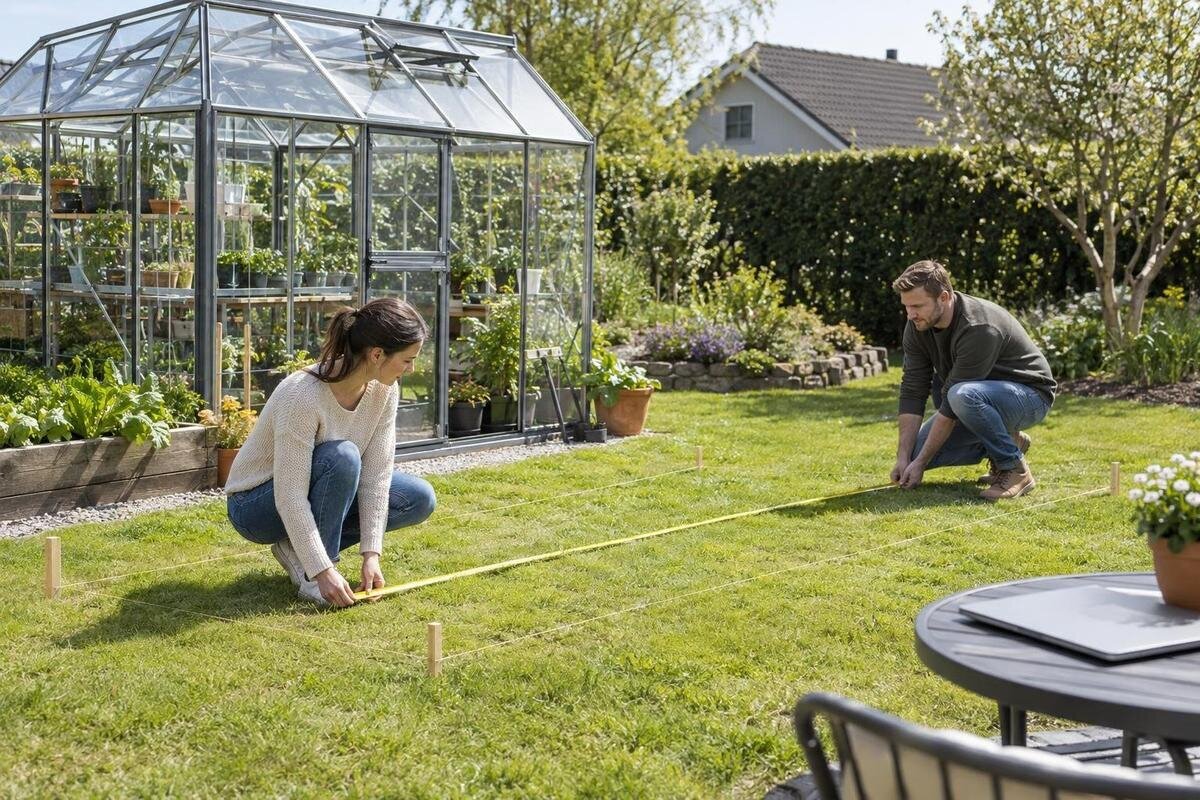
Measure the place where the greenhouse will stand, rather than estimating from the size of the lawn or a catalogue photograph. Use a tape measure to record the longest usable length and width, and note fixed edges such as a fence, wall, raised bed, shed or path. If the plot narrows or has an angle, measure its narrowest points too; the total garden area does not show whether a rectangular footprint will fit. Write every result in the same unit, and mark which figures describe clear ground. Keep the raw measurements rather than rounding them up, so you have an honest boundary against which to compare each product page. Where a path must remain open, measure its required width separately instead of treating it as spare greenhouse space.
On the product page, identify exactly what the dimensions refer to: the outside of the frame, a base, a roof projection or the interior floor. Width and length do not automatically mean usable planting space, and a photograph is not a scale drawing. Compare the listed measurements with your notes, then include the working clearance specified for assembly, access and maintenance. If it is unclear whether a dimension includes projecting parts, ask before ordering instead of treating the smallest outline as definitive. For example, an aluminium classic greenhouse listing should be assessed using its own published dimensions, not a guess based on its image or name. Save the diagram or specification used for comparison, and keep external and internal measurements clearly separate.
Read height and usable-area dimensions separately
Length and width are only part of the fit. Check the stated overall height and where it is measured, as well as any lower side height or roof profile shown on a dimensioned drawing. This matters if branches, eaves, a wall or another fixed feature overhangs the planned position. A label such as overall height may not describe every point on the frame, so read the diagram rather than assuming the value refers to the side walls. If a listing provides only a headline footprint, request the missing measurements instead of estimating them from perspective in a photograph. Check that the dimensions match the exact configuration you are considering, particularly if the page describes more than one option.
Keep external size separate from usable room inside. The frame and internal supports take up some of the footprint, while the arrangement of shelves, containers and plants determines how much open floor remains. Sketch the measured outline and mark the items you intend to use; include the space needed to reach them, not only their positions against a wall. This rough plan can reveal an awkward layout before purchase, but it cannot replace the model’s published internal dimensions. Where those are absent, ask for them. Compare each candidate consistently, so you do not judge one by its outside size and another by an advertised growing area.
Check the doorway and everyday route
A greenhouse can fit its footprint yet be inconvenient to enter if the doorway faces a bed, path, wall or storage area. Locate the door on the plan and check its clear opening, direction of travel and the space needed in front of it; these details may not appear in a main product photograph. Compare the opening with the trays, watering equipment or containers you expect to carry through. If its width or height is not stated, do not infer it from the image. Ask for the actual clear opening and confirm which model or option those measurements describe.
Also consider how you will reach the door once the greenhouse is in place. Trace the route from the house or garden entrance, including gates, steps, corners and narrow paths, then measure any bottleneck. This helps you judge whether routine carrying and movement are practical, rather than focusing only on the structure’s outline. If you use a trolley, consider its turn at corners and the space to set items down. Separate day-to-day access from assembly access: they are different questions, and an accessible doorway does not guarantee that a chosen site is convenient to work in. If the approach changes with movable items such as bins or furniture, note where they will go after installation.
Assess the proposed position around the greenhouse
Check the proposed position at different times of day rather than judging it from a single visit. Note where nearby buildings, fences and trees cast shade, and how that changes as the sun moves. This is a site-planning check, not a guarantee of a particular growing result: your intended use and the plants you plan to grow matter as well. Consider whether routine access to water or other supplies is practical, without assuming that any service or equipment is included with the greenhouse. If a lean-to style is on your shortlist, use the aluminium lean-to greenhouse listing to find its own positioning details; do not infer required clearances from the title alone. Note seasonal as well as permanent obstructions, since trees and hedges may not shade the site in the same way all year.
Look for fixed features that could constrain the location after delivery: overhanging branches, roof edges, drainage routes, taps or other services, and room to move around the frame. A blank patch on a garden plan may be used by gates, bins or seasonal furniture in practice, so assess the space as it is used day to day. If the intended site is close to a building, boundary or service, confirm any access and installation requirements with the supplier or an appropriately qualified person. The purpose is to catch practical conflicts before ordering, not to derive a technical installation plan from a web listing.

Confirm the base and ground requirements
Treat the base and the ground beneath it as separate items to verify. Read what the product information says the greenhouse must stand on, whether a base is required or optional, whether it is included, and what site preparation is expected. A photograph or product title may refer to a base without making clear what is supplied, so use the written specification and contents list. Compare those instructions with the surface you have in mind—soil, paving or another prepared area—and do not assume that a patch that looks flat satisfies the stated requirements. Note any extra work or materials that the instructions place outside the product order. Use guidance for the exact model, since information for another size or style may not describe your selected base.
If the instructions call for a level, firm or otherwise prepared support, establish how that applies to your particular surface before purchase. A slope, soft ground or uneven paving may affect the work needed, but there is no single solution to infer from a photograph. The Prestige greenhouse listing with metallic base in its title illustrates why a model name is not the same as a complete statement of what is in the box or what the site must provide. If guidance is incomplete, or you are unsure whether your existing surface is suitable, ask the supplier or a qualified installer before arranging work. If you plan to hire someone, share the relevant product drawing and site measurements before agreeing preparation work.
Compare materials by the stated specification
Read material descriptions closely enough to compare like with like. Check what the frame is made from and what the glazing or covering consists of, then look for any stated panel thickness, finish, fixing details or care requirements that matter to your use. A broad material label does not describe every part of the structure, and two pages may use different wording for comparable components. If the specification is unclear, ask which part a description refers to and whether it applies to the exact model or configuration in your basket. Do not assume that a product image shows construction details not listed in the text. If the page links to a manual, check that it names the same model or version as the one you are considering.
Treat claims about performance, maintenance and replacement parts as specific questions to verify, not as conclusions that follow from a material name. Read how the seller describes cleaning and upkeep, and check whether information about replacement glazing or components is available if it would affect your decision. Where a page is silent, do not fill the gap with assumptions about strength, heat retention or service life. The limited-edition aluminium greenhouse listing identifies a product, but its name alone does not confirm the glazing, finish or fittings. Record only details stated for the precise model you are considering, so your comparison stays evidence-based.
List the parts, options and assembly arrangements
Build a contents list from the written specification: frame, glazing, door and vents where described, fixings, base, assembly instructions, plus shelves or other accessories shown separately. Product photography may include staged items that are not part of the order, so mark each item as included, optional or not stated. Do not rely on words such as complete without a list that explains what they mean. Where the page offers configurations, confirm which one is selected in the basket. If something important is absent from the contents information, ask whether it is supplied before treating the product as ready to use.
Check what assembly involves before paying. Look for stated assembly requirements, tools or assistance, and do not assume that help is included with delivery. If you plan to hire someone, establish the scope and cost separately and confirm who is responsible for preparing the site. For example, the listing titled Aluminium Greenhouse with Built-in Storage still needs checking for the scope of the named feature, its fittings and what the package contains. If assembly instructions are available before purchase, read enough to judge whether the work fits your plans. List any separately purchased items and services alongside the greenhouse so that your comparison reflects the order you would actually need, rather than the display image.
Understand exactly how delivery works
Check delivery terms before choosing a model, particularly if access to the garden is restricted. Confirm whether delivery is available to your postcode, the charge, and exactly what the service includes. Find out where the goods will be handed over and whether unloading, carrying through a house or garden, or placing components at the intended site is included; do not assume any of these. If the wording is unclear, ask what the recipient must arrange and whether someone needs to be present. Keep delivery costs separate from the product price when comparing options. Check whether vehicle access restrictions need to be reported in advance.
Ask how the greenhouse is packed and whether the seller can provide package dimensions, approximate weights and parcel count. This helps you plan access and a safe, dry place to keep the order before assembly; package measurements are different from the dimensions of the assembled structure. Confirm how delivery is arranged, how the carrier will contact you and what to do if an item is missing or damaged, using the current terms rather than guessing about deadlines. The Bloomcabin Orangery listing should be checked for its own delivery information; its name does not tell you package size, access arrangements or delivery scope.

Review the order and seller’s terms
At checkout, review the basket line by line. Match the exact product name or model and selected configuration with the page, then check quantity, options, accessories and delivery charge. Do not confuse the greenhouse price with the full cost of getting it ready: site preparation, a separately listed base, extra parts, assembly assistance or delivery-related arrangements may be additional. Use the current basket summary and terms for the amount applicable to your order, not an old screenshot, search snippet or figure remembered from another product. Check that any add-on you intended to buy appears in the basket. Before final confirmation, verify the delivery address and contact details as well as the product selections.
Read the seller’s current terms for cancellations, returns, damaged or incomplete goods and warranty coverage, and keep the order confirmation and specification. Follow any stated procedure and timescale rather than assuming a standard rule. If customer service confirms an important point, retain the written reply with the order details. Reopen the exact page—such as the Garden Orangery T listing—and make sure the model description matches the item in your basket. If something material remains unclear, resolve it before submitting payment; a clear answer now is more useful than trying to reconstruct the listing later.
Make a like-for-like shortlist before payment
Use a simple comparison sheet rather than relying on a strong first impression or one headline measurement. For each candidate, record the external footprint, overall height, door position and opening, base requirements, frame and glazing details, included parts, assembly arrangements, delivery terms and any unanswered question. Label each item as confirmed, not stated or still to ask; never fill a missing measurement with a figure from a similar model. This makes differences visible and shows whether an apparently lower product price depends on a separate base, accessory or service. Keep the page or specification you used alongside the notes.
Apply your measurements as a pass-or-pause test. A product is ready to consider only when the stated dimensions fit the site with the clearance required by its instructions, the door and working space remain usable, and delivery and preparation have a workable plan. If a key measurement or inclusion is missing, seek confirmation before paying; if the answer changes your choice, update the notes. A name such as Pyramid Greenhouse Bloomcabin Oasis identifies an option, not a dimension drawing, so check the exact specification for the selected model. Keep written replies alongside the comparison sheet, especially when an answer changes your assessment of measurements or included parts.
Frequently asked questions
Which greenhouse dimensions should I compare?
Compare the external length and width with the clear space on site, then check the overall height, any projecting parts and the door’s clear opening. Keep internal measurements separate from external ones. Use a drawing for the exact model and ask for any important measurement that is not stated.
How can I check whether a greenhouse fits an irregular plot?
Measure the narrowest sections and note fixed obstructions, then mark the proposed outline on a plan or on the ground. The total garden area alone is not enough to show that the footprint will fit. Allow for the clearances in the product instructions and retain any path or access space you need.
Does a greenhouse order include a base and accessories?
That depends on the exact product and order. Check the written contents list and basket for the base, glazing, fixings, shelves and other add-ons. A photograph or model title is not a reliable substitute for an explicit list of what is included.
How much space should I leave in front of the greenhouse door?
There is no universal allowance. Check how the door opens and follow the manufacturer’s stated clearances. Make sure the approach works with nearby paths and beds, and with the items you expect to carry inside. Ask for the clear opening and operating space if the page omits them.
What should I confirm about greenhouse delivery?
Check postcode availability, charges, the handover point, unloading arrangements, access restrictions and any package information the seller can provide. Confirm how to report missing or damaged items under the current terms. Do not assume the carrier will move the order to the final garden position.
An online greenhouse purchase is ready to place when the site, product and delivery plan agree on the same facts. Keep a record of the measurements, compare them with the exact model’s drawings and base requirements, and confirm what is supplied and how it will arrive. If an essential point remains uncertain, pause and ask; resolving a mismatch before payment is easier than discovering it after delivery.
