
One Large Glass Pane or Several Smaller Panes in a Greenhouse?
Greenhouse glazing guide
Choosing between one large greenhouse pane and several smaller ones affects more than the view through the glass. The layout changes the amount of visible framing, the size of each piece to move and what you may need to identify if a pane is damaged. Pane size alone, however, does not tell you how much useful light plants receive, whether the glass is suitable for a particular setting or what a replacement will cost. Those answers depend on the complete glazing specification and the frame designed to hold it. Compare drawings for the exact model and configuration, then weigh appearance against handling and future repair.

What counts as a large greenhouse pane?
Large and small are relative descriptions, not standard greenhouse sizes. One design might use a broad sheet within each frame bay; another might divide a similar opening into a regular grid. Count the individual pieces of glass, not the number of roof sections or structural bays: one bay can hold several panes. A single pane may also have a sloping or irregular outline, so its dimensions are not captured by a simple width alone. The useful comparison is a pane-by-pane drawing with dimensions, rather than a photograph or a general phrase such as full-length glazing. Ask which parts the count covers, because the roof, sides, end walls, doors and opening vents may use different pieces.
A visible line across the glazing is not always a structural bar: it may mark a joint between separate sheets. Conversely, a frame member can separate two glazed openings even when each opening contains just one pane. That distinction matters when comparing a broad sheet with several smaller pieces, because the appearance depends on both the glass joints and the surrounding framework. Ask the supplier to distinguish these features on the drawing. Also separate fixed glazing from doors and opening vents, which have their own frames. A greenhouse described as having large panes may still contain smaller pieces in these positions, so the description need not apply uniformly to the entire building.
How pane size changes the look of a greenhouse
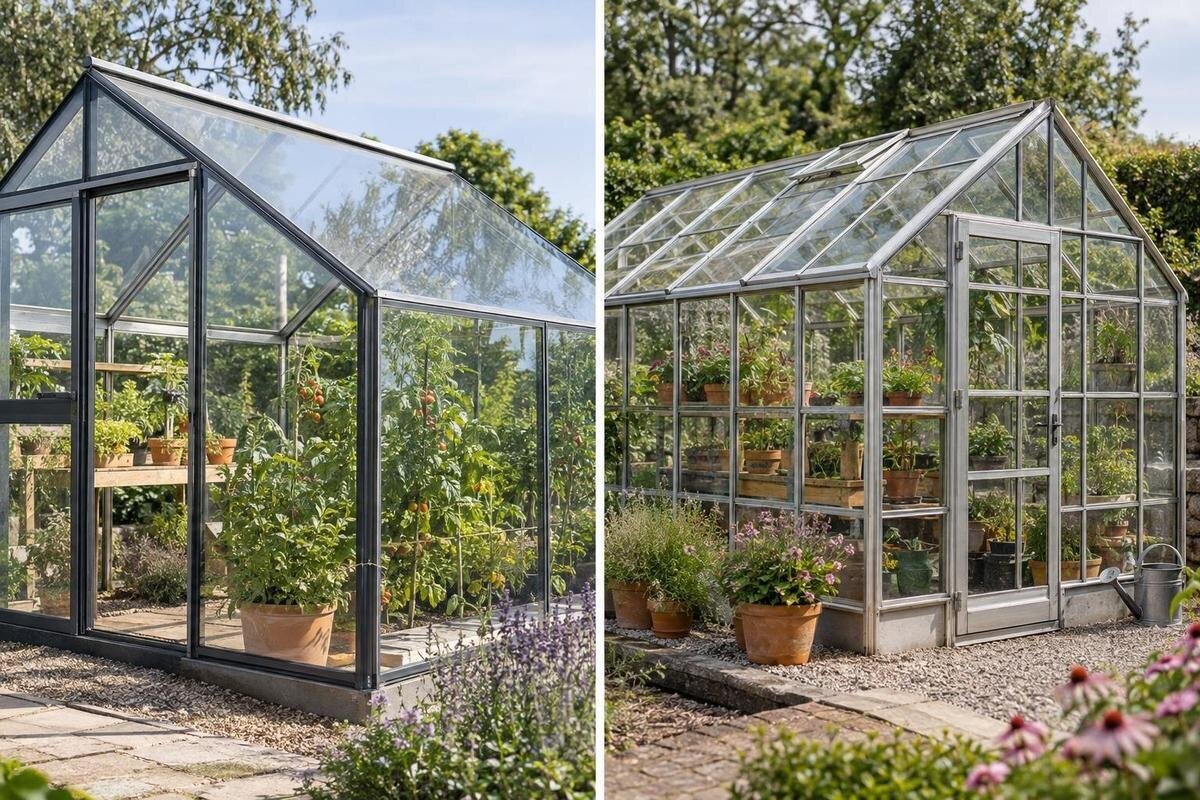
With fewer panes, there are usually fewer internal divisions across the same glazed opening, so the eye sees a broader, simpler field of glass. That can make plants or the garden beyond appear less interrupted, while smaller panes create a finer rhythm of horizontal and vertical lines. This is a visual effect, not a measure of quality. The impression still depends on the width and finish of the frame members, the proportions of the building and how bars meet at doors, vents and corners. Study elevations rather than relying on pane count alone: the same number of pieces can form very different patterns when panes are long, square or irregular.
Consider the view from outdoors and from inside the greenhouse. A grid may suit the character you want and give the glazing a more detailed pattern; a few large sheets can make the frame less prominent if the supporting layout also has fewer divisions. When assessing the Pyramid-type greenhouse, look at how the proposed pane divisions relate to the outline of each face. Check the roof and end walls as well as the long sides. A pattern that looks balanced on one elevation can change around a sloping edge or an opening. View the drawings at the same scale, then consider which faces will be most visible from your house, patio or main garden path.
Do larger panes give plants more light?
Pane size by itself does not say how much useful light reaches plants. If the opening and glass are otherwise comparable, fewer bars can leave more of the opening visually clear, but the result depends on bar width and the overall frame layout; pane count is not a light measurement. Roof angle, orientation, nearby shade, cleanliness and the specified glazing also affect what reaches the growing space. A broad sheet is not automatically brighter, and a fine grid is not automatically too dark. Treat claims about light as something to verify against the glazing specification and greenhouse drawing, not as a simple consequence of choosing large or small panes.
Keep the glazing material and pane layout separate in your comparison. Glass type, tint, coating or surface treatment, where offered, can change glazing characteristics; changing the number of pieces does not tell you whether those properties have changed. For a model such as the Classic greenhouse, request the glazing specification alongside the layout you are considering. If light-transmission figures are supplied, check whether they describe the glass itself or account for the complete framed opening. Figures for glass alone do not include the obstruction from surrounding bars. This distinction helps you avoid attributing a difference in glazing performance to pane size when the options actually use different glass.
Handling glass during delivery and fitting
Large pieces can be awkward to move even where their weight is manageable: their width, shape, fragile edges and route through gates, doors or around corners all matter. For a given glazing material and thickness, a larger area will generally mean a heavier individual piece, but the actual weight must come from the specification. Before ordering, check the largest pane dimensions, its weight if available, packaging dimensions and delivery point, then compare them with access to the greenhouse site. A pane that looks straightforward on an elevation may be difficult to manoeuvre into a confined garden. Ask the supplier who is responsible for handling and fitting the glass.
Several smaller panes divide the job into more individual pieces. That may make each piece more manageable, but it also means more items to identify and account for during delivery and fitting. Do not assume smaller automatically means simple: unusual shapes, fragile edges or a difficult roof position can still call for professional help. When considering a specific model, such as the Prestige greenhouse, request the actual pane schedule rather than estimating from an image. The supplier’s stated dimensions and handling guidance are more useful than general rules, especially if the route from the delivery vehicle includes narrow access, steps or limited space to set items down.

What pane size means for replacement
If a pane is damaged, a large format means the replacement is a large individual unit; that can make transport and handling more demanding than for a small unit. With several smaller panes, damage may be confined to one listed piece, but replacing it is not necessarily cheaper, faster or easier. The glass must fit the frame and match the greenhouse’s approved specification, and a pane can have a distinctive shape or position. Neither format guarantees that a spare will be readily available. Ask before purchase how the maker identifies replacement pieces and whether the glazing can be ordered for the exact model and configuration you are buying.
Compare the complete replacement enquiry, not just the area of glass. Ask whether a quotation covers the pane alone or also packing, transport, fitting and any associated retaining parts that need replacement. A small shaped piece may require a different quotation from a standard rectangular pane, so size is only one consideration. For the Limited Edition greenhouse, ask how the supplier would identify and quote for a replacement in your selected configuration. You need not obtain hypothetical prices for every piece, but understanding the ordering process helps you judge the practical difference between layouts. Neither a larger pane nor a greater number of smaller ones establishes the eventual repair cost.
Cleaning and checking the glazing
Pane divisions affect the amount of framework and the number of edges you see and clean. For an opening of similar overall size, several smaller panes generally create more corners and dividing bars than a single broad pane. Those bars can take extra attention when wiping glass and can make dust or debris more noticeable at intersections. A large pane presents a wider surface and may be quicker to wipe, but it can be harder to reach, particularly on a roof. The total glass area is set by the greenhouse design; pane count alone does not measure cleaning time or maintenance.
Pane divisions affect the number of visible joints, but they do not reveal how the glass is retained. Clips, seals and other retaining details vary between systems; follow the maker’s guidance on what needs routine inspection. Consider cleaning access from inside and outside, including obstructions from plants, benches and the site boundary. When assessing a lean-to greenhouse, check the clearance along its exposed faces and how the adjoining wall affects access to the roof. Do not assume a smaller roof pane will be easier to reach simply because it is smaller. Where glazing cannot be cleaned safely from the ground, arrange suitable professional help rather than improvising access.
How to compare pane layouts fairly
For a meaningful comparison, hold the greenhouse itself constant wherever possible: use the same overall size, roof shape, frame and glazing material. Put the two elevations side by side and note exactly what changes. Does an extra horizontal line represent a glass joint, an additional frame member or a different vent arrangement? Do wider panes also mean wider structural bays? If so, you are comparing more than pane size. Where suppliers offer different buildings rather than alternative layouts for one model, record those differences explicitly. You can still assess appearance and handling, but you cannot confidently attribute every difference to the number of glass pieces.
Include solid sections and openings in this comparison rather than counting glass across the whole footprint. With a greenhouse with built-in storage, establish which parts of the proposed elevations are glazed and which belong to the storage section. Compare the corresponding glazed areas, not the total building size. Record the largest piece, any unusual shapes and the position of opening vents for each option. A simple comparison sheet can separate confirmed dimensions from unanswered questions without turning every missing detail into a presumed disadvantage. If an illustration and a quotation show different layouts, establish which version is being offered before drawing conclusions about its pane pattern.
Questions to ask before ordering
Before ordering, ask the supplier to identify the selected glazing arrangement in the quotation, rather than leaving it as a general description such as large-pane glazing. Establish whether it is standard for your chosen size, an available option or merely the arrangement shown in a catalogue image. Ask what the glazing package includes: fixed panes, door glass, vent glass and any shaped end pieces should be accounted for. Clarify whether fitting is included or arranged separately, and who will confirm that the site access is suitable. If an alternative pane layout is proposed, ask for its approved drawing and specification before accepting the change.
Clarify how the glazing will be supplied and checked on arrival. Ask whether packages are labelled to match the pane schedule, whether there are separate consignments and how missing or damaged items should be reported. When discussing a Spacious Greenhouse, use the schedule for the selected building size to establish the contents of the order; overall floor area does not tell you how many glass pieces to expect. Agree who will check the delivery against that schedule, particularly if fitting is arranged separately. These details help distinguish an incomplete delivery from a misunderstanding about what was ordered, without requiring you to unpack or handle glass contrary to the supplier’s guidance.

Choosing a layout for your priorities
Your preference may be clear once you separate the trade-offs. Larger panes may suit a priority for broad views with fewer visible divisions, provided delivery, fitting and replacement are practical at your site. Several smaller panes may appeal if you prefer a pronounced grid or smaller individual replacement units, while accepting more pieces to identify and more divisions to clean. These are priorities, not guarantees: the exact frame design and glazing specification still matter. If you value both a clear view and straightforward future repairs, compare those features independently. A visually simple layout can still contain an awkward roof piece, while a finer grid can include non-standard shapes.
Judge the pattern across the whole building rather than expecting one repeated pane size. For a T-shaped orangery greenhouse, compare the elevations of each part of the plan and examine how glazing lines meet around corners and openings. The drawing, rather than the model name, must establish the individual pane arrangements. Think about the view at standing and seated height: a horizontal division may be more noticeable across your usual sightline than elsewhere. If two approved options are available, compare them from the same viewpoint. This gives you a more useful basis for choosing than simply counting which version has fewer panes overall.
Keep the glazing details for future repairs
Treat the glazing schedule as part of the greenhouse’s permanent records. Save the dated drawing, exact model and size, configuration, glass specification and any supplier reference for individual panes. Marking pane locations on a copy of the elevation can make a future enquiry clearer, especially where roof pieces are not identical. Keep the information accessible rather than relying on memory or a product name alone. If you order a pane later, update the record with its source and the position it replaced. A replacement may look similar yet differ in shape or specification, so a clear record helps you check compatibility before ordering.
Make the location references unambiguous. For example, a note such as left-hand roof pane needs a stated viewpoint; an elevation labelled from outside or a numbered diagram is clearer. Keep revisions separate and identify the drawing that matches the greenhouse actually supplied, rather than allowing an earlier quotation drawing to become the repair reference. Photographs of the completed greenhouse can supplement this record, especially around vents and shaped end pieces, but they cannot replace dimensions or the glass specification. If you later pass the greenhouse to another owner, include these records. The usefulness of either pane format depends partly on being able to identify the right piece years after the initial purchase.
Frequently asked questions
Are smaller panes safer to handle?
A smaller piece may be easier to manoeuvre if the glass, shape and route are otherwise comparable, but pane size alone does not establish safe handling or the glass’s performance. Ask the supplier about the specified glazing and handling requirements for your greenhouse. Use a suitably qualified person for fitting or dealing with damaged glass.
Will one large pane give my plants more light?
Not necessarily. With the same opening and glazing, fewer bars may leave more of the area unobstructed, but pane count does not measure useful light. Glass specification, frame layout, orientation, roof angle and shade all matter. Compare like-for-like drawings and glazing details rather than assuming a larger pane will make the greenhouse brighter.
Are smaller panes easier to replace?
They are smaller individual units, which may help with handling, but that does not guarantee an easier or cheaper replacement. A pane still needs to match the greenhouse’s shape, dimensions and glazing specification, and replacement availability depends on the supplier. Ask how to identify a matching piece before you buy.
Can I replace several small panes with one large pane?
Only if the manufacturer confirms that the frame and configuration are designed for it. A pane’s size cannot be chosen from the opening dimensions alone, and changing a layout may affect how it is supported. Do not alter the frame or combine pieces based on appearance; ask for an approved drawing or advice from a qualified professional.
What information should I keep for a replacement order?
Keep the model and configuration details, a drawing showing where each pane sits, and the glazing specification. Ask the supplier which dimensions or identifiers it needs to match a replacement. If glass is broken, do not use fragments as a template; seek help to identify a safe, compatible replacement.
Neither format is automatically the better choice. Large panes prioritise a broad, less divided view; smaller panes bring a finer grid and more individual units to handle and track. The sound comparison is the approved layout for the exact model, backed by a pane-by-pane drawing and a clear way to identify compatible replacements. If the drawing does not show each piece or the glazing specification is unclear, resolve that before ordering; appearance, handling and future repair are easiest to judge together.
