
How to Use Compost in Greenhouse Beds Without Overfeeding
Greenhouse growing guide
Compost can improve a greenhouse bed, but every addition also brings nutrients and soluble salts. Because a covered bed receives less direct rainfall than open ground, repeated top-ups can change its nutrient balance over time. The right amount depends on what is already in the soil, how mature and nutrient-rich the compost is, the crop and the intended use. Check those factors and measure the bed before applying anything; a familiar bucketful or annual layer is not a universal dose.

Compost is a nutrient input as well as a soil improver
Compost is both an organic-matter amendment and a source of plant nutrients. It can support soil structure and add organic material, but its nutrient content varies with the feedstocks and composting process. Finished material may still supply nitrogen, phosphorus, potassium and soluble salts; “mature” does not mean “nutrient-free”. A product sold as compost may be intended mainly as a soil improver rather than a complete growing medium. In a greenhouse, beds are often cropped repeatedly and receive less direct rainfall than open ground. Nutrients not taken up or carried away in drainage can remain, so this year’s generous addition may add to last season’s surplus. Better soil texture alone does not prove that more nutrients are needed.
Overfeeding can mean too much of one nutrient, a high total nutrient load or excessive soluble salts—not just an overdose of nitrogen. Excess nitrogen can encourage leafy growth at the expense of flowering or fruiting, while salts can make it harder for roots to take up water. These effects are not diagnostic: poor growth, pale leaves or scorched edges can have other causes. Treat compost as part of the bed’s nutrient history, not harmless bulk to add by habit. If soil tests and the intended crop show no reason to add it, using none is a sensible outcome. Set the purpose and amount before opening a bag, rather than deciding by eye as you work.
Check maturity separately from nutrient strength
A well-finished compost is generally stable, has an earthy rather than sharply sour or ammonia-like smell, and contains little recognisable fresh feedstock. These are useful clues, not proof: a cool sample on its own does not establish that a whole batch is mature. A pile that repeatedly heats after turning or smells strongly may still be breaking down. Coarse woody fragments can persist for longer, so their presence is not conclusive either. Unfinished material can continue decomposing in a bed and may settle or affect young roots. That makes its behaviour harder to predict at planting time, even if it looks dark and crumbly.
Check what went into the compost and what the supplier says it is for. Home-made garden compost, green-waste compost, leaf-based material and manure-based compost can differ in nutrient content, pH, texture and salinity. Colour and feel cannot tell you the phosphorus or soluble-salt level. Read the product description and any analysis, and ask about feedstock and intended use if these are unclear. A germination test may flag material that inhibits germination, but it does not establish nutrient strength or suitability for every crop. Maturity is about how far decomposition has progressed; analysis addresses what the material contains.
Test the greenhouse bed before adding more
Start by finding out what the bed already contains. Take a representative sample from the actual growing soil, following the testing laboratory’s directions for depth, timing and preparation. In a long bed, collect several small subsamples across the same managed area and combine them only if it is sensible to treat that area as one unit. Keep beds with different amendment histories or crop use separate. Avoid sampling only in a planting hole, beside a compost heap or from one visibly affected patch: any of those can skew a result away from the soil where most roots grow. Note previous additions and crops when you label the sample.
Ask which measures are included. A soil report may cover pH and available nutrients such as phosphorus and potassium; salinity testing may need to be requested separately. Tell the laboratory that the sample comes from a greenhouse bed and that you are considering compost, so its advice addresses the intended use. Keep the sampling date, bed name and recent amendment history with the result. If you are planning beds for the Bloomcabin Prestige Greenhouse, mark sampling areas on the proposed layout. Existing soil results describe the sampled ground, not purchased soil or compost that might later be used to fill a new bed.
Read compost and soil analyses together
Look for the compost’s feedstock, maturity information and nutrient results, especially nitrogen, phosphorus and potassium, if supplied. Check whether figures describe total or available nutrients, whether they are given on a dry-matter basis or as received, and whether the report includes pH or electrical conductivity, which relates to soluble salts. A high total nutrient figure does not mean that all of it is immediately available to plants. Conversely, a concentrated material may supply a meaningful nutrient load in a small volume. If the units or testing method are unclear, ask the supplier or testing service before calculating an application.
Read the compost information alongside the greenhouse soil result and guidance for the crop you plan to grow. Check which nutrients the soil already supplies adequately and whether the proposed compost would add more of those alongside anything the crop needs. A recommendation for a potting mix is not automatically a bed rate, and results obtained by different test methods may not be directly comparable. When planning a growing layout for the Spacious Greenhouse, retain the analysis for each material you intend to use. Ask the testing service to explain unclear units or results rather than treating two similar-looking numbers as equivalent.

Measure the cultivated bed, not the greenhouse floor
Measure the usable soil surface, not the whole greenhouse floor. For a rectangular bed, multiply its length by its width in metres to get square metres; a bed 3 m long and 1.2 m wide has 3.6 m² of soil surface. Exclude paths and permanent non-growing areas. For an L-shaped or otherwise irregular bed, divide the growing surface into simple sections, calculate each and add them without counting any area twice. If beds have different soil tests or crops, keep their areas separate rather than combining them into one total for convenience.
Use the selected greenhouse plan and measure the inside growing layout. An external footprint or a product-range figure does not tell you how many square metres of bed you have. The Classic aluminium greenhouse listing covers variants from 40.6 to 302.3 sq ft; use the specific model information and your own bed sketch rather than applying compost to a headline area. Keep containers, grow bags and in-ground beds as separate growing media: their volumes, drainage and nutrient histories are not interchangeable. A labelled sketch can also prevent a path or a fixed feature from being included by mistake.
Convert a supported rate into a measured volume
Calculate an amount only after you have a rate supported by the compost label, soil analysis, crop guidance or a qualified horticultural adviser. If a suitable instruction states litres per square metre, multiply that rate by the measured bed area. If it gives kilograms per square metre, measure mass rather than guessing from a bucket. Keep units consistent, and do not convert a nutrient limit into a volume rate unless the compost’s nutrient concentration and the conversion basis are known. If an instruction gives a maximum rate, treat it as a ceiling rather than an automatic target.
For a volume illustration only, a 3.6 m² bed covered to a planned depth of 1 cm would take 0.036 m³, or 36 litres (3.6 × 0.01 × 1,000). This is arithmetic, not a recommended compost depth; use the rate determined for the material and crop. A Lean-To Greenhouse is listed in options from 40 to 154 sq ft, but the chosen layout—not the model name or overall footprint—must provide the actual bed measurements. Compost settles and its bulk changes with moisture, so a volume calculation and a weighed, dry-matter-based analysis are not interchangeable.
Spread a planned amount evenly
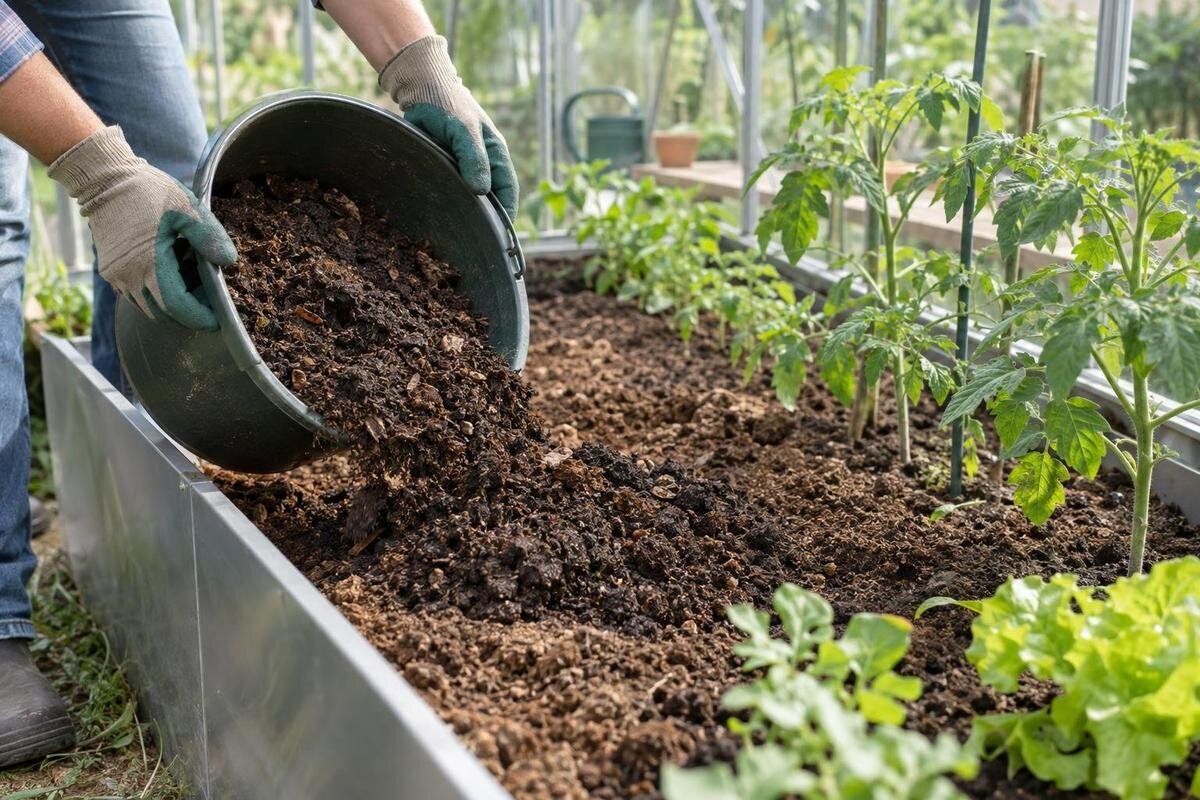
When compost is justified, distribute only the calculated amount over the area intended for treatment. A marked bucket or measured container can make the total repeatable, but divide the material across the bed rather than tipping several full measures into each planting hole. A concentrated pocket can expose a small root zone to a much higher nutrient or salt level than the bed average. Whether compost should be left on the surface or mixed into the soil depends on the material, crop and bed-management method. Follow instructions for that compost instead of assuming that deeper mixing always makes it safer.
Set aside the measured total before spreading, then divide it between clearly identified parts of the bed. This helps prevent a heavy application near the entrance and a lighter one at the far end. Keep unused material separate so it does not become an accidental extra layer, and avoid walking on the growing surface while applying it. If you are considering the Limited Edition greenhouse, check the proposed path and bed arrangement against how you will carry and distribute compost. Good access makes an even application easier; it does not change the amount justified by the soil, material and crop.
Keep crop zones and bed calculations separate
Do not assume every bed in a greenhouse needs the same compost treatment. Crop nutrient demand, previous amendments, soil texture and test results can differ between areas, even when the beds are side by side. Use crop-specific horticultural guidance to decide whether an organic-matter addition is useful for the next crop, then compare that need with the soil and compost results. Compost is not a precise substitute for every nutrient input. If a bed needs one kind of improvement but compost would add an unwanted nutrient, seek advice on a more suitable material rather than applying a larger or smaller guess.
Give each differently managed area a bed name and record its planned crop before assigning compost quantities. A shared delivery of compost does not mean that every bed should receive an equal share: one may need an addition while another needs none. When comparing layouts for the T-Shaped Orangery Greenhouse, consider whether you can keep those areas clearly identified and reach them without crossing planted soil. Record any change of crop before applying the material, rather than carrying forward an amount calculated for an earlier plan. Where crop advice and a soil report appear to conflict, ask for clarification instead of averaging their recommendations.

Review the nutrient balance before adding more compost
Do not schedule a fresh compost layer automatically every spring or after every crop. Organic matter breaks down over time, but some nutrients can remain in the soil; plant uptake, drainage and irrigation all affect the balance. A bed that received nutrient-rich compost recently may need no more, even if the surface looks less dark or fluffy. Use your records and soil-testing advice to decide when to reassess. Re-test after repeated substantial additions or when the management history or crop response makes an updated result worthwhile; there is no universal interval that suits every bed.
Assess the response to a compost application against its original purpose. If you wanted to improve the soil’s physical condition, note changes in workability and water movement rather than judging success only by leaf colour. If the application was intended to supply nutrients, review crop performance alongside the soil results; unusually lush growth or leaf scorch alone cannot establish the cause. For beds planned within a Pyramid-type greenhouse, the same approach applies: a different greenhouse shape does not change how compost information should be assessed. Investigate an unexpected response before repeating the application, and keep watering changes separate from compost changes in your notes.
Plan a layout that makes measured applications practical
Physical access helps make a measured plan practical. Leave enough working space to see bed edges, carry a measured container along the path and apply material to soil rather than scattering it over non-growing surfaces. If the greenhouse plan includes fixed storage or benches, map those separately before calculating the planting area. The product page for the aluminium greenhouse with built-in storage identifies storage as part of the model; use the selected plan to distinguish that space from the beds, rather than assuming the whole footprint is available for crops. Clear boundaries also make later sampling and record-keeping easier.
Keep the compost label or analysis with the application record, including its batch details where available. Record the date, bed, treated area and actual quantity, not just the intended amount; if you used less than planned, that difference matters when reviewing the bed later. For home-made compost, note the main ingredients and the maturity observations you relied on. Retain earlier records rather than replacing them with the latest entry, so repeated additions remain visible. This gives you and a horticultural adviser a useful history when deciding whether the next application would improve the bed or simply add nutrients it already has.
Frequently asked questions
How can I tell whether compost is mature?
Finished compost is usually stable, earthy-smelling and largely free of recognisable fresh material. Repeated heating after turning or a sharp, sour smell can indicate that it is not ready, but appearance and smell are only clues. Maturity does not reveal nutrient strength, so check the feedstock and any analysis separately.
Does mature compost have low nutrient levels?
No. Maturity describes how far decomposition has progressed, not how much nitrogen, phosphorus, potassium or soluble salts the compost contains. Mature manure-based compost, for example, may still contribute a substantial nutrient load. Use the product information or analysis alongside a test of the greenhouse soil.
How much compost should I add to a greenhouse bed?
There is no universal amount. It depends on the bed’s test results, the compost’s nutrient content, the crop and the purpose of the addition. Measure the actual bed area, then calculate from guidance that applies to that compost and use. A volume conversion is not itself a recommended rate.
Can I put compost straight into planting holes?
Avoid adding unmeasured handfuls to individual holes. Concentrated compost can create a much richer or saltier pocket than the surrounding soil. If compost is recommended, follow the material-specific directions and apply the planned amount consistently over the intended area, unless crop guidance advises another method.
How often should I add compost to a greenhouse bed?
Do not assume that every bed needs a fresh layer each year. Previous applications, crop use and drainage all affect what remains in the soil. Keep a record of what you added and use soil-test advice, compost information and the next crop’s needs to decide whether another application is justified.
A measured compost application begins with two separate checks: whether the material is mature and suitable, and whether the bed needs the nutrients it will add. Combine that information with the next crop’s needs, measure only the cultivated surface and keep a record of what goes where. If the evidence does not show a need for compost, leaving it out is part of good nutrient management.
