
Direct Sowing or Raising Transplants for Greenhouse Crops?
Greenhouse growing guide
Greenhouse sowing presents two distinct choices: put seed straight into its final bed or container, or raise seedlings in temporary cells and move them later. Neither route is automatically earlier or easier. Root response, crop duration, sowing conditions, final spacing and the room available at each stage all matter. Tomatoes and carrots, for example, do not make the same demands on their roots. A mixed plan usually makes more sense than choosing one method for every crop: sow some vegetables where they will mature and start others in individual pots or modules.

Direct sowing and raising transplants are different methods
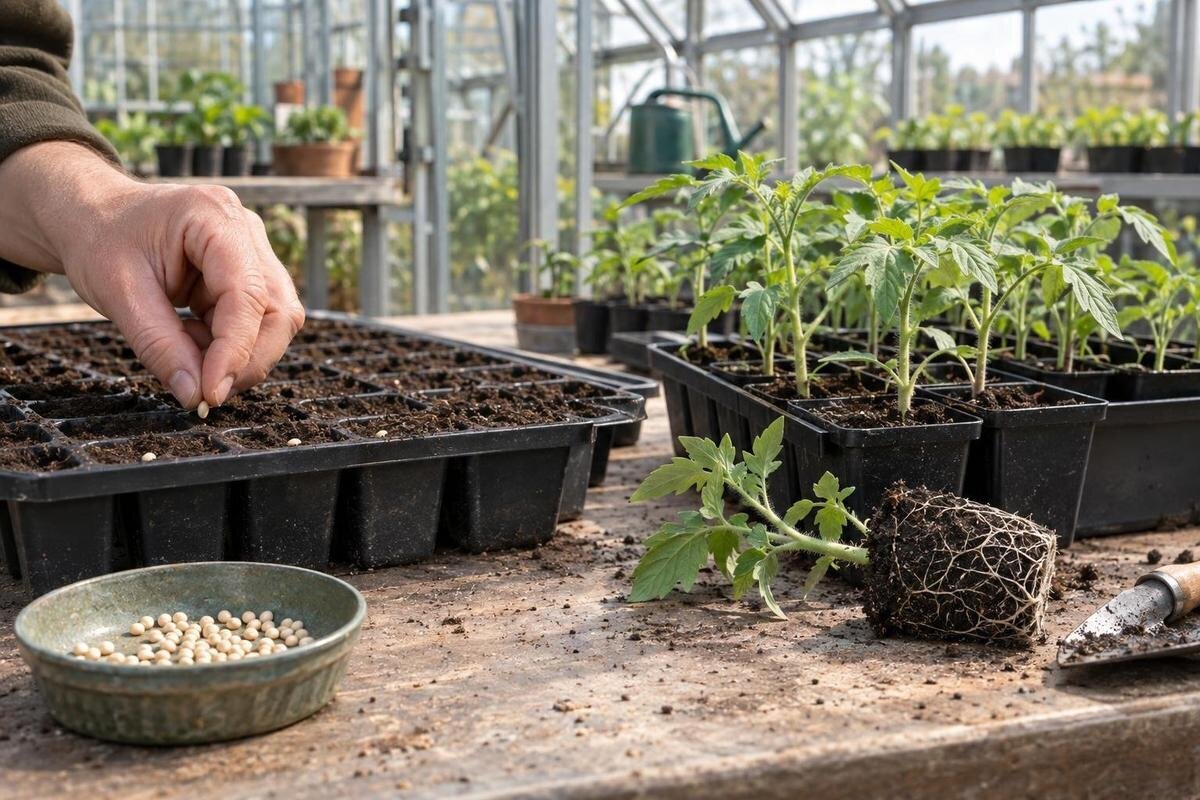
Direct sowing means placing seed in the bed, border, trough or container where the crop is intended to finish growing. There is no move from a seed tray into a separate final position. A seed germinating on a greenhouse bench is not direct-sown if you later prick it out or plant it into a bed; it has been started under cover as a transplant. Raising transplants means sowing into a temporary cell, module, pot or tray and moving each young plant when it is ready. The destination might be another part of the greenhouse, a larger container or an outdoor bed. Seed sown in its final pot and left there is direct-sown, even though it began under glass.
The distinction is about the crop’s journey, not whether the seed germinates beneath glass. A greenhouse might be used as a nursery, as the crop’s permanent growing place, or for both. Nursery plants need a temporary position before their final one; direct-sown plants occupy their growing position from germination. If you are comparing enclosures, the Classic aluminium greenhouse range lists options from 40.6 to 302.3 sq ft. That is a listed area range, not the amount of bench space in a particular layout. Decide where trays, beds and access will sit before treating the whole floor as propagation room.
Root habits and seed size influence the choice
Root response is often the clearest dividing line. Carrots and parsnips form a main root, so they are normally sown where they are to mature; moving a young plant can damage or distort that root. Radishes and many salad leaves establish quickly enough for direct sowing to be convenient. Tomatoes, peppers and aubergines, by contrast, are commonly raised in pots or modules and planted on as young plants. The point is not that transplanting makes them more robust; it lets you manage their early growth separately from the final bed. A crop’s growth habit and harvestable part are better guides than the general fact that it will be grown under glass.
Seed size and sowing pattern matter too. A large seed is easy to place at a chosen interval; very small seed may be scattered too thickly in a permanent row, so a module can help produce evenly spaced plants. That is a practical advantage, not proof that every small-seeded crop should be transplanted: fine seed can be sown thinly where it will grow and later thinned. If nursery crops and permanent crops must share an enclosure, use the Limited Edition aluminium greenhouse range as a scale reference only; its listed area spans 40.6 to 302 sq ft. The route still depends on the actual crop positions, access and how the space will be used.
Direct sowing suits root crops and quick rows
Direct sowing is the usual choice for root crops whose harvest depends on an undisturbed root. Sow carrots and parsnips in the final bed or container rather than raising seedlings to plant out. Radishes are similarly straightforward in their final growing place, especially when you want a short row ready in succession. Thin crowded seedlings in place, following the crop’s growing instructions, rather than trying to rescue every spare plant by transplanting it. Prepare a fine, even seedbed and label the rows: young seedlings can be difficult to distinguish from weeds, and irregular spacing makes later care harder.
Salad leaves, spinach and some quick-growing herbs can also be direct-sown in a greenhouse bed or trough. This works well if you plan to harvest the crop young, pick it in stages or fill a defined strip. Sow modest batches so one patch does not mature all at once, and leave enough room to reach the plants for watering and picking. Direct sowing does not remove the need for thinning, weeding or steady moisture while seeds germinate; it simply avoids moving the seedlings. Lettuce is more flexible than a root crop: it can be sown in place or raised individually and transplanted when you want orderly spacing.
Modules help with warm-season fruiting crops
Tomatoes, peppers and aubergines are commonly raised in modules or small pots before being planted into their final greenhouse position. Starting them separately keeps the future bed free while seeds germinate and seedlings develop, and lets you raise only the number of plants you plan to grow. Follow crop- and cultivar-specific guidance for sowing and planting times; a very early start is not automatically a useful head start. If seedlings wait too long in small cells, they can become crowded or difficult to manage before the greenhouse bed is ready. Labelling the pots also helps keep varieties and sowing batches distinct.
Cucumbers and other cucurbits are often sown one to a pot or module and moved with the root ball intact, because rough handling can set young plants back. Some growers sow directly into the final bed or container when conditions suit the crop, but the greenhouse being available is not a reason to sow into cold conditions. The Bloomcabin Prestige Greenhouse range is listed from 40.6 to 302 sq ft; read that area alongside the intended layout, because seedling pots and mature plants occupy space at different times. The crop, not the model name, determines whether raising a transplant is worthwhile.

Some crops suit either route
For several greenhouse crops, the purpose of the sowing helps break the tie. Lettuce can be direct-sown as a row of leaves, or raised individually when you want plants at set intervals. For small batches of dwarf French beans, modules can make it easier to count and place seedlings; direct sowing into the final bed or container avoids moving them. Either way, give the plants their intended growing position with their eventual size in mind. A temporary gap in a tray is not a good reason to raise more plants than the greenhouse can accommodate.
Herbs vary too. Coriander is often simplest sown into the pot or bed where it will grow, while basil is commonly started under cover and transplanted after it has established. These are useful tendencies, not fixed rules for every cultivar or setup. If you are comparing greenhouse options as well as crops, the T-Shaped Orangery Greenhouse can be considered alongside a sketch of your temporary and permanent growing positions. The greenhouse’s shape does not decide whether a particular crop should be direct-sown or transplanted; its growing habits and your planting plan do.
Plan sowing around the intended planting date
Use the intended planting date, rather than a general urge to get started early, to plan the sequence. For transplant crops, count back from when the bed or container should be ready, allowing for the germination and seedling stages described on the packet or in reliable crop guidance. For direct-sown crops, sow when the final soil or compost and conditions suit the seed. Putting seed in a greenhouse earlier does not help if the growing medium is unsuitable. Local weather, greenhouse exposure, cultivar and whether the space is heated all affect timing, so a calendar month cannot guarantee that conditions are right.
Build in a check between sowing and planting. If the destination is occupied, a transplant batch may have to wait; if plants are ready before the bed is clear, holding them in small cells adds care and can slow progress. Successional direct sowing can stagger a supply without a nursery tray, while a batch of transplants gives you more control over how many plants reach their final positions. The Pyramid-type greenhouse range is listed from 60 to 203 sq ft; use a chosen model’s actual layout when considering space, but base sowing dates on the crop schedule and the real planting area, not headline dimensions.
Each method has different care demands
Direct-sown seed needs reliable moisture at the seedbed until it germinates. In a greenhouse, one row can dry while nearby pots remain damp, so inspect the sowing area rather than assuming the whole structure has the same moisture level. Water gently enough not to wash small seed into clumps or expose it, and do not leave the bed saturated. Modules need attention too: each small volume of compost must be monitored, and cells may dry at different rates, especially when seedlings are at different stages. Raising transplants therefore replaces some seedbed checks with regular tray care; it does not remove the need to water.
Light and temperature matter after emergence whichever route you use. A greenhouse can warm quickly in bright weather, yet overnight conditions may be much cooler; cover alone does not guarantee a stable seed-starting environment. Seedlings kept too warm and dim may stretch, while direct-sown crops can also stall if conditions do not suit them. Check plants regularly, provide conditions appropriate to the crop and avoid holding a batch in tiny modules beyond its useful stage. If comparing the aluminium greenhouse with built-in storage, distinguish the named storage provision from the bright, accessible growing area needed for trays.
Allow for temporary and permanent growing space
Space is a crop-by-crop trade-off. Direct sowing occupies the permanent bed, pot or trough from the beginning, so the planned crop must fit around plants already growing there. Transplants take up temporary nursery space, but the final bed remains free until the seedlings move. That can help when a long-season crop needs a separate start, yet it can create a bottleneck if several batches overlap. Think about which spaces are occupied at sowing, at transplanting and as the crops grow; the question is not only where a tray fits today, but what must be ready later.
Use the actual growing layout rather than advertised floor area as a proxy for capacity. The Spacious Greenhouse range is listed from 506 to 753 sq ft, but even a large enclosure needs usable routes between growing areas, room to tend crops and a place for temporary seedlings. A compact greenhouse may make direct sowing into final containers more practical; a larger one may make raising batches convenient, but neither is a rule. For an existing greenhouse, a quick sketch of beds, pots, benches and access can show whether the two stages can coexist.

Make the decision crop by crop
Before sowing each crop, identify where the mature plant will grow, check whether it tolerates root disturbance, compare the time available with its expected seedling stage, and decide whether you can provide suitable conditions in a tray or final bed. If the root is sensitive and the crop grows well from a final-position sowing, direct sowing is usually simpler. If a separate start helps with timing or controlled spacing, raise a transplant. If both seem plausible, consider the task you would rather manage: thinning a row, or watering and moving a tray.
Then check the seed packet and make the method specific to the variety and current conditions. Note the intended planting place as well as the sowing date, so you do not produce seedlings without a free destination. The Lean-To Greenhouse range is listed from 40 to 154 sq ft; if comparing this or another greenhouse, use the relevant layout to decide where final crops and temporary starts would go, rather than assuming every square foot can support both. A record of what worked for each crop can help you choose more confidently at the next sowing.
Compare results for crops that suit both methods
For a crop that suits either method, a small comparison can help you decide which is worth repeating. Lettuce is a useful example: sow part of a batch in its final position and part in modules, using the same variety and recording the dates. Choose a comparable harvest stage, such as individual leaves or whole heads, rather than judging one batch as baby leaves and the other as mature plants. Note when each batch becomes harvestable and how many useful plants it produces. Different sowing dates or growing positions can affect the result, so treat the comparison as a practical guide to your setup rather than proof that one method is universally better.
Record the work involved as well as the harvest. For the direct-sown batch, note thinning, gaps that need resowing and how long the bed is occupied. For the module batch, note tray watering, compost and pots used, any plants lost during the move, and time spent planting. A method that produces slightly earlier leaves may not be worthwhile if it demands much more attention; equally, reliable spacing may justify raising individual plants. Keep the observations brief enough to maintain through the season. Comparing useful plants, harvest dates and effort gives you a clearer basis for the next sowing than remembering only which seedlings appeared first.
Frequently asked questions
Can I direct-sow every vegetable in my greenhouse?
No. A greenhouse does not remove the differences between crops. Carrots and parsnips are generally sown in their final position, while tomatoes and peppers are commonly raised in modules or pots. Lettuce, beans and some herbs can suit either route. Check root sensitivity, seed-packet advice and whether the final bed or container is ready.
Do transplants always give an earlier harvest?
No. A transplant gains time only if it has been raised in suitable conditions and can move into its final position at the right stage. Starting too early may leave a seedling crowded, weak or waiting for a bed. Direct-sown plants avoid a move and may establish well. Compare the whole crop schedule, not just the sowing date.
Which vegetables should usually be direct-sown?
Root crops such as carrots and parsnips are usually best sown where they will grow, because disturbing the main root can affect development. Radishes and many salad leaves are also often direct-sown for successive harvests. Lettuce is more flexible, so transplanting individual plants can still make sense when you want set spacing.
Can I sow seeds early in an unheated greenhouse?
Only when the crop guidance and conditions allow. A greenhouse may warm in the sun, but nights can be much cooler, and winter light may not support strong seedlings. Check the seed packet and local growing guidance; an early calendar date is not a substitute for suitable conditions. If conditions are not right, wait.
Should I raise cucumber plants in modules?
It is common to sow cucumbers individually in pots or modules and transplant them with the root ball intact, because rough handling can check young plants. Direct sowing into the final bed or container can also work when conditions suit the crop. Follow variety-specific guidance, and avoid sowing so early that seedlings outgrow their temporary space.
Choosing between the two methods is not about making a greenhouse entirely a nursery or entirely a seedbed. Direct sowing avoids an extra move and suits crops that should remain undisturbed; raising transplants lets you manage early growth and spacing before the final position is ready. Pair those strengths with each crop’s root habits, the conditions available and the planting date. A simple plan that names the final place for every batch keeps seed trays from becoming the default destination and makes future sowings easier to judge.
