
How to Estimate Greenhouse Heating Costs
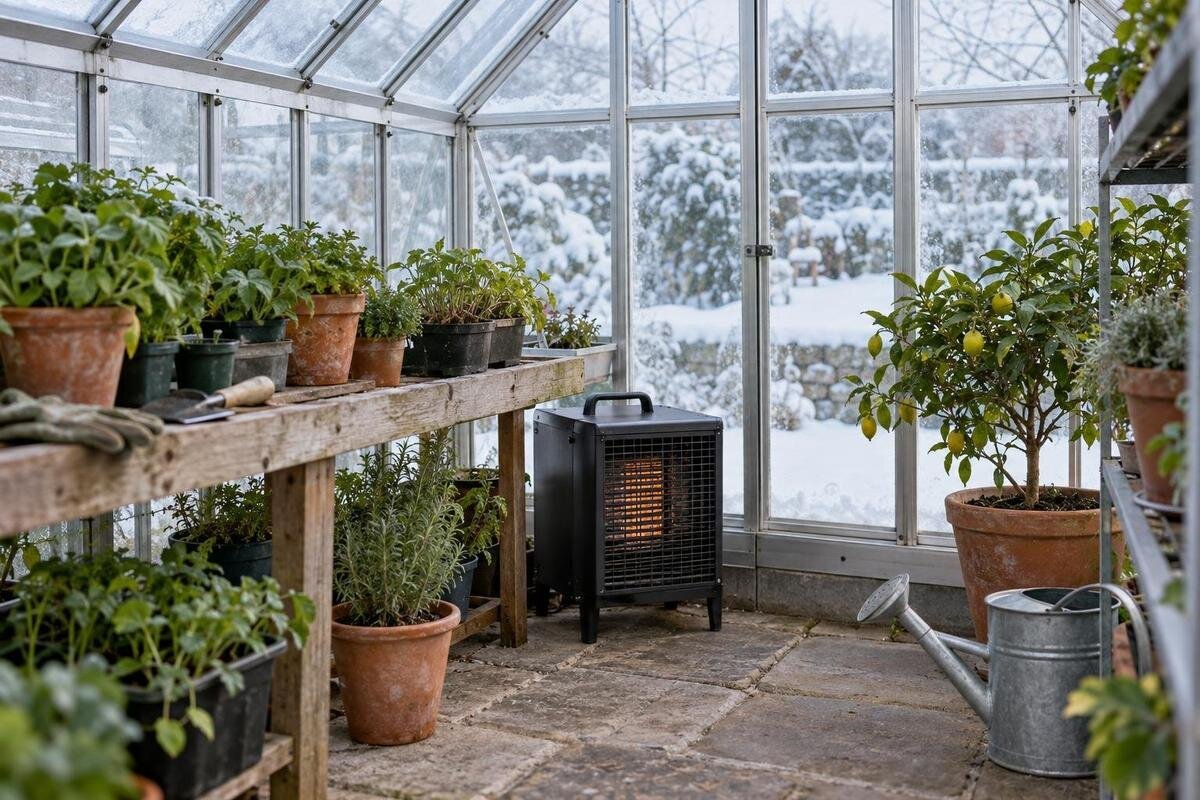
Greenhouse heating costs
Greenhouse heating has no single UK winter cost. Your budget depends on the temperature you need, heat loss, outdoor weather, heater use and the tariff you pay. The worked example below makes its assumptions explicit; its heat-loss value and electricity price are illustrative, not product specifications or a quote.
Set the temperature target before pricing the season
First decide what the greenhouse is for over the period you are costing. Protecting a collection from an unacceptable low temperature, holding conditions for dormant plants and keeping crops growing through winter can call for different targets. Use the requirements of the plants and tasks you actually have, rather than choosing a setting because it sounds like a normal greenhouse temperature. This calculation prices a chosen target; it cannot determine a suitable temperature for every plant. If you need extra warmth only for potting or working, do not cost that temperature as a continuous overnight setting.
Write down the heating schedule as well as the target: for example, an overnight minimum, any warmer daytime period and the hours when heating is not required. Air heating and a heated propagation bench are different loads, so do not treat them as though they warm the same area. Operate the thermostat according to its instructions and check the temperature where the plants stand. Direct sun or a heater outlet can make one sensor reading unrepresentative, while a colder corner may not reach the same temperature. A thermostat setting is a control target, not a guarantee of uniform conditions throughout the greenhouse.
Measure the greenhouse area you will heat
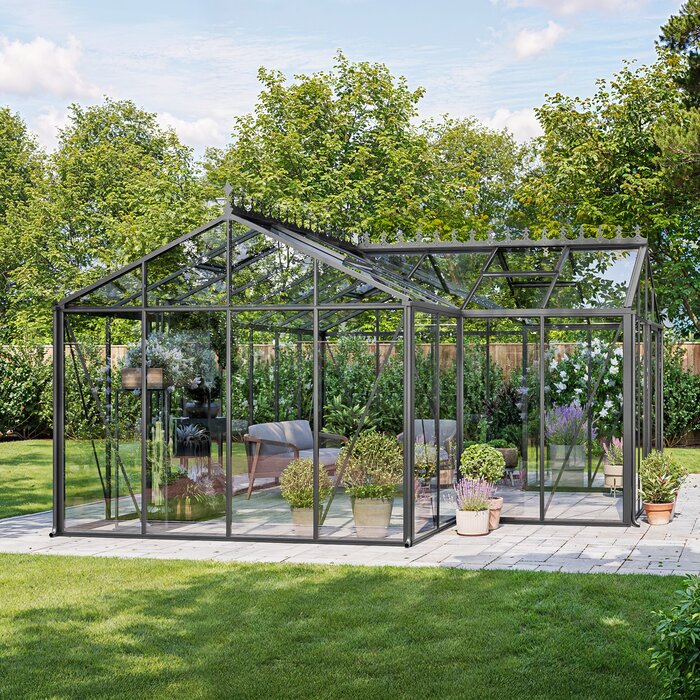
Define the heated space before taking measurements. For the exact configuration you are considering, record its length, width and height, along with the roof form, ends, sides and door openings. Note whether a partition, lobby or attached space is inside or outside the heated boundary. Floor area alone does not describe a tall or irregular enclosure. Catalogue ranges can help you compare possible sizes: the Bloomcabin Prestige Greenhouse size range is listed from 40.6 to 302 ft². That is a span of options, not one fixed greenhouse, so cost the selected configuration. Keep its dimensions with your budget so that a later change of size does not leave you using an estimate for the wrong enclosure.
Keep footprint and heat-loss area as separate quantities. Footprint is useful when checking how much ground the structure occupies; heat loss depends on the surfaces exposed to colder air and on air leakage. Record dimensions in a consistent unit, and use a technical drawing where one is available rather than estimating from a photograph. If some of the greenhouse will be left unheated, mark that boundary clearly. The more precisely you define the space and its dimensions, the less likely you are to apply a whole-building estimate to only part of it, or to omit a connected area that the heater will also warm.
Use local outdoor temperatures and site exposure
Weather is a major input, and a single UK-wide winter temperature will not represent every garden or every spell of cold. Use hourly readings from your site if you have them; otherwise, build scenarios from a nearby weather station or a reputable local weather record. Consider the months you intend to heat, not just the coldest day on record. For a seasonal budget, add the estimated energy across the relevant days. Do not multiply one severe 24-hour example by the whole winter unless you deliberately want that stress-test figure.
Daily or monthly averages can hide cold nights. Heating demand is created during the hours when outside temperature is below your chosen set point; warmer hours do not necessarily cancel those colder hours. Wind can increase air leakage, while exposure to a clear night sky can affect surface temperatures. Record shelter, nearby walls or trees, and how often doors are opened. The Lean-To Greenhouse range is listed from 40 to 154 ft², but a model category and area are not measurements of the weather at your installed site. Keep local exposure as a separate input.
Choose a heat-loss assumption for the budget
A heat-loss coefficient, often written as H, expresses how much heat an enclosure loses for each degree of temperature difference between inside and outside. Its units are watts per kelvin (W/K); a difference of one kelvin is the same size as a difference of one degree Celsius. In the budget example below, H = 100 W/K is an assumed value, not a measured greenhouse specification. It means an assumed loss of 100 watts for each degree of difference under steady conditions. This lets you explore how weather and the chosen temperature affect spending without pretending to know the performance of a particular model. For a purchasing decision, ask whether a model-specific heat-loss assessment is available and what conditions it covers. A qualified heating professional can assess the enclosure where dependable performance data are missing.
The relevant inputs include the exposed surfaces, glazing, frame, ground boundary and air leakage; leakage also changes with wind and how doors or vents are used. Avoid assigning a heat-loss value from the apparent glazing or frame alone. The Classic aluminium greenhouse listing covers sizes from 40.6 to 302.3 ft², but that range does not provide a heat-loss coefficient. If you lack dependable data, show lower, central and higher H assumptions and label them clearly. You can also compare an assumption with measured heater use during a period when the indoor temperature remains reasonably steady. Record sunshine, open vents and any other heat sources, since they can distort that comparison. A trial can improve your budget, but it is not a certified thermal assessment or a substitute for checking heater capacity.
Convert the temperature difference into heat demand
For a simple hourly budget model, calculate the positive temperature difference for each hour: max(0, chosen set point − outside temperature). Add those differences to get degree-hours, then use this formula: heat demand in kWh ≈ H in W/K × degree-hours ÷ 1,000. This estimates heat lost through the enclosure before allowing for gains from sunlight or other heat sources. If the set point changes during the day, use the target for each time period. An average H is also a simplification if wind or ventilation changes substantially. A spreadsheet can keep the hourly weather, target temperature and calculated demand in separate columns. Treat this as a running-cost model, not a heater-sizing calculation: it does not establish whether the equipment can maintain the target during the coldest conditions.
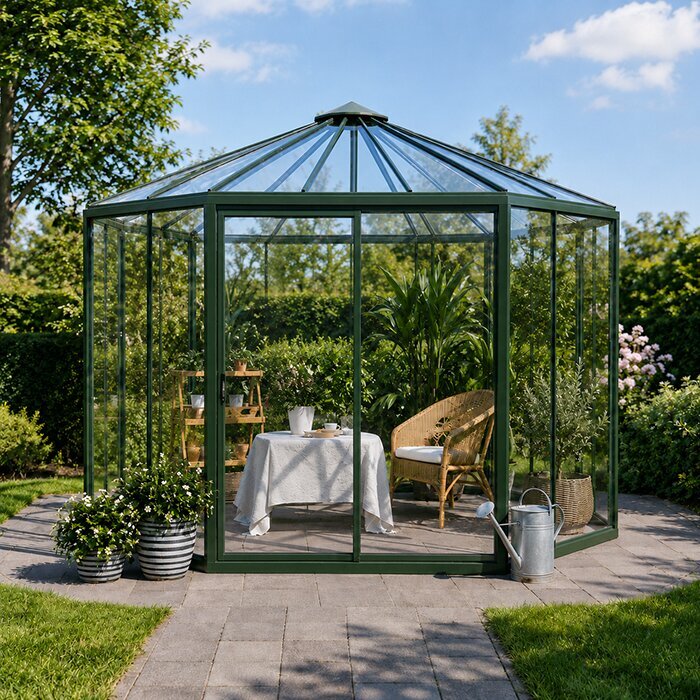
For a worked example, assume H = 100 W/K, a constant 8°C set point and an outside temperature that stays at 2°C throughout 24 hours. The difference is 6°C, or 144 degree-hours, so estimated heat demand is 100 × 144 ÷ 1,000 = 14.4 kWh for the day. If the same assumptions are used with an outside temperature of −3°C throughout, demand becomes 26.4 kWh. These are illustrative conditions, not a forecast or recommended plant temperature. The Pyramid-type greenhouse range is listed from 60 to 203 ft²; as with any shape, listed area alone is not enough to determine H.
Apply your tariff to the energy estimate
Once you have a heat-demand estimate, convert it to the energy you will pay for. For a deliberately simple electric example, assume that each kWh of heat delivered requires one metered kWh; check your heater’s documented input and performance rather than assuming this for every system. At a hypothetical tariff of 28p per kWh, 14.4 kWh costs 14.4 × £0.28 = £4.032, or about £4.03 for the day. Repeating the same calculation for 30 identical days gives £120.96, about £121. The rate is illustrative, not a current UK average. Keep unrounded figures in the calculation and round only the displayed total. Under the colder example, 26.4 kWh would cost about £7.39 for one day at the same rate. This shows why a budget based only on a mild day can understate spending during a cold spell.
Use the unit rate on your own bill, and check whether it changes by time of day. If it does, multiply the energy in each tariff period by that period’s rate and add the results. The standing charge is normally separate from the extra cost of running a heater; show it separately if you are calculating the whole household bill. Fuel-burning equipment needs its own calculation using the fuel price and documented efficiency to convert useful heat into billed fuel. Do not apply the electricity example directly to a different energy source.
Check the estimate against heater runtime
A second calculation can show whether your heat-loss estimate is in a plausible range. For an electric heater, multiply its electrical input in kW by the hours it actually runs at that input. A hypothetical 2 kW heater running at full input for six hours a day uses 12 kWh a day. At 28p per kWh, that is £3.36 a day, or £100.80 over 30 identical days. This differs from the earlier example because the assumed use is 2.4 kWh lower each day. The comparison is useful: review the weather, set point, assumed H and run-time estimate rather than forcing the two totals to match.
A rated power figure does not tell you how long the heater will run. Thermostat cycling, variable output, door openings and the sensor’s position all affect consumption. If you monitor actual use, choose a method suitable for the heater and follow the equipment instructions; have a qualified electrician deal with circuit monitoring where needed. Readings in a long or branched space may also vary from one end to the other. A product title such as T-Shaped Orangery Greenhouse identifies a model form, not internal partitions or temperature distribution, so check the selected layout and follow the heater maker’s guidance on sensor position.
Account for greenhouse size, height and shape
For two enclosures with otherwise similar construction, weather and set point, a larger exposed envelope will generally lose more heat in total. But cost does not rise in a fixed proportion to floor area: height, roof shape, glazing, door openings and air leakage all change the amount of surface losing heat. Two greenhouses with the same footprint can have different exposed areas and volumes. Compare their dimensions and heat-loss inputs rather than applying a universal price per square foot or assuming that doubling the floor area doubles the bill.
The Spacious Greenhouse range is listed from 506 to 753 ft². That listed range is useful for identifying the scale of the available choices, but it is not an energy rating. For any option, use the exact dimensions and heated boundary in your calculation. If you plan to heat only a defined part, work out whether a real boundary separates it from the rest of the greenhouse. A curtain or screen should not automatically be treated as an insulated partition; its effect depends on the design and how well the space is separated.
Separate storage and other unheated spaces
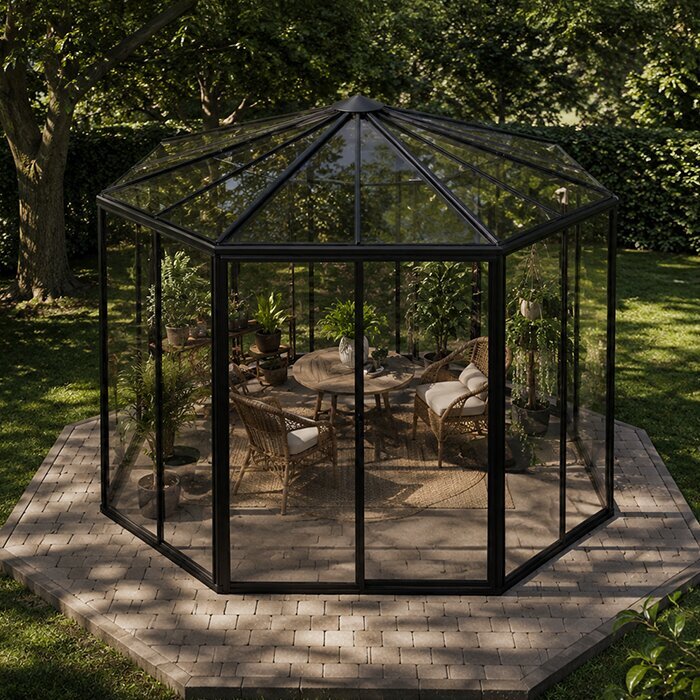
Decide whether attached or adjoining areas are part of the heated volume. If the greenhouse air is free to circulate into a storage area, that space may add to the load even if you do not intend to keep plants there. If there is a closed partition, the amount of heat exchanged depends on that boundary and any gaps. Treat separately controlled areas as separate zones where appropriate, and use their own set points and schedules. Do not simply subtract a section of floor area if the remaining spaces still share air or heat through an open connection.
The greenhouse with built-in storage listing names storage in its title, but the title alone does not tell you which volume will share heated air, or whether a particular configuration has a separating boundary. Check the selected model’s drawing and define what you will heat. The same principle applies to a porch, work area or propagation space: include it if it is inside the heated boundary, and do not assume its temperature or insulation performance from its name. If a propagation bench has its own heater, record that electricity separately and add it to the overall budget; do not overlook it because you are primarily costing air heating. Clear boundaries make both the H estimate and the final budget easier to review.
Improve the estimate with a winter trial
Make the uncertainty visible rather than hiding it in one precise-looking total. Prepare a mild, central and cold-weather case, keeping the set point, tariff and number of days explicit. Test uncertainty in H separately: with the example’s 144 degree-hours, illustrative values of 80, 100 and 120 W/K give 11.52, 14.4 and 17.28 kWh respectively. At 28p per kWh, those daily costs are approximately £3.23, £4.03 and £4.84. These figures show the effect of an uncertain input; they are not verified bounds for a product. When comparing models, record the exact option rather than only the family name: the Limited Edition greenhouse range is listed from 40.6 to 302 ft². Keep a separate entry for each selected size, and date the tariff used so that you can update the comparison without rebuilding the whole budget.
Once heating begins, note indoor and outdoor temperatures, thermostat settings, heater hours or metered kWh, and the tariff periods involved. Compare like with like: a mild week will not validate an estimate for a much colder spell. To reduce demand, check for damaged panels or poorly closing doors and address them in line with the manufacturer’s guidance. Before adding an internal screen or insulation, confirm that it is suitable for the structure and does not compromise plant light or required ventilation. Recalculate or measure the effect rather than assuming a fixed percentage saving.
Frequently asked questions
Is 28p per kWh a typical UK electricity price?
No. It is a hypothetical figure used to demonstrate the calculation, not a current average. Check the unit rate on your own bill or tariff. If you have different day and night rates, estimate the energy used in each period separately.
Does a 2 kW heater use 2 kWh every hour?
It uses 2 kWh in an hour only if it draws its full 2 kW input continuously for that hour. A thermostat may switch it off, and some heaters vary their output. The rating alone does not tell you how many hours it will run.
Should I include the electricity standing charge?
Usually not when calculating the extra cost caused by greenhouse heating, because the standing charge is payable whether or not the heater runs. Show it separately if you are working out the total household bill rather than the additional heating cost.
Can I estimate heating costs from greenhouse floor area alone?
No. Floor area helps you compare sizes, but heat loss also depends on exposed surfaces, height, air leakage, weather and the temperature you maintain. Use the selected greenhouse dimensions and a defensible heat-loss estimate rather than a universal cost per square metre.
How can I make the estimate more reliable?
Record the set point, outdoor conditions and actual heater energy use over representative cold periods. Compare those readings with your calculation and keep the tariff and heating schedule alongside them. A short trial will not describe every winter, but it can reveal which assumptions need adjusting.
A useful heating budget is a calculation you can update, not a fixed winter figure. Keep the target temperature, local weather, heat-loss assumption, heater use and tariff together, then compare the result with measured consumption during cold periods. That makes it easier to see whether the main uncertainty is the greenhouse itself, the weather or the hours of heating.
