
Can an Aluminium Greenhouse Be Extended Later?
Greenhouse planning guide
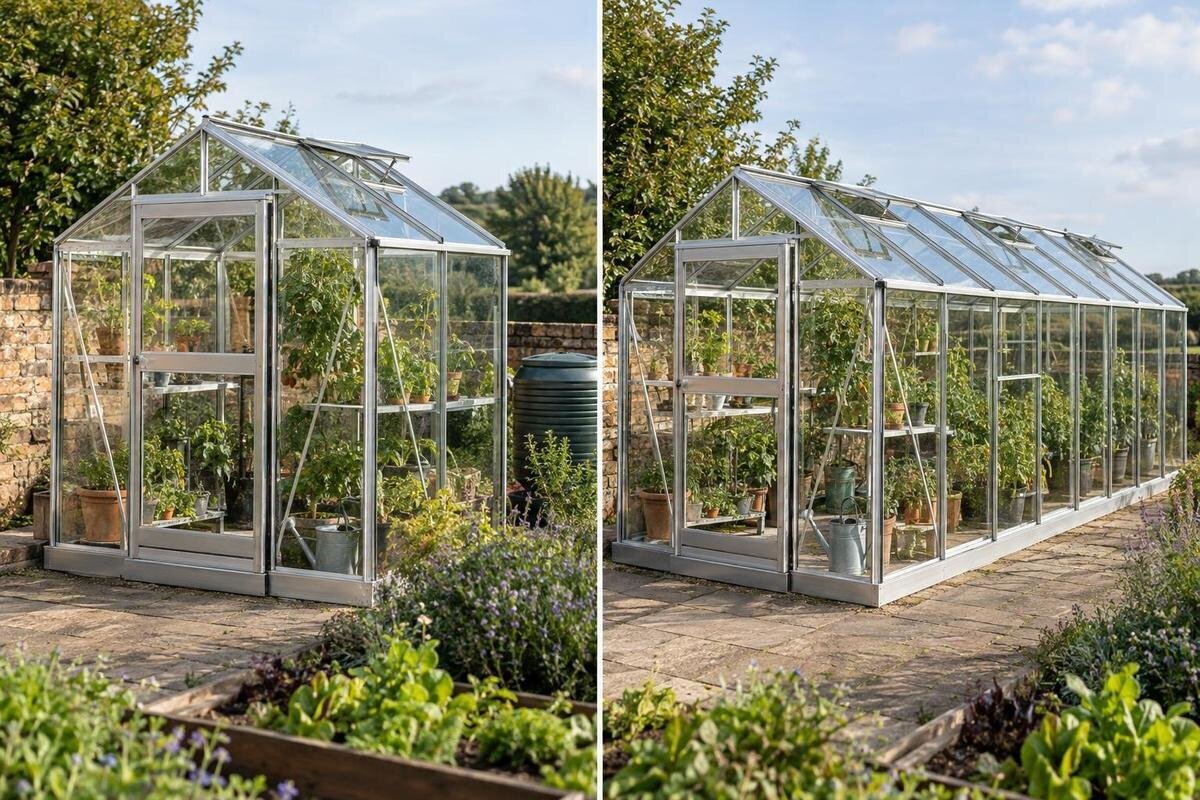
An aluminium greenhouse can sometimes be extended, but the frame material alone does not tell you whether a particular model is designed for it. The answer depends on the exact model and version, compatible frame and glazing parts, whether those parts can still be obtained, and what must change on the base. A greenhouse sold in several sizes is not automatically extendable after assembly. Before buying a smaller unit on the assumption that it can grow later, ask for model-specific evidence and plan around the enlarged footprint.

Can an aluminium greenhouse be extended after installation?
Sometimes, but only when the manufacturer confirms that the exact greenhouse can accept a specified extension. Aluminium describes the frame material; it does not mean the structure uses repeatable bays or that its joints, roof members, glazing and end frame can be lengthened. One model may be designed around sections that can be added, while another may be supplied only in fixed configurations. A dealer’s description of a greenhouse as modular should be tied to a named kit and compatible model, size and version. Unless the manual or maker’s written guidance supports that combination, assume the installed footprint is fixed rather than budgeting on future enlargement.
An extension changes the whole structure, not simply a panel or two. Depending on the design, it may need matching frame members, glazing, connectors or bracing, and changes to the end assembly or parts that run along the roof and sides. The larger footprint also changes the area the base must support and how the greenhouse fits the garden. Before you plan around extra growing room, ask for the exact extension kit and an assembly drawing that shows the enlarged arrangement. Get confirmation that it applies to your greenhouse, including its size and version; a photograph or a list of larger sizes is not enough evidence.
What counts as a genuine extension?
A genuine extension enlarges the existing structure using components intended to connect to it. That is different from ordering a larger size at the outset, replacing the greenhouse, moving it to a newly prepared base or adding a second structure alongside it. Each route may provide extra growing space, but none proves that the original frame is extendable. Ask the seller to define what they mean by an extension: a kit to fit a model that has already been assembled, a size offered only before manufacture, or simply a larger version in the same product family. Ask which exact size each statement applies to. Those meanings are not interchangeable, and the distinction can affect the base and work involved.
Read catalogue area ranges as choices, not retrofit promises. For instance, the Classic aluminium greenhouse listing shows options from 40.6 ft² to 302.3 ft². This helps compare the sizes presented for that model, but it does not say that the smallest assembled greenhouse can be lengthened to the largest. A product family can cover several footprints without every size sharing the same parts. Ask which configurations are available as new orders and whether a separate extension kit is approved for your particular size and version. Request the kit reference, instructions and a drawing; a broad product title or a verbal assurance that something should fit does not establish compatibility.
Identify the exact model and version
Start with paperwork from the original order, not a broad product category. Record the exact model name, size bought, purchase date or generation if known, assembly manual reference, configuration and glazing type. Keep the order confirmation and any parts list; clear photos of labels and frame arrangements can help a supplier identify the unit. If paperwork is missing, ask what information or photographs are needed before deciding what to buy. Similar appearance is not enough to identify compatible parts: versions may share a name while their drawings or components differ. Note any replaced panes, doors or later alterations, as the greenhouse in the garden may no longer match the original order.
Product names are only a starting point. The Limited Edition greenhouse listing identifies a named product family, but it cannot establish which version you own. When contacting the supplier, distinguish confirmed details from estimates: an order reference is more useful than a guessed purchase year, and a manual code is more reliable than a resemblance to a current photograph. If you bought the greenhouse second-hand, include any documents passed on by the previous owner and explain what is missing. Ask the supplier whether the information is sufficient to identify the unit, or whether an inspection is needed. This prevents an enquiry about an older greenhouse being answered against the current catalogue model.
Check compatibility and parts availability
Compatibility and supply are separate questions. Even if a manufacturer says a design can be lengthened, every part needed has to match your version and be obtainable. Ask for official kit or part references and a list of what is included: added frame sections, glazing, connectors and fixings, altered end-frame pieces, and parts for openings or ventilation if the new layout affects them. Also ask which pieces from the existing greenhouse stay in use and which must be moved or replaced. A vague assurance that parts are standard does not show that the interfaces align. You need a drawing or parts schedule for the exact model, not just a description of the proposed work.
Ask whether the kit is intended for a greenhouse that has already been assembled, rather than only for an order placed before the original build. Confirm that the supplier can provide all the required matching items, not just that an extension exists on paper. The aluminium Lean-To Greenhouse listing illustrates why aluminium greenhouse is too broad a description when requesting parts: give the exact model and configuration, not only the frame material. Check whether the original assembly instructions are available too, so an installer can compare the proposal with the supplied design. If a part is no longer listed, ask what approved option, if any, applies to your version.

Assess the existing base
Extending the frame also changes the ground footprint. The existing base may be too short, or its layout may not suit the enlarged plan; whether it can be retained, lengthened or replaced depends on the greenhouse design and the site. Ask the manufacturer for the revised base drawing and have a competent installer or relevant building professional assess the existing arrangement before committing. Do not assume that adding a strip of paving is sufficient, or that the old base remains suitable because it supported the original size. Ask what checks are needed for fit and alignment, and how any join between existing and new work should be handled. The question is whether the complete extended structure has an appropriate base.
Base planning is easier when the supplier can see the exact unit and garden. Share photos and the existing base measurements, along with the proposed overall footprint. Ask whether a door, access path, edging or change in surface level could be affected. If you are enquiring about the model shown in the greenhouse with built-in storage listing, include that configuration in the enquiry rather than describing it simply as an aluminium greenhouse. Mark the position of the storage area on the existing plan so that it is included in the assessment. Where base work is uncertain, ask the person assessing it to work from the manufacturer’s drawing rather than a guessed extension line.
Check the roof, glazing and fixed features
Check every component that defines the enclosure, not only the frame length. Existing glazing may not suit a new section or a moved end; roof and side panels, their retention details, connectors, seals, vents and doors can be specific to the model. Ask whether the extension kit includes new panels and altered openings, and whether removed pieces are meant to be reused at the new end. Do not order loose glazing or alter profiles on the assumption that similar-looking parts will fit. Use manufacturer-issued diagrams for the exact configuration, and ask for guidance if the proposal changes an opening or roof layout. The specification should explain how the extended arrangement uses both the new and existing components.
Geometry matters as well. A straight length extension will not necessarily preserve a planned door position, roof arrangement or interior access, and it cannot be assumed to create a different overall shape. The T-Shaped Orangery listing is a separately named form to compare if the intended layout is more complex; it does not show that another greenhouse can be reshaped into it. Decide whether you need more length, a different outline or simply more usable floor space, then compare a manufacturer-approved drawing for that specific requirement. Avoid choosing components from different configurations unless the manufacturer has designed and confirmed the combination.
Plan the enlarged footprint in the garden
Before treating extra floor area as useful, check the full enlarged footprint against the garden. Allow for doors opening, the route you use to reach plants, access to clean or repair the structure, existing beds, trees, fences and other buildings, and any path or drain affected by the change. Draw the current and proposed outlines using the supplier’s dimensions; catalogue floor area alone does not give the outside length and width. Consider where benches, tall crops and tools will go, because a longer greenhouse can still feel cramped if the route through it is obstructed. Also check that there is room to bring components to the site and carry out the work.
The Spacious Greenhouse listing gives a range from 506 ft² to 753 ft², which can help you compare the sizes presented on that page. It does not state that a smaller assembled unit can be expanded to the larger one. For your garden, request the outline drawing for the exact size and compare its overall dimensions and door position with the space available. Include the base edge and any working clearance you need. Use the stated area as one comparison point, not as a substitute for a plan or proof of future expandability.
Compare an extension with buying a larger greenhouse
Compare an approved extension with three alternatives: ordering the intended larger size from the outset, replacing the greenhouse, or keeping it and adding a separate structure if the garden has room. Assess each route from complete specifications, including base work, dismantling or building work and any help required, rather than comparing the price of a kit with that of a whole greenhouse. Think about how you will use the area over several seasons: propagation space, permanent crops, benches and storage all compete for floor area. The right option is the one that suits your plan and fits the site, without relying on parts that may not be available later.
A differently shaped model may also be worth comparing if more space is the goal. The Pyramid Greenhouse listing presents sizes from 60 sq ft to 203 sq ft. For a useful comparison with an extension, request the overall dimensions and layout of the specific size you are considering. Sketch the same benches, pots and access route into both plans rather than judging them by floor area alone. Note whether each option accommodates the things that prompted the enquiry, such as a separate propagation bench or room for larger containers. This makes the comparison about usable growing space and keeps a whole-product alternative distinct from an alteration to your existing greenhouse.

Budget for the complete extension project
Cost the whole project before buying an extension kit. Request a written, itemised quotation that separates matching components from any glazing, base alterations, dismantling, reassembly and installation work. Ask what happens to existing pieces that are removed and who is responsible for checking that the enlarged arrangement follows the maker’s instructions. Do not assume a kit price covers every part or labour; a quotation tied to the model, size and proposed layout is needed to establish the likely scope. Ask whether anything has to be sourced separately and whether the quote covers the work on the existing greenhouse as well as the added section.
For a fair cost comparison, obtain a separate quotation for a complete replacement in the size you need. The Prestige Greenhouse listing displays areas from 40.6 ft² to 302 ft², so identify the exact configuration being priced rather than requesting a quote for the family name alone. Check whether each quotation includes the same scope of work, and record exclusions beside the totals. A replacement proposal might leave removal of the old greenhouse to you; an extension proposal might exclude work on the existing base. Neither should be treated as a complete project cost until those gaps are accounted for. Keep the quotations with their drawings so that later revisions can be compared accurately.
Buying now with a possible extension in mind
If you are choosing your first greenhouse, separate what you need now from what you might want later. A smaller model should accommodate your initial crop plan without depending on an unconfirmed extension. Mark any potential enlarged footprint on the garden plan before choosing the position of the greenhouse, paths and permanent planting. Leaving space can preserve a practical option, but it does not establish that the frame can be extended. Consider how certain the extra space requirement is: a planned increase in growing area deserves more weight than a vague possibility. Where the larger size is already necessary for your intended use, compare buying it at the outset with the full cost and disruption of an approved later extension.
Distinguish confirmation of compatibility today from a promise of future availability. A kit currently offered for a model does not, by itself, establish that all its components will remain obtainable when you want them. Ask what the supplier can actually confirm about future orders, and keep any written terms with your purchase documents. If you consider buying extension components in advance, clarify whether the set is complete, how it should be stored and whether buying it now changes the proposed installation arrangements. Do not buy a partial collection of parts simply to secure the possibility. Your decision should still make sense if the greenhouse remains at its original size throughout your ownership.
Frequently asked questions
Can every aluminium greenhouse be extended?
No. Aluminium describes the frame material, not whether a model is modular. Look for documentation or written confirmation that names an extension kit for your exact model, size and version.
Does a product page showing larger sizes prove that mine can be extended?
No. A range of sizes may describe choices when ordering a new greenhouse. Ask whether there is an approved retrofit kit for the greenhouse you already have, and request the relevant drawing and parts list.
Can I use parts from a similar greenhouse?
Do not assume they will fit. Similar-looking models may use different components or layouts. Ask the supplier to confirm compatibility against your exact model and version before ordering.
Will the existing base need changing?
Possibly. A longer footprint may require a different base arrangement, but the answer depends on the greenhouse and site. Use the manufacturer’s revised drawing and have uncertain base work assessed by a competent professional.
What if the right extension parts are unavailable?
Avoid improvising an alteration. Compare buying a larger complete greenhouse, keeping the existing one or adding a separate structure. Check the footprint, base and access requirements for each option.
An aluminium greenhouse can be extended later only when the manufacturer confirms that the exact model and version accept compatible parts, and the enlarged arrangement has a suitable base. Check the glazing and frame components, confirm that the parts can be supplied, and compare the full work with buying a larger greenhouse or adding a separate structure. If those details cannot be established, plan to use the greenhouse at the size supplied rather than counting on an extension that may not be possible.
