
Greenhouse Aubergines Flowering but Not Setting Fruit
Greenhouse crop problems
When greenhouse aubergines flower but no fruit follows, it is tempting to blame a lack of pollinators. More useful questions are whether pollination occurred, whether the growing position provides enough warmth and light, and whether the plant could retain a young fruit. Flowers alone do not guarantee a crop. Check the swelling at the base of the bloom, compare several flowers, and record day and night conditions before changing feed or giving up on the plant.

01
First check whether fruit has started to form
Fruit set becomes visible when the ovary at the flower’s base, within the green calyx, begins to swell and continues enlarging after the petals fade. Petals withering or falling is normal and does not, by itself, mean that pollination failed. If the base does not enlarge over the following days, there is no visible fruit set. If a tiny aubergine appears, then yellows, shrivels or stops growing, initial development occurred but the fruit was not retained. This distinction helps organise your observations: no initial swelling makes pollination and conditions during flowering worth checking; later arrest calls for a closer look at moisture, light, overall growth and the fruits already developing on the plant.
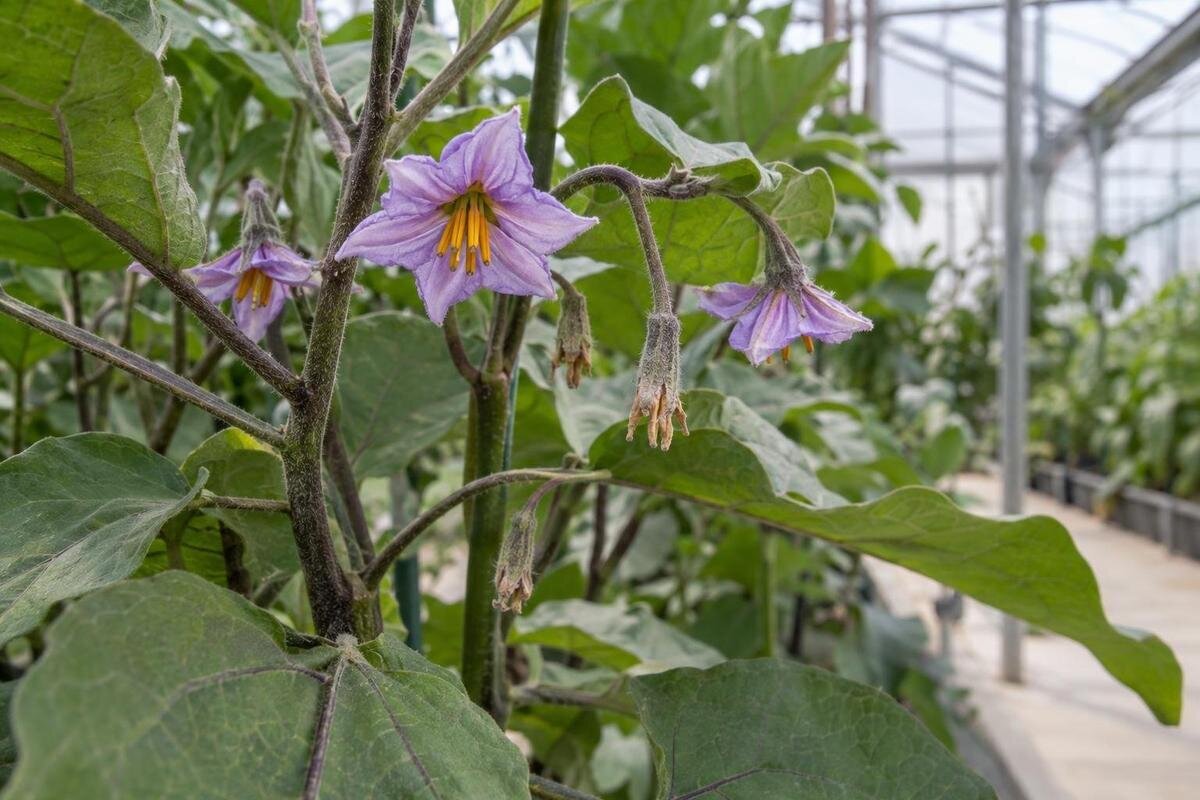
Tag several blooms with loose plant labels and note when each opens, whether you assisted pollination, and what happens to its base over the following days. Keep labels loose enough not to constrict a growing stem or fruit. Check flowers on different branches: one early bloom or one plant position cannot represent the whole crop. A side-on close-up of a fresh flower can show the stigma relative to the anthers; a second photo after the petals fade can help confirm whether its base enlarged. Include a date and a wider photograph of the plant so that flower details remain connected to its overall condition. A young, recently planted aubergine may shed an occasional early flower while settling, so look for a repeated pattern rather than treating the first lost bloom as a crop failure.
How pollination works in aubergine flowers
Aubergine flowers contain both reproductive parts: pollen-bearing anthers and a stigma in the same bloom. They can use their own pollen, so a second plant or a separate male flower is not normally required. This differs from crops with distinct male and female flowers, where pollen has to move between them. The important distinction is between a flower being capable of self-pollination and pollination actually taking place. Pollen still needs to reach the stigma, and the presence of an open flower does not show whether that has happened.
The RHS aubergine growing guide recommends opening greenhouse doors and vents on warm days to give pollinating insects access, or hand pollinating with a small paintbrush. Neither approach guarantees that every flower will produce fruit. The same guide highlights warmth, sunshine and a steady moisture supply as important for cropping. Treat pollination as one factor to investigate alongside those growing conditions. Seeing few insects is a reason to try assisted pollination, not enough evidence to diagnose every dropping flower as a pollination failure.
02
Try hand pollination on a few open flowers
Choose several newly opened, undamaged flowers that you can reach without bending their stems. With a small, soft paintbrush, gently brush the pollen-bearing anthers and the stigma within each bloom. There is no need to find a separate male flower. Use a light touch rather than forcing the brush into the flower, pulling petals apart or shaking the whole plant. Mark the flowers you have treated and repeat with a few fresh blooms over several days. This is a practical comparison, not a reason to handle every flower repeatedly.
Leave a similar set of flowers untouched and mark both groups so you can compare swelling after the petals fade. Choose blooms of similar age on the same plant where possible; comparing an early flower on a weak plant with a later one on a vigorous plant tells you little about assisted pollination. Record how many flowers you tested, not just the successful ones. If treated flowers set more often, limited pollination becomes more plausible, though changing weather and differences between blooms can still influence the result. If neither group sets, investigate growing conditions and plant health. For a separate greenhouse purchase, the Limited Edition aluminium greenhouse is a model to compare for access: allow room to reach flowering branches without brushing against adjacent plants, and verify the usable internal layout before choosing a size.
Consider the variety and the plant’s stage of growth
Check the variety name and the plant’s growing history before comparing it with another aubergine. The RHS notes that aubergines need a long growing season and that newer, smaller-fruited varieties can be better suited to UK conditions. A recently planted specimen and an established plant of another variety are not a reliable comparison, even if both have flowers. Record the sowing or purchase date, transplanting date and any period when growth slowed. These details help put the first flowers in context without assuming that early blossom should immediately produce a full crop.
Read the seed packet or supplier’s growing guidance for the expected fruit size and growth habit. Do not judge a small-fruited variety against the eventual size of a large-fruited one, or use a calendar date alone to decide that a plant has failed. Compare successive flowers on the same plant and note whether new leaves and shoots are developing normally. Keep the original label with your records so that a nursery or gardening adviser can interpret the observations accurately. When planning a greenhouse with several growing areas, mark inspection routes on the floor plan. The T-shaped orangery greenhouse is a separate layout option to examine; check whether plants in each part would remain accessible once their leaves spread, rather than judging access from the outline alone.

03
Measure temperature at flower height, day and night
Use a minimum–maximum thermometer or data logger near flowering branches, out of direct sun and away from glazing. A sensor warmed by sunlight measures itself as much as the air, and a reading at the roof or door may not match conditions around the canopy. Record overnight lows and daytime highs over several days, alongside when vents and doors are used. Weather forecasts and a greenhouse display mounted elsewhere provide useful context, but neither necessarily shows the conditions at the flowers. If one side of the greenhouse is more exposed, compare readings there with those near the centre.
Aubergines need warmth to crop successfully, and the RHS identifies a growing position that is too cold as a possible reason for a lack of fruit. The supplied guidance does not establish a precise temperature at which flowers stop setting, so use your readings to identify patterns rather than impose a universal cut-off. Note repeated cool nights, sustained daytime heat and any accompanying wilting. A minimum–maximum thermometer records extremes but not how long they lasted; a logger can help distinguish a short spike from prolonged exposure. Match the readings to the dates when affected flowers opened, rather than assuming today’s temperature explains an older failed bloom. For a separate comparison of the pyramid-type greenhouse, establish where flowering plants, sensors and vents would sit. Its shape and listed floor area alone cannot establish the temperatures a crop would experience.
Balance ventilation with warmth
If readings show daytime heat building, use existing vents and doors to release it before the interior reaches its peak, then check the temperature again at plant height. Adjust ventilation to current conditions, not to a rigid date or routine: a cloudy, cool day and a bright, hot day need different responses. Avoid assuming that leaving doors wide open overnight is harmless in a cool spell. Aubergines need fresh air, but prolonged cold exposure can trade a heat problem for another stress.
Air circulation helps manage temperature and humidity, but it does not establish that pollen has reached a flower’s stigma. A strong direct draught is not a substitute for gentle vibration and may stress the plant. Check whether still air is local to dense foliage or common across the greenhouse. Leaves touching the glazing or tightly packed neighbouring crops can make it difficult to inspect flowers and manage the space around them. Make gradual adjustments where conditions allow, then observe the result at canopy height. If a storage area forms part of a proposed layout, keep its access route separate from the growing space. For the Limited Edition greenhouse with built-in storage, verify the division between storage and cultivation areas, along with vent positions, rather than assuming the full footprint is available for plants.
04
Keep root moisture steady and feed only for a reason
A flowering aubergine can drop blooms or fail to hold a small fruit when the root zone swings between very dry and saturated. Check moisture below the surface, because a dry top layer does not always mean the whole root ball is dry. Containers and beds also lose water at different rates, especially during warm spells. Aim for consistent moisture while allowing excess water to drain. A plant that wilts despite damp compost or soil needs its roots and drainage checked, not another automatic watering.
Review feeding as part of normal crop care, rather than treating extra fertiliser as an immediate cure. The RHS recommends a high-potassium liquid feed for container-grown aubergines once flowering begins, while plants in enriched ground may not need regular feeding. Follow the chosen fertiliser’s label for dilution and frequency, and check whether the compost already contains feed. Weak growth or discoloured leaves can have several causes, so do not diagnose a deficiency from poor fruit set alone. Changing several products at once also makes the response harder to interpret. Watering access is worth considering in a greenhouse purchase: a reachable pot is easier to check individually than one hidden behind a crowded bed. Compare the Prestige greenhouse using a proposed arrangement of containers, paths and watering access, without treating the model itself as a remedy for poor fruit set.
Check light, crowding and signs of flower damage
Aubergines need a bright position and enough healthy leaf area to support developing fruit. Compare plants in different parts of the greenhouse and note whether neighbouring crops, dense foliage or shade reduce light around the canopy. Weak, stretched growth or a heavily shaded side can signal limited light, but no single leaf shape proves that it is the cause. Avoid stripping healthy leaves around flowers; removing too much foliage can reduce the plant’s capacity to grow fruit.
Look inside dropping blooms and over new leaves for visible damage. Thrips may be found in flowers, while mites and aphids may be more apparent on foliage or tender growth. Tiny insects, scars, distorted buds, leaf stippling or fine webbing make identification worthwhile, but they do not prove that a pest caused every failed flower. Photograph both the suspected pest and its damage; a close-up of a damaged petal alone may not identify the cause. Avoid spraying a flowering crop without identifying the problem and checking the treatment label, including crop suitability and possible pollinator exposure. When comparing growing space, use the published footprint of the spacious greenhouse to draw a planting plan with inspection routes. Extra floor area only helps access if the proposed planting leaves those routes usable.

05
A fruitlet that stalls points to wider stress
If an ovary swells but a young aubergine later yellows, shrivels or stops enlarging, look beyond pollen movement alone. Initial swelling shows that development has begun, but is not proof of successful fertilisation or a guarantee that the fruit will continue growing. Erratic watering, heat, cold nights, root restriction, low light and a plant carrying several developing fruits can all limit retention. Compare the affected fruit with healthy ones and check the plant on the same day, not just after the fruit has changed. An existing fruit load may affect later flowers, but do not remove healthy fruit or leaves as a first response without considering the variety’s growing guidance and the plant’s condition.
Check overall growth: a vigorous, leafy plant with few fruits presents a different pattern from a weak, wilted or damaged plant, although excess nitrogen can also produce plenty of foliage. Note how many fruits are already growing, along with recent feeding, watering and greenhouse readings. Check container size and whether water penetrates the root ball rather than running straight through or down its sides. Do not pull a flowering plant from its pot merely to investigate an otherwise healthy root system. For future space planning, use the mature crop rather than a newly planted seedling as your reference. The stated dimensions of the classic aluminium greenhouse can inform a layout comparison, but the plan also needs room for containers, supports and foliage later in the season.
Check greenhouse layout before changing the crop routine
Conditions can vary within one greenhouse: air may be hotter near the roof, while a doorway or shaded side creates a different pattern around the plants. Compare temperature and light where affected and healthy plants are growing, and note whether dense foliage or an obstruction is limiting airflow. A single reading from elsewhere in the structure may miss these differences. The pattern across the crop can be more informative than the greenhouse’s overall average.
If one area consistently produces fewer fruits, assess its light, temperature and ventilation before changing every plant’s care. Note whether the difference follows a doorway, a shaded wall or a crowded bench, and compare plants of similar variety and age. Where practical, move a container to a better position without damaging its roots or supports, then assess newly opening flowers rather than expecting old failed blooms to recover. A lean-to format does not automatically mean warmer or more suitable conditions; the wall, orientation, ventilation and local exposure all matter. For a separate purchase comparison, assess the lean-to greenhouse against its intended site, including nearby shading and access to its openings. A change of structure is not the first response to a problem confined to one poorly positioned plant.
Frequently asked questions
Do greenhouse aubergines need hand pollination?
Not every plant needs it, but it is worth testing if flowers repeatedly fail to set. The RHS recommends hand pollination with a small paintbrush as an option for greenhouse aubergines. Treat a few open flowers gently and compare them with untouched blooms; a better result suggests pollination may have been limiting, but does not prove it was the only cause.
Why are the flowers falling off before fruit appears?
Poor pollination, unsuitable growing conditions or wider plant stress may be involved. Check warmth, light, root moisture and visible pest damage rather than assuming one cause. Look for swelling at the base of several flowers after they fade; petals dropping alone do not identify a problem.
What temperatures should I check?
Measure daytime highs and overnight lows at flower height, with the sensor shaded from direct sun. Aubergines need warmth, and a position that is too cold can limit cropping. Record repeated cool nights and sustained daytime overheating alongside flower development; the supplied RHS guidance does not give a universal fruit-set temperature cut-off.
How can I tell whether a flower has set fruit?
After the petals fade, look for the ovary within the green calyx at the flower’s base beginning to swell and continuing to grow. Petals falling alone do not indicate failure. No enlargement over the following days means there is no visible fruit set; a swelling that later stalls warrants checks for wider plant stress.
Should I add fertiliser or introduce pollinators?
Neither is an automatic fix. Review feeding history and follow an appropriate fertiliser label; container-grown aubergines have different feeding needs from plants in enriched ground. On warm days, open doors and vents to allow pollinating insects access. A small hand-pollination trial is more useful than assuming you need to introduce pollinators.
Treat poor fruit set as a pattern to investigate, not a single diagnosis. Tag open blooms, compare hand-pollinated and untouched flowers, measure day and night temperatures at the canopy, and watch whether the ovary enlarges. Consider those observations alongside root moisture, light, existing fruits and the plant’s overall condition. Keep records of each adjustment and assess newly opening flowers: an old bloom that failed to set cannot show whether the conditions have since improved.
