
Greenhouse Automation Without Mains Electricity: What Is Practical?
Off-grid greenhouse planning
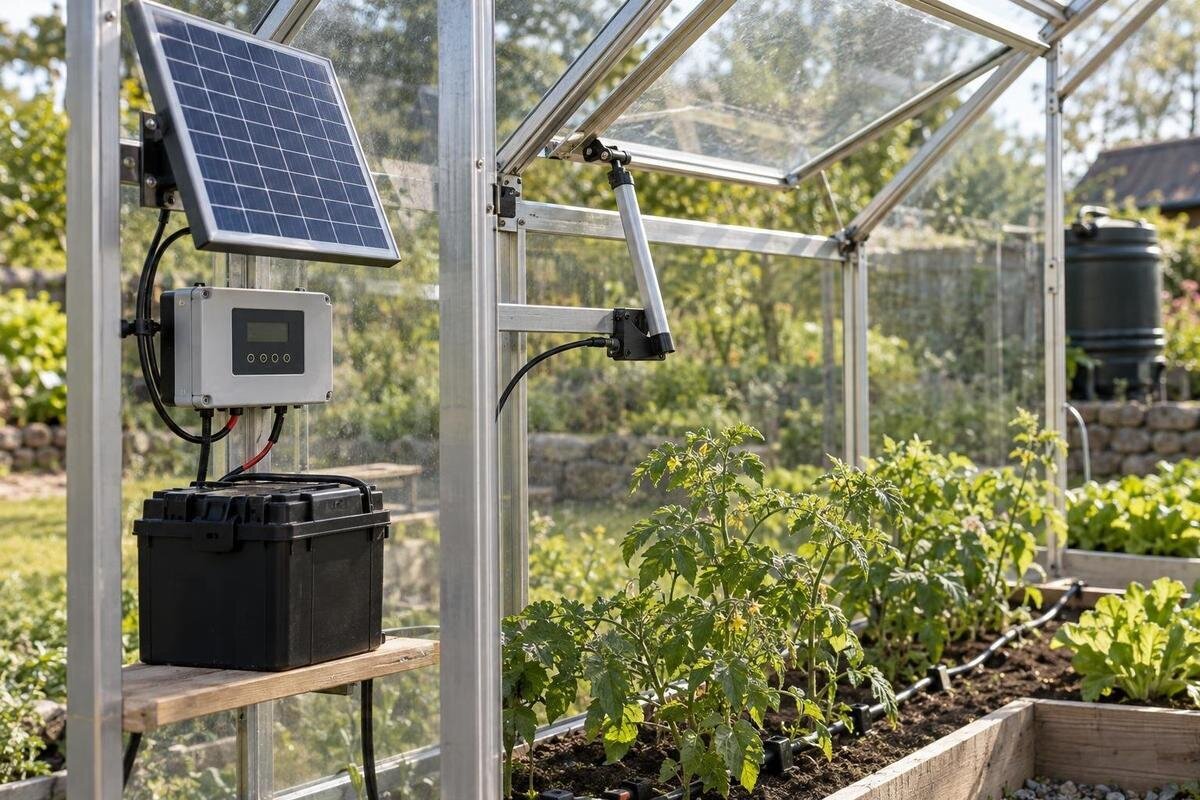
Running a greenhouse without mains electricity does not rule out useful automation. Passive vent openers need no electrical supply, and battery-powered devices can handle selected controls; irrigation can also be automated where the water source, pressure and equipment match. None of these makes growing fully self-managing: batteries run down, tanks empty, sensors miss local conditions and an automated vent may not provide enough ventilation on its own. The practical approach is to automate one clearly defined task at a time and preserve a manual fallback.

01
What “off-grid” means for greenhouse automation
Here, off-grid means no dependable mains electricity at the greenhouse, not necessarily no mains water, mobile signal or access to a charged battery. Separate the jobs into three groups: passive mechanisms that respond mechanically to heat, battery-powered controls that need stored electrical energy, and watering systems that need a reliable water source as well as a control method. A device described as wireless may still depend on a powered controller or gateway; an automatic valve does not create the water pressure it needs. Ask what each part requires, including any charging arrangement, rather than treating “off-grid” as a single feature.
That distinction matters when comparing the greenhouse and its equipment. A listing for a Classic greenhouse identifies a structure; it does not establish which vents, openers, sensors or powered accessories are included. Draw up two separate lists: the openings and water route provided by your chosen configuration, and the controls you plan to add. If mains-free operation is essential, ask the supplier to confirm the exact configuration and compatibility before basing your plan on an assumed feature.
Choose tasks worth automating
Begin with a short, honest record of the work you actually do, rather than a catalogue of gadgets. On representative growing days, note when you open or close vents, water, inspect seedlings, refill a container or respond to a change in weather. Record what prompted each task, how long it took and what could go wrong if it were delayed. Include the season and the plants being grown: a routine that suits one crop or month may not describe the rest of the year. This log helps show whether the recurring need is ventilation, watering, an alert or simply easier access.
Then define what a useful system would do. A vent opener may reduce repeated manual adjustments but cannot guarantee identical conditions in every corner; a timer can repeat a schedule but cannot know that a line is blocked unless the system can detect and report it. Rank tasks by frequency and consequence, then choose one with a clear test for success. “The vent moves within the maker’s stated limits” is testable; “the greenhouse looks after itself” is not. Keep the first setup simple enough to observe and troubleshoot before adding more controls.
02
Passive ventilation needs no battery, but has limits
Manual vents use no electricity, but the labour saving depends on someone being present when conditions change. Plan how you will reach each opening without moving pots or climbing over beds, and decide who will close it if the weather shifts. The position and size of openings, as well as the way air moves through that particular greenhouse, affect the result. Having a vent does not prove it will maintain your preferred conditions throughout the growing space. Follow the greenhouse and vent maker’s guidance for the intended openings, and consider how you will check areas that are not close to them.
A thermostatic wax-cylinder opener moves a compatible vent as its surroundings warm or cool, using a mechanical response rather than a mains supply or battery. It is a low-complexity option, not a programmable climate controller: it does not follow a timetable, report a fault or respond to every variable a grower might monitor. For a shortlisted Prestige Greenhouse, confirm which vents are in the selected configuration and whether the opener is suitable for them. Check its operating range, travel, mounting requirements and stated load limits against the specific vent; do not assume one mechanism will serve every opening.
Battery-powered controls add capability and dependencies
Battery controls can provide timed or sensor-led action where a passive mechanism cannot do the required job. Depending on the equipment, the chain may include a sensor, controller, motor or valve, and one or more batteries; a separate receiver or gateway may also be needed. Every additional part creates another dependency. A battery thermostat may control a compatible actuator, while a tap timer may manage a suitable valve, but neither should be assumed to operate a fan or pump unless its instructions explicitly allow that load. Draw the complete chain on paper, including any charger or solar supply, before buying individual parts.
Ask the manufacturer to confirm compatibility between the controller and the exact actuator or valve, along with voltage and current requirements, operating conditions, vent travel or water pressure, and any required accessories. Check that the controls suit the greenhouse’s actual vent type or plumbing arrangement rather than relying on a generic description such as “automatic”. If a Pyramid-type greenhouse is on your shortlist, use the selected configuration details to mark each intended control point. Ask for the relevant dimensions and mounting details so the equipment supplier can assess fit, including clearance throughout the vent’s movement. Keep the instructions available for later troubleshooting.

03
Check battery life and failure behaviour
An advertised battery life is useful only alongside its test conditions. Runtime may depend on how often an actuator moves, how long a controller stays awake, the number of connected devices and the operating conditions allowed by the manufacturer. Ask whether the figure describes standby use or active operation, which battery type was tested, and what to expect during the busier part of your growing year. Compare replaceable and rechargeable arrangements by the effort of checking and replenishing them, not just the stated interval. If charging depends on a panel, confirm the complete system’s compatibility and the conditions in which it is expected to recharge.
Find out what the device does when its battery is low or exhausted: it might stop, remain in place, release a vent or signal an alert. The answer varies by product and should come from its instructions, not assumption. A low-battery warning helps only if it is visible or delivered while the controller and any communications link still work. Check for a local indicator, manual override and a practical way to operate the vent or valve. Keep a spare if the manufacturer recommends one, and record replacement dates so a forgotten battery does not become a hidden point of failure.
Plan the water supply separately from the power supply
Electricity is only one part of automatic watering. Identify the water source first: a tap, rainwater tank, another stored supply or a combination. A water main may be available where there is no electrical connection, while a rainwater system depends on collection, storage and replenishment. Dry weather can leave a tank short just when watering demand rises. Estimate demand from the planned crops, containers, season and your own observations, then allow for the period the system needs to operate without a refill. Greenhouse floor area alone is not a water-use estimate: planted area, container size and watering method all affect the requirement.
Next, match delivery to the available pressure and flow. Gravity-fed irrigation needs outlets and valves suited to the pressure available from the water source at its intended height; other arrangements need a pump, which requires a suitable power supply. Check minimum operating pressure, flow limits, filtration and pipe connections in each component’s instructions, then consider how you will refill and clean the storage arrangement. If comparing the Spacious Greenhouse, mark the beds, containers and proposed watering zones on your selected layout. Use those details to assess demand and the route from the water source, including access to filters and isolation valves.
04
Test timed and gravity-fed irrigation as a complete system
A timer can make watering more regular without a mains-powered controller, but the timer, tap and water source must work together. A battery-operated tap timer still needs a suitable connection and adequate incoming pressure; a gravity-fed line needs components designed for low pressure and a source positioned as its maker specifies. Check how many zones the valve can run, what happens if its battery fails and whether it has a manual setting. A timer repeats the schedule you set. It cannot tell that a plant is dry, a tank is empty or an emitter is clogged unless the system has a suitable way to detect those conditions.
Before trusting the setup, run water through the complete route to the furthest outlet. Check connections for leaks, compare the flow from several emitters using identical collection cups, and confirm that the timer closes as expected, following the equipment’s test procedure. Repeat after moving lines, changing zones or cleaning a filter. When considering a T-Shaped Orangery Greenhouse, plan irrigation zones from the selected layout and plant positions. Group plants with similar watering needs where practical, and check that each zone receives water during its scheduled run. Keep a way to shut off the supply and water manually if the timer or a line fails.
Sensors and remote alerts have their own power needs
Temperature, humidity and soil-moisture sensors can add useful information, but a reading represents only the sensor’s location and condition. Position and compare sensors as the manufacturer directs, avoiding an unrepresentative spot such as direct sun or immediately beside the vent being controlled. Check whether the unit records a history, shows the current reading locally and lets you set an alert; these are separate functions. A controller responding to one sensor cannot automatically account for every bed or pot. Compare readings with conditions where the plants are, and check periodically for damage, drift or a flat battery.
Remote alerts have more dependencies than a local display: the sensor and controller need power, and any radio link, gateway, internet service or phone connection in the chain must be available. Establish what can still be read or controlled if the connection drops, whether alerts are delayed or stored, and whether an account or service is required. If considering a Lean-To Greenhouse, test coverage at its proposed position and check it again with the equipment in its final location. Confirm that a trial notification reaches the person who will respond, rather than merely appearing in the device’s log. Treat an alert as an extra warning, not proof that every device has worked.

05
Make room for equipment and routine access
Give vents, batteries, controllers, valves and filters places where you can inspect them without disturbing plants or dismantling benches. Leave each vent’s moving path clear, route water lines so they can be seen and reached, and keep control boxes within the environment their makers permit. A greenhouse can be exposed to condensation, splashes, temperature changes and direct sun; check each item’s stated protection and operating conditions rather than assuming that “outdoor” covers every position. Fixed wiring, higher-capacity batteries or solar equipment may need a suitably qualified person to specify or fit. Do not improvise electrical work from a product description.
Think about seasonal access as well as the initial installation. When considering a Limited Edition greenhouse with built-in storage, confirm the storage layout and access on the relevant configuration plan. Decide which spare parts and maintenance items need to be kept nearby, and check their storage requirements; an enclosed storage area should not automatically be treated as a suitable environment for batteries or electronics. Place sensors in the growing area they are intended to monitor, away from equipment that could distort their readings. Make battery changes, filter cleaning and manual vent operation straightforward. Equipment that is awkward to reach is less likely to be inspected regularly.
Test each function before relying on it
Commission each job on its own before combining controls. Follow the manufacturer’s procedure to test a vent’s intended movement, a timer’s open-and-close cycle, sensor readings and any warning. Simulate a low battery or lost connection only in the way the maker specifies. For irrigation, confirm delivery at the end of the line and establish what happens if the source is empty or flow stops. Record the setup, settings, battery type, last service date and manual override. If a test reveals an uncertain failure position or incompatibility, pause and ask the supplier or a competent installer rather than relying on guesswork.
Keep a written fallback for ordinary operation: how to open or close each vent by hand, isolate watering, check the remaining water and identify a depleted battery. Decide how often to inspect each item from the maker’s maintenance instructions and your own task log, then review that interval when seasons, crops or equipment change. When finalising a Limited Edition aluminium greenhouse configuration, have the actual openings and selected equipment confirmed together before running these tests. The aim is to make routine work predictable and spot faults early, not to remove every visit.
Frequently asked questions
Can a greenhouse vent opener work without electricity?
Yes. A compatible thermostatic wax-cylinder opener moves a vent in response to temperature without a mains connection or battery. It is not a programmable controller or a fault monitor, so check its operating range, travel and load limits against the specific vent. Keep manual access for conditions the opener cannot sense.
Can I run a greenhouse fan from a battery?
Possibly, if the fan, controller and battery are specified to work together and the battery can support the required running time. Check the manufacturer’s energy figures, operating conditions, charging method and low-power behaviour. A generic battery rating does not establish suitability, and a fan does not remove the need to check that its airflow is appropriate for your setup.
Can I use stored rainwater for automatic watering without mains electricity?
It can be practical if the stored supply, pressure and irrigation components match. A gravity-fed system needs valves and outlets designed for the available pressure; other arrangements may need a pump and a suitable power source. Plan for dry spells, check filtration and flow, and keep a way to water manually if the tank or timer fails.
How can I estimate whether a battery will last?
Ask for runtime information that reflects the device’s actual workload, including how often an actuator moves and how many components it powers. Check the battery type, operating conditions, charging method and low-battery warning. Then monitor the system through the relevant season and record replacements; a quoted standby figure alone may not reflect active use.
Do remote alerts work without mains electricity?
They may, but every part of the chain needs power: the sensor, controller and any receiver or gateway. A network or phone connection may also be needed to deliver an alert. Check what remains available if communication drops, and test coverage at the greenhouse before relying on remote notifications.
A workable mains-free greenhouse is built around limits you can see: how far a vent can open, how long a battery can supply its controller, how much water is available and whether a signal reaches the site. Start with a task log, choose the simplest method that meets a real need, and test its fallback before relying on it. Automation can reduce repetitive effort, but regular observation remains part of growing.
