
Greenhouse Fans: Circulating Air or Extracting It?
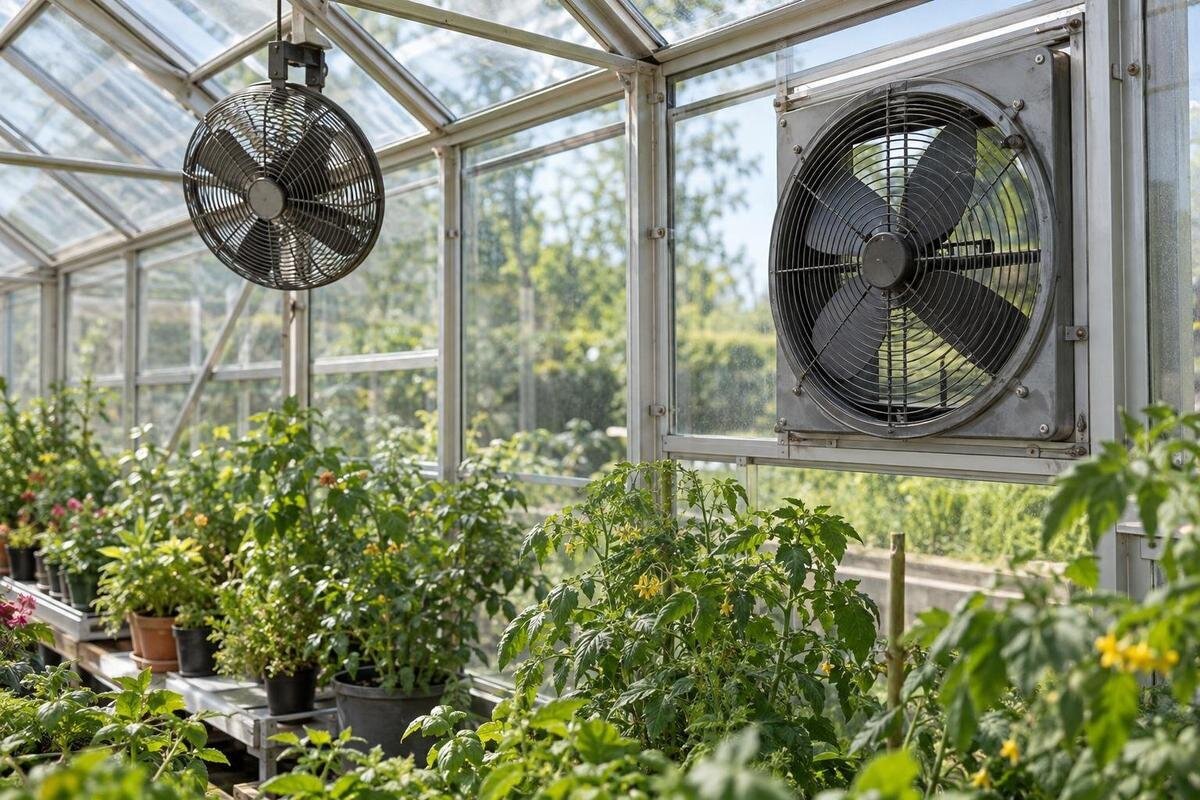
Greenhouse ventilation
Greenhouse fans are often grouped under ventilation, but the word can hide two different jobs. A circulation fan moves air around inside the enclosure; an extraction fan pushes indoor air outside and relies on replacement air coming in. The first may reduce stagnant pockets without removing accumulated heat. The second can carry heat away only as part of a complete inlet-to-outlet route. A sketch of openings, benches and crop rows, backed by temperature and humidity readings, helps you decide which airflow problem you are trying to solve.

01
A circulation fan moves air; an extractor exchanges it
A circulation fan takes air from one part of the greenhouse and sends it back into the same enclosure. Its job is internal movement: it can reduce still pockets and help conditions become more even from one growing area to another. It does not, simply by moving air, create an exchange with the outdoors. As a rule, circulation redistributes warmth already inside rather than carrying it away. A breeze close to the fan therefore tells you little about corners behind benches, space under a canopy or the far end of a long house. Think of it as mixing greenhouse air, not exhausting it.
An extraction fan carries greenhouse air outside. For air to keep moving, replacement air has to enter through another opening or a designed inlet. If that route is closed, obstructed or poorly placed, the extractor may draw through unintended gaps or move less air than expected. When incoming air is cooler than the greenhouse, sustained exchange can carry some heat out; if the incoming air is just as warm or warmer, it cannot promise a cooler space. Nor does an extractor automatically serve every bench: air can travel straight from the nearest inlet to the outlet. A separate circulation fan may help distribute movement, but each fan needs a defined role.
Map openings and obstacles before placing fans
Draw a plan and a simple side view of the actual greenhouse. Mark every opening that genuinely opens, including doors, roof vents and windows, then show the intended positions of fans. Add crop rows, benches, shelves, solid partitions, paths and any tall structures that could divide the air route. Note which vents and doors can be open at the same time in ordinary use; a door that stays shut while the fans run is not a dependable inlet. Include the selected enclosure’s approximate length, width and height where known. Floor area alone does not show internal volume, layout or obstructions.
Draw one arrow for air entering and another for the route towards an outlet; use separate arrows for air that a circulation fan recycles inside. The Spacious Greenhouse range is listed from 506 to 753 ft², a useful reminder that one product family can cover a broad footprint range. Use the dimensions of the exact option you are considering, not a generic diagram. Those figures are not a fan-capacity recommendation. A side view helps too: show roof openings and plant level so you can see whether your planned flow reaches the growing area or simply stirs air high above it.
02
Position circulation fans around the growing area
Place circulation fans to move air through the occupied growing area, rather than directing all their flow into an empty aisle or the roof space. A fan can support a lengthwise loop, a cross-current or movement around a locally still area, but there is no universal direction or mounting height for every greenhouse. Follow the fan maker’s guidance on clearance, orientation and coverage. More direct force is not automatically better: a concentrated jet can disturb one row while leaving another corner still. Check the intended pattern across the whole canopy, not only the movement immediately in front of the fan.
The shape of the enclosure matters. In a lean-to, include the adjoining wall on the sketch: it forms a boundary to the airflow, and benches or tall plants against it may leave sheltered pockets. When considering the Lean-To Greenhouse, use the chosen configuration’s drawings to locate its openings and available growing space. A circulation arrangement copied from a freestanding greenhouse may not follow the same route. Once a fan is running, compare movement behind plants and benches with movement in the central growing area. Check both the outward flow and the space through which air returns towards the fan. Adjust position or direction only within the product instructions.
Plan the extraction route through the growing area
An extractor needs an outlet connected to a useful route through the greenhouse. A position next to the nearest inlet can pull replacement air straight outside, leaving the crop area largely untouched; mark the proposed inlet and outlet on the plan before deciding where the fan could go. Warm air tends to rise, so an upper outlet may be considered in some arrangements, but it is not a rule that overrides the fan’s specified orientation, the greenhouse openings or structural constraints. If several outlets are involved, show which ones will operate together. Treat each suggested position as a candidate to check against the equipment instructions, not as a universal installation direction.
The Classic aluminium greenhouse range is listed from 40.6 to 302.3 ft²; its size range does not tell you where an outlet sits or how air will cross a particular interior. On your selected model, mark the actual exhaust point and identify a replacement-air opening far enough away to encourage a route through the occupied space. If benches, crops or partitions would leave a short path around them, rethink the route or consider internal circulation as a separate job. Any mounting or electrical work should be assessed by a suitably qualified professional.

03
Give replacement air a route through the greenhouse
The inlet is part of an extraction layout, not an optional detail. As indoor air leaves, replacement air must enter through an opening that is available while the fan runs. If doors or vents are closed, blocked by stored items or only partly open, the actual route may differ from the one you intended. Screens, grilles and other restrictions can also affect airflow; follow the equipment documentation rather than assuming an opening’s full area is usable. Do not count an open door as the inlet if it is normally shut during the period you are trying to manage.
On a branched plan, trace each section separately. Air may cross the main aisle from inlet to outlet while an arm or rear corner gets little movement. When considering the T-Shaped Orangery Greenhouse, include each arm of the selected layout and mark its confirmed openings. Ask whether replacement air passes through those growing areas or takes a shorter route to the exhaust. The distance from a fan is not the only consideration: a nearby bench behind a solid obstruction may receive less movement than a clear aisle farther away. Internal circulation may help air reach an underserved arm, but that loop still needs to connect with the wider exchange route if extraction is also required.
Use temperature and humidity readings to find the problem
Use readings as well as how the air feels. Place temperature and relative-humidity sensors in representative growing areas, including a suspected stagnant corner and a central point; if possible, compare the inlet area and an outdoor location too. Keep sensors out of direct sun and away from a fan’s immediate blast, warm glazing and wet surfaces, and follow each instrument’s positioning instructions. Record at consistent intervals, noting the time, outside conditions, fan state, open vents, doors and shade. Repeat on ordinary days rather than drawing a conclusion from one brief reading. Matching conditions make comparisons more useful.
A clear difference between parts of the house may point to uneven mixing, while a persistently warmer interior than incoming outdoor air may prompt you to inspect the exchange route; neither pattern proves a fan is the sole cause. Solar gain, openings and obstructions matter too. Temperature and humidity loggers do not directly measure air speed, so similar readings are not proof that every canopy receives adequate movement. If considering the Pyramid Greenhouse Bloomcabin Oasis, use the selected size’s drawings to plan sensor locations at plant level and in any suspected warm or still area. Keep their positions consistent between tests. Relative humidity also shifts as temperature changes; interpret both values together rather than treating a lower percentage alone as evidence that moisture has left.
04
Check existing vents before adding extraction
Before adding an extractor, confirm what the existing vents can do in the conditions you are troubleshooting. Note which roof or side vents open, whether their movement is unobstructed, and whether a manual or automatic control leaves them open when extraction is needed. Check the greenhouse and opener manuals instead of assuming every glazed panel is a vent. This step can reveal that the planned route is blocked before it reaches the fan. Where recorded heat follows strong sunlight, remember that ventilation and shading address different parts of the problem: air exchange carries heat away only if the incoming air and conditions allow it, while shade reduces some solar input.
Check the opening arrangement for the exact size you are considering in the limited-edition aluminium greenhouse range. On the plan, distinguish fixed glazing from opening vents and note how each vent is operated. During a test, record whether an opening remained available throughout the period or opened only part-way through it. A temperature change may coincide with a vent opening rather than with the fan starting, so the timing matters when assessing results. Also check whether shelves, foliage or shading obstruct the air path even when the vent itself moves freely. Assess any proposed shading separately against the crops’ light needs and confirmed compatibility, without counting it as a substitute for replacement air.
Test changes one at a time
Once you have a baseline, make one practical change at a time. For example, change the direction of one circulation fan or use an available vent in its documented operating position, then record the same locations and controls again. Before each change, note what you expect it to improve: a stagnant corner, a difference between growing areas or a slow temperature drop. Compare similar times and outside conditions; a cooler or cloudier day can make a fan adjustment appear more effective than it was. Keep a note of fan state and direction, vent position, sensor location and any unusual watering or weather.
Repeat the check as plants grow, because taller foliage can alter a route that was clear earlier in the season. Include storage, shelves, trellising, watering equipment and temporary trays on the plan if they sit across the airflow. When considering a greenhouse with built-in storage, mark the storage area and access space on the selected layout, then trace how air will reach the adjacent growing area. Do the same for movable items: a stack of trays placed beside an inlet can change the conditions between tests. Note these changes before attributing a different reading to the fan. Observe a running fan from a safe distance and follow its manual.

05
Match the fan’s stated duty to your greenhouse
Choose a fan by its stated purpose and performance information, not appearance or electrical wattage alone. Check whether its manual identifies it for internal circulation or extraction, what the maker’s airflow figures mean in the stated conditions, and what happens when guards, grilles, screens or ducts are part of your intended route. For a circulation model, look for guidance on coverage, direction, clearances and any speed control. For extraction, confirm the required opening and how replacement air should be provided. Check that the product is specified for the greenhouse environment and that its controls suit the way you intend to operate it. Ask a qualified professional about electrical installation.
The Prestige Greenhouse range is listed from 40.6 to 302 ft², but the range is not an airflow rating and cannot establish which fan will suit a particular option. Take the selected model’s confirmed dimensions, height, openings and intended growing layout to the fan supplier, then compare them with the fan’s published data and operating instructions. Ask how any restriction created by the planned inlet, screen or outlet affects the stated performance, rather than relying only on a headline figure if the maker distinguishes operating conditions. Keep performance claims tied to the exact fan model and arrangement; greenhouse model names alone establish neither fan fit nor ventilation capacity.
Assess how circulation and extraction work together
Where both types of fan are used, compare the intended circulation loop with the inlet-to-outlet route. Check whether the circulation fan helps incoming air reach the growing areas or directs it towards the exhaust before it has crossed them. A loop that works with the vents closed may behave differently when extraction starts and replacement air enters. Record which fans were running during each observation, rather than treating all fan operation as one condition. If one area improves while another becomes still, inspect how the two routes interact before adding more equipment. The aim is useful movement through the occupied space, not simply stronger airflow beside an opening.
Check the arrangement during the periods when it will actually be used. An extraction route that depends on an open door during the afternoon may be unavailable once that door is closed, even if the fan continues running. Likewise, a circulation fan and an extractor may have separate controls and may not always operate together. Compare their documented operating modes with your observations and note which openings are available in each mode. If a route repeatedly disappears or bypasses the plants, the layout or control arrangement needs assessment rather than a higher fan speed by default. Take the annotated plan and readings to the manufacturer or a suitably qualified installer if the cause remains unclear.
Frequently asked questions
Can a circulation fan cool a greenhouse?
It can even out conditions and reduce stagnant pockets, but it does not exchange air with the outdoors just by moving it around. To carry heat out, greenhouse air must be replaced by outside air through a working inlet-to-outlet route. If the incoming air is hot, extraction cannot guarantee a cooler space.
Do I need both a circulation fan and an extraction fan?
Not necessarily. The choice depends on what your layout and readings show. A circulation fan addresses internal movement; an extractor exchanges indoor air for replacement air. They can complement each other when both jobs are needed, but adding one without identifying the airflow problem may not improve conditions where plants are growing.
Where should an extraction fan go?
Choose its position as part of a route from a usable inlet, through the growing area and out through the exhaust. Avoid placing it where it can pull air directly from a nearby inlet and bypass plants. Check the fan and greenhouse instructions for suitable openings and mounting positions; there is no universal location for every structure.
Can an extraction fan reduce humidity?
It may do so if the incoming outside air contains less moisture than the air it replaces, but the result depends on conditions and on the source of moisture inside. Relative humidity also changes with temperature, so compare temperature and humidity together. Air circulation alone redistributes greenhouse air; it does not remove moisture outdoors.
Do similar temperature readings prove that air is moving well?
No. Similar readings at different points do not directly measure air speed or prove that every canopy gets enough movement. Compare several locations, record the fan and vent positions, and use a suitable airflow-measuring method if you need to assess air movement directly. Follow the instrument and fan manufacturers’ instructions.
Choose by the symptom you can observe. Local stillness points towards a circulation problem; heat that is slow to leave calls for a check of the exchange route, inlet air and openings. A fan can only do its intended job when the air has a path to follow. A clear layout and readings from the growing area are more useful than counting fans or choosing solely by floor area.
