
Greenhouse Grow Bags: Root Space, Drainage and Support
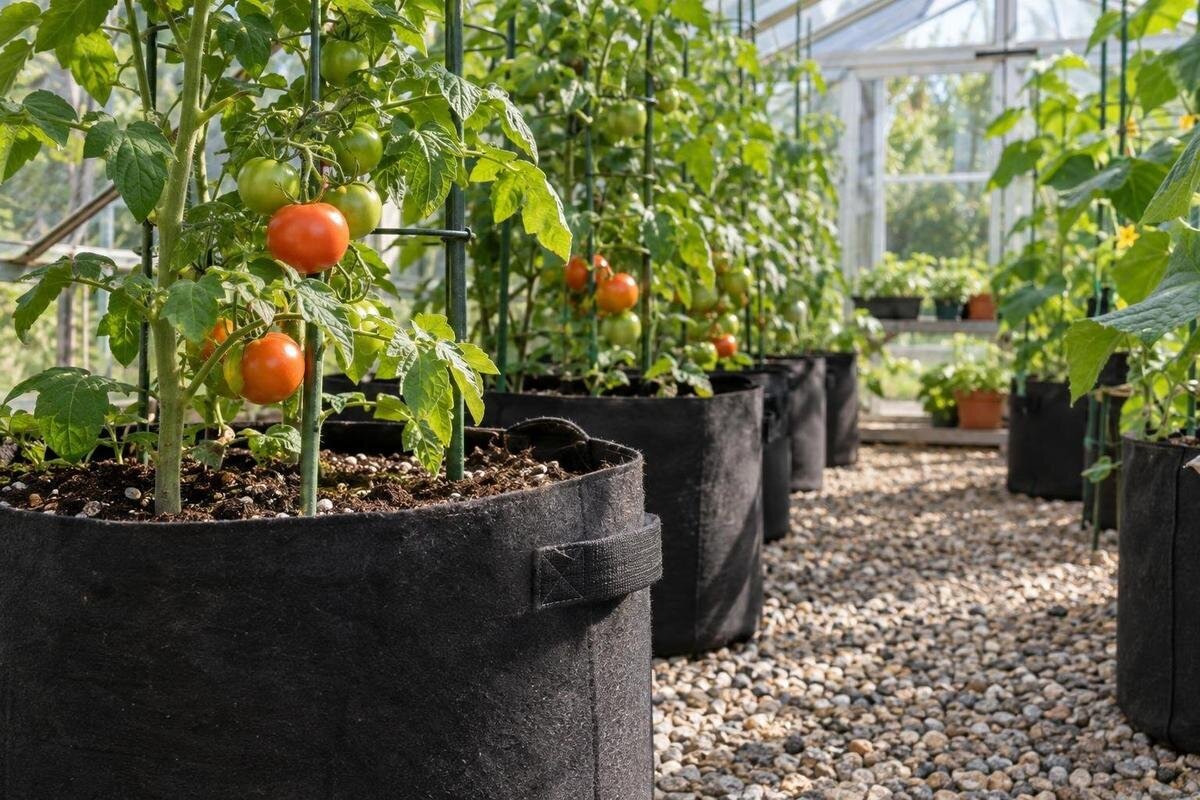
Greenhouse growing guide
Greenhouse grow bags can make planting positions easier to change, but a bag’s printed size is useful only if it matches the crop’s rooting needs and the depth of medium you will actually use. Compare the volume each arrangement holds, then allow for drainage, plant supports and room to work along the rows. The worked layout below uses hypothetical dimensions to show the arithmetic; it is not a crop-specific recommendation or a specification for any greenhouse model.

Grow bags and permanent beds provide different root zones
A grow bag creates a defined pocket of growing medium around a plant or planting group. That separation can make it simpler to change planting positions between crops, keep different media apart or replace one unit without rebuilding the rest of the growing area. The trade-off is that roots are limited to the bag unless they can pass through its openings into the ground. A permanent bed gives roots a continuous area of medium, so they are not divided by bag walls and planting positions can shift within the bed. If the bed is open to the soil below, its rooting environment may also extend beyond the visible sides. The term ‘grow bag’ can describe a sealed bag supplied with growing medium or an empty container that you fill yourself. Establish which you are comparing: for a pre-filled bag, check the declared volume and planting instructions; for an empty bag, check its intended filled capacity and suitable medium. This distinction also affects your shopping list, because an empty container’s price does not include the medium needed to fill it.
Neither system automatically provides the right amount of root space: both need to suit the crop and fit the greenhouse’s actual usable floor. A bag layout takes up the full container footprint, with additional room needed to reach and tend the plants. A bed occupies a fixed strip, including spaces between plants. The Classic aluminium greenhouse options are listed from 40.6 to 302.3 ft². Use the dimensions for the specific option you are considering in your plan; the full range does not show how much floor remains clear after paths, door access and equipment.
Calculate the volume the filled bag will hold
Bag count is not a measure of root space. Estimate the capacity of each bag from its internal length, width and the depth of medium you intend to use. For centimetre measurements, multiply length by width by filled depth, then divide by 1,000 to estimate litres. For example, a rectangular fill measuring 90 cm × 30 cm × 25 cm gives 67.5 litres. Treat that as an estimate: a bag may taper, bulge or settle as it is filled, and the unfilled headspace does not hold growing medium. Use a stated capacity or the manufacturer’s filling guidance when available.
Keep floor area and growing-medium volume separate in your calculations. The lean-to greenhouse range is listed from 40 to 154 ft², but an overall area figure does not say how many litres fit in a bag or how deep a bed can be. Measure the selected greenhouse’s usable interior dimensions, then calculate the growing system within them. If you compare bags of different shapes, record both their capacity and their filled depth; two containers with the same estimated volume do not necessarily provide the same rooting shape.
Match bag size and planting count to the crop
Choose root volume for the established crop, not just the size of a young transplant. The amount of medium and the useful rooting depth depend on the crop and variety, its growing period, and whether it will be pruned or trained. Use crop-specific horticultural guidance for the recommended container size or planting density. If a bag or growing-medium supplier gives a planting count, check that it applies to the dimensions and capacity of the product you have; a number printed for one format should not be assumed to suit another. Dividing the bag’s litres by its plant count gives a useful comparison figure, but not a separate compartment for each plant. For example, a hypothetical 60-litre bag shared by three plants averages 20 litres per plant, while their roots occupy the same medium. Compare that figure alongside planting spacing and rooting depth rather than treating it as proof that the bag suits the crop.
Shape matters as well as litres. A broad, shallow bag and a narrow, deep one can have similar capacities but offer different rooting profiles. Leave enough medium for the intended fill depth rather than counting the bag’s flattened shipping dimensions. Keep the greenhouse calculation separate: the Limited Edition greenhouse range is listed across 40.6 to 302 ft² of floor area, which is a structure-size measure, not a crop-specific bag recommendation. First establish the crop’s growing requirements; then check that the chosen layout can fit those bags, paths and supports.
Check drainage before filling the bags
Find out how excess water leaves each bag before adding growing medium. Different bags may have different outlet arrangements, so check the product instructions and locate the drainage openings before placing the container. Don’t cover those openings with a solid surface, another bag or a support foot. If you are reusing a container, check that it is intended for reuse and follow its cleaning and drainage guidance rather than assuming an old opening is still clear.
Plan where runoff will go. A tray can catch drips, but it should not be left full so the bag sits in collected water. On open soil, roots may grow through drainage openings into the ground, so the bag may no longer be an entirely separate root zone. If you want to keep roots contained, choose a suitable surface or barrier while preserving a route for excess water to escape. On a hard floor, check that water cannot pool beneath the bags or make the working path slippery.

Water each bag according to its moisture
Greenhouse covering excludes most direct rainfall from the growing area, so watering needs to be planned. A bag with less medium may have a smaller reserve of available moisture than a much larger bed, but how quickly it dries also depends on the growing medium, temperature, ventilation and plant size. Do not use the same amount for every bag just because the containers look alike. Check them individually, particularly when they hold different crops or are in different positions within the greenhouse.
Check moisture in the root zone, using a method suitable for the medium, rather than judging only by the surface. Aim to wet the occupied root area while allowing excess water to drain away; avoid leaving the base standing in runoff. If one bag repeatedly dries sooner than its neighbours, review its plant size, fill depth and position before changing the whole watering routine. Drainage is a useful observation, but it does not by itself tell you how much water or fertiliser every crop needs.
Support tall crops independently of the bag
Plan supports for tall or trained crops before the bags are full and planted. A cane or trellis that relies on a light, flexible container for stability may shift as the plant grows. Decide where each support will stand, whether its base will interfere with a drainage outlet and whether you can still reach the bag to water and inspect it. A support that is separate from the bag can help keep its weight and movement from pulling the container out of position, but it still needs to be stable for the intended use.
Do not assume a greenhouse frame is an approved anchoring point for crop supports. The T-shaped orangery greenhouse is a distinct model and layout option, but its name does not establish where supports can be fixed or what loads the frame can carry. Check the instructions for the selected greenhouse and ask the manufacturer or installer before attaching a crop line or trellis. If that use is not confirmed, plan a separately supported arrangement and ensure its position does not obstruct the path, doors or bag outlets.
Worked comparison: six bags or two permanent beds
Consider a purely illustrative clear growing floor measuring 2 m by 3 m. Allow a 0.6 m path down the centre and a 0.7 m growing strip on each side: together they use the full 2 m width. If each strip is a 3 m long bed filled to 0.25 m deep, its nominal medium volume is 0.7 × 3 × 0.25 m, or 0.525 m³ (525 litres). Two beds therefore hold about 1,050 litres at that fill depth. This calculation assumes rectangular beds filled evenly; it does not specify a suitable depth for any particular crop.
Now place three hypothetical bags along each strip. If each bag’s filled dimensions are 0.8 m × 0.6 m × 0.25 m, its rectangular fill volume is 0.12 m³, or 120 litres. Six bags hold 720 litres in total, about 330 litres less than the two beds; each bag also remains a separate root zone. Along each 3 m strip, the three bags occupy 2.4 m, leaving 0.6 m to divide between gaps and clearance at the ends. Across the strip, a 0.6 m wide bag leaves only 0.1 m spare. Those spaces explain some of the volume difference, but they do not necessarily provide enough room for support feet or spreading foliage. Draw those separately rather than assuming that unused floor around the bags is available for another plant. The Pyramid-type greenhouse options are listed from 60 to 203 ft², but use the dimensions of the specific greenhouse you select when adapting this example. These figures compare medium volume only, not crop suitability, planting count or support stability. Beds open to the ground, or bags with roots growing out through their openings, can provide access to soil beyond the calculated volume.
Leave room for paths, doors and fixed storage
A plan needs to work after plants have grown, not only when the bags are empty. Mark the bag footprints, then allow a clear route to water, tend and harvest the crop without stepping on containers or reaching over neighbouring plants. Include door access and any equipment that will remain in place. Plant canopies and supports may extend beyond the bag’s edge, so do not treat the container footprint as the full space needed for a mature crop. Choose a path width that works for your equipment and the way you intend to use the greenhouse; the 0.6 m path in the example is not a universal standard.
Allow for fixed features before assigning the remaining floor to bags or beds. The greenhouse with built-in storage identifies storage as part of the model; check the specific option’s dimensions and the space needed to access it before treating the overall greenhouse area as plantable. Keep frequently used items accessible without blocking a path, bag outlet or support base. A scaled drawing helps expose these conflicts before you order growing medium or fill containers, when changing the arrangement is still straightforward.

Choose the system that suits your growing routine
Bags can suit a plan where separate pockets of medium or adjustable planting positions are useful. You can arrange empty containers before filling them and keep different crop groups in distinct units. However, a full, watered bag may be awkward to lift, so treat its position as fixed for the growing period unless you know it can be moved safely without disturbing the plant. Check whether a container is intended for reuse and follow its care instructions; do not assume every bag has the same lifespan or is suitable for every growing medium. For an empty bag, ask the supplier whether its material is intended for growing the crops you plan to harvest and for the conditions in which it will be used. A photograph or fabric description alone does not establish suitability. If handles are provided, check their intended use rather than assuming they are designed to lift the container when full. Include replacement containers and medium in your comparison with a permanent bed.
A permanent bed is a better fit when you want one continuous growing area and are content with its fixed footprint. It may hold more medium than a row of bags in the same strip, as the worked example shows, but its actual root environment depends on its base and the ground beneath it. When comparing the Prestige greenhouse range, use the dimensions of the selected option to test a bed-and-path plan rather than assuming a model name or overall area guarantees a particular amount of clear growing width.
Test the layout before filling the bags
Before planting, mark the planned positions on the greenhouse floor or lay out the empty bags. Check that the path stays clear, drainage openings remain unobstructed and each plant can be reached for watering and routine care. Confirm the filled dimensions and the amount of medium required; a container’s outer dimensions or flattened package size may not match its capacity when full. Set out crop supports at the same time, so you can see whether they interfere with doors, access or neighbouring bags. Once the arrangement works, filling and planting can follow the plan rather than forcing last-minute changes.
For a larger growing area, the Spacious Greenhouse range is listed from 506 to 753 ft². That overall floor-area range does not determine how much root space each crop needs, nor does it make every part of the floor useful for planting. Work from the dimensions of the specific option and subtract the space reserved for access and fixed features before settling on bag numbers or bed sizes. Revisit the layout after the first growing period: actual watering patterns, access and plant growth can show where the next season’s arrangement needs adjustment.
Frequently asked questions
How do I calculate the volume of a grow bag?
Use the bag’s internal length, width and filled depth. For a roughly rectangular shape, multiply the three measurements in centimetres and divide by 1,000 to estimate litres. For tapered or flexible bags, use the stated capacity or amount of medium required where available; a rectangular estimate may be too high.
How many plants should I put in one greenhouse grow bag?
There is no universal number. It depends on the crop, variety, bag capacity, planting method and how the plants will be trained. Follow crop-specific growing advice and the instructions for the bag or growing medium rather than transferring a planting count from a different bag.
Do grow bags need drainage holes?
Excess water needs a way to drain away, but outlet arrangements vary. Check the bag’s instructions and locate its drainage openings before filling. On a solid floor, make sure water can leave the outlets and flow away without pooling beneath the bag. Do not make extra holes without checking the manufacturer’s guidance.
Are grow bags easier to move than permanent beds?
They are easier to reposition when empty. Once filled and watered, a bag can be awkward to move, and shifting it may disturb the plant or its support. Plan for filled bags to stay in place during the growing period; a permanent bed is fixed from the outset.
Can I attach a crop support to the greenhouse frame?
Don’t assume the frame is designed to carry a trellis or crop load. Check the instructions for the specific greenhouse and ask its manufacturer or installer before attaching supports. A separately supported structure may be an alternative, provided it can stand securely without blocking access or drainage.
A sound grow-bag plan brings root volume, drainage and support together with the space needed to reach each plant. Bags provide separate growing zones, while a permanent bed offers a continuous volume; neither choice removes the need to match the medium to the crop. Use the worked figures as a way to compare layouts, then base your final arrangement on the actual bags, plants and greenhouse dimensions.
