
How to Keep a Greenhouse Diary for Next Year’s Plan
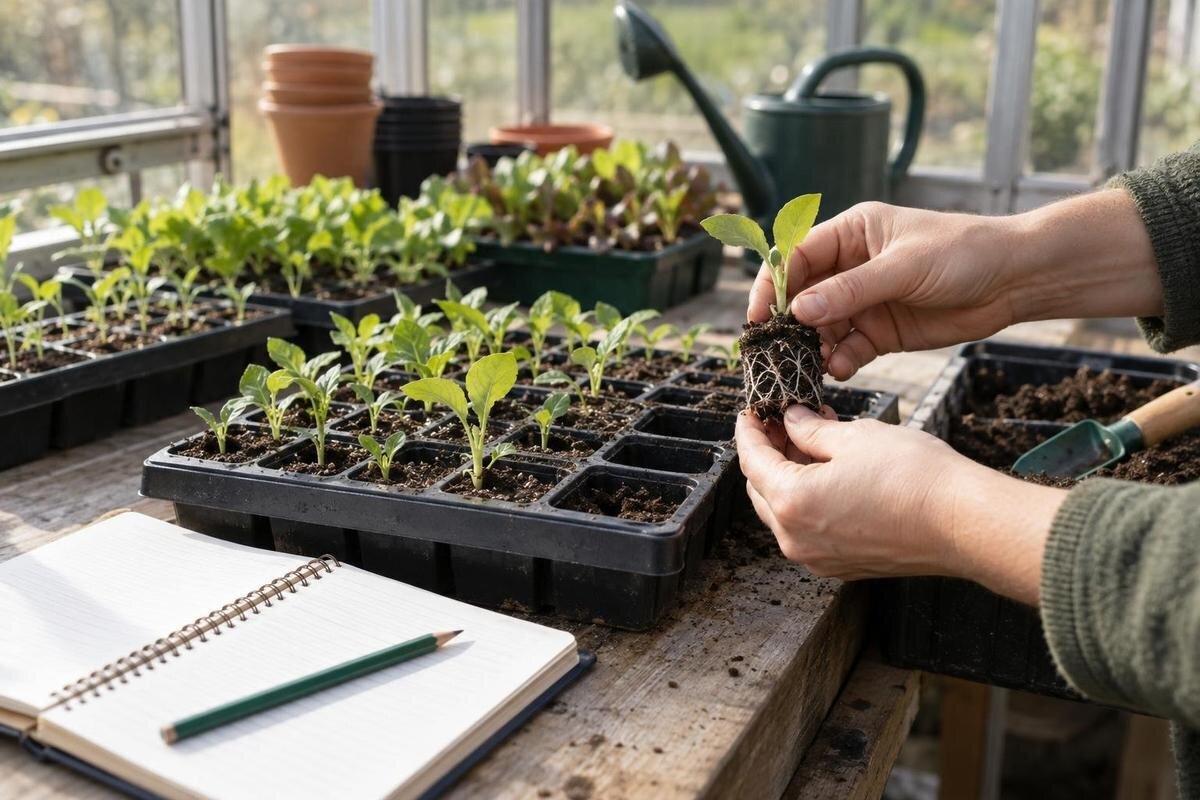
GREENHOUSE GROWING GUIDE
A greenhouse diary is most useful when it helps you make a better decision next season. A sowing date alone cannot explain why a batch was late, which job repeatedly slipped, whether plants occupied a bench longer than planned or how much usable produce came from the space. Record sowing, conditions, work, space and harvests in a format you will keep up to date. Then review the entries while the details are still clear. The aim is not to document every hour, but to leave yourself reliable evidence for a more realistic plan.

Decide what next year’s plan needs to answer
A greenhouse diary is not a transcript of every day. Its job is to connect what you planned with what happened and what the result required in time and space. A sowing date beside a crop name is a start, but it will not tell you whether a batch was late because sowing slipped, emergence took longer than expected, bench space was occupied or a job was repeatedly postponed. Linking a few observations lets you separate these possibilities when you plan again. Treat the entries as evidence for a future choice, not as a judgement on how well you gardened.
Before the season begins, write down three questions you want the diary to answer. They might be which sowings reached the bench together, which crops gave a worthwhile harvest for the labour involved, or which routine jobs were missed when several tasks coincided. You may also want to know when the greenhouse felt full or whether another sowing fitted around the plants already growing there. Keep the questions specific to your crops and available time. They give the notes a purpose and help you decide what deserves a column; details that would not affect a decision can stay out.
Choose a format you will keep using
Choose paper, a spreadsheet or a phone-based system according to what you can update while working. A notebook is simple to keep nearby but may be harder to sort by crop; a spreadsheet can filter dates and total entries but is useful only if you open it; a digital note can be quick to capture but needs a predictable filing method. There is no benefit in choosing the most elaborate tool if it adds friction. Pick one you can use consistently, even during a busy spell, and keep the main record in one place.
Use the same date format and distinguish the date an event happened from the date you wrote it down. Give entries a batch ID or crop name so they can be found again; a contents page, index tab or searchable heading can help. Leave room for short notes rather than designing a form that demands a full report each time. If photographs help you remember a layout or a plant’s progress, file them with the date and batch ID. An unlabelled folder of pictures is difficult to compare with written records months later.
Map the greenhouse and identify each crop batch
Make a simple sketch of how the greenhouse is used: mark benches, borders, shelving, storage, routes and the entrance. Label the main areas with short codes such as A and B, then use those codes in your crop entries. The sketch does not need to be a measured plan; its purpose is to distinguish locations and show what was fixed and what moved during the season. Update it if a bench or storage area changes position. Keep batch codes separate from location codes: a batch labelled TOM-01 keeps that identity when it moves from bench A to border B. Put the batch code on its plant label as well as in the diary. Otherwise, two sowings of the same variety can become difficult to tell apart just when you need to compare their progress.
Include storage in the sketch rather than treating every part of the structure as growing space. Note which supplies you keep close to the benches and whether retrieving them interrupts a task or blocks access. The aluminium greenhouse with built-in storage provides a relevant catalogue option if your records identify storage as a concern. Before comparing it with your current arrangement, establish what you need to store and check the selected model’s storage dimensions and access. Your diary can distinguish a shortage of crop space from tools occupying a bench that could otherwise hold trays.
Record sowing and propagation as a sequence
Give each crop-and-variety batch its own identity, even if you sow the same crop more than once. Use a batch summary with fields for the batch ID, crop and variety, seed source or lot if known, planned sowing date, actual sowing date and number sown. Beneath it, keep dated entries for first emergence, subsequent seedling counts, potting on, moves between locations and the final outcome. Recording first emergence separately from a later count avoids making one date stand for two different observations. Add the tray dimensions and number of trays where space matters. Leave a blank field empty or mark it as not recorded; do not use zero to mean missing information. Keeping planned dates beside actual dates helps you see where the calendar slipped, while dated counts show when losses occurred rather than just how many plants remained.
Illustrative example only — these fictional figures are not a sowing timetable: Batch A, Crop X, Variety Y; planned sowing 12 March, actual sowing 14 March; 18 seeds sown; first emergence 20 March; 14 seedlings counted on 24 March; 12 potted on 2 April; 10 placed in their final position on 17 May; first harvest 20 July; 8.4 kg over 11 picks; 3 hours 20 minutes of work recorded. This summary connects propagation with the eventual result without claiming why the counts changed. Add a reason for a loss only if you observed it. When comparing the Prestige greenhouse with metallic base, use the tray dimensions and overlapping batch dates from these records to prepare a proposed bench layout. Confirm the dimensions of the selected option before treating that layout as workable.

Connect growing conditions with your notes
Conditions are easier to interpret when each note identifies the crop, location and time. If you record weather outside, distinguish it from an observation inside the greenhouse. If you use a thermometer or another measuring device, note its position and when you took the reading; a reading at one bench is not automatically a description of every growing area. Record the type of observation consistently, whether it is a measured value or a brief note about a notable change. This gives next year’s comparison more context than a general comment such as conditions were poor.
Add the actions you took, with dates: for example, when you changed shading or ventilation, or moved a batch. Describe what happened before adding a possible explanation, and mark a guess as a guess. If a reading is missing, leave a gap rather than reconstructing it from the outdoor weather forecast. When considering a lean-to greenhouse, note the proposed site, nearby wall and growing positions in your planning record. Keep these site notes separate from observations made in your existing greenhouse: they describe a different setting, not measured conditions. Once you begin using a new space, record where the measuring device is placed so that later comparisons do not accidentally combine readings from different positions.
Track greenhouse jobs and labour
A short work log can reveal whether a plan fits the time you have available. Note the task, date, crop or area, and roughly how long it took. Include one-off work such as setting up a space as well as recurring jobs, and use the same time units throughout. You need not time every small action; a sensible estimate is more useful than a detailed record that becomes a burden. Also note work that was delayed or missed, and what else was happening at the time. Those entries can explain why a carefully written calendar did not match the week you actually had.
At the end of each week or month, total the work by crop or task if that would help next year’s decisions. Separate regular upkeep from the extra time spent on sowing, moving batches or harvesting, so one unusually busy day does not hide the overall pattern. For shared jobs, such as cleaning a bench used by several batches, record the time against the area rather than counting it in full for every crop. If you are considering the Spacious Greenhouse, whose listing spans 506 ft² to 753 ft², identify which jobs would cover a larger area and which would depend on plant numbers. This gives you specific workload questions to resolve rather than assuming hours increase in direct proportion to floor area.
Record how long each space stays occupied
For each batch, note when it first occupies a bench, shelf or border and when it leaves that space. Record the number of trays or plants and the area or zone used, then compare the planned release date with what actually happened. A simple calendar or occupancy table can show when several batches overlapped, how often the busiest area was full and whether storage or access became awkward. This is different from a map of the greenhouse: the map shows where things are, while the diary shows when each area is in use.
Look for the peak overlap rather than relying on a season-wide total. A few trays taking up the same space at the same time may create a bigger constraint than a larger total spread across several months. The Classic aluminium greenhouse listing includes options from 40.6 ft² to 302.3 ft²; treat that as catalogue area, not as a measure of benches or crop capacity. Compare the actual selected dimensions and arrangement with your occupancy notes, including the space you need for access and storage.
Measure harvests consistently
Choose a harvest measure you can repeat, such as weight or count, and record the date and batch each time. If you harvest frequently, enter each pick or add totals over a regular period; use the same method from one crop to the next where practical. Keep usable produce separate from anything discarded, and note a reason if you know it. This avoids treating a total harvested as though every part had the same value to you. First and last harvest dates can also show how long a crop contributed, while the total alone cannot.
When you review results, compare crops using the same units and keep the area they occupied in view. Label each total clearly: a batch total, a per-plant figure and a whole-greenhouse total answer different questions. Illustrative example only: two batches yielding 4 kg each have equal recorded harvests, but one may have occupied twice as much space or required more picking time. Neither total alone tells you which better suited your needs. Include a short note about whether the produce was used, shared or left unpicked, since next year’s plan should reflect demand as well as output. If you are comparing the Limited Edition aluminium greenhouse, carry these crop-level results into your proposed planting plan rather than treating a larger harvest as an automatic reason to choose a larger structure.

Keep experiments and setbacks factual
Write down what you observed before deciding what caused it. Note the batch or area affected, the date, what changed and what happened afterwards. If a plant looked different, describe the visible change rather than giving it a confident diagnosis in the diary. When several things changed at once, record them all; the outcome may be worth following up, but it will be hard to attribute to one factor. Mark possible explanations as questions or hunches, and distinguish a planned trial from an ordinary change in routine.
For a small comparison, decide in advance what you want to compare and what result you will record, then keep the labels consistent. For example, an illustrative trial might compare two sowing dates for the same variety and record the date each batch reaches the same defined stage. Write down that stage before starting; changing the measure afterwards makes the results harder to interpret. Note other differences, including seed source, container and location, so they remain visible when you review the outcome. If you are considering a T-shaped orangery greenhouse, use its actual plan to label proposed growing zones rather than assuming its outline creates equivalent trial spaces. A comparison made in one season can suggest a useful question for the next, but it does not establish that a single change caused the result.
Review the diary before drawing next year’s plan
Review the entries while the season is still easy to remember. Sort them by crop and month, then compare intended dates with actual sowing, moves, harvests and space use. Separate patterns that appeared more than once from unusual events; one interruption may not justify changing a whole plan, while a repeated clash deserves attention. For each crop, make a brief decision: repeat as planned, change the timing or quantity, test a different approach, or leave it out. Add the reason, so next year you can tell whether the choice was based on harvest, labour, space or a combination.
Turn those decisions into a calendar with realistic room for jobs and overlapping batches, not just a list of ideal sowing dates. Beside each proposed change, write the observation behind it and what you will look for next season. For example, reducing a batch because plants went unused calls for a record of demand, whereas shifting a sowing to avoid a bench clash calls for occupancy dates. Keep unresolved questions visible rather than turning every hunch into a firm rule. If your records prompt a comparison with the pyramid-type greenhouse, use its selected dimensions to sketch the arrangement you would actually need. Identify the specific diary problem that arrangement should address. Retain the season’s original records alongside the new plan, so next year you can assess whether the change helped rather than remembering only what you intended.
Frequently asked questions
What should a simple greenhouse diary include?
At minimum, give each crop batch an identity and record what happened and when: sowing, emergence, moves, notable conditions, work and harvest. Add a brief result and a note for next year. You can build on this core when a particular planning question needs more detail.
How often should I update my greenhouse diary?
Make an entry when something changes or happens that you may want to compare later, such as sowing, moving a batch, changing a routine or picking produce. A short weekly catch-up can capture routine jobs, but mark estimates as estimates rather than filling gaps from memory.
Do I need to record temperature and weather every day?
No. Record conditions if they help answer a question about your crops or routine. If you take readings, note when and where they were taken and what the instrument recorded. A brief note about a notable change can be more useful than a long series of readings you will not review.
How can I compare the same crop across different years?
Compare like with like where possible: the same crop and variety, the same way of counting harvests, and the dates and conditions you recorded. Note changes in space, tasks or routine as well. A difference between years is a clue to investigate, not proof that one factor caused it.
Can a diary help me decide whether I need a larger greenhouse?
It can show when space was at a premium, which areas were occupied and whether the problem was timing, layout or total capacity. Keep your usable bench and crop space distinct from a greenhouse’s stated floor area, and compare the diary with the actual dimensions and layout of any option.
Keep the record simple enough to maintain, but consistent enough to compare. When you plan again, use it to choose sowings that fit your space and time, recognise harvests worth repeating and make targeted changes where the same difficulty returned. A diary cannot make every season predictable; it can replace vague memories with observations from your own greenhouse.
