
Adding Shelves or Hanging Baskets Without Overloading a Greenhouse
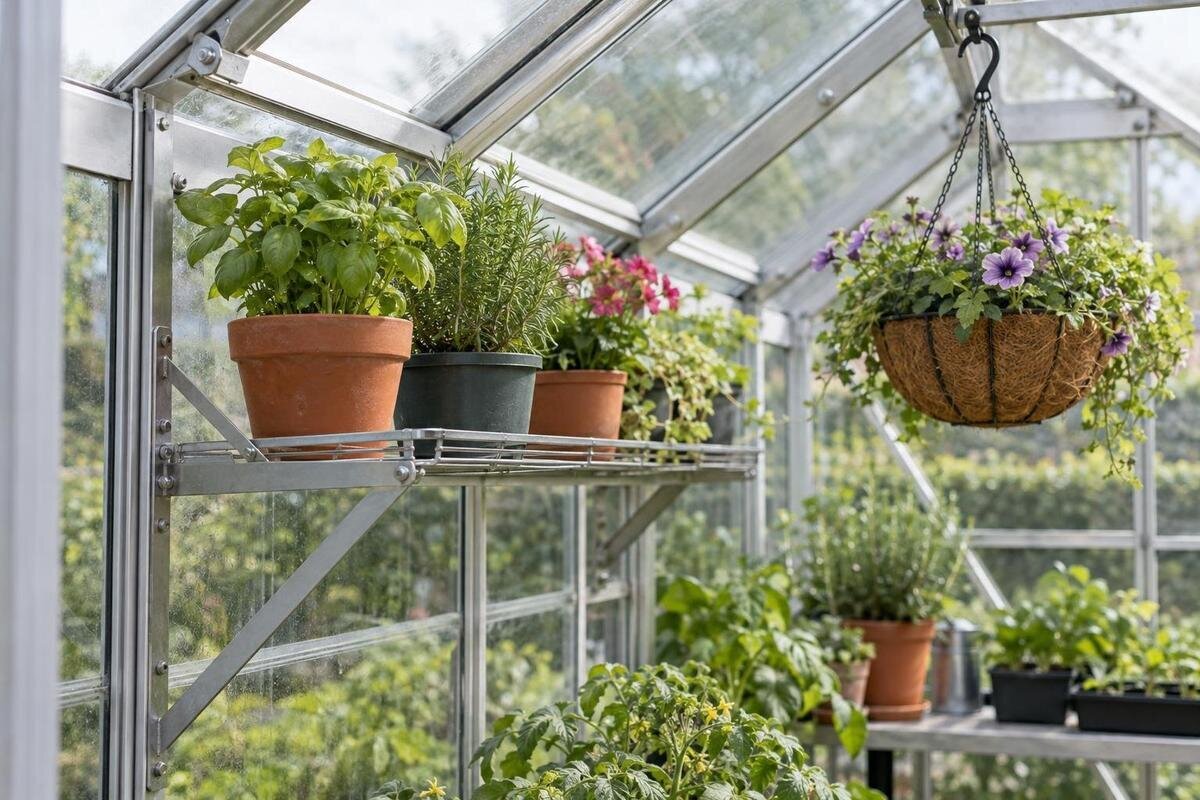
Greenhouse storage
Adding shelves and hanging baskets can make a greenhouse more practical by creating growing and storage space above the floor. Frame-mounted accessories also add load to the structure, and the amount changes once pots are filled, watered and planted up. A shelf’s own weight, its brackets and everything on it need to be accounted for; a hanging basket can also move. The safe approach is to identify the exact greenhouse, use only fixing points and accessories approved for it, and check the documented load for the complete arrangement. If there is no clear guidance, do not guess from the frame’s appearance.

Before choosing an accessory 1
Identify the greenhouse before buying accessories
Before buying a shelf or basket, identify the greenhouse as precisely as possible. Record the manufacturer, model or range, size or version shown on the order, and any changes made since the original assembly. Keep the assembly manual, accessory instructions, parts diagram and order confirmation together. A catalogue entry such as Lean-To Greenhouse can help you match a range name, but it does not confirm that your frame has the same configuration or state its permitted accessory loads. Similar-looking houses may use different profiles, joints and approved fittings, so appearance alone is not a reliable guide to where weight may be fixed.
If paperwork is missing, ask the supplier or manufacturer for the manual and accessory documentation for that exact model and version. Include the model name, order or serial reference if available, the accessory you want to fit and its proposed position; photographs of the relevant frame joint may help identify parts. Ask which fixing point is approved, which accessory identifier is required and whether the load limit applies per item, fixing or frame member. An image or product-page description cannot confirm capacity. Avoid buying generic brackets first and then looking for somewhere to attach them: the documented fixing method should guide the purchase.
Find the fixing points in the model-specific instructions
Look for an explicit drawing or instruction that identifies the permitted fixing point. It might show a designated accessory rail, an approved mounting profile or a supplied support, but do not assume that every greenhouse has those parts. A glazing bar, ridge, roof member, gutter, door frame or pane-retaining clip is not automatically load-bearing just because it is metal or easy to reach. Use only the point and attachment method specified for your exact model and accessory. The limited-edition greenhouse listing identifies a catalogue range; its name cannot tell you which component on your particular structure may carry a shelf.
Read the load wording carefully. A figure might apply to a complete shelf, each fixing, one rail or a defined arrangement, and those limits are not interchangeable. Check whether the stated allowance includes the shelf and brackets, which fixings it assumes, and whether it depends on a specified position or spacing. If the manual gives a maximum for one point, do not multiply it to invent a total for several points unless the manufacturer explicitly permits that calculation. Where the instructions show a fitting but give no load value, ask for clarification before hanging or loading it.
Before choosing an accessory 2
Count the complete load, including water
Estimate the heaviest intended contents, not the weight of an empty shelf. The supported load can include the shelf itself, its brackets, pots, growing medium, established plants, labels, trays, tools and water retained after watering. A container that feels manageable when dry may be much heavier once filled and wet; plants also gain mass as they grow. Read the manual to see whether its limit refers to contents only or to the total supported assembly. If the wording does not define what to include, get that clarified instead of treating an uncertain figure as spare capacity.
Make a separate inventory for each shelf and basket, then check whether several accessories share a rail or frame member. Loads at different fixing points can still act on the same part of the structure, so a per-accessory rating may not answer the combined-load question. Note what each accessory is intended to hold and revise the plan when pots, trays or equipment change. When requesting a figure, use the exact name in your records—for instance, T-Shaped Orangery Greenhouse—and give the proposed position and accessory details. The model name helps identify the house; its own instructions must supply the relevant load guidance.
Do not assume the roof can carry hanging baskets
Treat each hanging basket as a suspended load whose weight changes. Include the basket, liner, chain or bracket, growing medium, plant, any saucer and water it may retain; consider its fullest likely condition rather than how it feels just after planting. A basket may also swing when watered, touched or disturbed, unlike a shelf resting on supports. Use only the documented load and fixing arrangement, and allow for movement so the basket cannot strike a door or glazing. Do not judge whether a hook is suitable by its apparent thickness or how firmly it seems to grip.
Do not suspend a basket from the ridge, rafters, glazing bars, gutters or glass-retaining components unless the exact greenhouse instructions designate that location and state what it can support. A listing for a Pyramid-type greenhouse identifies a model; it is not a roof-loading approval. Several baskets on one rail may create a combined load even when each seems modest. If the documentation does not cover the fixing point, number of baskets and combined arrangement, choose a suitable freestanding stand or ask the manufacturer or an installer to review the proposal.

Before choosing an accessory 3
Plan shelves around the growing space
Plan shelves around the plants you intend to grow, not just the number of pots you can fit. An upper shelf can free up bench space, but its trays and plants may shade the growing area below. Consider which plants need the brighter positions and how tall they will become before deciding on shelf depth and height. Leave enough room above seedlings for their later growth rather than arranging shelves around their current size. For baskets, account for trailing foliage as well as the container: it can spread into neighbouring plants and make individual pots harder to inspect or water.
Group pots so that routine watering and handling remain manageable. Trays can help contain drips, but retained water contributes to the supported load; do not let a convenient shelf become a place to accumulate unused pots or equipment. Keep heavy supplies, such as bags of compost, on storage designed for them rather than lifting them onto a frame-mounted shelf. A suitable freestanding unit can provide extra growing levels without loading the greenhouse frame. If the available space still cannot accommodate your plants, the Prestige greenhouse page is one place to begin comparing alternatives. Compare usable layout separately from accessory capacity, which needs confirmation in the chosen model’s documentation.
Keep doors, vents and glazing accessible
Check clearances before fixing a shelf or basket. Avoid interfering with doors, opening windows, vents, braces, glazing panels or the routes used to inspect and clean them. Leave room to operate handles fully and open vents as intended; an accessory should not rest against glazing or press on a pane. Measure the shelf’s depth and the basket’s overall drop, then consider how the space will change as plants fill out. Keep the aisle clear enough to carry a watering can and tend plants without knocking a basket or twisting around an obstruction.
A larger floor plan may offer more places to arrange plants, but it does not prove that the frame can carry a greater suspended load or more shelving. The Spacious Greenhouse listing identifies a named model; treat floor area and accessory-load approval as separate information. Draw the intended positions and compare them with the relevant manual, including the reach of doors and vents. If the only suggested position is on a member the instructions do not identify, do not choose it simply because it seems convenient or stronger.
Before choosing an accessory 4
Use compatible fittings and do not improvise attachments
Choose accessories that the manufacturer lists for the exact model or has confirmed as compatible. Check the accessory identifier, required mounting profile and fitting method rather than relying on a broad description such as universal greenhouse shelf. Similar clamp widths or screw sizes do not prove that a fitting grips the correct part or transfers weight safely. A shelf designed to sit on a particular rail may require that rail to be present and correctly installed. Confirm the stated load limit and its conditions for the complete accessory before purchase; if key information is missing, ask for it.
Do not create a fixing point by drilling, cutting, riveting, bonding or clamping onto a frame member unless the manufacturer approves that exact modification. An unapproved hole or pressure clamp can damage a profile, interfere with glazing or put force into a part not designed for it. Do not attach a cable or hook through a pane-retaining clip. The Classic greenhouse catalogue page can help identify a named product range, but it cannot make an unlisted bracket compatible. If a change to the greenhouse is proposed, get model-specific instructions and a qualified review rather than adapting the frame by trial and error.
Install accessories as the instructions specify
Follow the accessory manual in order, using the named parts and positions. Do not force a fitting that will not seat as shown, substitute a longer screw or improvise a spacer; stop and check the part number and compatibility. If access to the fitting would require disturbing glazing or removing a structural component, leave that work to a suitably qualified installer. Keep the area clear while fitting, and do not use a shelf, rail or basket as a handhold. The aim is to install the documented system as designed, not to make a generic accessory fit by applying more force.
Before adding contents, confirm that the attachments match the instructions, but do not conduct a homemade proof test by loading the shelf beyond its permitted use. Add contents only as the manual directs; if it calls for an even distribution, avoid piling everything at one edge or hanging extra items from the shelf. Keep the stated maximum in view, and remember it may cover the accessory and its contents together. If something does not sit securely or an attachment moves during installation, unload it and seek technical advice rather than trying a different fixing point.

Before choosing an accessory 5
Recheck the arrangement as plants and contents change
Revisit the arrangement when plants grow or contents change. Wet growing medium, collected water, fruiting plants, added trays and tools can raise the load after an installation that initially seemed light. Replacing small pots with larger containers can also concentrate more weight on one part of a shelf, even if the number of pots stays the same. Check the total contents and their distribution against the documented arrangement, and remove items that are no longer needed rather than adding them by habit. Follow any inspection guidance in the manual; these checks do not replace a stated limit or make an unapproved fixing suitable.
Pay attention to signs that something has shifted: a bracket that loosens, a rail that moves, a member that bends, a new gap or a pane that no longer sits as it did. If you notice movement, unusual noise or damage, stop using the accessory until the cause has been assessed. Do not tighten fasteners harder or move the basket to another unapproved point as a quick fix. If glazing is involved, avoid handling or adjusting it yourself and ask a qualified installer to inspect the area.
Choose freestanding storage or consider a replacement
If no approved fixing point or documented allowance can be found, the practical answer may be not to attach the accessory to the frame. A floor-standing shelf or basket stand can avoid transferring its load to the roof or glazing bars, but it still needs to be designed for the intended contents and stable on the greenhouse floor. Check its footprint, access, any water exposure and the maker’s instructions; a freestanding unit can obstruct an aisle or vent too. This option is useful when you need extra growing positions but cannot verify a suitable frame-mounted arrangement.
When storage is the reason for considering a different greenhouse, a greenhouse listed with built-in storage is an option to investigate, not a claim about accessory compatibility. Check what the chosen model includes and obtain its own documentation before deciding whether it meets your needs. For an existing house, give the supplier or manufacturer the model details, accessory identifier and proposed location, and ask for the approved point and load information. If a proposed solution needs structural alteration, have it reviewed by a qualified installer. A replacement or upgrade enquiry makes more sense than an unsupported modification when no approved route exists.
Frequently asked questions
Can I hang a basket from any roof bar?
No. Use a roof or frame fixing only if the instructions for your exact greenhouse specify that point and the permitted load. Glazing bars, the ridge and gutters are not automatically designed to carry accessories. If the manual does not confirm the location, ask the manufacturer or a qualified installer.
What should I include when estimating a shelf load?
Include the shelf and brackets if the stated limit covers the complete accessory, plus pots, growing medium, plants, trays, tools and retained water. Check whether the manual defines the limit as contents only or total supported load. If it is unclear, get clarification rather than assuming the fitting has spare capacity.
Are no-drill clamp fittings automatically safer?
No. A clamp still transfers force to the part it grips, and it may not be approved for that profile or location. Use one only when the greenhouse or accessory instructions confirm compatibility and the permitted load. A no-drill fitting is not automatically harmless to the frame or glazing.
Can several shelves share one rail?
Only if the instructions allow that arrangement. A limit for one shelf or fixing does not necessarily cover several accessories attached to the same rail or frame member. Check the combined-load guidance and the specified positions; do not multiply a per-point figure unless the manufacturer explicitly permits it.
What if I cannot find the greenhouse manual?
Gather the model name, order or serial reference if available, accessory details and photographs of the proposed fixing area. Ask the supplier or manufacturer for the correct instructions and load information. Do not rely on a similar model’s manual or test an uncertain fixing by adding weight.
Making shelves and baskets work safely is mainly a documentation and layout task: match the exact greenhouse, use approved fixing points and accessories, and stay within the stated limit for the complete arrangement. Count wet, mature contents as well as the fittings, and never treat a roof member or glazing bar as a ready-made hook. Where guidance is absent or the layout depends on altering the frame, leave the attachment unmade until the manufacturer or a qualified installer has reviewed it. If no approved option fits, consider freestanding storage or an upgrade enquiry.
